

Refinance mortgage guidelines can vary depending on the type of loan you have, your credit profile, your home equity, and your reason for refinancing. Some homeowners refinance to lower their interest rate or monthly payment. Others refinance to shorten their loan term, switch loan programs, or tap into home equity with a cash-out refinance.
Understanding refinance mortgage guidelines is important before you apply. FHA, VA, USDA, and conventional refinance loans all have different rules for credit scores, equity, debt-to-income ratios, mortgage insurance, and documentation. Understanding how these refinance mortgage guidelines work helps you choose the refinance option that aligns with your financial goals.
In this guide, we will explain refinance mortgage guidelines in plain English, including the basic requirements for major loan programs, the different types of refinance options available, and what lenders review when approving a refinance. If you’re looking to lower your payments, pay off your mortgage quicker, or tap into your home equity, this article will show you how to get started.
Key Takeaways About Refinance Mortgage Guidelines
Refinance mortgage guidelines depend on the loan program, lender requirements, and your overall financial profile. Most lenders will review your credit, income, home equity, debt-to-income ratio, and payment history. Some refinance programs, such as streamline refinance options, may require less documentation than a standard refinance. The right refinance loan depends on whether your goal is to lower your payment, change your loan term, or pull cash out of your home equity.
What Is A Mortgage Refinance?
A mortgage refinance is when you trade in your current home loan for a new one. The new loan might come with a lower interest rate, a different repayment period, a new type of loan, or even let you tap into some cash from your home’s equity. Many homeowners refinance to improve monthly affordability, consolidate higher-interest debt, or move from one mortgage program to another. A refinance can be helpful, but it only makes sense when the new loan improves your overall financial position. That is why understanding refinance mortgage guidelines matters before moving forward.
When Homeowners Consider Refinancing
Homeowners usually consider refinancing when interest rates drop, their credit improves, they want to remove mortgage insurance, or they need funds for major expenses such as home improvements or debt consolidation. Others refinance because they want more stable terms, such as moving from an adjustable-rate mortgage to a fixed-rate mortgage, or to pay off their loan faster.
Refinancing With FHA Loans
Many homeowners opt for FHA loans when their credit isn’t ideal or their DTI is high. Because the Federal Housing Administration stands behind these loans, they open doors for folks who might not have much equity or whose finances show more risk.
FHA Refinance Mortgage Guidelines
An FHA refinance may help homeowners who need more flexible qualifying standards than conventional loans typically allow. FHA refinance loans are often considered by borrowers with lower credit scores, limited home equity, or higher debt-to-income ratios. For some homeowners, an FHA refinance can be a practical option for lowering payments, switching loan terms, or moving into a more manageable mortgage structure.
Who An FHA Refinance May Help
FHA refinance loans are often a good fit for homeowners who do not meet conventional refinance mortgage guidelines. This can include borrowers whose credit scores are still recovering, those with less equity in their homes, or those whose overall file is stronger than a single number may suggest. Because FHA loans are government-backed, lenders may have more flexibility than they do with some conventional refinance options.
Basic FHA Refinance Requirements
To qualify for an FHA refinance, lenders usually review your credit history, income stability, employment, mortgage payment history, debt-to-income ratio, and the amount of equity you have in your home. The exact requirements can vary based on whether you are applying for an FHA rate-and-term refinance, an FHA cash-out refinance, or an FHA streamline refinance.
FHA Refinance Credit, Equity, And DTI Guidelines
A lot of people looking to refinance with an FHA loan usually need a credit score of at least 580 to get better financing options. But keep in mind, some lenders might want an even higher score. FHA refinance loans can also work for homeowners with less equity than is typically required for a conventional refinance. Debt-to-income ratios are often capped at around 43 percent, although stronger compensating factors may help in some cases.
FHA Mortgage Insurance And Costs
One important point borrowers need to understand is that FHA refinance loans include mortgage insurance. If you are refinancing from a conventional loan to an FHA loan, this added cost can affect whether the refinance actually saves you money. Even if FHA makes qualification easier, the long-term cost of mortgage insurance should be weighed carefully against the benefit of the new loan.
When An FHA Refinance Makes Sense
An FHA refinance may make sense when a homeowner needs more flexible approval standards, wants to lower the interest rate or monthly payment, or cannot qualify for a conventional refinance. It can also help borrowers who want to move from an adjustable-rate loan into a fixed-rate mortgage. The best choice depends on the total cost of the new loan, not just whether the borrower can get approved.
VA Refinance Guidelines
A VA refinance can be a strong option for eligible veterans, active-duty service members, and some surviving spouses who want to improve the terms of their current mortgage. VA refinance loans are often used to lower an interest rate, reduce a monthly payment, change the loan term, or access home equity through a VA cash-out refinance. Since VA loans are backed by the Department of Veterans Affairs, they are able to provide more flexible qualifying criteria. They may be more affordable than other refinance options for eligible borrowers.
Who A VA Refinance May Help
A VA refinance may help homeowners who already have a VA loan and want a simpler rate-and-term refinance, as well as eligible borrowers who want to refinance a non-VA loan into a VA loan. For many military borrowers, the VA program can be appealing because it does not require monthly mortgage insurance and may offer competitive terms compared with other loan types.
Basic VA Refinance Requirements
To qualify for a VA refinance, borrowers generally need to meet eligibility requirements tied to military service or surviving spouse status. Lenders also review factors such as payment history, occupancy requirements when applicable, income or residual income, debt obligations, and the purpose of the refinance. The paperwork and approval requirements can vary depending on whether someone is going for a VA streamline refinance or a VA cash-out refinance.
VA Credit, DTI, And Eligibility Considerations
The VA does not set one universal minimum credit score for all refinance loans, but individual lenders often apply their own credit standards. The debt-to-income ratio is also reviewed, although a stronger overall file, especially one with solid residual income, may help offset weaknesses in other areas. This is why VA refinance approval is usually based on the full borrower profile rather than one single number.
VA Funding Fee And Closing Cost Considerations
One important part of a VA refinance is the VA funding fee, although some eligible borrowers are exempt. Homeowners should also understand that refinancing still involves closing costs, even if those costs are rolled into the new loan balance or offset in another way. Rather than saying a borrower will not need to bring cash to closing, it is more accurate to explain that out-of-pocket costs depend on how the loan is structured and whether fees are financed, credited, or paid separately.
When A VA Refinance Makes Sense
A VA refinance may make sense for eligible homeowners who want to lower their rate, improve monthly affordability, move from an adjustable-rate mortgage to a fixed-rate loan, or tap home equity with a cash-out refinance. The key is to compare the long-term benefit of the new loan against the total cost of refinancing, including fees and any funding fee that may apply.
USDA Refinance Mortgage Guidelines
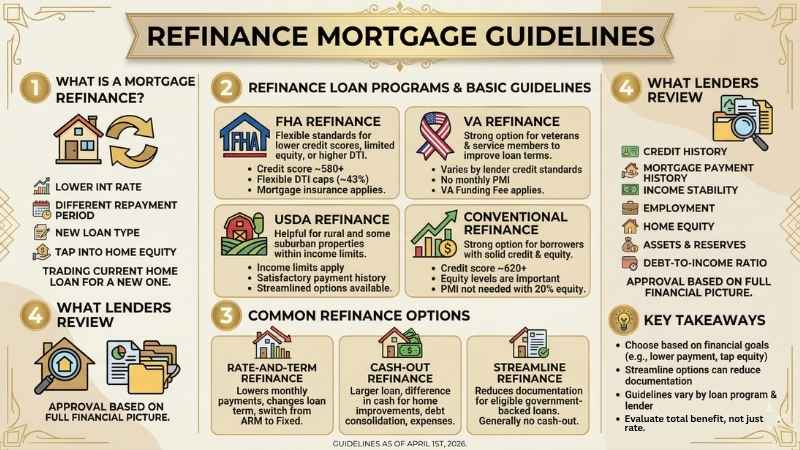
A USDA refinance may help homeowners with an eligible USDA loan who want to lower their interest rate, reduce their monthly payment, or move into more affordable mortgage terms. USDA refinance loans are designed for qualifying properties in eligible rural and certain suburban areas, and they can be especially helpful for borrowers who meet income requirements and want a government-backed refinance option.
Who A USDA Refinance May Help
A USDA refinance may be a good fit for homeowners who already have a USDA loan and live in an eligible area. This option is often considered by borrowers who want payment relief or better loan terms without moving to a different mortgage program. Because USDA loans are intended for moderate-income households in eligible locations, USDA refinancing is usually most helpful for borrowers who still meet the program’s general eligibility standards.
Basic USDA Refinance Requirements
To qualify for a USDA refinance, lenders usually review the type of USDA loan you currently have, your mortgage payment history, the location of the property, your household income, and your overall financial profile. The exact requirements can vary depending on the type of USDA refinance being used, including whether the refinance is a streamlined option or a more fully documented transaction.
USDA Eligibility, Income, And Property Rules
One of the most important things to understand about USDA refinance is that eligibility is tied to both the property and the household. The home generally needs to be in a USDA-eligible area, which is why location matters more here than it does with many other refinance programs. Household income is also important because USDA loans are intended for borrowers who fall within the program’s income limits for their area. For many readers, this is the part that needs the clearest explanation, because USDA rules are not based only on credit score or home equity.
USDA Credit And Debt-To-Income Considerations
USDA does not always work like a conventional refinance when it comes to qualification. Lenders still review credit and debt-to-income ratio, but the overall file matters. In many cases, lenders look for a solid payment history and a manageable level of debt compared with income. Borrowers should understand that lender standards can vary, even when the loan is backed by a government program.
When A USDA Refinance Makes Sense
A USDA refinance may make sense for homeowners who already have a USDA loan and want a lower payment or better mortgage terms while staying within the USDA program. It can be especially useful for borrowers who may not fit conventional refinance mortgage guidelines as easily and who benefit from the structure of a government-backed loan. As with any refinance, the goal should be to improve the borrower’s overall financial position, not just to replace one loan with another.
Conventional Refinance Mortgage Guidelines
A conventional refinance may be a strong option for homeowners with solid credit, stable income, and enough home equity to qualify for competitive terms. Unlike FHA, VA, and USDA loans, conventional refinance loans are not backed by a government agency. Because of that, they often work best for borrowers with stronger overall financial profiles who want flexibility in loan terms and potentially lower long-term borrowing costs.
Who A Conventional Refinance May Help
A conventional refinance is often a good fit for homeowners who have built equity in their property, improved their credit since they first took out their mortgage, or want to avoid some of the costs associated with government-backed loans. It may also make sense for borrowers who want to remove mortgage insurance, refinance out of an FHA loan, or access competitive pricing based on a stronger financial profile.
When A Conventional Refinance Makes Sense
A conventional refinance often makes sense when a homeowner has at least moderate to strong credit and enough equity to qualify for better terms. It can be especially attractive for borrowers who want to lower their interest rate, shorten or extend the loan term, or move away from FHA mortgage insurance. For homeowners with 20 percent or more equity, conventional refinancing may be particularly appealing because private mortgage insurance may not be required.
Conventional Credit, Equity, And DTI Requirements
In many cases, lenders require a minimum credit score of around 620 for a conventional refinance. However, higher scores usually lead to better pricing and more flexible terms. Equity is also important. Borrowers with more equity generally have more refinance options and may qualify for lower-risk pricing. Debt-to-income ratio is another key factor, and many lenders prefer it to stay within standard conventional guidelines unless the borrower has strong compensating factors.
PMI And Cost Considerations
One advantage of a conventional refinance is that private mortgage insurance is generally not required once a homeowner has at least 20 percent equity. This can make conventional refinancing especially attractive to borrowers seeking to lower their total monthly housing costs. However, if equity is below that level, PMI may still apply, so borrowers should compare the full monthly payment and not just the interest rate.
What Lenders Review For A Conventional Refinance
Lenders usually review income, employment, credit history, available assets, property value, and overall financial stability when evaluating a conventional refinance. Because conventional loans tend to rely more heavily on risk-based pricing, the strength of the full file can make a major difference in the final loan terms offered.
Common Types Of Refinance Mortgage Options
Not all refinance loans work the same way. Some homeowners refinance to lower their interest rate or monthly payment. Others want to tap into home equity, simplify the paperwork with a streamlined option, or move from one loan program to another. Figuring out the various refinance mortgage options can really help you decide on the best route to reach your financial goals.
Rate-And-Term Refinance
A rate-and-term refinance involves replacing your existing mortgage with a new loan that alters the interest rate, the repayment term, or both. This is a popular refinancing option for homeowners aiming to lower their monthly payments, pay off their loan more quickly, or transition from an adjustable-rate mortgage to a fixed-rate mortgage. Typically, this type of refinance does not involve taking cash out of your home equity; instead, it focuses on improving the terms of your current loan. It’s essential to follow refinance mortgage guidelines to ensure a smooth process and a beneficial outcome.
Cash-Out Refinance
A cash-out refinance allows you to replace your current mortgage with a larger loan and receive the difference in cash. Homeowners may use cash-out refinance funds for home improvements, debt consolidation, emergency expenses, or other major financial needs. Because this type of refinance increases the loan balance, lenders usually apply stricter equity, credit, and pricing standards than they do for a standard rate-and-term refinance. A cash-out refinance can be useful, but it should be carefully evaluated because it converts home equity into new debt.
Streamline Refinance
A streamline refinance is designed to make refinancing easier for eligible borrowers who already have certain government-backed loans. FHA, VA, and USDA each have streamlined refinance options for qualifying homeowners. These programs may reduce documentation requirements and may not require the same level of income verification or appraisal review as a standard refinance. However, a streamline refinance is generally intended to lower the rate or improve loan terms, not to take cash out.
Refinancing From One Loan Type To Another
Some homeowners refinance not just to improve the rate or term, but to switch loan programs altogether. For instance, someone might switch from an FHA loan to a conventional loan to ditch the mortgage insurance they have to pay for a long time. Or they could go the other way and refinance into an FHA loan if they find that the rules for conventional loans are just too tough for their financial situation right now. Others may move from an adjustable-rate mortgage to a fixed-rate mortgage for more predictable payments. This type of refinance can make sense when the new loan structure better matches the homeowner’s current financial situation.
How To Choose The Right Refinance Option
The right refinance option depends on your goal. If you want to lower your payment or adjust your loan term, a rate-and-term refinance may be the best fit. If you need access to home equity, a cash-out refinance may be worth considering. If you already have an FHA, VA, or USDA loan and want a simpler refinance process, a streamline refinance may be the better route. If your current loan no longer meets your needs, switching to a different loan type may offer a better long-term solution. The key is to compare the full cost of the new loan against the benefit you expect to receive.
What Lenders Review Before Approving A Refinance
Before approving a refinance, lenders look at the overall strength of the borrower’s file. While the exact requirements depend on the loan program, most lenders review several of the same core areas. These include credit history, current mortgage payment history, income stability, employment, home equity, assets, and debt-to-income ratio. Credit plays a crucial role in the refinancing process, as it directly influences both loan approval and interest rates. Borrowers with good credit are more likely to get better refinancing terms. Those with poor credit may have fewer options and face higher costs.
Additionally, lenders pay close attention to mortgage payment history, as recent late payments can complicate refinancing, particularly under refinance mortgage guidelines for streamlined or rate-reduction programs.
Income and employment are reviewed to confirm that the borrower can support the new loan payment. In addition, lenders consider the equity the homeowner has built, as equity often affects program eligibility, pricing, and whether mortgage insurance may apply. Assets may also be reviewed to ensure the borrower has sufficient reserves when required. Debt-to-income ratio is another important factor, but it is usually considered along with the rest of the file rather than in isolation. In many cases, refinance approval is based on the full financial picture, not just one number. That is why two homeowners with similar credit scores may still qualify for very different refinance options.
How To Choose The Right Refinance Program
The right refinance program depends on what you want the new loan to accomplish. Some homeowners refinance to lower their interest rate or monthly payment. Others want to shorten the loan term, switch from one loan type to another, remove mortgage insurance, or access equity through a cash-out refinance. If your main goal is a lower payment or better loan structure, a rate-and-term refinance may be the best fit. If you already have a government-backed loan and want a simpler process, a streamline refinance may be worth exploring. If you want to use your home equity for large expenses or debt consolidation, a cash-out refinance may make more sense. Homeowners who have improved their credit or built more equity may also find that switching from FHA to conventional is worth considering. The optimal refinance program isn’t necessarily the one that boasts the lowest advertised interest rate. Instead, it should enhance your overall financial situation by considering factors such as closing costs, mortgage insurance, the loan term, and your long-term goals. By evaluating refinance options through the lens of total benefit—rather than focusing solely on the interest rate—and adhering to refinance mortgage guidelines, you can make a more informed and beneficial decision.
What To Expect During The Refinance Process
The refinance process is similar to applying for a home purchase loan. However, some refinance programs require less documentation than others. In most cases, the process begins with reviewing your current mortgage, financial profile, and refinance goal. From there, the lender evaluates which refinance options may fit your situation based on factors such as credit, income, home equity, and the type of loan you currently have. After submitting your application, the lender will thoroughly review the documents to determine whether an appraisal is needed, verify your income, or complete the underwriting process. Generally, refinance mortgage guidelines require a thorough review for standard refinance loans.
However, certain streamlined refinance options for FHA, VA, and USDA loans may require less paperwork and omit specific steps depending on the program used.
Like any mortgage transaction, the refinance process is designed to confirm that the new loan is a better fit for the borrower and meets program requirements. The exact timeline and documentation depend on the loan type, the lender, and whether the refinance is a standard, cash-out, or streamline transaction.
Documents You May Need For A Refinance
When seeking a refinance, borrowers should be prepared to provide various documents verifying their income, assets, employment, and existing financial obligations. According to refinance mortgage guidelines, this documentation may include recent pay stubs, W-2 forms, tax returns, bank statements, and any other records requested during underwriting. Some refinance programs require full documentation, while others may allow reduced documentation.
Turn Your Equity Into Cash
Use your home’s value to pay off debt, fund renovations, or invest.FHA Streamline Refinance Mortgage Guidelines
An FHA Streamline Refinance is for folks who already have an FHA loan and want to lower their interest rate or monthly payment with a simpler refinancing process. Compared with a standard refinance, the FHA Streamline program may reduce documentation requirements and, in many cases, avoid a new appraisal. However, borrowers still need to meet program rules, and the refinance must provide a clear benefit.
Who An FHA Streamline Refinance May Help
This refinance option is mainly for folks who already have an FHA loan and are looking for a quicker and easier way to get better terms on their current mortgage. It is often used by homeowners who want to reduce their rate, move from an adjustable-rate mortgage to a fixed-rate loan, or lower their monthly payment without going through a full traditional refinance process.
Basic FHA Streamline Refinance Requirements
To do an FHA Streamline Refinance, you usually need to have an FHA-insured mortgage already and show that you’ve been keeping up with your mortgage payments. In general, the refinance must also provide a tangible benefit, such as a lower combined rate or payment, depending on the transaction. Because lender requirements can vary, borrowers should not assume that reduced documentation means no review at all.
Appraisal, Income, And Credit Considerations
One reason the FHA Streamline program is popular is that it may not require a new appraisal and may involve less income documentation than a standard refinance. However, that does not mean every lender follows the exact same refinance mortgage guidelines. Some lenders may still apply additional requirements based on their own refinance mortgage guidelines. Borrowers should also understand that the FHA Streamline Refinance is generally used for rate-and-term refinancing, not for cash-out refinancing.
Payment History Matters
Even though an FHA Streamline Refinance can be more flexible than a full refinance, mortgage payment history still matters. Borrowers should expect lenders to review whether the current FHA mortgage has been paid on time in accordance with program standards. Broad statements suggesting that other recent credit issues never matter can be misleading; this section should focus on the fact that the borrower’s overall payment profile may still be under review.
When An FHA Streamline Refinance Makes Sense
An FHA Streamline Refinance may make sense for a homeowner who already has an FHA loan and wants a more affordable or more stable mortgage without going through a full traditional refinance. It can be especially useful when the homeowner’s main goal is payment relief or a lower rate rather than cash back. As with any refinance, the real question is whether the new loan improves the borrower’s overall financial position after costs are considered.
VA IRRRL Refinance Guidelines
A VA IRRRL, also called a VA streamline refinance, is designed for homeowners who already have a VA loan and want to improve the terms of that mortgage with a simpler refinance process. Many borrowers use a VA IRRRL to secure a lower interest rate, reduce their monthly payments, or transition from an adjustable-rate mortgage (ARM) to a fixed-rate loan. Compared with a full refinance, the process may involve less documentation. However, borrowers still need to meet program and lender requirements.
Who A VA IRRRL May Help
A VA IRRRL may help eligible homeowners who already have a VA loan and want a more efficient way to refinance without starting over with a full traditional mortgage process. This option is usually best for borrowers whose main goal is to improve the terms of the current loan rather than take cash out.
Basic VA IRRRL Requirements
To qualify for a VA IRRRL, the borrower generally must already have a VA-backed mortgage and demonstrate that the refinance provides a clear net tangible benefit. This typically means the new loan must improve the borrower’s situation by offering a lower rate, lower payments, or a more stable loan structure. Lenders will also assess mortgage payment history and other program requirements in accordance with refinance mortgage guidelines before approving the refinance.
Credit, Income, And Appraisal Considerations
One reason many homeowners consider a VA IRRRL is that it may require less documentation than a standard refinance. In many cases, a new appraisal may not be required, and income documentation may be less extensive than for a full underwritten loan. However, that does not mean every borrower is approved automatically or that lender requirements are identical in every case. Individual lenders may still apply overlays or review the overall file before final approval.
Payment History And Lender Review Still Matter
Borrowers should not assume that credit or payment history never matters simply because the refinance is called streamlined. While the VA program can be more flexible than some other refinance options, lenders may still consider recent mortgage payment history and the overall strength of the file. That is why it is more accurate to describe the VA IRRRL as a simplified refinance, not a no-review refinance.
When A VA IRRRL Makes Sense
A VA IRRRL may make sense for a homeowner who already has a VA loan and wants to improve the terms of that mortgage without pursuing a cash-out refinance. It is often a practical option when the borrower wants a lower rate, better monthly affordability, or the stability of moving into a fixed-rate loan. As with any refinance, the full benefit should be weighed against closing costs, fees, and the loan’s long-term impact.
USDA Streamline Refinance Guidelines
A USDA Streamline Refinance is designed for homeowners who already have an eligible USDA loan and want to improve their mortgage terms with a simpler refinance process. This option is often used to lower the interest rate, reduce the monthly payment, or make the loan more affordable over time. Compared with a standard refinance, the USDA streamline process may reduce documentation requirements. However, borrowers still need to meet program and lender refinance mortgage guidelines.
Who A USDA Streamline Refinance May Help
A USDA Streamline Refinance may help homeowners who currently have a USDA-backed mortgage and want a more efficient way to refinance without going through a full traditional refinance process. This option is generally most useful for borrowers whose main goal is to improve the terms of their existing USDA loan rather than pull cash out of the property.
Basic USDA Streamline Refinance Requirements
To qualify for a USDA refinance, borrowers typically need an eligible USDA loan and a satisfactory payment history that meets program standards. The refinance should generally result in a clear advantage for the borrower, such as a lower interest rate or lower monthly payments. Since refinance mortgage guidelines can vary by transaction type and lender requirements, it’s more accurate to describe the program as streamlined rather than automatic.
Credit, Income, And Appraisal Considerations
One reason borrowers consider USDA Streamline Refinance is that it may involve less documentation than a full refinance. In some cases, the process may not require the same level of income verification or a new appraisal that would be expected on a standard refinance. However, borrowers should not assume that no review is required. Lenders may still apply their own requirements and review the overall file before final approval.
Payment History Still Matters, But Avoid Repetition
Mortgage payment history is still an important part of USDA streamline eligibility, but the section does not need to repeat the same “timely on payments for the past 12 months” formula throughout the article. A cleaner way to explain it is that borrowers generally need to show acceptable recent mortgage payment performance under refinance mortgage guidelines. That sounds more natural and avoids making the article feel repetitive.
When A USDA Streamline Refinance Makes Sense
A USDA Streamline Refinance may make sense for a homeowner who already has a USDA loan and wants a simpler way to lower the rate or improve monthly affordability. It can be especially useful for borrowers who want to stay within the USDA program rather than switch to another loan type. As with any refinance, the decision should be based on whether the new loan creates a meaningful long-term benefit after costs are considered.
Frequently Asked Questions About Refinance Mortgage Guidelines:
What Credit Score Do You Need for a Refinance Mortgage?
The credit score needed for a refinance mortgage depends on the loan type and the lender. Conventional refinance loans often start around the low-620 range, while government-backed refinance options may be more flexible. In practice, stronger credit helps borrowers qualify for better pricing, lower fees, and more refinance choices.
Can I Refinance My Mortgage if I Have Little or No Equity?
Yes, in some cases, you can refinance with limited equity, but the answer depends on the loan program. Government-backed options, such as certain FHA streamline and USDA refinance paths, may offer less equity flexibility than a standard conventional refinance. The key is whether the refinance meets refinance mortgage guidelines and still creates a real financial benefit after costs are considered.
Do I Have to Refinance With My Current Lender?
No. You can usually refinance with your current lender or a different lender. Comparing multiple Loan Estimates can help you evaluate the true cost of the refinance, including the rate, fees, and the total cash needed at closing.
How Much Does it Cost to Refinance a Mortgage?
Refinancing usually comes with closing costs, and Freddie Mac says borrowers can often expect refinancing costs of roughly 3% to 6% of the loan principal, depending on the lender, credit profile, and location. Even when a refinance is advertised as low-cost or no-closing-cost, the fees are often rolled into the loan balance or offset through pricing, so borrowers should review the full Loan Estimate carefully.
What is the Difference Between a Rate-and-Term Refinance and a Cash-Out Refinance?
A rate-and-term refinance is when you switch up your interest rate or the length of your loan, or even both, but you’re not looking to take out any cash from your home’s equity. A cash-out refinance replaces the current mortgage with a larger loan and gives the borrower the difference in cash. Many homeowners use a rate-and-term refinance to improve affordability, while a cash-out refinance is usually used for debt consolidation, renovations, or other large expenses.
Is a Streamline Refinance Really Easier?
A streamline refinance is usually easier than a full refinance, but it is not the same as a no-review loan. HUD says an FHA streamline refinance involves limited documentation and underwriting, and specifically notes that “streamline” does not mean there are no costs involved. USDA and VA streamline-style refinance options still have program standards, lender overlays, and benefit requirements that borrowers must meet.
This article about “Refinance Mortgage Guidelines: What You Need To Know” was updated on April 1st, 2026.