
When you hear the phrase recommended lender by realtors, it usually refers to a lender who has built trust by helping transactions move smoothly from pre-approval to closing. In many cases, real estate agents recommend lenders who communicate well, meet deadlines, explain financing clearly, and help avoid last-minute surprises.
For homebuyers, that recommendation can be helpful, but it should not replace comparison shopping. A lender recommended by your realtor may offer strong service and reliability. However, you should still compare interest rates, closing costs, loan options, and responsiveness before deciding.
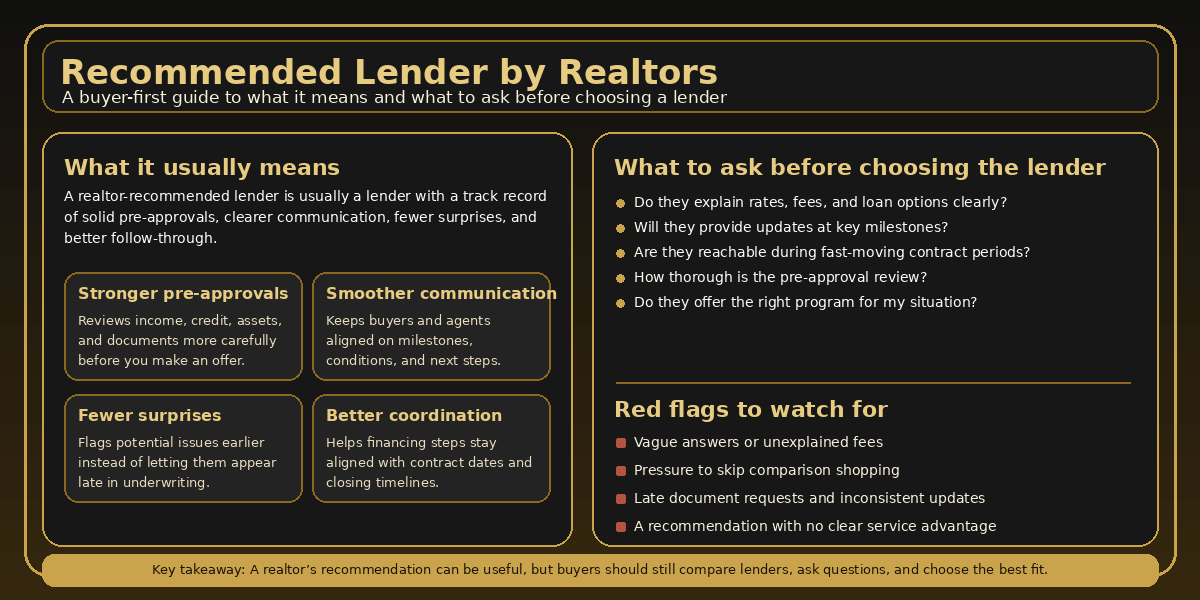
A strongly recommended lender by realtors often stands out in four ways: they issue solid pre-approvals, communicate clearly with all parties, solve problems early, and stay on top of deadlines throughout the transaction. At the same time, buyers should watch for red flags such as vague answers, poor follow-up, unexplained fees, or pressure to move forward without understanding the loan terms.
In this guide, we’ll explain what a recommended lender by realtors really means, when using one can help, what questions buyers should ask before choosing a lender, and what real estate agents usually look for in a lending partner.
What Does “Recommended Lender By Realtors” Really Mean?

When a realtor refers to a lender as a recommended lender by realtors, they usually mean a lender who has built trust over time by helping transactions move more smoothly from pre-approval to closing.
That does not mean every file is perfect or that every closing happens without delays. Real estate transactions can be affected by appraisals, title work, insurance, seller negotiations, and buyer documentation. But a strong lender can reduce avoidable problems by carefully reviewing the file, communicating clearly, and addressing issues early.
In practical terms, a recommended lender by realtors is often someone who:
- issues pre-approvals based on a real review of income, credit, and assets,
- communicates clearly with buyers, agents, and other parties,
- flags problems early instead of waiting until the last minute,
- helps structure the loan correctly based on program guidelines,
- stays engaged throughout the process rather than going quiet when challenges arise.
In other words, a recommended lender by realtors is usually one that makes the transaction more predictable, transparent, and easier to manage for everyone involved.
Realtors’ Go-To Lender for Tough Deals
Borderline files, low scores, and manual underwrites welcome
Why Realtors Need a Trusted Lending Partner
Real estate is a stressful and competitive business. Realtors juggle:
- Showings and open houses
- Negotiations and inspections
- Appraisals, repairs, and deadlines
- Buyer emotions and seller expectations
Additionally, they are often required to answer mortgage questions that they shouldn’t have to handle. The wrong lender can:
- Go silent when problems show up
- Deny borrowers who are late in the process
- Ask for the last-minute conditions that cause delays
- Missed closing dates and costs everyone money and trust
That’s why the recommended lender by realtors is usually the one who:
- Picks up the phone
- Knows the guidelines
- Tells the truth up front
- Does everything possible to get the loan closed
Why Realtors Across the Country Recommend Gustan Cho Associates
Real estate agents usually do not recommend a lender based solely on branding. In most cases, they prefer lenders who communicate clearly, issue realistic pre-approvals, stay engaged through deadlines, and understand how to structure more complex borrower files.
This matters even more when a buyer has credit challenges, a higher debt-to-income ratio, self-employment income, or a prior loan denial. In those situations, realtors often look for lenders with strong knowledge of guidelines and a track record of identifying issues early rather than late in the transaction.
For many agents, the goal is not simply to choose a local lender or a large national lender. It is to work with a lender whose process is responsive, predictable, and well-suited to the type of buyers they serve.
Gustan Cho Associates is one example of a lender that markets itself around complex file experience, agency-guideline lending, and consistent communication. For buyers and agents, the real question is not the brand name alone, but whether the lender can provide solid pre-approvals, clear updates, and reliable execution from application to closing.
No Lender Overlays Means More Approvals
Some mortgage lenders add stricter internal rules on top of the standard guidelines set by FHA, VA, USDA, Fannie Mae, or Freddie Mac. These extra rules are commonly called lender overlays.
An overlay requires a higher credit score than the program minimum, allowing a lower debt-to-income ratio than automated underwriting permits, or applying stricter waiting periods after bankruptcy, foreclosure, or other credit events.
Because of overlays, one lender may decline a borrower even though the borrower may still qualify under the basic program guidelines with another lender.
In simple terms, a lender with fewer overlays may be able to approve some borrowers that a stricter lender turns down. That does not mean every declined loan can be approved elsewhere, but it does mean borrowers should not assume one lender’s answer is always the final answer.
Gustan Cho Associates uses this no-overlay positioning as part of its value proposition, particularly for borrowers with more complex credit or income scenarios. For buyers and real estate agents, the key takeaway is that it’s helpful to ask whether a loan denial was based on actual program guidelines or on a lender’s stricter rules.
Higher Debt-to-Income Ratios When AUS Allows
One reason some buyers are declined by one lender and approved by another is the debt-to-income ratio, also known as DTI. This ratio compares your monthly debt payments to your gross monthly income before taxes.
DTI is basically a way to figure out how much of your paycheck is already tied up in things like credit card bills, car loans, student loans, and your future housing costs.
Some lenders apply stricter internal limits, while others rely more closely on automated underwriting findings. For example, Fannie Mae says loans run through Desktop Underwriter can allow up to a 50% total DTI in many cases. In contrast, manually underwritten loans generally have lower limits unless other factors help support the file.
For borrowers, the important point is simple: a higher DTI does not always mean an automatic denial. Automated underwriting may still approve a loan when the overall application is strong, such as when the borrower has solid credit, stable income, cash reserves, or other compensating factors. Freddie Mac’s Loan Product Advisor also evaluates DTI along with loan-to-value and reserves in its feedback.
That does not mean every high-DTI borrower will qualify. It means buyers should understand whether a lender is following automated findings closely or applying stricter internal rules than the program itself requires.
Full Menu of Loan Programs for Every Type of Buyer
One reason some realtors prefer working with lenders that offer a broader range of mortgage programs is simple: not every buyer fits neatly into the same box.
A lender with only one or two main products may be quick to say no when a borrower has lower credit, non-traditional income, veteran eligibility, rural property goals, or a more complex financial profile. A lender with a wider range of programs may be better able to match the buyer to the right loan, rather than forcing every application through the same narrow standard.
For example:
- FHA loans may help buyers with lower credit scores or smaller down payments.
- VA loans can be a great choice for veterans, active-duty military members, and some surviving spouses who qualify.
- USDA loans may help qualifying buyers purchase in eligible rural areas with low down payment requirements.
- Conventional loans may work well for borrowers with stronger credit, stable income, and a more standard file.
- Non-QM loans may help self-employed borrowers, real estate investors, or buyers with income that is harder to document using traditional methods.
For realtors, this matters because greater program variety can reduce the risk that a buyer gets stuck after pre-approval. After all, the lender does not offer the right loan structure for that borrower’s situation.
In other words, a lender with multiple solutions may be better equipped to keep a transaction moving when the buyer does not fit a standard approval profile.
Realtors Rely On Us to Close On Time
Clear communication, fast turn times, and guideline-only underwriting
Communication and Service That Make Realtors Look Good
Available Seven Days a Week
One reason realtors often recommend certain lenders is communication. In fast-moving transactions, delayed responses can create unnecessary stress for buyers, agents, sellers, and listing agents.
When your realtor recommends a lender, ask whether that lender:
- responds during evenings or weekends when contract deadlines are active,
- provides updates at key stages of the mortgage process,
- keeps both the buyer’s agent and listing agent informed when appropriate,
- explains document requests and conditions clearly,
- stays accessible when issues come up unexpectedly.
A responsive lender does not guarantee a perfect transaction, but strong communication can reduce confusion, prevent avoidable delays, and help everyone stay aligned from offer to closing.
Some lenders, including Gustan Cho Associates, use accessibility and frequent updates as part of their service model. The key for buyers is not just whether a lender claims to be available, but whether that availability leads to clearer expectations and a smoother loan process.
Proactive Updates on Every File
Nothing is more frustrating for a realtor than:
- Not knowing where a loan is in the process
- Getting vague answers
- Being surprised by last-minute problems
Our process is built around communication:
- You’ll get email updates automatically at every stage of the mortgage process.
- Our team will reach out with calls and texts to both the buyer’s agent and the listing agent.
- Clear timeline expectations from pre-approval to clear to close
As a recommended lender by realtors, we understand that your reputation is tied to ours. Keeping everyone informed is one of the best ways we protect that.
Educating Borrowers So Realtors Can Focus on Real Estate
Buyers often ask their realtor questions like:
- “What’s this condition?”
- “Why do they need this document?”
- “What does this form mean?”
Those are mortgage questions — and they should be answered by the lender, not the realtor.
We take time to:
- Explain documents in plain language
- Walk buyers through disclosures
- Set expectations on documentation, timelines, and conditions
This allows realtors to focus on what they do best: finding and negotiating homes, not explaining underwriting.
Many Borrowers Seek a Second Opinion After a Loan Denial
Many homebuyers come to a new lender after being told no elsewhere. In some cases, the denial is based on a lender’s own stricter rules rather than the full range of options available under agency or alternative loan guidelines.
That does not mean every declined borrower will qualify with a different lender. But it does mean a second review can sometimes uncover other paths forward, especially when the original lender had narrower program options or stricter overlays.
For buyers and real estate agents, the key takeaway is simple: one denial does not always mean the homeownership journey is over. Sometimes it means the file needs a different loan structure, a clearer documentation strategy, or more time to improve qualifying factors.
Gustan Cho Associates is a recommended lender by realtors, particularly for borrowers who have faced declines elsewhere. They specialize in cases involving overlays, program fit, or more complex credit and income profiles.
How Working With a Realtor-Recommended Lender Can Help Homebuyers
If your realtor recommends a lender, the potential benefit is not just familiarity. In many cases, it is about working with a lender who already has a reputation for being responsive, organized, and reliable during a fast-moving transaction.
For homebuyers, that can lead to several practical advantages.
A stronger pre-approval can help you shop with more confidence because the lender may have reviewed your income, credit, assets, and documentation more carefully before you make an offer.
Communication may also be smoother when the lender, buyer’s agent, and listing side stay aligned throughout the transaction. That can reduce confusion around deadlines, conditions, and next steps.
A lender who explains the process clearly can also help reduce surprises. Buyers are less likely to feel blindsided by document requests, timeline changes, or underwriting conditions when expectations are set early.
Another benefit is better coordination between financing steps and contract deadlines. When the lender stays engaged and communicates clearly, it is often easier to keep the transaction moving through pre-approval, appraisal, underwriting, clear to close, and closing day.
Of course, buyers should still compare lenders, ask questions, and carefully review rates, fees, and loan options. A realtor’s recommendation can be helpful, but it should be part of an informed decision, not a substitute for one.
Some lenders, including Gustan Cho Associates, position themselves around this kind of communication and flexibility, especially for borrowers with more complex scenarios.
Your Competitive Edge: A No-Overlay Lender Partner
Help more buyers qualify and close more transactions
How to Partner With Gustan Cho Associates
If you are a realtor looking for a reliable, recommended lender who can handle tough files, or a homebuyer who wants a lender your realtor can trust, we’d love to connect. Please contact us at 800-900-8569, text us for a faster response, or email us at alex@gustancho.com.
We will:
- Review your scenario
- Go over your options
- Explain how our no lender overlays, flexible guidelines, and strong communication can help you and your clients
Whether you are in a state where we are currently licensed or you need guidance, our team is here seven days a week to help.
Whether you’re a realtor seeking a long-term lending partner or a homebuyer whose agent has recommended us, we are ready to review your scenario and help you move forward toward achieving the American Dream of homeownership.
Frequently Asked Questions Abut Recommended Lender by Realtors:
Should I Use the Recommended Lender by Realtors?
You are not required to use the recommended lender by realtors. A recommendation can be helpful because that lender may already have a reputation for clear communication, realistic pre-approvals, and reliable follow-through. Still, buyers should compare rates, fees, loan options, and responsiveness before making a final decision. Industry guidance also emphasizes asking detailed questions when choosing a lender.
Can a Realtor Require Me to Use a Specific Lender?
No. A realtor can recommend a lender, but the buyer still has the right to choose the mortgage company that best fits their needs. That is one of the most common concerns buyers have when an agent strongly suggests a preferred lending partner.
Why Do Realtors Recommend Certain Lenders?
Realtors often recommend lenders who communicate well, issue solid pre-approvals, stay on top of deadlines, and help prevent avoidable surprises during the transaction. In practice, agents usually prefer lenders who are responsive and easy to work with under real contract pressure.
Is it Smart to Compare a Realtor’s Recommended Lender with Other Lenders?
Yes. Even if the recommended lender is strong, comparing at least a few lenders can help you evaluate interest rates, closing costs, loan options, speed, and overall service. A realtor’s recommendation can be a good starting point, but it should not replace doing your own comparison.
What Questions Should I Ask a Realtor-Recommended Lender?
Ask how they determine pre-approval, what loan programs they think fit your situation, whether their rates and fees are negotiable, how often they provide updates, and how they handle timeline issues before closing. Those questions can help you tell the difference between a lender who is connected to an agent and one who is actually a good fit for your file.
Is Using a Recommended Lender Always Better for Getting an Offer Accepted?
Not always, but it can help in some situations. A lender with a strong reputation for communication and execution may make listing agents feel more confident that the financing side of the deal will stay on track. That said, the best lender for you is still the one that combines reliable service with competitive terms and the right loan options for your situation.
This article about “Recommended Lender By Realtors With No Lender Overlays” was updated on March 10th, 2026.
Why Top Agents Put GCA First on Their List
We follow agency guidelines—not extra credit score or DTI overlays