
Can Homeowners Be on Title But Not on Mortgage? What Borrowers Should Know
The primary emphasis of this blog centers around the waiting period obligations that individuals face after foreclosure, specifically those on title but not on mortgage. We often receive queries from married home buyers grappling with financial challenges, making it difficult for them to maintain their existing homes.
Can homeowners be on title but not on a mortgage? Discover the relationships among titles, ownership, and mortgage responsibilities, including associated risks, benefits, and lender restrictions.
These homeowners often fall behind on their mortgage payments and risk foreclosure. These homeowners often fall behind on their mortgage payments and risk foreclosure. This guide will explore the waiting period requirements applicable to individuals on the title but not on the mortgage following a foreclosure.
Waiting Period Requirements After Foreclosure To Qualify For a Mortgage

They are currently seeking information regarding potential alternatives to retain their current residence. Homeowners can proactively reach out to their lenders, initiating a discussion to explore various alternatives that could help them avoid a traditional foreclosure. Dale Elenteny, a senior mortgage loan originator at Gustan Cho Associates says the following:
Lenders often present alternatives such as a mortgage following a deed-in-lieu of foreclosure or even a short sale. These options become particularly relevant when one of the spouses is listed on title but not on mortgage.
Homeowners should be aware that being on the title doesn’t necessarily imply being on the mortgage note. In the unfortunate event that a home is on the verge of foreclosure, there’s a possibility for the spouse not mentioned on the mortgage note to still qualify for a new mortgage loan. This qualification is based on their inclusion on the home title, offering a potential avenue for securing a fresh mortgage and, consequently, preserving their home. Understanding the nuances of the relationship between mortgage and title is crucial in navigating challenging situations.
Homeowners on Title But Not On Mortgage: Facts For Borrowers
Many people ask if homeowners can be on the title but not on the mortgage. In most cases, someone can be on the title without being on the mortgage. Still, there are important legal, financial, and lending factors to consider before buying a home or making changes later.
If you did not sign the mortgage note, you are generally not personally liable for the mortgage debt. However, your ownership interest can still be at risk if the borrower defaults and the property is foreclosed.
This topic matters most for married couples, domestic partners, and families helping with a home purchase. It also comes up in estate planning or when only one person qualifies for a loan because of income or credit. Being on the title and being on the mortgage are different, and this can affect ownership rights, financial responsibilities, refinancing, and other real estate choices. Understanding the difference helps borrowers avoid mistakes and plan better for homeownership.
Being On Title But Not On Mortgage: What Does This Mean?
Being on the title means you have legal ownership rights to the property. A title holder can live in the home, inherit it, and benefit financially if the property increases in value. Title and ownership are closely linked.
In many cases, yes, you can add someone to the title through a deed without refinancing. However, doing so does not add that person to the mortgage, and it may create legal or lender-related issues if not handled properly.
If you are on a mortgage, you are responsible for paying back the home loan. The mortgage note proves this debt. To be on the mortgage, you must meet the lender’s requirements, such as credit score, income, job status, and debt-to-income ratio. The main concern here is the loan itself.
Understanding Title, Ownership, and Rights
Who owns the property in question can be determined by the property title. One person or several people can be on the title. The share of ownership depends on how the title is set up. Someone can have ownership in the property even if they are not listed on the mortgage. The title and the mortgage are two different things. The mortgage note is a contract in which the signer agrees to be liable for the loan, allowing the lender to take legal action.
Being on Title But Not on Mortgage: What It Entails
The title and mortgage are separate. The mortgage note is a contract that makes the signer responsible for the loan, so the lender can take legal action if payments are missed. If a title holder did not sign the mortgage note, they are not required to pay the mortgage, but they could still lose their ownership if the home is foreclosed. However, many may not notice it. Usually, removing someone from the mortgage requires a refinance, loan assumption, or lender-approved change. A person may remain on title even if they are not on the mortgage, but the mortgage lender’s rules still control the debt obligation.
Reasons A Title Holder Is Also A Homeowner But Not A Mortgage Holder
The mortgage can be drawn up with only one person, and the title can have multiple owners because of family or marital ties, inheritance, or planning. The rights of ownership and the liability of the mortgage debt can be separate to a degree.
Being on title but not on mortgage is a big part of the question of whether homeowners can be on title but not on the mortgage, which is why people often ask.
A spouse can often be on the title but not on the mortgage. This is common when only one spouse qualifies for the home loan, although lender rules and state laws may affect how the transaction is structured.
A Title Holder That’s Not A Borrower From A Lender’s Perspective
Many assume that owning a home means you must be on a loan, but that’s not always true. Lenders may allow a spouse, partner, or family member to have ownership without being a borrower, depending on their rules and state laws. whereas a property owner is anyone who has legal rights to a property. The roles of borrower and property owner can be filled by a single person or multiple people. One person may be both an owner and a borrower, but another person can be just an owner, while the other is both an owner and a borrower. In the context of underwriting, title work, refinancing, liability, and estate planning, this distinction is important.
Why A Homeowner May Be On The Title But Not On The Mortgage
There are several reasons a homeowner might be on the title but not on the mortgage. The borrower may have better credit, less debt, or steadier work. To improve loan approval chances, the less-qualified person is left off the mortgage but can still be on the title for legal ownership.
Marriage is another common example. Sometimes, only one spouse is on the mortgage, but both can be on the title for legal or inheritance reasons.
In other cases, a family member who contributes to a down payment might be added to the title, but this should be done carefully, considering lender and occupancy rules. Estate planning is another reason. Homeowners may add a spouse, adult child, or family member to the title to make future transfers easier. Sometimes, someone is left off the mortgage due to poor credit, recent financial problems, high debt, or insufficient proof of income.
Take First Step Toward Making Your Dream A Reality
Apply Now And Get recommendations From Loan ExpertsWhy Credit or Income Issues May Keep Someone Off the Loan
Excluding an applicant from a loan can sometimes simplify the qualification process. If one applicant has significant debt, a low credit rating, recent delinquencies, or an inconsistent job history, leaving them off the loan can make it easier to qualify.
If one person has a lot of debt, low credit, late payments, or unstable work, using only the stronger applicant can help get the loan approved. The other person can still be on the title if the rules allow.
They may prefer to share ownership between both spouses, or they may wish for a specific family member to have a partial ownership stake in the property. The decisions made in this regard can have implications on taxation, probate, inheritance, and the legal rights involved, so they should be made with utmost care.
How Lenders Perceive Title Holders Not Included as Borrowers
Lenders focus on who is legally responsible for paying the loan. They assess the risks for each borrower. Lenders also check who will be on the title, since this affects the lien, ownership rights, and closing paperwork.
Before finalizing a loan, it is customary for lenders to examine title ownership. Before approving a loan, lenders review title ownership to ensure it complies with the rules.
Some loans allow a non-borrowing spouse to be on the title, while others have additional requirements. In community property states, having only one spouse on the title may require additional checks, as it can affect the specific closing documents and the lender’s requirements. Borrowers may have different vesting ways due to state law, property use, marital status, and occupancy type. Closing attorneys, title companies, and lenders should be consulted early in the process to avoid last-minute title plan issues.
Is It Possible For The Title And Mortgage To Be Under Different Names?
Consider the following situation: Jim and Mary Jones, a married couple, find themselves in a challenging predicament as their current home, valued at $400,000, faces the imminent threat of foreclosure. What adds a unique layer to their circumstance is that, on the one hand, Mary Jones is the sole individual listed on the mortgage loan, while on the other, both Jim and Mary are named on the title. The genesis of their financial strain stems from Mary Jones experiencing unemployment for an extended period spanning over a year.
Despite her commendable efforts in securing a job, the arduous reality remains that she needs to catch up on mortgage payments, rendering their once-cherished home now financially unattainable.
This intricate situation prompts reflection on the interplay between ownership and financial responsibility. While the title reflects shared ownership, the mortgage burden falls solely on Mary’s shoulders. The divergence between title and mortgage details highlights the complexity of their predicament, raising questions about the broader implications and potential resolutions for such cases.
Can a Spouse Be Listed On Title But Not On Mortgage And Still Qualify For A New Mortgage After Foreclosure?
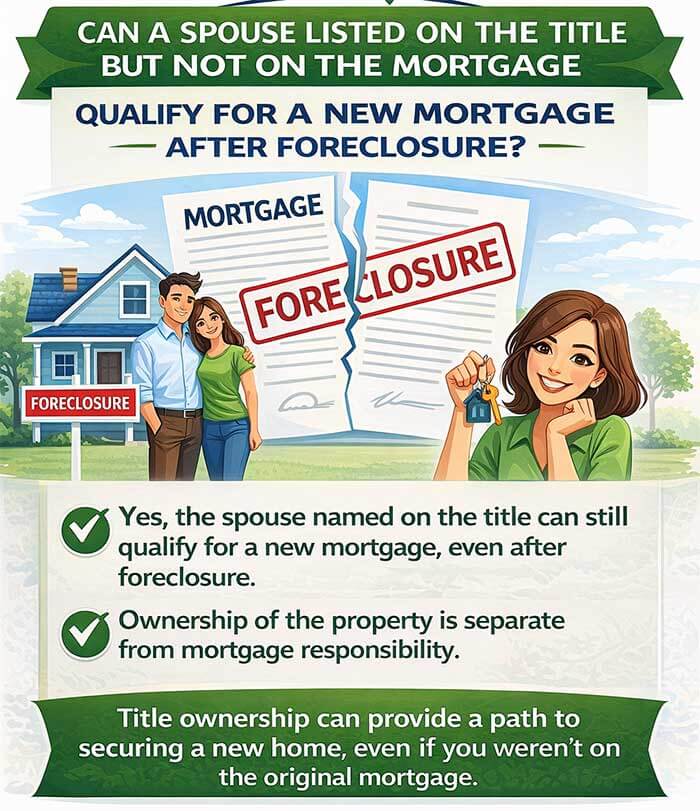
Five years ago, while acquiring their home, Jim Jones, a full-time student at that time, was not part of the mortgage loan arrangement; only Mary Jones was designated as the borrower. However, Jim’s name was included in the title alongside Mary.
In the present scenario, grappling with the challenges of raising young children and caring for pets, they have concluded that renting an apartment is no longer a suitable option for their family. Interestingly, they have discovered that home rentals tend to incur higher costs compared to the financial commitment associated with a mortgage.
This realization has led them to consider purchasing a $200,000 home seriously. With his fair credit standing and annual income of $40,000, Jim is actively exploring the feasibility of embarking on this new homeownership journey. The idea is a financial consideration and reflects their evolving family needs and aspirations. The collaborative decision-making process involves assessing various factors, including housing options, financial readiness, and the family’s overall well-being.
Waiting Period After Foreclosure For Spouse On Title But Not On Mortgage
Following a foreclosure, there is a required waiting period for Mary Jones, who is listed on the mortgage but not on title, to become eligible for a new home loan. Jim Jones satisfies the conditions with a minimum credit score of 580, and his income meets the debt-to-income ratio requirements.
It’s a legitimate option for individuals seeking to adjust property ownership without affecting their eligibility for a new mortgage. You can be on the title and not on the mortgage in many cases.
Being on title means you have an ownership interest in the property, while being on the mortgage means you are legally responsible for repaying the loan. While Mary’s income cannot be considered for the loan application, she can still be included on the home title, even though she cannot be part of the loan application. As a result, Jim qualifies for an FHA loan for a new home purchase, whereas Mary’s eligibility is restricted due to the waiting period following foreclosure.
Refinance Mortgage With Only One Spouse on Mortgage
If, during a prior refinancing, one spouse was removed from both the title and the mortgage, thereby retaining only the other spouse on the loan, it’s worth noting that they can still meet the criteria for obtaining a new home mortgage. This eligibility remains applicable even when the property they reside in is undergoing foreclosure. Importantly, this circumstance does not fall under the classification of bail.
To elaborate further, adding a new borrower on title but not on mortgage allows for flexibility in the ownership structure without impacting the mortgage qualification process.
However, it is crucial to emphasize that any removal from the mortgage with deceptive intentions or as part of a deliberate plan to foreclose on the home is strictly prohibited. Adherence to ethical practices in such financial transactions is paramount to ensure fair dealings and protect the rights of all parties involved. Therefore, individuals should approach such adjustments with transparency and honesty, adhering to legal and ethical standards in the real estate and mortgage processes.
Can a Spouse Listed on the Title but Not on the Mortgage Qualify for a New Mortgage After Foreclosure?
Suppose your spouse has diligently managed the monthly mortgage payments over an extended period, and unforeseen circumstances result in foreclosure. In that case, you still can qualify for a new home mortgage loan, even if your name is not on the mortgage note.
Homeowners can include their spouse on title but not on mortgage. In the unfortunate event of foreclosure, the spouse mentioned on title but not on mortgage note retains eligibility for securing a new mortgage.
This unique arrangement allows for a separation between property ownership and mortgage responsibility, providing a potential avenue for the non-mortgage-holding spouse to explore new homeownership opportunities. It’s an arrangement that underscores the significance of title ownership in such situations, offering a potential financial lifeline for those facing foreclosure challenges.
Homestead Rights vs. State Regulation
State laws govern title rights, marital claims, and homestead protections. One spouse may have homestead rights even if not on the mortgage. Sometimes, a title holder who is not a borrower must sign certain documents at closing. Giving general advice without knowing state laws can be risky, since state and mortgage rules can conflict.
Examples Of Being On The Title And Not On The Loan
It’s common for both spouses to be on the title and loan, but sometimes only one spouse is on the mortgage and title. Family deals can also affect title ownership, such as when a parent helps buy a home or a property is inherited. Sometimes, after closing, a borrower adds a spouse or family member to the title by executing a quitclaim deed or a similar document. This changes who owns the property, but does not change the mortgage. The original borrower stays responsible for the loan unless the lender agrees to a refinance, assumption, or other change.
Down Payment Gift and Non-Borrowing Owner Issues
A common case is when someone gives gift money for a home purchase and then wants to be on the title. Whether this is allowed depends on the loan type, lender rules, occupancy, and paperwork. Buyers should not assume that giving gift funds means they will gain ownership, or that changing the title after closing is simple.
Title Without Mortgage: Pros and Cons
There are advantages to being on title but not on the mortgage. A title holder may have a stake in the property’s ownership, the benefit of equity increasing with appreciation, and legal rights. Being on the title but not on the mortgage has benefits. You can own the property, build equity as it appreciates, and retain your legal rights. This setup can help married couples, estate planning, and family ownership goals. The partnership goes down the drain.
Risks of Adding Someone to the Title After Closing
There are risks when adding to the mortgage after the deal is done. It may lead to dividing ownership rights and make it risky to add someone to the title after closing. It might change ownership rights, affect estate planning, or cause disputes if relationships change. Sometimes, making changes without telling the lender can create problems.
Homeowners should read their mortgage documents and get professional advice before making any title changes. Rest is the most observable event.
Factors like the spouse’s credit, debts that are lower than are owned or recorded differently, or income documentation that exceeds what is permitted for the spouse to own the title. This is why many couples ask if a spouse can be on the title but not on the mortgage. Most of the time, the answer is yes. Still, it depends on the loan program, the couple’s legal status, state laws, and the lender’s rules.
Are Title Holders Liable for the Mortgage
Usually, a title holder is not responsible for the mortgage debt like a borrower. The lender cannot collect the debt from the title holder. Still, the title holder does not have complete protection. If the mortgage is not paid, the lender can foreclose on the home since the property secures the loan. A title holder could lose ownership if this happens. Even without mortgage liability, title holders still face major responsibilities for the home.
How To Change Ownership Title Despite A Mortgage
You can add or remove someone from the title with a deed. But ownership title and mortgage title are different. The mortgage stays with the original borrower unless the lender agrees to change it.
Many homeowners misunderstand the difference between mortgages and property titles. Removing someone from the title does not remove them from the mortgage.
Adding someone to the title does not put them on the mortgage either. Usually, adding someone to the mortgage requires refinancing, which needs lender approval.
Options To Add A Borrower To The Mortgage Through Refinancing
If both people want to be on the mortgage, they will probably need to refinance. The lender will again review income, credit, debt, and property value. Refinancing can match ownership and mortgage responsibility, but it means a new approval process, interest rate, and loan term.
The Role of Lenders, Attorneys, and Title Companies
Since title issues involve mortgages and legal rights, homeowners should talk to professionals before making decisions. It’s best to work with a mortgage lender, real estate attorney, or title company for advice.
Lenders can review ownership and non-borrowing title holders, while attorneys and title companies handle legal and state-specific issues.
This is especially important for estates, divorces, inheritances, estate planning, family transfers, community property states, or adding someone to the title after closing. While the answer to whether homeowners can be on the title but not on the mortgage is usually yes, the details can be complex.
Final Thoughts on Can Homeowners Be on Title But Not on Mortgage
Yes, many homeowners can be on the title without being on the mortgage. The title shows ownership, while the mortgage is about debt. Someone can own a home without being responsible for the loan, but this can affect rights, risks, refinancing options, and legal obligations. Borrowers should not treat title and mortgage as the same thing. Before buying, refinancing, or changing the title, it’s important to understand how ownership, loan responsibility, and lender rules fit together.
When Is It Necessary To Consult A Lender, Consider An Attorney, Or A Title Company
The best way is to talk with a mortgage expert and a real estate or title professional to set things up right from the beginning.
Gustan Cho Associates has no overlays on government and conventional loans. Besides government and conventional loans, we have a network of over300 wholesale lenders, including investors of non-QM and alternative loan programs. We have a national reputation of being a one-stop lending shop.
Not only does Gustan Cho Associates do residential loans, but we have every commercial and business loan available in today’s marketplace, including hard money loans, factoring, SBA loans, equipment financing, and bridge loans.
Homebuyers who need to qualify for a mortgage with a lender with no mortgage overlays on government and conventional loans, please get in touch with us at Gustan Cho Associates at 800-900-8569. Text us for a faster response. Or email us at gcho@gustancho.com. The team at Gustan Cho Associates is available seven days a week, on evenings, weekends, and holidays.
FAQ About The Article: Can Homeowners Be On Title But Not on Mortgage
What Should Homeowners Do If They Are Facing Foreclosure Due To Financial Challenges?
Homeowners should proactively reach out to their lenders to discuss potential alternatives to traditional foreclosure, such as a deed-in-lieu of foreclosure or a short sale. These options become relevant when one spouse is on the title but not on the mortgage.
Can A Spouse Listed On The Title But Not On The Mortgage Still Qualify For A New Mortgage After Foreclosure?
Yes, in some cases, a spouse listed on the title but not on the mortgage may still qualify for a new mortgage loan after foreclosure. This eligibility is based on their inclusion on the home title, allowing them to secure a fresh mortgage and preserve their home potentially.
Is It Possible For The Title And Mortgage To Have Different Names For A Property?
Yes, it is possible for the title and mortgage to have different names for a property.
What Factors Affect The Waiting Period After Foreclosure For A Spouse On The Title But Not On Mortgage?
Factors such as credit score and income can affect the waiting period for a spouse on the title but not on the mortgage to become eligible for a new home loan.
Can A Spouse Be Added To The Title But Not The Mortgage To Adjust Property Ownership Without Affecting Mortgage Eligibility?
Yes, adding a new borrower to the title but not on the mortgage can allow for flexibility in property ownership without impacting the mortgage qualification process. However, it should be done transparently and ethically.
Is It Allowed To Remove A Spouse From The Mortgage With Deceptive Intentions Or As Part Of A Deliberate Plan To Foreclose On The Home?
No, any removal from the mortgage with deceptive intentions or as part of a plan to foreclose on the home is strictly prohibited.
This blog about the waiting period after foreclosure requirements for borrowers on title but not on mortgage was updated on April 13, 2026.