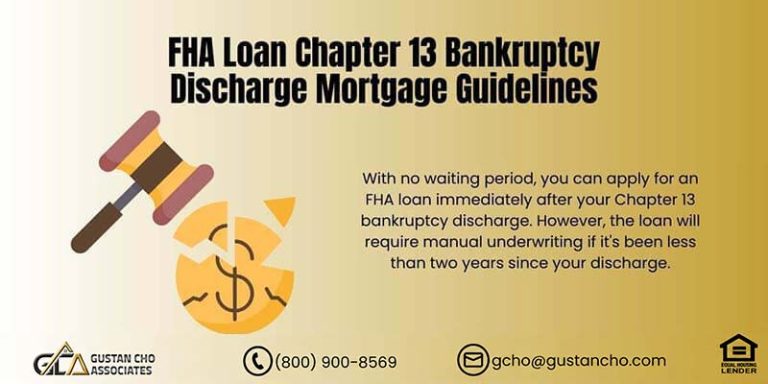
This guide covers mortgage guidelines on foreclosure and bankruptcy. If a mortgage loan borrower had a prior bankruptcy, there is a 2-year waiting period from the date of the bankruptcy discharge before a home buyer has to wait to qualify for FHA and VA Loans. If you have foreclosure but not bankruptcy, the following applies:
- There is a mandatory 3-year waiting period from the date of the sheriff’s sale
- or the date the deed of your house was transferred out of your name before a home buyer can qualify for FHA and USDA Loans
- The 3-year waiting period also applies for short sales and a deed in lieu of foreclosure as well.
This article presents the most current rules from HUD/FHA, Fannie Mae, Freddie Mac, VA, and USDA, drawing directly from the latest agency guidelines. For instance, Fannie Mae generally requires a seven-year waiting period after a foreclosure, which may be reduced to three years with documented extenuating circumstances.
Mortgage Guidelines on Foreclosure and Bankruptcy: How Long To Wait and How To Qualify Again
Mortgage regulations regarding foreclosure and bankruptcy are often complex, leading many prospective homebuyers to question their future mortgage eligibility. However, a history of bankruptcy or foreclosure does not necessarily preclude homeownership. Eligibility can be restored, but the required waiting period varies based on the type of bankruptcy, the specific loan program, documentation, and the extent of credit improvement. Each agency maintains distinct guidelines, resulting in different timelines for Conventional, FHA, VA, and USDA loans.
Can You Get a Mortgage After Bankruptcy or Foreclosure?
Individuals who have experienced Chapter 7 or Chapter 13 bankruptcy, foreclosure, a deed-in-lieu, or a short sale should recognize that qualifying for a new mortgage involves more than simply meeting the required waiting period.
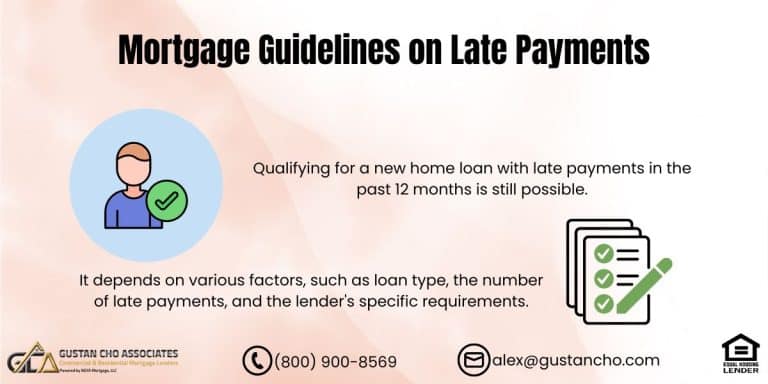
Lenders require evidence of financial recovery, including established credit history, no recent late payments, and stable income that meets current standards.
Fannie Mae seeks documentation of credit reestablishment following financial setbacks, while FHA, VA, and USDA emphasize positive credit reports, consistent on-time payments, and proof of renewed financial stability. This guide provides information for individuals seeking clarity on mortgage guidelines after foreclosure or bankruptcy, applicable waiting periods, and steps to requalify after Chapter 7 bankruptcy.
Lender’s Evaluation of Credit Post Major Derogatory Events.
What Mortgage Guidelines on Foreclosure and Bankruptcy inform lenders about the appropriate timing for loan applications following significant credit events? These guidelines specify the required waiting periods, necessary documentation, and the extent of financial recovery needed before you can reapply.
Bankruptcy is a legal way to get help with debt, while foreclosure means losing your home because you cannot make payments. Both are serious credit issues, but mortgage programs treat them differently.
Chapter 7 usually clears certain debts and often means a longer wait for a new loan than Chapter 13, which is a court plan to pay back debts. Foreclosure timelines can include completed foreclosures, giving the home back to the lender, or other ways of settling the debt. Each agency has its own rules and uses certain dates, like when the case is finished or closed, to decide when you can apply again.
Can You Get a Mortgage After Bankruptcy And Foreclosure?
Many individuals with a history of bankruptcy or foreclosure can qualify for a mortgage again. The primary considerations are the timing of eligibility and the most suitable loan program for the applicant’s circumstances. Government-backed loans typically offer greater flexibility after significant credit issues than conventional loans. Adhering to official program guidelines is essential for obtaining a mortgage after foreclosure or bankruptcy.
Even after fulfilling the required waiting period, additional lender-specific criteria, underwriter assessments, or automated systems may influence the approval outcome.
Applicants with lower credit scores or prior financial difficulties may find FHA, VA, or USDA loans more accessible due to less stringent requirements. In contrast, Fannie Mae and Freddie Mac generally impose longer waiting periods after foreclosure or Chapter 7 bankruptcy, subject to individual circumstances. For instance, individuals who have completed a Chapter 13 bankruptcy may become eligible sooner than those with a foreclosure and subsequent missed payments. Documented hardship can expand available options, whereas ongoing credit problems may limit them.
Guidelines for Conventional Loans After Bankruptcy and Foreclosure
For conventional loans, the standard waiting period is 7 years from the foreclosure completion date, or 3 years with documented extenuating circumstances. Dale Elenteny, a senior mortgage loan originator at Gustan Cho Associates says the following:
The waiting period is officially measured from the new loan’s disbursement date, although automated underwriting systems may reference the credit report date.
The waiting period after bankruptcy is usually shorter than after foreclosure, but both can take a while. Freddie Mac generally requires a 48-month (4-year) wait after most Chapter 7 and 11 bankruptcies, as well as after a foreclosure. If the foreclosure was caused by a Chapter 7 bankruptcy, there may be special rules. Some people with Chapter 13 bankruptcy may only need to wait 24 months (2 years), depending on whether their case is finished.
Chapter 7 Bankruptcy vs. Chapter 13 Bankruptcy
Longer waiting periods are the norm for Chapter 7 bankruptcies because debts are discharged. In contrast, Chapter 13 bankruptcies involve paying back debts through a court-approved plan. Required payments are often viewed more favorably, which can mean a shorter wait for some loans. But this is not guaranteed. Freddie Mac has different waiting times for Chapter 7 and 11 bankruptcies compared to Chapter 13.
Foreclosure or Bankruptcy? Find Out If You Can Qualify Now
Waiting periods and lender overlays vary by loan type. Share your dates and goals, and we’ll confirm what you qualify for today—and the fastest path to approval
What Are Extenuating Circumstances?
Fannie Mae lets you wait less time between a foreclosure and a new loan if you can prove there were real special circumstances. You must show in writing that the problem was not your fault, that it caused your credit trouble, and that you had no other way to avoid it. This rule is stricter than just having general financial difficulties. For borrowers with new, serious negative credit events, one primary loan option is the FHA.
HUD guidelines on FHA loans states that a Chapter 13 bankruptcy does not automatically disqualify the borrower, and the borrower-answer guidance published by HUD cites 4000.1 as the governing rule.
FHA rules say you can be considered for a loan only if you have made payments for at least 12 months during your Chapter 13 plan. You must have made these payments on time and have the court’s approval. Your full financial situation still matters, even if you have waited the required time for FHA or VA loans after a major credit problem. Just waiting out the required period is not enough to guarantee approval. Lenders will look closely at what you’ve done to rebuild your credit since your setback.
FHA Mortgage Guidelines on Foreclosure and Bankruptcy
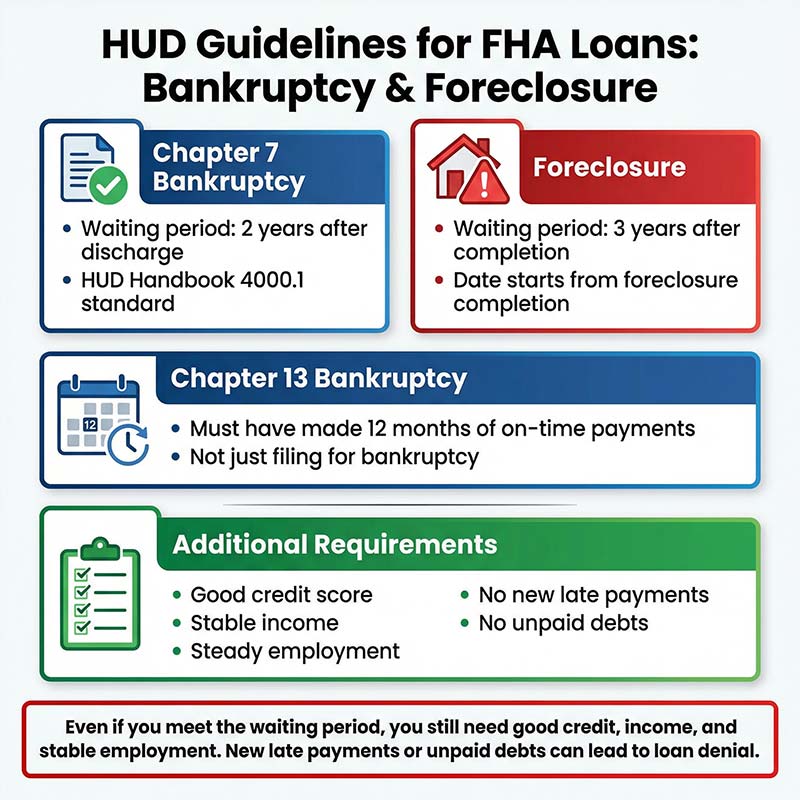
HUD guidelines are stricter about Chapter 7. The HUD Handbook 4000.1 sets the standard at 2 years after a Chapter 7 discharge and 3 years after a foreclosure for an FHA-insured mortgage. This is still true in the latest HUD Handbook 4000.1.
For FHA loans, it is important to know when your waiting period begins. For Chapter 13, you must have made payments for 12 months and paid on time, not just filed for bankruptcy.
For foreclosure, the waiting period starts from the date the foreclosure is completed. Make sure you know the correct dates so you do not apply too soon. Even if you meet the waiting period, you still need good credit, enough income, and a steady job. New late payments, unpaid debts, or unstable work can still lead to a loan denial.
Guidelines for VA Loans Following Bankruptcy and Foreclosure Events
For veterans and service members who qualify for VA loans, this option offers big benefits for buying a home again. VA rules require a 2-year wait after a Chapter 7 bankruptcy, 1 year after a Chapter 13 bankruptcy, and 2 years after a foreclosure. VA also helps people recover after losing a home. VA loans often let you buy a home sooner than other programs, but you still need to meet the lender’s income and credit requirements.
VA Loan Guidelines After Bankruptcy and Foreclosure
People who qualify for VA loans often have a better chance after financial problems, because VA loans are less strict than regular loans after foreclosure or Chapter 7 bankruptcy. Having better credit and a steady income helps you get approved for a VA loan.
If your Chapter 7 bankruptcy or foreclosure was finished more than 36 months ago, it is not counted as a major credit problem.
VA typically applies the 2-year rule after Chapter 7, the 1-year rule after Chapter 13, and the 2-year rule after foreclosure. USDA typically applies the 36-month rule, after which Chapter 7 discharge, foreclosure, deed-in-lieu, and short sale are no longer considered adverse credit per the cited handbook.
Guidelines for USDA Mortgages Following Foreclosures and Bankruptcies
USDA follows a similar rule for giving the home back to the lender or for short sales. If you finished Chapter 11, 12, or 13 bankruptcy less than 12 months ago, USDA may require special approval depending on your situation.
For eligible buyers in certain areas, these programs can help you become a homeowner again. If you have had a major credit event, rebuilding your credit is essential.
Fannie Mae requires this, and USDA separates easy approvals from those that need a closer review. Making payments on time, managing your debt, and showing good credit habits will improve your chances. Even if the waiting period is over, recent credit problems can still make it harder to get approved.
Importance of Automated Approvals and Manual Underwriting
Both computer systems and people review your application to determine whether you qualify for a loan, based on set rules. The USDA handbook separates easy approvals from those that need a closer look or special permission. Lenders usually follow these rules when deciding if you are a risk.
Common Mortgage Lending Industry Standards For The Waiting/Review Period Of Loan Submissions
National mortgage groups set waiting periods before you can apply for a new loan. Regular loans are usually the strictest. For example, Fannie Mae requires 7 years without a foreclosure and 7 years after bankruptcy. Freddie Mac usually requires 4 years with no bankruptcies or foreclosures. Some loans let you apply 3 years after a foreclosure or 12 months after finishing Chapter 13 bankruptcy, as long as you have the needed approvals and no extra unpaid debts from the bankruptcy.
Measuring Waiting Periods.
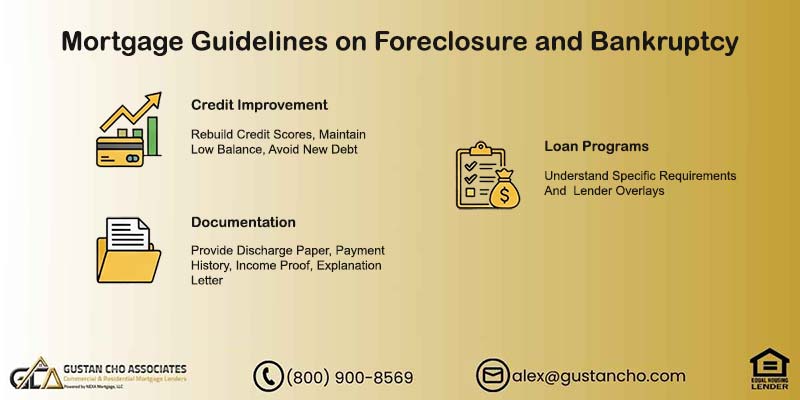
These waiting periods serve as initial benchmarks, but comprehensive underwriting remains critical. Lender-specific criteria, credit scores, and property type can all influence the final decision. Proactive measures such as timely bill payments, minimizing new debt, regularly reviewing credit reports for errors, maintaining stable employment and income, and saving funds demonstrate financial recovery to lenders.
The Impact of Credit Re-Establishment on Mortgage Approvals

Borrowers should know that the credit report date is important. Fannie Mae allows automated underwriting to use this date to check if you meet the waiting period, even though the disbursement date is the official rule. Reporting errors can cause problems. One mistake is thinking all loan programs use the same waiting period—they do not.
Another common mistake is failing to determine which loan program best fits your timeline. You might not qualify for a conventional loan yet, but FHA, VA, or USDA could be available much sooner.
Another mistake is focusing only on the bankruptcy discharge or foreclosure date without checking if the credit report shows the event correctly. A third mistake is applying too early without proof that you have re-established credit. A fourth is ignoring recent late payments, high balances, or unstable income because you think the old event is the only thing that matters. Choosing the right program can make the difference between approval and rejection.
Mistakes Borrowers Make After Foreclosures and Bankruptcies
Mortgage guidelines on foreclosure and bankruptcy might seem overwhelming, but they become much clearer when you look at each loan type separately. Having a foreclosure or bankruptcy in your past does not mean you can never own a home again. What matters most are the details: when the event happened, how you have recovered, and what you can document.
FHA, VA, and USDA loans often offer more flexible options.The best approach is to align your recovery timeline and credit progress with the right loan program, rather than assuming all lenders follow the same rules.
It depends on the loan program. Fannie Mae generally requires 7 years after foreclosure, though a 3-year exception may apply with documented extenuating circumstances. FHA generally uses 3 years, VA commonly uses 2 years, and USDA generally treats a foreclosure discharged 36 months prior as not adverse credit in its handbook framework.
Steps to Qualify for a Home Loan Post Bankruptcies/Foreclosures
FHA typically mandates a two-year wait following a Chapter 7 bankruptcy and a three-year wait after a foreclosure. VA guidelines require a two-year waiting period after Chapter 7 bankruptcy or foreclosure, while some individuals with Chapter 13 bankruptcy may qualify after twelve months of timely payments. USDA does not consider a Chapter 7 bankruptcy or foreclosure completed more than 36 months ago to be a major credit issue. In this article, we will cover and discuss mortgage guidelines on foreclosure and bankruptcy.
Having a Foreclosure and Bankruptcy in Mortgage Qualification
What if you had a foreclosure and bankruptcy at the same time? If you had a foreclosure and bankruptcy at the same time and your foreclosure was part of personal bankruptcy, the 3-year waiting period will apply.
Unfortunately, I get many calls from potential home buyers who think they are able to qualify for a home loan who had a foreclosure and bankruptcy 2 years prior.
Unfortunately, these potential homeowners get the bad news that they need to wait an extra year. Gustan Cho Associates NMLS 873293 offers non-QM loans. There are no waiting period requirements after bankruptcy and/or foreclosure with non-QM loans.
Qualify For Mortgage Even You Had Foreclosure and Bankruptcy
Apply Online And Get recommendations From Loan Experts
Home Loan After Foreclosure and Bankruptcy in Mortgage Qualification
Gustan Cho Associates specializes in helping borrowers with prior bad credit. We also help borrowers with high debt-to-income ratios. There is nothing anyone can do to exempt waiting period guidelines on government and/or conventional loans. However, Gustan Cho Associates Mortgage Group can help home buyers qualify for mortgages with no waiting period after bankruptcy and/or foreclosure with our non-QM loans.
- Borrowers with open collections, unsatisfied judgments, credit scores as low as 500, short-term on the job, or are self-employed can qualify for home loans
- However, under FHA Mortgage Guidelines On Foreclosure And Bankruptcy borrowers who has a foreclosure and/or bankruptcy at the same time, there is a three-year waiting period after the recorded date of the foreclosure to qualify for FHA Loans
- Under Fannie Mae and Freddie Mac Mortgage Guidelines On Foreclosure And Bankruptcy, borrowers with mortgage part of Chapter 7 bankruptcy can qualify for conventional loans four years from the discharged date of Chapter 7.
The foreclosure can be recorded after the discharged date of Chapter 7 bankruptcy. Understand how to qualify for a home loan again, waiting periods by loan type, and mortgage guidelines on bankruptcy and foreclosure.
Rebuilding Credit After Foreclosure And Bankruptcy In Mortgage Qualification
Mortgage Guidelines On Foreclosure And Bankruptcy on government and conventional loans have a mandatory waiting period. However, with NON-QM Loans, there are no waiting periods to qualify for a mortgage after bankruptcy and/or foreclosure. There are no maximum loan limits with non-QM loans. There is no private mortgage insurance required.
Down payment requirements are 5% to 20%. The amount of the down payment depends on the borrower’s credit scores. Mortgage rates depend on down payment and credit scores.
Gustan Cho Associates has 5% down payment NON-QM Jumbo Loans with no mortgage insurance requirement. Even though mortgage applicants have waiting period requirements on government loans, they should consult with a loan officer if they qualify for non-QM loans. Loan officers can advise borrowers on how to rebuild credit and some will assist and advise on how to improve credit scores
Frequently Asked Questions (FAQs) on Mortgage Guidelines on Foreclosure and Bankruptcy
Can I Qualify For A Mortgage After Foreclosure?
- Yes, but most loan programs require a waiting period of 2–7 years, depending on the loan type and circumstances.
How Long Is The Waiting Period After Foreclosure For FHA Loans?
- FHA loans typically require a 3-year waiting period from the foreclosure completion date.
Can I Get A Mortgage After Bankruptcy?
- Yes, depending on loan type and whether the bankruptcy was Chapter 7 or Chapter 13, you can qualify after a waiting period.
What Is The Waiting Period For A Conventional Loan After Foreclosure?
- A conventional loan usually requires a 7-year waiting period after foreclosure, which can be reduced to 3 years with extenuating circumstances.
What Are The Guidelines For FHA Loans After Chapter 7 Bankruptcy?
- FHA loans require a 2-year waiting period from the bankruptcy discharge date, provided the borrower has re-established good credit.
How Soon Can I Get A VA Loan After Bankruptcy Or Foreclosure?
- VA loans generally require a 2-year waiting period after bankruptcy or foreclosure, with certain exceptions for extenuating circumstances.
Does Chapter 13 Bankruptcy Affect Mortgage Eligibility?
- Yes, but FHA and VA loans allow borrowers to qualify in Chapter 13, provided they have made on-time payments for at least 12 months with court approval.
Are There Exceptions For Extenuating Circumstances?
- Many programs reduce waiting periods if the foreclosure or bankruptcy was caused by factors beyond your control, such as a medical crisis or job loss.
Can I Qualify For A Non-QM Loan After Bankruptcy Or Foreclosure?
- Yes, non-QM loans often have no waiting periods, focusing instead on recent financial stability and alternative documentation.
How Does Foreclosure Or Bankruptcy Impact Credit Scores?
- Both can significantly lower your credit score by 100-200 points.
- Still, scores can recover with consistent, on-time payments over time.
How Long After A Chapter 7 Bankruptcy Can I Buy A House?
- Again, it depends on the program. FHA generally uses 2 years after a Chapter 7 discharge.
- VA commonly uses 2 years. USDA generally treats a Chapter 7 discharge more than 36 months prior as not adverse credit.
- Conventional loans often require longer recovery periods depending on whether the loan follows Fannie Mae or Freddie Mac standards.
Can I Get A Mortgage While In Chapter 13 Bankruptcy?
- Sometimes, yes. FHA guidance says Chapter 13 does not automatically disqualify a borrower and may allow eligibility after 12 months have elapsed from the payout period, provided payment performance and approvals are satisfactory.
- VA commonly cites 1 year for Chapter 13. USDA guidance also discusses Chapter 11, 12, and 13 cases with closer review depending on completion status and underwriting recommendation.
Is Foreclosure Worse Than Bankruptcy For Mortgage Approval?
- Often, yes, for conventional lending.
- Fannie Mae’s standard foreclosure waiting period is generally longer than many bankruptcy waiting periods.
- In practical underwriting, both are major derogatory events, but foreclosure can be more restrictive depending on the program and timeline.
What Helps Me Qualify Again After Bankruptcy Or Foreclosure?
- The biggest factors are time since the event, re-established credit, no new major derogatory items, stable income, manageable debt, and accurate reporting of the event date on the credit report.
- Fannie Mae expressly requires re-established credit after significant derogatory credit events.
Do All Lenders Follow The Same Mortgage Guidelines On Foreclosure And Bankruptcy?
- No.
- The base rules depend on the loan program, and some lenders may add overlays or apply stricter underwriting.
- That is why one lender may decline a file while another lender using a different program or credit interpretation may approve it.
- Agency standards provide the framework, but lender execution can still vary.
Borrowers who need more information on Mortgage Guidelines on Foreclosure and Bankruptcy or need to qualify for a mortgage, please contact us at 1-800-900-8569 or text us for a faster response. Or email us at gcho@gustancho.com. We are available 7 days a week, evenings, weekends, and holidays.
Get Your “Back to Homeownership” Timeline
We’ll map your options for FHA, VA, USDA, Conventional, and Non-QM based on your foreclosure/bankruptcy dates so you know exactly what’s next