Mortgage approval conditions can feel frustrating because they usually show up when you are already close to the finish line. The underwriter has reviewed your file and sees a possible approval, but there are still items that must be cleared before the lender can issue a clear-to-close.
These conditions may be simple, such as updated pay stubs, bank statements, proof of homeowners’ insurance, or a letter of explanation. Others may take more time, such as appraisal repairs, title issues, employment verification, large deposit documentation, or loan program requirements.
A conditional approval does not mean your mortgage is finished. It means the loan is moving forward, but the lender still needs proof that your income, assets, credit, property, and loan program meet the guidelines. The faster you send complete documents and avoid new financial changes, the better your chances of moving from conditional approval to final approval and clear to close.
What Are Mortgage Approval Conditions?

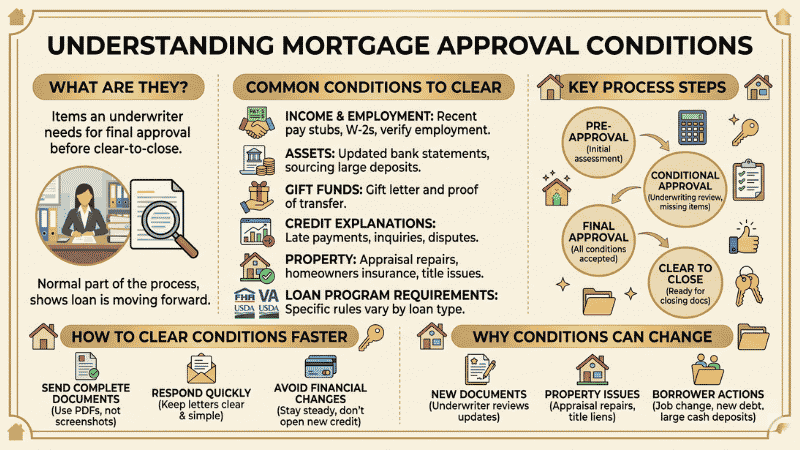
Mortgage approval conditions are items the underwriter needs before your loan can receive final approval and be cleared to close. A conditional loan approval means the lender has reviewed your file, but certain documents, explanations, or verifications are still required.
Pay stubs must be recent, and bank statements must match the dates. Employment is now checked through official sources. Homeowners’ insurance comes before closing day. Credit questions arrive by mail sometimes.
Big deposits? They require written details. Gift money requires proof that it does not have to be repaid. Appraisals might flag new concerns weeks later. Title checks uncover old liens or errors. Tax records may miss filings or show mismatches. Rent history shows payment patterns – unless living free with family. Some lenders ask for confirmation either way.
Borrowers might hand over documents showing a past bankruptcy, a home repossession, a discounted payoff, or a court-ordered repayment plan. With these on file, lenders check whether everything – how much money comes in, what’s owned, property details, credit record, and chosen loan type – lines up with approval rules. Only after each item gets a green light does the go-ahead for funding come through.
Conditional Approval vs. Final Approval vs. Clear to Close
Most times, getting a conditional thumbs-up on a loan feels promising – yet the deal isn’t sealed. The person checking your paperwork sees potential, though some hurdles still need to be stepped over before everything locks in.
A pre-approval is the first step in the process. It looks at your credit, income, assets, and debts to give a quick idea of what you can borrow. Conditional approval happens after underwriting reviews the full loan file. Final approval happens after the underwriter accepts all required conditions. Clear to close is the next major step, meaning the lender is ready to prepare the closing documents.
Borrowers should not assume the loan is finished after conditional approval. The loan can still be delayed or denied if conditions are not met, documents do not support the file, or new issues appear before closing.
Common Mortgage Approval Conditions Borrowers May Need To Clear
Mortgage approval conditions can vary by loan file. Some borrowers only need a few updated documents. Others may need to explain credit issues, document large deposits, or fix property-related concerns.
Common mortgage conditions may include:
- Income and employment documents. The underwriter may request updated pay stubs, W-2s, tax returns, or verification of employment.
- Bank statements and asset documents. You may need updated bank statements, proof of earnest money, explanations for large deposits, or proof of down payment funds.
- Gift fund documents. If someone is helping with the down payment, the lender may require a gift letter and proof that the funds were transferred.
- Credit explanations. The lender may ask about late payments, collections, bankruptcies, foreclosures, credit disputes, or recent credit inquiries.
- Property conditions. These may include appraisal repairs, homeowners’ insurance, flood insurance, title corrections, or payoff information for liens.
- Loan program requirements. FHA, VA, USDA, conventional, and manual underwriting files may have different conditions. Some files may need rent history, Chapter 13 trustee approval, bankruptcy papers, or self-employment documents.
Most mortgage approval conditions are normal. They do not always mean the loan is in trouble. They usually mean the underwriter needs more proof before issuing a clear-to-close.
Mortgage Approval Conditions—Know What They Mean Before Clear to Close
Conditions are normal, but they must be cleared the right way. Get a simple breakdown of what your lender is asking for and how to respond so your closing stays on track.Income, Employment, Asset, Credit, and Property Conditions
Most mortgage approval conditions fall into five main categories: income, employment, assets, credit, and the property itself. Understanding which category a condition falls into can help you respond faster and avoid delays.
Income Conditions
Income verification helps the lender verify that you earn enough to qualify for the mortgage. Common requests include:
- Updated pay stubs
- W-2 forms
- Tax returns
- Year-to-date earnings
- Profit and loss statements for self-employed borrowers
- Documentation for overtime, bonuses, commissions, or other variable income
The underwriter wants to make sure the income used to approve the loan is accurate, stable, and properly documented.
Employment Conditions
Lenders must verify that your employment is current before closing. Common employment conditions include:
- Written verification of employment
- Explanations for employment gaps
- Documentation for a recent job change
- Proof of a new position before starting work
Many lenders also perform a final employment verification shortly before closing.
Asset Conditions
Asset conditions focus on your down payment, closing costs, and cash reserves. Common requests include:
- Updated bank statements
- Large deposit explanations
- Proof of earnest money
- Gift fund documentation
- Retirement or investment account statements
The lender must be able to trace the source of the funds and confirm that they meet program guidelines.
Credit Conditions
Credit conditions often involve questions about items appearing on your credit report. Common examples include:
- Letters explaining late payments
- Collection account documentation
- Bankruptcy paperwork
- Foreclosure or short sale documents
- Credit dispute explanations
- Documentation for recent credit inquiries
These conditions help the underwriter understand the borrower’s credit history and determine whether additional documentation is needed.
Property Conditions
Property conditions are tied to the home being financed. Common property-related conditions include:
- Appraisal repairs
- Homeowners insurance documentation
- Flood insurance requirements
- Title issues
- Payoff information for liens
- Condominium or HOA documentation
Even if the borrower qualifies financially, the property must also meet lender and loan program requirements before the loan can receive final approval.
Most mortgage approval conditions are routine and can be cleared quickly when documents are provided promptly and completely.
Why Conditions Can Change Before Closing
Mortgage approval conditions can change before closing because the lender continues to verify the loan file until the clear-to-close is issued. A conditional approval means the loan has passed an important review, but it is not final approval.
New conditions can appear when updated documents are reviewed. For example, a new bank statement may show a large deposit, a new pay stub may show fewer hours, or a credit refresh may show a new account or higher balance. Even small changes can raise new questions for the underwriter.
Property issues can also create new conditions. An appraisal may call for repairs. A title search may find an old lien. Homeowners’ insurance may come in higher than expected and affect the borrower’s debt-to-income ratio. Flood insurance may be required after the property is reviewed.
Some conditions change because the borrower makes a financial move during the loan process. Opening new credit, financing furniture, changing jobs, moving money between accounts, or depositing undocumented cash can all create new underwriting questions.
This is why borrowers should keep their finances steady until closing. Do not make major changes unless your loan officer says it is safe to do so. The goal is to keep the file as clean and stable as possible until the lender issues the clear-to-close.
How to Clear Mortgage Approval Conditions Faster
The fastest way to clear mortgage approval conditions is to send complete documents the first time they are requested. Use full PDF bank statements, pay stubs, tax documents, and insurance binders instead of screenshots or partial pages. If the underwriter asks for a letter of explanation, respond quickly and keep the explanation clear, simple, and consistent with your documents.
Avoid making financial changes while your loan is under review. Do not deposit undocumented cash, open new credit, change jobs, move money between accounts without a paper trail, or make large purchases before speaking with your loan officer. These actions can create new conditions and delay your clear-to-close.
Borrowers should also ask their loan officer before paying off collections, disputing accounts, or removing disputes from credit reports. What seems helpful may hurt your approval if it changes your credit score, debt-to-income ratio, or automated underwriting findings. The goal is to keep your file stable until the underwriter clears all conditions and issues a clear-to-close.
What Not To Do While Conditions Are Pending
Once your mortgage has a conditional approval, the safest move is to keep your finances steady. The underwriter is still reviewing your file, and any new activity can create new conditions or delay your clear-to-close.
- Avoid opening new credit cards, financing furniture, buying a car, or co-signing for anyone before closing. New debt can change your credit score, monthly payments, and debt-to-income ratio.
- Do not make large cash deposits without talking to your loan officer first. Lenders need to document the source of your money. Cash deposits can be hard to prove and may not be usable for your down payment or closing costs.
- Do not move money between accounts unless there is a clear paper trail. If you transfer funds, keep records showing where the money came from and where it went.
- Do not change jobs, quit your job, or switch from W-2 income to self-employment without checking with your lender. Employment changes can affect income approval, even if the new job pays more.
- Do not ignore requests from your loan officer or processor. Missing pages, screenshots, blurry documents, and late responses can slow down the file.
- Do not pay off collections, close accounts, dispute credit items, or remove disputes unless your lender tells you to. These changes can affect your credit report or automated underwriting findings.
The goal is simple: avoid anything that makes the underwriter ask more questions. Keep your credit, income, bank accounts, and employment as stable as possible until the loan closes.
What Happens If Conditions Are Not Cleared?
If mortgage approval conditions are not cleared, the loan may be delayed, suspended, or denied. A conditional approval is not the same as final approval. The underwriter still needs to confirm that the borrower, the property, and the loan program all meet the lender’s requirements.
Some conditions are easy to fix. For example, the lender may need an updated pay stub, a full bank statement, proof of homeowners’ insurance, or a simple letter of explanation. Once the borrower submits the correct document, the file can usually proceed.
Other conditions are more serious. The loan may run into problems if income cannot be verified, funds cannot be sourced, the appraisal does not support the value, title issues cannot be cleared, or new debt pushes the borrower over the allowed debt-to-income ratio.
If a condition cannot be cleared, the lender may ask for another solution. This could mean adding more documentation, paying down debt, changing the loan structure, switching loan programs, or getting a second review from another lender.
Borrowers should not ignore mortgage approval conditions or assume they are optional. Every condition must be reviewed and accepted before the lender can issue the clear-to-close. The faster the borrower responds with complete and accurate documents, the better the chance of keeping the loan on track.
Special Cases That Can Add More Conditions
Some mortgage files need extra review because the borrower, property, or loan program has more moving parts. This does not always mean the loan is in trouble. It usually means the underwriter needs more proof before giving final approval.
Chapter 13 bankruptcy is one example. The lender may need payment history from the trustee, court approval, bankruptcy schedules, discharge papers, or a letter explaining the cause of the bankruptcy. If the loan is manually underwritten, rent history may also be reviewed.
Past credit problems can also add conditions. Borrowers with a bankruptcy, foreclosure, short sale, deed in lieu, collections, charge-offs, or recent late payments may need to provide letters of explanation and supporting documents. The underwriter wants to see what happened, when it happened, and whether the borrower has recovered.
Self-employed borrowers often receive more income conditions than W-2 borrowers. The lender may request personal and business tax returns, year-to-date profit-and-loss statements, business bank statements, CPA letters, or proof that the business is still operating.
Manual underwriting files may also require more documentation. This can include verification of rent, explanations of payment shock, reserves, compensating factors, or additional letters explaining the borrower’s overall financial picture.
VA, FHA, USDA, conventional, and non-QM loans can each have different conditions. VA loans may involve questions about residual income or a Certificate of Eligibility. FHA loans may require closer review of credit, collections, or property repairs. USDA loans may need income and property eligibility checks. Conventional loans may place greater emphasis on automated underwriting findings, reserves, mortgage insurance, or condo project details.
The more unusual the file is, the more important clean documentation becomes. Borrowers can help by sending complete documents, answering questions promptly, and avoiding any new financial changes while the file is under review.
Why One Lender May Clear Conditions and Another May Deny
Lender overlays can make mortgage approval conditions harder to clear. An overlay is an extra rule added by a lender on top of FHA, VA, USDA, Fannie Mae, or Freddie Mac guidelines.
Some borrowers are denied because of lender overlays, not because the loan program automatically prohibits the loan. For example, one lender may require stricter credit score requirements, lower debt-to-income ratios, higher reserves, or additional rent verification, while another lender may follow the agency’s guidelines more closely.
This matters during conditional approval because the same borrower may have different outcomes depending on the lender. Working with a lender that understands agency guidelines and has fewer overlays can help borrowers clear conditions, avoid unnecessary denials, and move closer to clear-to-close.
Final Thoughts on Mortgage Approval Conditions
Mortgage approval conditions are a normal part of the loan process. They do not always mean something is wrong with your file. Most of the time, the underwriter needs updated documents, clearer proof, or one more explanation before the loan can move forward.
The important thing is to respond quickly and send complete documents the first time. Avoid opening new credit, changing jobs, moving money without a paper trail, or making large purchases while your file is still under review.
Conditional approval is a good step, but the loan is not finalized until all conditions are met and the lender issues the clear-to-close. Stay in touch with your loan officer, keep your finances steady, and take each request seriously until the loan closes.
FAQs About Mortgage Approval Conditions
How Long Does it Take to Clear Mortgage Conditions?
Some mortgage conditions can be cleared the same day if the borrower submits the required documents promptly. Other conditions may take several days, especially if they involve an appraisal, title issue, insurance update, employment verification, or outside third party. The cleaner the documents are, the faster the file can move forward.
Does Conditional Approval Mean I am Approved for the Mortgage?
Conditional approval means the lender has looked over your stuff and thinks there’s a way to get you approved, but the loan isn’t finalized yet. You still need to clear the remaining conditions before the lender can issue final approval and clear to close.
Can Underwriting Conditions Delay Closing?
Yes, underwriting conditions can delay closing if documents are missing, incomplete, outdated, or do not support the loan file. Delays can also occur if a condition involves the appraisal, the title company, the employer, the insurance agent, or another outside party.
Can I Get a Closing Disclosure Before All Conditions are Cleared?
Yes, in some cases, a lender may issue the Closing Disclosure before all conditions are fully cleared. However, receiving the Closing Disclosure does not always mean the loan is ready to close. The lender still needs final approval and clear to close before signing can happen.
What are Prior-to-Doc Conditions?
Prior-to-doc conditions are items that must be cleared before the lender can prepare closing documents. These are usually important items tied to income, assets, credit, title, appraisal, or loan approval. The lender will not move the file to the closing documents until these conditions are accepted.
What are Prior-to-Funding Conditions?
Before funding, conditions must be cleared before the lender releases the loan funds. These may include final employment verification, signed closing documents, updated insurance proof, funding numbers, or last-minute title items.
Can My Loan be Denied After Clear to Close?
It is uncommon, but a loan can still run into problems after clear to close if something major changes before funding. Examples include job loss, new debt, fraud concerns, title problems, or a major change in credit. Borrowers should keep their finances stable until the loan is fully closed and funded.
Should I Send Screenshots to Clear Mortgage Conditions?
Screenshots are usually not the best way to clear mortgage conditions. Lenders often need full PDF statements, complete documents, all pages, and clear records that show names, dates, account numbers, and transaction details. Sending complete documents the first time can help avoid repeat requests.
This article about “Mortgage Approval Conditions: What They Mean Before CTC” was updated on June 17th, 2026.