Learning how to move out of your parents’ house starts with deciding whether you can comfortably support yourself. You may be ready if you have a stable income, a realistic housing budget, and enough money for upfront costs without draining your savings. Estimate your rent or mortgage payment, utilities, insurance, food, transportation, debt payments, and other monthly expenses.
You should also maintain an emergency fund after paying your security deposit and moving expenses, or your down payment and closing costs. Whether you plan to rent or buy, choose a monthly payment you can manage without relying on credit cards or family assistance.
How Much Money Should You Save Before Moving Out?
Learning how to move out of your parents’ house requires more than saving for the first rent or mortgage payment. Your target should reflect local housing costs, moving expenses, existing debts, and the amount of emergency savings you will have left afterward.
Use this formula: Savings needed = total upfront housing costs + moving and setup costs + emergency fund
Upfront Expenses for Renters
Renters should estimate the following costs based on actual prices in their area:
- Rental application and screening fees
- Security deposit
- First month’s rent and, when required, last month’s rent
- Utility connection fees or deposits
- Renters insurance
- Moving expenses
- Essential furniture and household supplies
- Pet deposits or parking fees, if applicable
Ask each landlord or property manager for a complete list of charges before applying. Rental requirements and deposit limits can vary by location and property.
Renter savings formula: Required lease payments and deposits + moving costs + setup expenses + emergency fund
Upfront Expenses for Homebuyers
Homebuyers generally need more than a down payment. Their savings estimate should include:
- Down payment
- Closing costs
- Prepaid property taxes and homeowners insurance
- Initial escrow deposits, when required
- Home inspection and other due diligence expenses
- Moving and utility setup costs
- Immediate repairs or essential purchases
- Cash reserves remaining after closing
Some eligible buyers may receive seller concessions, lender credits, gift funds, or down payment assistance. However, do not build your budget around assistance until a lender and applicable program have confirmed it.
Homebuyer savings formula: Down payment + estimated closing and prepaid costs + inspections + moving and setup costs + immediate repairs + emergency fund
Request a personalized estimate from a licensed loan officer because the amount needed can vary by loan program, property, location, taxes, insurance, and negotiated contract terms.
How Much Emergency Savings Should Remain?
Your emergency fund should remain available after paying all moving, rental, or homebuying expenses. Start by calculating the monthly cost of essentials:
Housing + utilities + insurance + food + transportation + healthcare + minimum debt payments = essential monthly expenses
Then use:
Essential monthly expenses × number of months you want covered = emergency-fund target
Many people plan for several months of essential expenses, but the appropriate amount depends on income stability, household size, health needs, property condition, available family support, and whether they rent or own. Someone with irregular income or sole responsibility for a home may need a larger cushion than someone with a stable income and shared expenses.
Build a Realistic Monthly Budget Before Leaving Home
Knowing how to move out of your parents’ house starts with understanding what independent living will cost every month. Build your budget using actual local prices instead of estimates based on what friends pay. Your budget should cover routine bills, irregular expenses, savings, and unexpected costs without requiring you to rely on credit cards or family assistance.
Housing, Utilities, and Insurance
Housing is more than rent or a mortgage payment. Depending on where and how you live, your monthly housing budget may include:
- Rent or principal and interest
- Property taxes and homeowners insurance
- Mortgage insurance, when applicable
- Renters insurance
- Electricity, gas, and water
- Internet and phone service
- HOA fees, parking, or pet charges
- Home maintenance and repairs
Ask landlords about which utilities are included in the rent. Prospective homebuyers should estimate the total monthly housing payment—not simply the loan’s principal and interest.
Transportation, Food, Debt, and Personal Expenses
Next, calculate your other essential and discretionary expenses. Include:
- Car payments, fuel, insurance, and maintenance
- Public transportation or rideshare costs
- Groceries and occasional dining out
- Credit cards, student loans, and other debts
- Healthcare, prescriptions, and personal care
- Clothing, entertainment, and subscriptions
- Savings and retirement contributions
- Household supplies and unexpected expenses
Review several months of bank and credit-card statements to identify what you actually spend. Do not remove expenses from your budget simply because you hope to spend less after moving.
Use this formula: Monthly income after taxes − housing costs − other expenses − savings = monthly financial cushion
A positive balance is helpful, but it should be large enough to cover higher utility bills, car repairs, medical expenses, and other unexpected expenses.
Test Your Budget Before Moving
Before signing a lease or purchasing a home, practice living with your expected housing costs for several months. Calculate what your future rent or total mortgage payment may be, including utilities and insurance. Subtract any amount you currently contribute toward housing, then transfer the difference into savings each month.
For example, if your future housing expenses are expected to be $1,800 per month and you currently pay your parents $500, transfer the remaining $1,300 into savings. Continue paying your normal bills without using the transferred money.
This trial period can help you determine whether the future payment is comfortable while also building funds for moving costs and emergencies. If you repeatedly need to withdraw the money, adjust your housing target, reduce other expenses, or delay the move until your income and savings are stronger.
Should You Rent or Buy Your First Place?
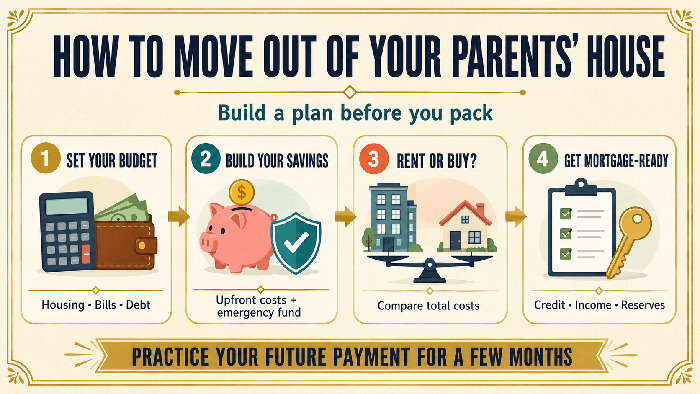
Learning how to move out of your parents’ house includes deciding whether renting or buying is a better fit for your current finances and plans. Neither choice is automatically better. Renting may provide flexibility and fewer repair responsibilities, while buying may offer greater housing stability and the opportunity to build equity. The right decision depends on your income, savings, credit, expected time in the area, and ability to handle unexpected costs.
When Renting May Be the Safer Choice
Renting may make more sense if:
- Your income or employment is not yet stable.
- You may move for work, school, or personal reasons.
- Buying would use most of your savings.
- You are still improving your credit or reducing debt.
- You are unfamiliar with the neighborhood.
- You do not want responsibility for major repairs.
- The total cost of owning is significantly higher than comparable rent.
A lease can give you time to learn what you want in a future home while building savings and improving your financial profile. However, review the lease carefully for renewal terms, rent increases, maintenance responsibilities, pet charges, parking fees, and early-termination penalties.
When Buying May Make Sense
Buying may be worth considering when you have a reliable income, manageable debts, sufficient savings, and expect to remain in the home long enough to justify the upfront and future selling costs.
You should be comfortable with the full monthly housing expense, including principal, interest, property taxes, homeowners’ insurance, mortgage insurance (when applicable), HOA dues, utilities, maintenance, and repairs. Qualifying for a mortgage does not necessarily mean the maximum approved payment is affordable for your lifestyle.
Buying may make sense when:
- You expect to remain in the area for several years.
- Your income is stable and well-documented.
- You can pay the upfront costs without draining your emergency fund.
- The total monthly payment fits comfortably within your budget.
- You are prepared to maintain the property.
- You understand that property values can rise or fall.
Homeownership can help you build equity as your loan balance lowers, but equity growth isn’t guaranteed. Market conditions, maintenance costs, financing expenses, and the future sale price all affect the financial outcome.
Costs That Rent-versus-Buy Calculators May Miss
Online calculators are helpful, but their accuracy relies on the assumptions you input. Some comparisons may not fully account for:
- Rent increases or lease-renewal fees
- Security and pet deposits
- Renters or homeowners insurance changes
- Property-tax increases
- HOA dues and special assessments
- Mortgage insurance
- Routine maintenance and major repairs
- Utility differences between an apartment and a house
- Lawn care, pest control, appliances, and household equipment
- Closing costs when buying
- Real estate commissions and other expenses when selling
- The return on your down payment might earn if invested elsewhere
- The possibility that the home’s value may decline
- The flexibility provided by renting
Compare the total cost of renting with the total cost of owning, not simply rent versus principal and interest. Also consider how much cash you would have left after moving. If buying would leave you unable to handle a repair, income interruption, or medical expense, renting may be the safer choice for now.
Can You Buy a Home While Living With Your Parents?
Yes, you may qualify to buy a home while living with your parents. A borrower does not need to rent an apartment or own a home before applying for a mortgage. However, living rent-free may affect how an underwriter evaluates housing-payment history, savings habits, and the increase from the current housing expense to the proposed mortgage payment.
When learning how to move out of your parents’ house, speak with a loan officer before assuming that the lack of rental history will prevent approval. Treatment varies by loan program, automated underwriting findings, manual underwriting requirements, and lender overlays.
Does Living Rent-Free Affect Mortgage Approval?
Living rent-free is not an automatic reason for mortgage denial. A lender may request a signed letter from a parent or homeowner confirming that you reside at the address and do not pay rent. If you contribute toward household expenses, tell the lender exactly what you pay and how you pay it.
An automated underwriting system may evaluate the application based on the borrower’s complete credit, income, debt, asset, and property profile. If the loan requires manual underwriting, the underwriter may examine the lack of housing-payment history more closely. FHA guidance, for example, requires manually underwritten files to evaluate housing obligations and other payment history in a specified order.
Do not create a lease, claim rent payments that were never made, or begin transferring money to a parent merely to produce a payment history. All information provided on a mortgage application must be complete and accurate.
How Lenders Review Credit, Income, and Debt
The lender will review whether you appear able and willing to make the proposed mortgage payment. This normally includes:
- Credit scores and the depth of your credit history
- Payment history on credit cards, auto loans, student loans, and other accounts
- Late payments, collections, judgments, bankruptcies, or foreclosures
- Employment history and income expected to continue
- Monthly debt obligations
- Funds needed for the down payment and closing
- Cash reserves remaining after closing
- The proposed total housing payment
The total housing payment may include principal, interest, property taxes, homeowners’ insurance, mortgage insurance, and HOA dues. The lender includes this payment with other qualifying debts when calculating the debt-to-income ratio.
A strong credit history, stable income, manageable debts, and consistent savings can help support the application. However, no single strength guarantees approval because the lender must review the entire file under the applicable program.
Documenting Savings and Gift Funds
Living with your parents may allow you to build savings for a down payment, closing costs, moving expenses, and emergencies. Lenders may verify these funds through bank statements, investment statements, or an approved electronic asset-verification service.
Avoid unexplained cash deposits or repeated transfers between accounts before applying. The lender may need to identify the source of large or unusual deposits. Keep records of transfers, deposited checks, asset sales, bonuses, and other funds that may be used for the transaction.
Parents and other eligible donors may be allowed to provide gift funds, depending on the loan program and transaction. A lender commonly requires:
- A gift letter identifying the donor and the amount
- A statement that repayment is not expected
- Evidence that the donor had the funds
- Documentation showing the transfer to the borrower or closing agent
Gift funds must be disclosed as gifts rather than informal family loans. A loan creates a repayment obligation that may need to be included in the borrower’s debt calculation. Gift eligibility, acceptable donors, documentation, and borrower-contribution rules vary by mortgage program. For example, Fannie Mae permits qualifying gift funds from acceptable donors for eligible principal-residence transactions, but requires that the gift and its transfer be documented.
Payment Shock, Reserves, and Manual Underwriting
Payment shock refers to a substantial increase in a borrower’s current housing expenses relative to the proposed mortgage payment. For someone living rent-free, the increase may go from zero to the full monthly mortgage payment.
Payment shock does not automatically make a borrower ineligible. Its importance depends on the loan program, automated findings, debt-to-income ratio, credit profile, disposable income, and underwriting method. Under FHA manual underwriting, a borrower with no current housing payment cannot use a history of making a similar housing payment as a compensating factor.
An underwriter may give additional consideration to strengths such as:
- Stable employment and income
- Low consumer debt
- Conservative debt-to-income ratios
- Significant funds remaining after closing
- A demonstrated pattern of saving
- Additional income not used to qualify, when permitted
- Sufficient residual or disposable income
Reserves are funds available after the down payment, closing costs, and other required expenses have been paid. Reserve requirements vary by program, property type, number of units, and underwriting findings. Even when reserves are not required, additional verified savings may strengthen the overall application. Fannie Mae, for example, gives greater weight to higher liquid reserves in its automated risk assessment.
Practicing the future payment can also help with personal budgeting. Transfer an amount equal to the expected mortgage, taxes, insurance, and HOA costs into savings each month. This does not replace a required housing payment history, but it can show you whether the payment is manageable while building additional funds for closing and emergencies.
Ready to Move Out of Your Parents’ House? Start With a Real Plan
Moving out takes more than wanting independence. Get a simple budget, savings target, rent estimate, and next-step checklist so you can move with confidence.
Down Payment, Closing Costs, and Cash Reserves
Understanding how to move out of your parents’ house and buy a home requires planning for three separate financial categories: the down payment, closing costs, and cash reserves. The down payment is not the total amount needed to purchase a home.
Down Payment
A down payment is the initial sum you contribute towards the total cost of the purchase. The required amount depends on the mortgage program, property type, occupancy, credit profile, and underwriting approval.
Certain conventional and FHA programs may allow low down payments for eligible borrowers. Qualified VA and USDA borrowers may be eligible for zero-down financing. Gift funds or down payment assistance may also be permitted, but the source and transfer of those funds must meet program requirements.
Down payment formula: Purchase price × required down payment percentage = estimated down payment
Closing Costs
Closing costs are expenses associated with obtaining the mortgage and completing the purchase. Depending on the transaction, they may include:
- Lender and underwriting charges
- Appraisal and credit-report fees
- Title services and title insurance
- Recording and settlement fees
- Prepaid homeowners insurance
- Prepaid interest
- Initial property-tax and insurance escrow deposits
- Discount points, if selected
- Inspection and other due diligence expenses
Seller concessions, lender credits, or assistance programs may reduce some costs, subject to program and transaction limits. Do not assume these funds will be available until they are documented and approved.
Cash Reserves
Cash reserves are verified funds remaining after the down payment, closing costs, and other required expenses have been paid. They may include eligible funds in checking, savings, investment, or retirement accounts, depending on the loan program.
Reserve requirements vary based on the mortgage program, underwriting findings, property type, and number of financed properties. Even when reserves are not required, keeping money available after closing can help cover repairs, moving expenses, higher utility bills, and income interruptions.
Use this planning formula: Total funds needed = down payment + closing and prepaid costs + moving expenses + required reserves
Before making an offer, ask your loan officer for an estimate of the cash needed to close and the amount expected to remain afterward. Avoid spending every available dollar on the purchase. Becoming a homeowner without an emergency cushion can leave you financially vulnerable when an unexpected expense occurs.
First-Time Home Loan Options
Learning how to move out of your parents’ house may include comparing several mortgage options. Being a first-time buyer does not automatically determine which loan is best. Eligibility depends on your credit, income, debts, available funds, military service, property location, and underwriting results.
Conventional Loans
Eligible first-time buyers may qualify for a conventional loan with as little as 3% down. Conventional financing may appeal to borrowers with stronger credit, and private mortgage insurance may eventually be removed when applicable requirements are met.
FHA Loans
FHA loans may offer more flexible credit and debt-to-income guidelines than some conventional programs. Eligible borrowers may qualify with 3.5% down when their credit score is at least 580. Scores from 500 to 579 usually need a minimum of 10% down payment. FHA mortgage insurance applies.
VA Loans
Eligible veterans, active-duty service members, and certain surviving spouses may qualify for a VA loan with no down payment. Borrowers must establish VA eligibility, intend to occupy the property as their primary residence, and meet lender and underwriting requirements. A VA funding fee may apply unless the borrower qualifies for an exemption.
USDA Loans
A USDA loan may provide 100% financing for eligible borrowers buying a primary residence in a USDA-approved area. Household income must remain within applicable limits, and the borrower, property, and loan must meet USDA requirements.
The lowest down payment does not always produce the lowest total cost. Compare the interest rate, mortgage insurance or funding fees, closing costs, monthly payment, eligibility rules, and cash remaining after closing before choosing a program.
Steps From Living With Parents to Buying a Home
Learning how to move out of your parents’ house and become a homeowner starts well before touring properties. The Consumer Financial Protection Bureau recommends reviewing your credit, assessing your finances, setting a home-price budget, and gathering application documents before shopping for a home.
1. Review Your Credit and Debts
Check your credit reports early enough to identify and dispute genuine errors. Review your credit-card balances, student loans, auto loans, collections, and other monthly obligations. Avoid opening new credit or making large, financed purchases before applying for a mortgage.
2. Establish a Personal Housing Budget
Decide what you can comfortably spend each month—not merely the maximum amount a lender may approve. Include the complete housing expense:
- Principal and interest
- Property taxes
- Homeowners insurance
- Mortgage insurance, when applicable
- HOA dues
- Utilities
- Maintenance and repairs
Leave enough room for food, transportation, healthcare, debt payments, savings, and personal expenses.
3. Document Your Income and Savings
Gather the financial records your lender requests. Depending on your income and loan program, these may include pay stubs, W-2s, tax returns, bank statements, retirement account statements, and documentation of bonuses or other income.
Keep records showing the sources of your down payment and closing funds. Tell your loan officer about gift funds, assistance programs, large deposits, or recent asset transfers.
4. Discuss Program Eligibility With a Licensed Loan Officer
Ask a licensed loan officer to compare the mortgage programs for which you may qualify. The discussion should cover:
- Down-payment requirements
- Estimated closing costs
- Credit and debt-to-income guidelines
- Mortgage insurance or funding fees
- Gift-fund and assistance rules
- Cash-reserve requirements
- The estimated total monthly payment
Disclose that you currently live with your parents and whether you pay rent. The treatment of housing-payment history and payment shock may vary by loan program, underwriting method, and lender requirements.
5. Obtain a Verified Preapproval
A verified preapproval should be based on a review of your credit, income, assets, debts, and supporting documentation. It can help establish an appropriate price range and show sellers that you have prepared for financing.
However, a preapproval is not final loan approval. It may contain conditions and can change if your credit, employment, income, debts, assets, interest rate, or proposed property changes.
6. Shop for a Home
Work with a qualified real estate professional and search within your personal budget. Evaluate more than the sale price. Consider property taxes, insurance costs, HOA dues, commuting expenses, utility costs, maintenance needs, and potential repairs.
Before signing a purchase agreement, understand the inspection, appraisal, financing, and other contingencies available to you.
7. Compare the Loan Estimate
Once you have a specific property and have provided the required application information, request and compare Loan Estimates. Review the loan type, interest rate, projected payment, mortgage insurance, origination charges, discount points, estimated cash to close, and whether the rate is locked.
Compare offers for the same loan type and obtain them within a similar period because market rates can change. The CFPB recommends using Loan Estimates from multiple lenders to compare mortgage offers. A Loan Estimate describes proposed terms; it does not mean the loan has received final approval.
8. Complete Underwriting, Appraisal, and Closing
After selecting an offer, respond promptly to requests for updated documents. The lender will complete underwriting and evaluate the borrower, property, appraisal, title work, insurance, and other loan conditions.
During this period:
- Continue paying every bill on time.
- Do not open or close credit accounts without consulting your loan officer.
- Avoid changing jobs or income arrangements without discussing the effect.
- Do not make large purchases or unexplained deposits.
- Keep funds needed for closing in documented accounts.
- Review the Closing Disclosure and ask about unexpected changes.
Once the lender issues final approval and all closing conditions are satisfied, you can sign the closing documents, provide the required funds, and complete the purchase.
Moving-Out Checklist
Learning how to move out of your parents’ house involves more than choosing a place and setting a moving date. Complete these practical tasks before receiving the keys.
Set Up Utilities and Internet
Verify which utilities are covered in the rent, HOA dues, or housing payment. Schedule electricity, gas, water, trash service, and internet before moving day. Ask whether connection fees or deposits apply.
Arrange the Right Insurance
Renters should get renters’ insurance to protect their belongings and have liability coverage. Homebuyers generally must arrange homeowners’ insurance before closing. Review the policy limits, deductibles, exclusions, and effective date.
Change Your Address
Update your address with the postal service, employer, banks, credit card companies, insurance providers, government agencies, and subscription services. Also, update your driver’s license and vehicle registration when required.
Budget for Moving Costs
Estimate the cost of movers, a rental truck, packing materials, fuel, storage, parking permits, and time away from work. Ask for written quotes and confirm what each moving company includes.
Buy Essential Household Items
Start with necessities rather than furnishing the entire home at once. Your initial list may include:
- A bed and basic furniture
- Cookware, dishes, and utensils
- Towels and bedding
- Cleaning products
- Toiletries and paper goods
- Trash cans and bags
- Basic tools
- A first-aid kit
- Smoke-detector batteries and a fire extinguisher
Avoid opening new credit accounts or financing furniture before a mortgage closes. New debt or a lower credit score could affect final approval.
Organize Lease or Closing Documents
Keep copies of your signed lease, inspection records, insurance policy, utility information, payment receipts, and property-manager contact details. Homebuyers should securely store their Closing Disclosure, deed, mortgage documents, title policy, inspection report, warranties, and repair records.
Save Emergency Contacts
Keep contact information for your landlord or property manager, utility companies, insurer, local emergency services, nearby family members, and trusted neighbors. Homeowners should also identify reliable plumbers, electricians, HVAC technicians, and other local service providers.
Protect a First-Month Cash Buffer
Keep money available after paying deposits, moving expenses, or closing costs. The first month may bring utility deposits, groceries, minor repairs, missing household supplies, and other costs not included in the original budget. A separate cash buffer can help you handle these expenses without relying on credit cards.
Before moving day, confirm that the utilities are active, insurance is effective, required payments have cleared, and you have keys, identification, documents, medications, chargers, and essential supplies readily available.
Rent-Versus-Buy Example
The following example is hypothetical and provided only to illustrate how a renter and a homebuyer may evaluate their options. Actual mortgage terms, housing costs, and approval results will vary.
Hypothetical Reader: Jordan
Jordan is learning how to move out of your parents’ house and is comparing an apartment with a starter home.
- Gross monthly income: $6,000
- Estimated take-home income: $4,700
- Monthly debt payments: $450
- Total savings: $26,000
- Estimated monthly rent: $1,550
- Estimated total mortgage payment: $2,050
- Estimated funds needed to close: $21,000
- Cash remaining after closing: $5,000
The estimated mortgage payment includes principal, interest, property taxes, homeowners’ insurance, and mortgage insurance. Jordan’s proposed mortgage payment and existing debts would total $2,500 per month. Based on gross income, the estimated debt-to-income ratio would be:
($2,050 housing payment + $450 debts) ÷ $6,000 gross income = 41.7%
Jordan might qualify for the mortgage, depending on the loan program, credit profile, underwriting findings, property, interest rate, and lender requirements. However, approval does not automatically make buying the safest choice.
After bringing approximately $21,000 to closing, Jordan would have only $5,000 remaining. That money might cover moving expenses, furniture, utility deposits, maintenance, an insurance deductible, or an unexpected home repair. One major repair or temporary loss of income could quickly exhaust the remaining savings.
Renting the apartment would cost about $500 less each month and require considerably less money upfront. Jordan could keep more savings available, practice managing independent living expenses, and continue building a larger down payment and emergency fund.
Buying makes sense if the property is in good condition, Jordan has stable employment, and the remaining cash provides an adequate emergency cushion. If not, renting temporarily may be the safer decision—even if a lender approves the mortgage.
The key lesson is to compare both monthly affordability and cash remaining after the move. Mortgage qualification measures whether a loan meets underwriting requirements; it does not determine whether the payment is comfortable for the buyer’s lifestyle and financial goals.
Common Mistakes When Moving Out for the First Time
Learning how to move out of your parents’ house also means avoiding decisions that could strain your budget or disrupt mortgage approval. Plan for the complete cost of independent living and protect your finances throughout the rental or homebuying process.
Spending Too Much on Housing
Do not choose a home based only on the maximum rent or mortgage for which you qualify. A high housing payment can leave too little money for food, transportation, healthcare, debt payments, savings, and emergencies.
Estimate the total monthly cost, including utilities, insurance, HOA dues, parking, maintenance, and other property-related expenses. Choose a payment that leaves a comfortable monthly cushion.
Draining Your Savings
Using nearly all your savings for a security deposit, down payment, closing costs, or moving expenses can leave you financially vulnerable. Renters may face unexpected fees, while homeowners may encounter repairs immediately after closing.
Keep an emergency fund available after completing the move. Homebuyers should also budget separately for moving costs, utility deposits, essential household items, and initial repairs.
Financing Furniture Before Closing
Avoid financing furniture, appliances, or a vehicle before your mortgage closes. A new account, credit inquiry, or monthly payment could lower your credit score or increase your debt-to-income ratio. These changes could affect the loan terms or final approval.
Wait until the mortgage has closed and your closing funds have cleared before making significant purchases. Even afterward, purchase essentials gradually rather than furnishing the entire home with debt.
Changing Jobs During Mortgage Underwriting
A job change during underwriting does not always prevent approval, but it can cause delays or affect the income used for qualification. Moving from salaried employment to commission, self-employment, contract work, or another variable-income arrangement may require additional documentation and analysis.
Tell your loan officer before resigning, reducing your hours, changing employers, or accepting a different compensation structure. The lender may verify your employment again shortly before closing.
Opening or Closing Credit Accounts
Do not apply for new credit cards, personal loans, or store accounts while your mortgage is being processed. New debt and credit inquiries can change the financial profile on which the preapproval was based.
Closing an existing credit card can also affect credit utilization and credit scores. Consult your loan officer before opening, closing, or substantially increasing the balance on any account.
Underestimating Utilities and Maintenance
First-time renters and homebuyers often focus on the advertised rent or mortgage payment while overlooking other costs. Depending on the property, these may include:
- Electricity, gas, water, sewer, and trash service
- Internet and phone service
- Renters or homeowners insurance
- HOA, parking, or pet charges
- Lawn care, pest control, and snow removal
- Appliance replacement and routine maintenance
- Plumbing, electrical, HVAC, or roof repairs
Ask for prior utility costs when available, and research typical expenses for similar properties in the area. Renters should confirm which repairs and utilities are their responsibility. Homebuyers should maintain both an emergency fund and a separate maintenance allowance.
A successful move is not simply one you can afford on the first day. It should leave you able to pay your regular bills, save money, and manage unexpected expenses after settling into your new home.
Final Thoughts About How to Move Out of Your Parents’ House
Learning how to move out of your parents’ house is not about moving as quickly as possible. It is about choosing a housing payment you can maintain while protecting your savings and long-term financial stability. Whether you decide to rent or buy, review your income, debts, upfront expenses, monthly budget, and emergency fund before committing.
If homeownership may be part of your plan, a licensed mortgage professional can help you evaluate your credit, income, available funds, and possible loan programs. You do not need to apply immediately. Start by developing a personalized mortgage-readiness plan, identifying areas that may need improvement, and setting a realistic timeline. When your budget, savings, and financing options align, you can move forward with greater confidence.
Frequently Asked Questions About How to Move Out of Your Parents’ House:
What Is the Best Age to Move Out of Your Parents’ House?
There is no perfect age. The right time depends on your income, savings, maturity, family situation, and local housing costs. Moving later is not a failure if staying home helps you prepare for stable independence and avoid unnecessary debt.
Is it Possible to Rent an Apartment Without Having a Credit History?
Yes, but the landlord may request stronger proof of income, a larger permitted deposit, references, a qualified co-signer, or prepaid rent where legally allowed. Screening standards and deposit laws vary by property and location. If a screening report results in a denial or stricter terms, federal law generally requires an adverse action notice.
Do You Need a Co-Signer for Your First Apartment?
Not always. A landlord may require a co-signer or guarantor when the applicant has limited credit, insufficient income, or no rental history. The co-signer becomes financially responsible if the tenant fails to pay, so everyone should understand the lease before signing.
Is It Better to Live Alone or With Roommates?
Living with roommates may reduce rent, utilities, and other shared expenses. Living alone provides more privacy and control but usually costs more. Before sharing a home, discuss payment dates, cleaning, guests, pets, noise, food, and what happens if someone leaves early. Each roommate should understand their obligations under the lease.
What Documents Do You Need to Apply for an Apartment?
Requirements vary, but landlords commonly request identification, proof of income, employment information, references, and permission to obtain a credit or tenant-screening report. Applicants may also need bank statements, previous address information, pet records, and documents from a co-signer.
How Far in Advance Should You Look for a Place?
Begin researching neighborhoods, prices, and requirements two or three months before your preferred move. Many available rentals cannot be held for that long, so serious applications may come in closer to the move-in date. Timing depends on the local market, property availability, and notice required at your current home.
How Do You Tell Your Parents You Are Moving Out?
Choose a calm time and explain that you have developed a budget, housing plan, and expected moving date. Show appreciation without presenting the decision as criticism of your family. Discuss belongings, shared bills, mail, keys, and whether your parents can realistically store anything you leave behind.
Is It Normal to Feel Nervous About Moving Out?
Yes. Moving out changes your finances, routine, responsibilities, and family relationships. Reduce anxiety by planning the move in stages, keeping an emergency cushion, learning basic household tasks, and maintaining supportive relationships. Feeling nervous does not necessarily mean you are unprepared.
This article about “How to Move Out of Your Parents’ House: Easy Steps” was updated on July 27th, 2026.
Want to Move Out and Buy Your First Home?
You may qualify for low down payment programs based on your credit, income, and savings. Get pre-approved before assuming renting is your only option.