FHA Mortgage After Bankruptcy Mortgage Guidelines: How to Qualify After Chapter 7 or Chapter 13
Borrowers can qualify for FHA mortgage after bankruptcy. There are two types of bankruptcies and HUD, the parent of the Federal Housing Administration, has different requirements with regards to each type of bankruptcy and the waiting period.
Learn FHA mortgage after bankruptcy mortgage guidelines, including Chapter 7 and Chapter 13 waiting periods, manual underwriting, credit rebuilding, and approval tips.
Just waiting out the waiting period after bankruptcy does not automatically make borrowers eligible for FHA Mortgage After Bankruptcy. We will discuss the FHA qualification requirements after each type of bankruptcy. In the following paragraphs, we will cover getting qualified and pre-approved for an FHA mortgage after bankruptcy.
Filing for bankruptcy does not permanently prevent homeownership with an FHA loan. Contrary to common belief, FHA guidelines may allow qualified individuals to purchase a home sooner than expected.
Borrowers must meet the required waiting period, show credit recovery, maintain stable income, and work with a lender experienced in FHA manual underwriting.
FHA loans are often chosen by those recovering from bankruptcy because of lower down payment requirements and flexible credit standards. Applicants must meet both FHA and lender-specific criteria. Key factors include the type of bankruptcy, discharge or dismissal date, payment history since bankruptcy, and whether approval is through automated or manual underwriting.
FHA Mortgage After Bankruptcy Mortgage Guidelines Explained
FHA guidelines for post-bankruptcy mortgages focus on the applicant’s financial recovery after bankruptcy. Both FHA and the lender assess financial behavior and actions taken since the bankruptcy filing.
The Federal Housing Administration’s policy is found in HUD Handbook 4000.1, which HUD describes as the consolidated source for FHA Single Family Housing policy.
Applicants may qualify for an FHA loan after bankruptcy if they demonstrate responsible financial management. This includes timely rent and loan payments, prudent credit use, no new significant late payments, stable employment, and sufficient income to support the mortgage.
Why Bankruptcy Does Not Automatically Stop FHA Approval
The main consideration is whether the applicant has achieved financial recovery and can manage a new mortgage. FHA guidelines are typically more flexible than conventional programs, allowing qualified borrowers to purchase a home with a lower down payment and more lenient credit requirements. Bankruptcy alone does not automatically disqualify applicants. Often, the main obstacle is lender overlays, as some lenders impose stricter criteria than the FHA guidelines.
Individuals with a history of Chapter 7 or Chapter 13 bankruptcy, foreclosure, deed-in-lieu, short sale, collections, charge-offs, or late payments may still qualify for FHA loans if they meet FHA requirements.
For example, FHA may allow a Chapter 13 borrower to qualify for a loan after 12 months of on-time payments and court approval. Some lenders, however, require the bankruptcy to be fully discharged for one or two years. This is a lender policy, not an FHA rule. It is important to work with a lender who understands FHA guidelines after bankruptcy and follows agency requirements when the file qualifies.
FHA Loan After Chapter 7 Bankruptcy
Chapter 7 bankruptcy is often called liquidation bankruptcy. It usually wipes out unsecured debt, such as credit card debt, personal loans, and medical collections.
For FHA mortgage purposes, the waiting period after Chapter 7 bankruptcy is generally measured from the bankruptcy discharge date, not the filing date.
HUD’s FHA guidance states that for manually underwritten loans, Chapter 7 bankruptcy does not disqualify a borrower if at least two years have passed since the discharge date, and the borrower has either re-established good credit or chosen not to incur new credit obligations. HUD also notes that less than two years, but not less than 12 months, may be acceptable with documented extenuating circumstances and responsible financial management after the bankruptcy.
FHA Chapter 7 Bankruptcy Waiting Period
The standard FHA waiting period after Chapter 7 bankruptcy is two years from the discharge date. This means the borrower usually needs to wait 2 years after the bankruptcy discharge before being eligible for standard FHA financing.
During the waiting period, borrowers should focus on rebuilding credit, saving funds, avoiding overdrafts, paying rent on time, and maintaining new accounts in good standing.
Can You Get an FHA Loan Less Than Two Years After Chapter 7?
In rare cases, FHA may allow a borrower to qualify less than two years after Chapter 7 discharge, but not less than 12 months, if the bankruptcy was caused by extenuating circumstances beyond the borrower’s control. Examples may include a serious illness, death of a wage earner, or another documented hardship that was not likely to happen again.
This process is challenging. The borrower must document the hardship, demonstrate that the issue has been resolved, and show responsible financial behavior after bankruptcy. Job loss alone may not qualify unless the overall file strongly supports the case.
FHA Loan After Chapter 13 Bankruptcy
Chapter 13 bankruptcy differs from Chapter 7 in that the borrower is placed on a court-ordered repayment plan. Many Chapter 13 borrowers continue making monthly trustee payments while seeking mortgage qualification.
FHA is one of the few mortgage programs that may allow borrowers to qualify while in an active Chapter 13 repayment plan.
FHA Chapter 13 Bankruptcy Waiting Period
A Chapter 13 bankruptcy does not automatically disqualify a borrower from getting an FHA-insured mortgage if at least 12 months of the repayment plan have elapsed, the borrower has made all required payments on time, and the borrower has written permission from the bankruptcy court to enter into the mortgage transaction. This is reflected in FHA bankruptcy guidance and commonly applied through manual underwriting.
This is a key advantage of FHA financing. Borrowers may not need to wait until Chapter 13 bankruptcy is fully discharged to qualify.
FHA Loan During Active Chapter 13 Bankruptcy
Borrowers may qualify for an FHA loan during an active Chapter 13 bankruptcy if they meet certain conditions. Typically, this requires at least 12 months of on-time trustee payments, court approval, and manual underwriting.
The lender will closely review the trustee’s payment history. Any late payments can present significant issues. The lender must also confirm that the borrower can afford the new mortgage payment while continuing Chapter 13 payments.
FHA Loan After Chapter 13 Discharge
After Chapter 13 discharge, some borrowers may be eligible for FHA financing without a lengthy waiting period, depending on automated underwriting results and lender requirements. However, lender overlays may impose additional waiting periods, even if FHA guidelines are more flexible.
For this reason, it is important to work with a lender experienced in FHA guidelines after bankruptcy, especially if Chapter 13 was recently discharged.
Qualify for an FHA Loan After Bankruptcy
FHA guidelines may allow eligible borrowers to buy or refinance after bankruptcy with proper waiting periods, re-established credit, and on-time payments.
FHA Manual Underwriting After Bankruptcy
Manual underwriting is common for borrowers seeking FHA mortgages during or soon after Chapter 13 bankruptcy. In manual underwriting, a human underwriter reviews the file rather than relying solely on automated approval.
Manual underwriting does not indicate a poor loan. It means the lender must document the borrower’s ability to repay the mortgage more thoroughly.
What FHA Manual Underwriters Review
An FHA manual underwriter will review the borrower’s credit history, bankruptcy history, rental payment history, income, employment, debt-to-income ratio, assets, reserves, and overall financial recovery.
The underwriter looks for evidence that the borrower has recovered from bankruptcy and is not repeating past financial issues. Strong compensating factors, such as verified rent history, stable employment, additional reserves, low payment shock, and conservative debt-to-income ratios, can strengthen the application.
Why Some Lenders Say No When FHA Allows It
Many borrowers are told they do not qualify for an FHA loan after bankruptcy, even when FHA guidelines permit it. This is often due to lender overlays.
A lender overlay is an additional rule set by the lender, not by FHA. For example, a lender may require a higher credit score, a longer waiting period, or may not allow manual underwriting after bankruptcy. Another lender may approve the loan if it meets FHA guidelines.
FHA Credit Requirements After Bankruptcy
Post-bankruptcy credit is important. FHA does not require perfect credit, but borrowers must demonstrate responsible credit behavior after bankruptcy.
A borrower who files bankruptcy and then incurs new late payments, overdrafts, collections, or high credit card balances may have difficulty qualifying. The lender must be confident the borrower is ready for a mortgage.
Re-Established Credit After Bankruptcy
Re-established credit means the borrower has opened or maintained credit after bankruptcy and paid it on time. This may include a secured credit card, an auto loan, an installment loan, or another credit account. Borrowers do not need to incur large amounts of new debt. In fact, open borrowers do not need to take on significant new debt.
Opening too many new accounts can harm the application. The goal is to demonstrate responsible payment history, not to accumulate unnecessary debt.
Credit after bankruptcy. FHA may still allow this if the borrower has chosen not to incur new credit obligations. However, the file may need stronger alternative documentation, such as rental history, utility payments, insurance payments, or other proof that the borrower pays obligations on time.
FHA Mortgage After Bankruptcy and Credit Scores
FHA credit score requirements are often more flexible than those for conventional loans. However, a credit score alone does not guarantee approval; the entire application is considered.
A borrower with a higher credit score but recent late payments may be considered riskier than one with a lower score and a clean payment history after bankruptcy. Lenders evaluate payment patterns.
Minimum Credit Score Is Not the Only Factor
Many borrowers focus solely on the minimum credit score, which is a mistake. FHA approval after bankruptcy also depends on debt-to-income ratio, income stability, payment history, assets, and automated underwriting findings.
A borrower may meet the minimum credit score but still be denied if the application has significant weaknesses. Conversely, a borrower with lower credit may qualify if strong compensating factors are present and FHA requirements are met.
Qualifying For FHA Mortgage After Chapter 7 Bankruptcy
A Chapter 7 Bankruptcy is called total liquidation. Borrowers with little to no income and little to no assets normally file Chapter 7 Bankruptcy. This form of bankruptcy eliminates all debts incurred by the consumer with the exception of government loans and certain types of exempt debts
The Following Types of Debts Cannot be Discharged in a Chapter 7 Bankruptcy:
- Federal Tax Liens
- Child Support
- Alimony
- Federal Student Loans
- Government Fines
- Debts Incurred Through Fraud
FHA Loans After Recent Chapter 13 Bankruptcy Discharged Date
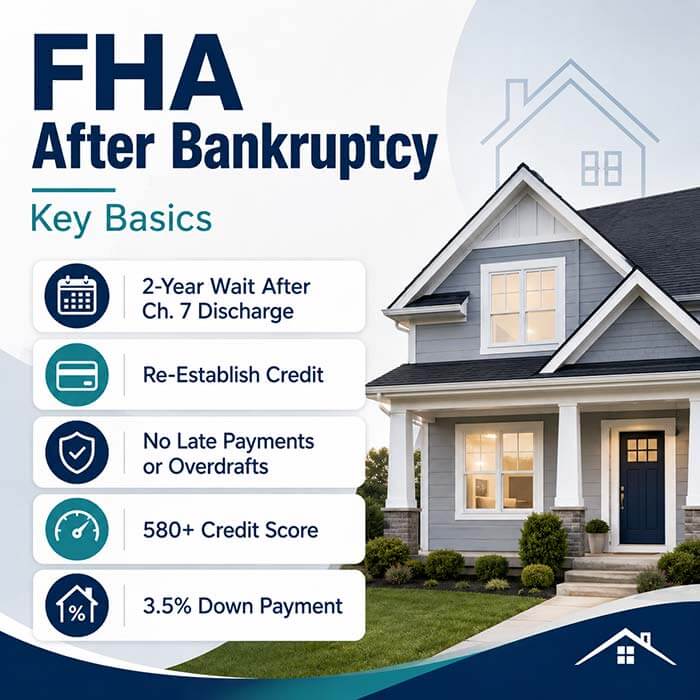
Here are the FHA Requirements in Qualifying for an FHA Mortgage After Chapter 7 Bankruptcy Discharged Date:
- The borrower needs to wait 2 years from the discharged date of the Chapter 7 Bankruptcy
- Lenders normally want to see re-established credit after bankruptcy
- Secured credit cards are the easiest and quickest way of re-establishing credit after bankruptcy and foreclosure
- No late payments after bankruptcy
- Late payments after bankruptcy can be a deal killer
- So please pay all of your monthly debt obligations on time
- No overdrafts
- Minimum of 580 Credit Scores to qualify for an FHA Mortgage
- 3.5% down payment required
Qualifying For FHA Mortgage During And After Chapter 13 Bankruptcy
Chapter 13 Bankruptcy is when a consumer needs the help of the U.S. Bankruptcy Courts to restructure their debts.
- When a consumer files for Chapter 13 Bankruptcy protection, the Bankruptcy Courts appoints a trustee
- Bankruptcy Trustees are private attorneys appointed by the court to oversee the petitioner
- A percentage of the petitioner’s income is set aside every month and is disbursed to the list of creditors
- The creditors get paid for a period of 60 months
- After that payment period is over, the remaining leftover debts are discharged, and the consumer no longer owes any debts
- In order to be eligible for Chapter 13 Bankruptcy, the bankruptcy petitioner needs to be employed
Unemployed petitioners are not eligible for Chapter 13 Bankruptcy Protection.
Qualifying For FHA Loans During Chapter 13 Repayment Period
Borrowers can Qualify for an FHA Mortgage One Year into a Chapter 13 Bankruptcy Repayment Period.
- 12 months of timely payments to creditors is required
- The minimum credit score required is 580 FICO
- Approval of Chapter 13 Bankruptcy Trustee
- Manual Underwriting
- All Manual Underwriting requires Verification of Rent
- Verification of Rent is only valid if the borrower can provide 12 months of canceled checks and/or 12 months of bank statements
If the borrower is renting from a registered property management company, the property manager can sign a VOR Form provided by the lender and this can be used in lieu of canceled checks and/or bank statements.
No Waiting Period After Recent Chapter 13 Discharged Date
There is no waiting period after a Chapter 13 Bankruptcy discharged date to qualify for an FHA Loan:
- Borrowers can qualify for an FHA Loan after Chapter 13 Bankruptcy discharge date with no waiting period
- The minimum credit score to qualify for a 3.5% down payment FHA Mortgage after bankruptcy is 580 FICO
- If Chapter 13 Bankruptcy has been seasoned for less than 2 years from the discharged date, then the borrower’s mortgage application needs to be a manual underwriting
- All manual underwrites requires verification of rent
Timely payments during and after Chapter 13 Bankruptcy.
No Waiting Period After Bankruptcy with NON-QM Loans
Gustan Cho Associates offers a portfolio mortgage program called NON-QM Loans:
- There is no waiting period after a bankruptcy or foreclosure
- NON-QM Loans require between 5% to 20% down payment and mortgage rates are normally higher than FHA or Conventional Loans
- However, borrowers can qualify for this loan program one day out of bankruptcy or foreclosure
- NON-QM Loans are a great loan program for homebuyers who otherwise could not qualify for a traditional conforming loan
- This is due to not being able to meet the mandatory waiting period
This holds especially true during a hot real estate market in areas where home prices are appreciating double digits year after year.
FHA Debt-to-Income Ratio After Bankruptcy.
The debt-to-income ratio (DTI) is critical after bankruptcy. DTI compares monthly debt payments to gross monthly income.
After bankruptcy, the lender must ensure the borrower is not taking on more debt than they can manage. A high DTI may be allowed with FHA, but the application must justify it.
Compensating Factors Can Help
Compensating factors are strengths that help offset risk in the loan file. Examples include verified cash reserves, strong rent payment history, stable income, low payment shock, and limited use of credit after bankruptcy.
Manual underwriting often depends heavily on compensating factors. The stronger the borrower’s file, the better the chance of approval.
Front-End and Back-End DTI
- The front-end DTI compares the proposed housing payment to gross monthly income.
- The back-end DTI includes the housing payment plus other monthly debts, such as car loans, student loans, credit cards, personal loans, and Chapter 13 trustee payments if applicable.
- Borrowers in Chapter 13 should note that trustee payments may count toward the debt-to-income ratio, which can affect home affordability.
Compensating factors are strengths that help offset risk in the application. Examples include verified cash reserves, strong rent payment history, stable income, low payment shock, and limited new credit after bankruptcy.
Documents Needed for an FHA Mortgage After Bankruptcy
Borrowers should be prepared to provide clear documentation of the bankruptcy. Missing documents can delay the mortgage process.
Chapter 7 Bankruptcy Documents
For Chapter 7 bankruptcy, borrowers may need the bankruptcy discharge papers, bankruptcy petition or schedules, credit report documentation, letter of explanation, and proof of re-established credit or responsible financial management.
The lender may also request documentation explaining the cause of the bankruptcy and evidence of financial recovery.
Chapter 13 Bankruptcy Documents
For Chapter 13 bankruptcy, borrowers may need the Chapter 13 payment history, the trustee payment ledger, bankruptcy court approval, the bankruptcy petition, the repayment plan, discharge papers (if discharged), and a letter of explanation.
If the borrower is in an active Chapter 13 repayment plan, court approval is typically required before closing on the FHA loan.
Letter of Explanation After Bankruptcy
A letter of explanation is often required after bankruptcy. This letter should be clear, honest, and concise. It should explain the circumstances, the reason for bankruptcy, what has changed, and why the borrower is now financially prepared to purchase a home.
What to Include in the Bankruptcy Letter of Explanation
The borrower should explain the hardship that led to the bankruptcy. Common reasons include job loss, medical bills, divorce, business failure, reduced income, or overwhelming debt.
The letter should avoid blaming others or using emotional language. It should focus on facts, recovery, and financial stability.
What Not to Say in the Letter
Borrowers should avoid exaggeration, vague explanations, or statements suggesting the same financial problem could recur. The lender wants assurance that the issue was temporary and has been resolved.
FHA Mortgage After Bankruptcy and Rental History
Rental history can be a strong component of an FHA mortgage application after bankruptcy. On-time rent payments for the past 12 months help demonstrate the ability to manage a housing payment.
Manual underwriting often places significant importance on verified rent history. Lenders may request canceled checks, bank statements, money order receipts, or a verification of rent from a property management company.
Payment Shock Matters
Payment shock occurs when the new mortgage payment is significantly higher than the current rent payment. A large payment shock can increase risk, especially after bankruptcy.
For example, if a borrower pays $1,200 in rent and seeks a $2,800 mortgage payment, the underwriter may question the ability to manage the increase. High income, substantial reserves, and low debt can help offset payment shock.
Why Am I Told I Do Not Qualify for FHA Mortgage After Bankruptcy?
There are many home buyers who are told that they do not qualify for an FHA Mortgage After Chapter 13 Bankruptcy discharged date by lenders.
- Borrowers are often confused when HUD Guidelines on Qualifying for FHA Loan After Chapter 13 Bankruptcy
- HUD Guidelines state there is no waiting period after the discharged date
- But they are told that they need to wait one year or two after the discharge date of their Chapter 13
- Banks such as Chase Bank and others often have mandatory waiting periods after the discharge date of Chapter 13
- This holds true even though HUD does not require any wait periods
The reason for this is because these banks and lenders have OVERLAYS on FHA Loans After Chapter 13 Bankruptcy Discharge.
Need an FHA Loan After Bankruptcy?
Whether your bankruptcy was recently discharged or you are still in a Chapter 13 repayment plan, you may have FHA mortgage options
FHA Mortgage After Bankruptcy With Collections or Charge-Offs
Many borrowers have collections or charge-offs after bankruptcy. Some accounts may have been included in the bankruptcy but still appear on the credit report. The lender will review whether these accounts were discharged and if any new derogatory credit has occurred since bankruptcy.
Collections Included in Bankruptcy
If collections were included in the bankruptcy, they should generally show a zero balance or be reported as included in bankruptcy. If they are reporting incorrectly, the borrower may need to work with the credit bureaus or creditors to correct the reporting.
New Collections After Bankruptcy
New collections after bankruptcy present a greater concern, as they may indicate the borrower has not fully recovered financially. New late payments, collections, or charge-offs after bankruptcy can significantly reduce the chances of FHA approval. and student loans
Borrowers should not assume a deferred student loan will be excluded. The payment calculation can affect approval, particularly if the borrower already has a high DTI.
Student loans can affect FHA qualification after bankruptcy because they may be included in the debt-to-income ratio. Even if a student loan is deferred or in forbearance, the lender may still be required to count a payment under FHA guidelines.
FHA Mortgage After Bankruptcy and Foreclosure
Some borrowers have experienced both bankruptcy and foreclosure, which can complicate the waiting period.
A common mistake is assuming the bankruptcy discharge date controls everything. If a mortgage was included in bankruptcy but the foreclosure occurred later, the lender may need to review the foreclosure date, the deed transfer date, or the FHA claim history, depending on the loan type and the file.
Bankruptcy Does Not Always Remove Foreclosure Waiting Period Issues
Bankruptcy may discharge personal liability on the mortgage debt, but it does not always transfer ownership of the property. If the borrower still remained on title after bankruptcy, the foreclosure or deed transfer timeline may matter.
This is one of the most complex areas of mortgage guidelines after bankruptcy. Borrowers should have their entire file reviewed before assuming eligibility.
FHA Mortgage After Bankruptcy Approval Process
The FHA approval process after bankruptcy begins with a comprehensive file review. The lender should examine bankruptcy documents, credit report, income, assets, debt-to-income ratio, and housing history before issuing a pre-approval.
Step One: Review the Bankruptcy Timeline
The lender needs to determine whether the bankruptcy was Chapter 7 or Chapter 13, the filing date, the discharge date, the dismissal date, if applicable, and whether any foreclosure or short sale occurred afterward.
Step Two: Review Credit Since Bankruptcy
The lender reviews all credit activity after bankruptcy. The most important question is whether the borrower has paid obligations on time since the bankruptcy.
Step Three: Run Automated Underwriting
The lender may run the file through FHA’s automated underwriting system. If the file receives an approved/eligible finding, the process may be easier. If it receives a refer/eligible finding, manual underwriting may be required.
Step Four: Prepare for Conditions
Borrowers should expect conditions, which may include updated pay stubs, bank statements, bankruptcy documents, rent verification, letters of explanation, court approval, or proof of funds.
Common FHA Mortgage After Bankruptcy Mistakes
Borrowers can improve their chances of approval by avoiding common mistakes.
Applying With the Wrong Lender
A lender may deny a borrower due to overlays, even if FHA guidelines allow the loan. Borrowers who have filed for bankruptcy should work with a lender familiar with FHA manual underwriting and post-bankruptcy guidelines to rebuild credit. This can backfire. Too many new accounts can lower credit scores and increase risk.
Missing Payments After Bankruptcy
Late payments after bankruptcy are a significant red flag. FHA may forgive past hardship, but the borrower must demonstrate financial recovery.
Shopping for Homes Before Getting Fully Reviewed
A basic pre-qualification is insufficient after bankruptcy. Borrowers should have their bankruptcy documents, credit, income, and DTI reviewed before making an offer.
Gustan Cho Associates Helps Borrowers After Bankruptcy
Gustan Cho Associates specializes in assisting borrowers who cannot qualify with other lenders due to overlays. Many borrowers denied by one lender after Chapter 7 or Chapter 13 bankruptcy are later approved by another lender that adheres more closely to FHA guidelines.
Gustan Cho Associates helps borrowers review loan applicant’s credit, assess waiting period requirements, prepare documentation, and identify potential underwriting challenges before processing. approval.
Gustan Cho Associates are experts in helping borrowers during and after Chapter 13 Bankruptcy. The goal at Gustan Cho Associates is to structure the file correctly, follow FHA guidelines, and give qualified borrowers a realistic path back to homeownership.
Qualifying and Choosing a Lender with No Overlays
FHA mortgage after bankruptcy guidelines can help borrowers purchase a home after a Chapter 7 or Chapter 13 bankruptcy. Success depends on understanding the waiting period, documenting financial recovery, rebuilding credit, and working with a lender that does not impose unnecessary overlays.
Bankruptcy does not end the possibility of homeownership. With proper guidance, documentation, and credit management after bankruptcy, many can qualify for an FHA loan and regain homeownership.
A Chapter 7 bankruptcy typically requires a two-year waiting period from the discharge date. Chapter 13 bankruptcy may allow FHA financing after 12 months of on-time trustee payments with court approval, even before discharge. Manual underwriting is often required, especially for active Chapter 13 borrowers.
Final Thoughts on FHA Mortgage After Bankruptcy Mortgage Guidelines
Borrowers who are told they do not qualify for an FHA Mortgage after a Chapter 13 Bankruptcy discharged date, please contact us at Gustan Cho Associates at 800-900-8569 or text for faster response. Or email us at gcho@gustancho.com. We are available 7 days a week, evenings, weekends, and holidays to take your mortgage inquiries and answer any questions you may have. Gustan Cho Associates is a five-star national mortgage company licensed in multiple states. We are nationally recognized for no overlays on FHA, VA, USDA, and Conventional Loans. We close most of our loans in 21 days or less.
FAQs About FHA Mortgage After Bankruptcy Mortgage Guidelines
How Long After Bankruptcy Can I Get an FHA Loan?
- For Chapter 7 bankruptcy, the standard FHA waiting period is usually two years from the discharge date.
- For Chapter 13 bankruptcy, FHA may allow borrowers to qualify after 12 months of on-time trustee payments with bankruptcy court approval.
Can I Get an FHA Loan While in Chapter 13 Bankruptcy?
- Yes, it may be possible to get an FHA loan while in an active Chapter 13 bankruptcy.
- The borrower generally needs at least 12 months of on-time Chapter 13 payments, court approval, and manual underwriting.
Does FHA Require a Two-Year Wait after Chapter 13 Discharge?
- Not always. FHA may allow financing after Chapter 13 discharge without the same waiting period required after Chapter 7, but automated underwriting findings and lender overlays matter.
- Some lenders add stricter rules.
What Credit Score Do I Need for an FHA Loan After Bankruptcy?
- FHA credit score requirements can be flexible, but the full file matters.
- Lenders review credit score, payment history after bankruptcy, debt-to-income ratio, income stability, and whether the file receives automated or manual underwriting approval.
Can I get an FHA Loan After a Chapter 7 Bankruptcy with Bad Credit?
- Possibly, but the borrower must meet FHA requirements and show responsible financial recovery after bankruptcy.
- New late payments, collections, or high debt after bankruptcy can make approval harder.
Do I Need to Pay Off Collections Before Getting an FHA Loan After Bankruptcy?
- Not always.
- Collections included in bankruptcy may not need to be paid again, but the lender must review how they report on the credit report.
- New collections after bankruptcy can create problems.
What Documents are Needed for an FHA Loan after Bankruptcy?
- Common documents include bankruptcy discharge papers, bankruptcy schedules,
- Chapter 13 payment history (if applicable), court approval (if still in Chapter 13), pay stubs, W-2s, tax returns (if needed), bank statements, rent verification, and a letter of explanation.
Can I Qualify for an FHA Loan if My Mortgage was Included in My Bankruptcy?
- Possibly, but the lender must review whether there was also a foreclosure, a deed-in-lieu, a short sale, or a title transfer after bankruptcy.
- The bankruptcy discharge date may not be the only date that matters.
Why Did One Lender Deny Me After Bankruptcy if FHA Allows It?
- The lender may have overlays. FHA sets minimum guidelines, but lenders can add stricter internal requirements.
- A different lender may approve the same borrower if the file meets FHA guidelines.
Is FHA Better Than Conventional after Bankruptcy?
- FHA is often easier than conventional financing after bankruptcy because FHA has more flexible credit and waiting period guidelines.
- However, the best loan depends on the borrower’s credit, income, down payment, bankruptcy history, and automated underwriting findings.
Get Clear FHA Bankruptcy Mortgage Guidance
FHA bankruptcy guidelines can be confusing. A mortgage expert can review your credit, discharge date, payment history, and loan eligibility.