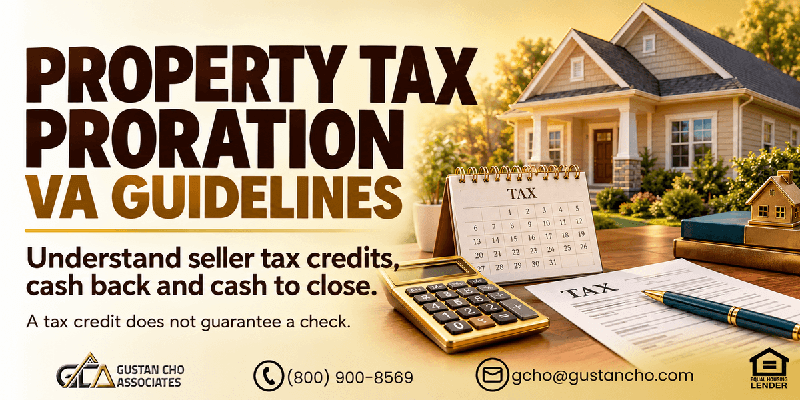
Property tax proration VA guidelines help determine how unpaid or prepaid property taxes are divided between the buyer and seller at closing. If the seller owes taxes for the time they owned the property, the buyer may receive a credit on the Closing Disclosure. That credit can reduce the veteran’s cash needed to close. Whether the final transaction results in money due to the buyer depends on all the closing figures and the lender’s review; the tax credit itself is not a promise of a check.
What Is Property Tax Proration on a VA Loan?
Property tax proration divides property taxes between the buyer and seller according to the duration each owns the home during the tax period.
The adjustment is made at closing so each party is responsible for the portion of taxes connected to their ownership period.
Property tax proration VA guidelines do not create extra VA loan proceeds for the veteran. The proration is a settlement adjustment between the buyer and seller.
Why Sellers Credit Buyers for Unpaid Property Taxes
In areas where property taxes are paid after they accrue, the buyer may eventually receive a tax bill that includes days when the seller still owned the property. At closing, the seller may credit the buyer for the seller’s share of those unpaid taxes. The amount depends on the tax period, closing date, local tax practices, and the terms of the purchase contract. The credit helps prevent the buyer from paying property taxes that belong to the seller’s ownership period.
How Property Taxes Are Prorated at Closing
The direction of the adjustment depends on whether the taxes have already been paid.
Taxes Paid in Arrears
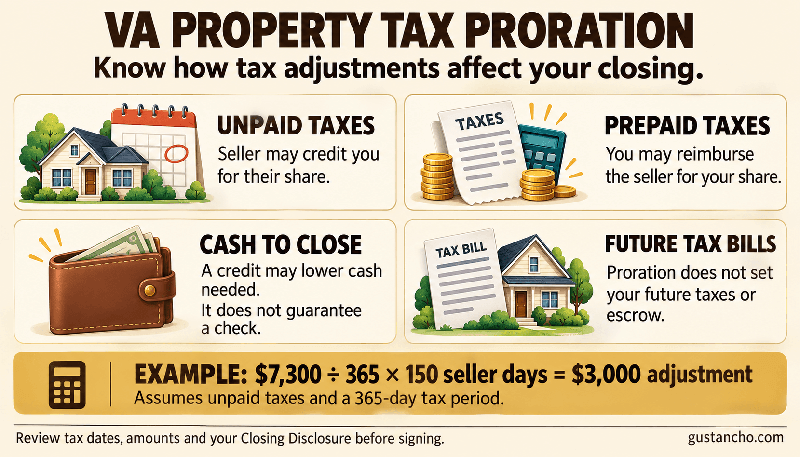
When taxes are paid after they accrue, the seller may owe the buyer a credit for the portion of the tax period that occurred before closing. The buyer later becomes responsible for paying the tax bill when it comes due.
Taxes Paid in Advance
If the seller already paid property taxes covering a period after the closing date, the adjustment can work in the opposite direction. The buyer may reimburse the seller for the buyer’s share of the prepaid taxes. This is why a property tax proration does not always result in a credit to the buyer.
Can a VA Buyer Receive Cash Back at Closing?
Certain credits and reimbursements may be allowed, but VA loans have rules on what can be returned to the borrower. We’ll help you understand what is permitted in your scenario.Property Tax Proration vs. VA Seller Concessions
A property tax proration divides taxes between the buyer and seller for the applicable tax period. When the seller owes taxes that the buyer will pay later, the seller’s credit accounts for the seller’s share of that obligation. The VA sets a limit on seller concessions at 4% of the home’s reasonable value, which is determined by the VA Notice of Value. Regular seller payments toward the buyer’s closing costs, such as eligible appraisal or title fees, do not count toward this 4% limit. But if the seller pays the veteran’s VA funding fee or prepays the buyer’s hazard insurance, those are considered seller concessions. For example, if the seller owes $3,000 in unpaid property taxes from their time owning the home, giving the buyer a $3,000 credit is a tax-proration adjustment. If the seller also pays the veteran’s VA funding fee, that payment is a seller concession. It is included in the 4% limit. Just calling something a “seller credit” does not determine how it should be handled. It’s best to have the lender review the purchase contract and Closing Disclosure to make sure each payment is classified correctly before you use them in your closing estimate.
Where to Find Property Tax Adjustments on Your Closing Disclosure
On the standard purchase Closing Disclosure, check these three locations:
- Page 3, Section L — “Adjustments for Items Unpaid by Seller”: Look here for the seller’s share of accrued, unpaid property taxes that you will pay later. This adjustment credits you for the seller’s obligation.
- Page 3, Section K — “Adjustments for Items Paid by Seller in Advance”: If the seller already paid taxes covering your ownership period, your reimbursement to the seller appears here and may increase the amount you owe at closing.
- Page 2, Section G — “Initial Escrow Payment at Closing”: This shows the deposit used to establish your mortgage escrow account for future property-tax and insurance payments.
The buyer–seller tax adjustment and the initial escrow deposit serve different purposes. One divides responsibility for taxes between you and the seller; the other funds an account for upcoming bills. Compare the tax period, dates, and amounts with your purchase contract and available tax records. Ask the lender or settlement agent to explain any discrepancies and their effect on your final cash-to-close before signing. Use the CFPB’s interactive guide to locate these entries on a sample form.
How Property Tax Credits Affect Cash to Close
A seller’s property tax credit can reduce the amount a veteran needs to bring to closing. For example, if your estimated cash to close is $6,000 and you receive a $2,500 seller tax adjustment, the amount needed would be $3,500, assuming all other figures remain unchanged. Review the adjustment alongside the other charges and credits on your Closing Disclosure.
Does the Seller’s Tax Credit Determine Your Future Property Taxes?
No. The tax proration settles the buyer’s and seller’s shares of a particular tax period. It does not set the buyer’s future tax bill or monthly escrow payment.
The seller’s old bill may reflect an exemption that the buyer cannot keep. A newly built home may also have a prior bill based mainly on the land, before the completed home is assessed. In either case, future taxes could exceed the amount used for the closing adjustment.
Ask the lender what tax estimate it used for your monthly payment and initial escrow deposit. If the property has an exemption or is newly built, also ask when the local assessor expects its next assessment. The Closing Disclosure shows the initial escrow payment separately from the buyer–seller tax adjustment.
Can a VA Buyer Receive Money From a Property Tax Proration?
Yes. VA permits veterans to receive cash back for amounts credited for prorated property taxes paid in arrears. VA’s Change 40 expressly clarified this permission in Chapter 3, Topic 2, Section c of the VA Lender’s Handbook. When property taxes are paid after they accrue, the seller may owe taxes for the time they owned the home. The seller’s credit accounts for that obligation, as the buyer may later be responsible for paying the bill, either directly or through an escrow account. This adjustment does not create additional VA loan proceeds. The full tax credit will not necessarily be issued as a check to the buyer. The Closing Disclosure combines the proration with closing charges, deposits, other credits, and required payments. Depending on those figures, the credit may reduce the cash the veteran must bring to closing or result in money payable to the veteran. The lender and settlement agent must verify the proration and review the complete settlement figures before confirming the amount to be disbursed.
Property Tax Proration Example
Suppose annual property taxes are $7,300, the applicable tax period has 365 days, and the purchase contract assigns 150 days of unpaid taxes to the seller. $7,300 ÷ 365 days = $20 per day $20 × 150 seller days = $3,000 At closing, the seller would be charged $3,000, and the buyer would receive a corresponding $3,000 adjustment. This may reduce the buyer’s cash needed to close. The buyer may later be responsible for a tax bill that includes those 150 days, either directly or through the mortgage escrow account. The $3,000 adjustment helps account for that future bill; it is not a $3,000 windfall. The final amount may differ if the tax bill, closing date, or contract’s proration method changes.
How Property Tax Credits Affect Cash to Close
A seller’s property tax credit can reduce the amount a veteran needs to bring to closing. For example, if your estimated cash to close is $6,000 and you receive a $2,500 seller tax adjustment, the amount needed would be $3,500, assuming all other figures remain unchanged. Review the adjustment alongside the other charges and credits on your Closing Disclosure.
Why VA Property Tax Prorations Can Change Before Closing
Discrepancies among the purchase contract, property tax records, and settlement calculations may require corrections before closing. Check these common sources of changes:
A Different Closing Date
Moving the closing date changes the number of days assigned to each party. Confirm which party the purchase contract assigns the closing day to.
Updated Tax Information
An early calculation may use the previous tax bill. If the applicable bill becomes available before closing, the settlement agent may update the adjustment in accordance with the contract.
An Incorrect Tax Period or Calculation Method
Check that the calculation uses the correct tax period and follows the contract’s proration method, including any agreed adjustment factor.
Exemptions or Changes in Assessed Value
Confirm whether the tax records reflect an exemption or an assessment that affects the calculation. Separately, ask the lender whether its estimate of your future taxes accounts for changes after purchase.
A Credit Classified Incorrectly
Ask the lender to verify whether each entry represents a legitimate tax proration, an ordinary closing-cost payment, or a VA seller concession. The description and treatment should match the actual transaction.
Do Other Mortgage Programs Handle Property Tax Credits Differently?
Property tax prorations are not unique to VA loans.
Conventional, FHA, USDA, and other mortgage programs can also recognize legitimate property tax adjustments at closing, but the treatment of credits, cash back, and borrower contributions depends on the applicable program guidelines.
For example, Fannie Mae allows a legitimate prorated real estate tax credit on a purchase transaction in areas where property taxes are paid in arrears. Borrowers should not assume that a rule applying to one mortgage program automatically applies to another.
What Veterans Should Review Before Closing
Compare the Closing Disclosure with the purchase contract and available tax records. Check:
- The tax period is being prorated
- The number of days assigned to the seller and buyer
- Whether taxes are paid in arrears or in advance
- The estimated or actual tax amount used
- Any exemptions affecting the calculation
- The property tax language in the purchase contract
- The final effect on cash to close
Ask the lender or settlement agent to explain discrepancies before signing.
Final Thoughts on Property Tax Proration VA Guidelines
Understanding the tax adjustment helps you prepare for closing and the bills that follow. Confirm how the proration was calculated, how it affects your closing figures, and what tax estimate the lender used for your future escrow payments.
FAQs About Property Tax Proration VA Guidelines
Does VA Determine the Amount of the Property Tax Proration?
No, VA does not dictate a proration amount for property tax. These amounts vary by purchase contract, closing date, practices of local governments, records, and specific settlement procedures.
Can Special Assessments be Prorated Between the Buyer and Seller?
Possibly. Special assessments are separate from regular property taxes and may be handled differently depending on the purchase contract and local requirements. The title or settlement company should determine which party is responsible for the assessment.
What Happens if the Current Property Tax Bill is not Available at Closing?
The settlement agent will have to use available records and the contract to arrive at an estimate for the tax bill. Local practices will determine if the parties will make a subsequent adjustment when the tax bill is issued.
Does a Seller Tax Credit Reduce My Future Escrow Payment?
Not automatically. The credit adjusts the closing figures; the lender estimates escrow from expected future taxes and insurance. Ask which tax amount the lender used, especially if the seller has an exemption or the home is newly built.
Can Property Taxes Increase After Buying a Newly Constructed Home?
It is possible. A previous tax bill may reflect taxes on vacant land or a partially built home. Property taxes will likely increase after the construction of the home. As such, VA buyers should not assume the previous tax bill of the seller will reflect the taxes they will pay.
This article about “Property Tax Proration VA Guidelines: Credits, Cash Back, and Cash to Close” was updated on October 1st, 2026.
Want To Make Sure You’re Getting the Right Tax Credits at Closing?
Our team will double-check your property tax proration under VA guidelines before you sign