How does a credit card balance affect the debt-to-income ratio?
How credit card balance affects debt-to-income ratio depends mainly on the required monthly payment, not the total amount owed. Mortgage lenders generally include the minimum payment shown on your credit report in your monthly debt obligations. A higher balance may increase that payment and raise your DTI, reducing how much home you can afford. Paying down or paying off cards may improve qualification, but confirm the required amount and documentation with your loan officer before using funds needed for closing or reserves.
Do Credit Card Balances Count in Debt-to-Income Ratio?
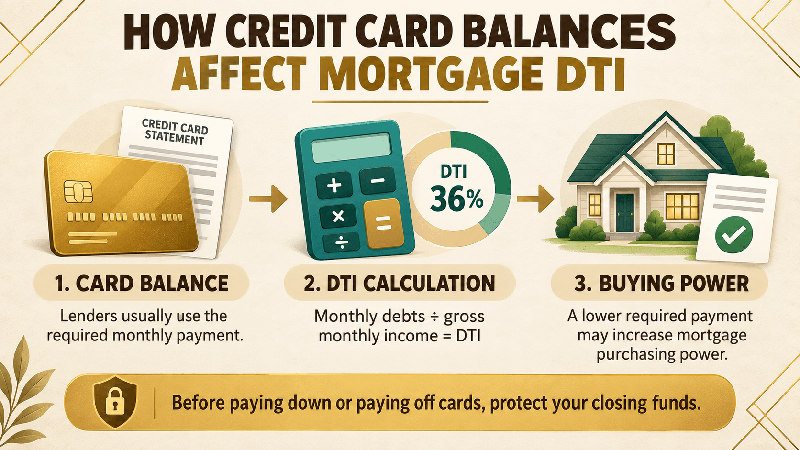
Yes, credit cards normally count in your debt-to-income ratio when the account has a required monthly payment. However, mortgage lenders generally do not use the full outstanding balance as a monthly debt. They use the qualifying monthly payment shown on your credit report or other acceptable documentation.
This distinction is important when explaining how credit card balance affects debt-to-income ratio. The balance affects DTI indirectly, as a higher balance may lead to a higher minimum payment.
For example, suppose you owe $8,000 on a credit card and the required minimum payment is $240. The lender generally counts the $240 payment toward your monthly debts, not the entire $8,000 balance. Mortgage DTI is calculated by dividing your qualifying monthly obligations, including the proposed housing payment, by your gross monthly income. If you earn $6,000 per month, a $240 credit card payment adds four percentage points to your DTI. Paying down a credit card may lower the required payment, but the change must be properly documented. A payment made through your online account may not immediately appear on your credit report. The lender may need an updated credit report, a credit supplement, an account statement, or other supporting documentation before approving the lower payment. If the credit report does not show a required payment, the lender may calculate one based on the balance and the applicable loan program. A credit card paid off before or at closing may also be excluded from DTI when the payoff is properly documented. Because guidelines and lender overlays can differ, borrowers should ask their loan officer to calculate the expected DTI improvement before using money needed for the down payment, closing costs, or reserves.
How Lenders Calculate Credit Card Payments for DTI
Mortgage lenders usually start with the minimum credit card payment required on the borrower’s credit report. They add that payment to the borrower’s other recurring monthly obligations, such as auto loans, student loans, personal loans, child support, and the proposed mortgage payment. The outstanding balance is not normally entered directly into the DTI calculation. However, how a credit card balance affects the debt-to-income ratio depends on the monthly payment connected to that balance. A larger balance may produce a higher minimum payment, which can increase the borrower’s DTI.
The basic calculation is:
Total qualifying monthly obligations ÷ gross monthly income = debt-to-income ratio
For example, assume a borrower earns $6,000 per month and has the following obligations:
- Proposed monthly housing payment: $2,000
- Auto loan: $400
- Student loan: $100
- Credit card minimum payment: $150
The borrower has $2,650 in total monthly obligations. Dividing $2,650 by $6,000 produces a back-end DTI of approximately 44.2%. Without the $150 credit card payment, the DTI would be approximately 41.7%. This example shows how a single credit card payment can make a meaningful difference, especially when a borrower is close to the maximum DTI allowed by the loan program or the automated underwriting system. Lenders generally rely on the payment reported to the credit bureaus unless updated documentation supports a different amount. Paying down a balance does not automatically lower the qualifying payment. The lender may need an updated credit report, a credit supplement, or an acceptable account statement before processing the new payment. If the credit report does not show a required payment, the lender must follow the applicable loan program guidelines to calculate one. For example, Fannie Mae may require the lender to use 5% of the outstanding balance when no lower payment can be documented. Desktop Underwriter may use the greater of $10 or 5% of the balance when no monthly payment is entered. Because FHA, VA, USDA, conventional, and Non-QM programs may treat missing or updated payments differently, the loan officer should verify the correct payment before determining the borrower’s final DTI.
What Happens When No Minimum Payment Is Reported?
A credit report may show an outstanding credit card balance without listing a required minimum payment. The lender cannot automatically treat the payment as zero. The account must still be reviewed and included in the borrower’s monthly obligations unless the applicable mortgage guidelines permit its exclusion.
The lender may first request documentation showing the actual required payment. Acceptable documentation may include a recent credit card statement, a creditor letter, or a credit supplement obtained from the mortgage credit report provider.
If an acceptable payment cannot be documented, the lender must calculate a qualifying payment in accordance with the loan program and the automated underwriting findings. This is one way credit card balances affect the debt-to-income ratio, even when no payment appears on the original credit report.
For Fannie Mae conventional loans, the lender generally must use 5% of the outstanding revolving balance when the credit report shows no payment and no supplemental documentation supports a lower amount. When no monthly payment is entered, Desktop Underwriter may use the greater of $10 or 5% of the balance.
For example, a credit card with a $4,000 balance and no reported payment could result in a $200 qualifying payment when the 5% calculation applies. If the borrower earns $5,000 per month, that calculated payment adds four percentage points to the DTI. This can create a major qualification problem when the actual minimum payment is much lower than the calculated amount. Obtaining a current statement that documents a smaller required payment may help, provided the lender and loan program permit its use. FHA, VA, USDA, Freddie Mac, and Non-QM programs may have different documentation and calculation requirements. Lender overlays may also apply. Borrowers should not assume that a missed payment will be ignored or treated the same way across all mortgage programs.
Credit Report Payment Versus Current Statement Payment
Mortgage lenders typically start with the minimum credit card payment listed on the borrower’s credit report. However, that payment may be outdated if the borrower recently paid down the balance, made new purchases, or received a credit-limit adjustment. A current credit card statement may show a different required payment. If the loan program permits, the lender may use the statement, creditor documentation, or a credit supplement to verify the updated amount. The new payment must be properly documented and entered into the loan application and automated underwriting system. This distinction can affect how credit card balance affects debt-to-income ratio. A lower balance may result in a lower minimum payment, but the lender cannot assume the payment has changed without acceptable documentation. If the current statement shows a higher payment, the lender may need to use the higher amount. Borrowers should send updated statements to their loan officer before relying on a lower payment to qualify.
Paying Down Versus Paying Off Credit Cards Before Closing
Paying down and paying off a credit card can produce different mortgage results. Before moving money, borrowers should understand which option will create the DTI improvement needed for approval. Paying down a credit card reduces the outstanding balance but leaves part of the debt unpaid. The required minimum payment may decrease after the creditor updates the account. However, the lender cannot use a lower payment until it is supported by acceptable documentation. Paying off a credit card balance reduces it to zero. When the payoff is properly documented and permitted by the loan program, the lender may exclude the monthly payment from the borrower’s DTI.
This distinction is important when explaining how a credit card balance affects the debt-to-income ratio. A partial paydown may improve credit utilization without changing the payment enough to help the borrower qualify. A full payoff may remove the entire monthly payment, but it also requires more cash.
For Fannie Mae loans, a revolving account paid off at or before closing does not have to be closed for its payment to be excluded from DTI. The lender must still document the payoff and evaluate the borrower’s use of credit. Borrowers should ask their loan officer to calculate the amount that must be paid, the expected qualifying payment, and the resulting DTI. Paying off cards without a plan could leave the borrower short of funds for the down payment, closing costs, prepaid expenses, or required reserves.
Can a Paid-Off Credit Card Be Excluded From DTI?
Yes. A credit card payment may be excluded from the debt-to-income ratio when the balance will be paid off before or at closing, and the lender receives acceptable proof of the payoff. The lender must also comply with the requirements of the loan program and the automated underwriting findings. Documentation may include:
- A current statement showing a zero balance
- Proof that the payoff cleared the borrower’s bank account
- A creditor payoff confirmation
- A credit supplement or updated credit report
- Closing documents showing the debt will be paid at closing
This is an important part of understanding how credit card balance affects debt-to-income ratio. Removing a $200 monthly payment from the qualifying debts can lower DTI even though the borrower’s income remains unchanged. For Fannie Mae loans, a revolving account paid off at or before closing may be excluded from long-term debt. Fannie Mae does not require the credit card account to be closed as a condition of excluding the payment. The lender must still evaluate the payoff as part of the overall loan analysis. Requirements may differ for FHA, VA, USDA, Freddie Mac, and Non-QM loans. Individual lenders may also have overlays. Borrowers should avoid using the card again before closing. New charges could create another balance, increase the required payment, and affect final qualification if the lender refreshes the credit report.
High Credit Card Balances May Lower Your Buying Power
High balances can affect credit scores, mortgage pricing, PMI, and qualifying payment. Get a credit and DTI review before you start shopping for homes.
Mortgage DTI Examples Involving Credit Cards
The following hypothetical examples show how a credit card balance affects the debt-to-income ratio through the required monthly payment. Actual approval depends on the loan program, automated underwriting findings, documentation, and lender requirements.
Example 1: One Credit Card Raises the DTI
A borrower earns $6,000 in gross monthly income and has these obligations:
- Proposed housing payment: $2,100
- Auto loan: $450
- Credit card payment: $180
The total monthly obligations are $2,730. Dividing $2,730 by $6,000 produces a DTI of 45.5%. Without the $180 credit card payment, the DTI would be 42.5%. One revolving payment increased the ratio by three percentage points.
Example 2: A Paydown Lowers the Minimum Payment
A borrower earns $5,000 per month. The proposed housing payment is $1,700, other debts total $550, and the credit report shows a $250 credit card payment. The total obligations are $2,500, producing a 50% DTI. After the borrower pays down the card, the creditor reduces the required payment to $100. Once the lender receives acceptable documentation, the total obligations drop to $2,350, and the DTI drops to 47%.
Example 3: Paying Off One Card Improves Qualification
A borrower earns $7,000 per month and has a proposed housing payment of $2,450, $700 in other debts, and two credit card payments of $125 and $175. The total obligations are $3,450, producing a DTI of approximately 49.3%. If the borrower pays off the card with the $175 payment and the lender can exclude it, the total obligations fall to $3,275. The new DTI is approximately 46.8%. Paying off the card results in a meaningful improvement, but the borrower must still have sufficient verified funds for closing costs, the down payment, prepaid expenses, and required reserves.
How Credit Card Payments Affect Mortgage Purchasing Power
Credit card payments reduce the portion of a borrower’s income available for a mortgage payment. The higher the required monthly payment, the less room the borrower may have for principal, interest, property taxes, homeowners’ insurance, mortgage insurance, and homeowners’ association dues. For example, assume a borrower earns $7,000 per month and qualifies with total monthly obligations up to $3,150. The borrower has $600 in other debts and a $250 credit card payment. After subtracting those obligations, up to $2,300 remains for the proposed housing payment. If the $250 credit card payment can be eliminated, up to $2,550 may be available for housing. That additional payment capacity could support a higher loan amount or help the borrower qualify for a home with higher taxes, insurance, or HOA dues. This demonstrates how a credit card balance affects the debt-to-income ratio and purchasing power through the required monthly payment. However, a $250 reduction in debt does not produce the same increase in loan amount for every borrower. Interest rates, loan terms, mortgage insurance, property expenses, loan programs, and lender requirements all affect the final result. The Consumer Financial Protection Bureau defines DTI as total monthly debt payments divided by gross monthly income. It also notes that DTI limits differ among lenders and loan products. Before paying down debt, ask your loan officer to compare the expected DTI improvement with the cash needed for the down payment, closing costs, and reserves.
Common Credit Card Problems That Delay Mortgage Approval
Credit card issues can change a borrower’s DTI or create new underwriting conditions. Common problems include:
- The credit report does not show a minimum payment. The lender may have to calculate a payment based on the balance, which can be much higher than the borrower’s actual payment.
- A recent paydown has not been documented. The borrower may have reduced the balance, but the lender cannot use a lower payment until acceptable documentation supports it.
- A paid-off card still shows a balance. The lender may request a zero-balance statement, proof of cleared funds, a creditor letter, or a credit supplement.
- The borrower pays down the wrong account. Paying a large balance with a small monthly payment may not improve DTI as much as eliminating a smaller balance with a higher payment.
- New charges appear before closing. Furniture, appliances, travel, or everyday purchases can raise the balance and minimum payment after pre-approval.
- The payoff uses the money needed for closing. A borrower may improve DTI but become short of funds for the down payment, closing costs, prepaid expenses, or reserves.
- Another person pays the account. A payment may still count unless the borrower meets the loan program’s documentation requirements for excluding debts paid by someone else.
These problems demonstrate why borrowers should not pay down, pay off, close, or use credit cards during the mortgage process without first speaking with their loan officer. A loan officer can determine which payment will yield the greatest DTI improvement and what documentation the underwriting will require.
How to Lower Credit Card DTI Without Draining Closing Funds
Borrowers do not always need to pay off all their credit card debt to qualify for a mortgage. The goal is to reduce the required monthly payments enough to meet the lender’s DTI requirements while preserving the money needed to close. Understanding how a credit card balance affects the debt-to-income ratio begins with identifying the exact monthly payment reduction needed. Ask your loan officer to calculate your current DTI and determine how much debt you must remove. Consider these steps:
- Target the payment, not just the largest balance. Paying off a $1,200 card with a $90 payment may help DTI more efficiently than paying down a $5,000 card with a $125 payment.
- Pay only what is necessary. A full payoff may not be necessary if a smaller paydown yields an acceptable, properly documented minimum payment.
- Confirm the documentation first. Ask whether the lender will need a new statement, proof of cleared funds, a credit supplement, or an updated credit report.
- Protect required assets. Set aside the down payment, closing costs, prepaid expenses, and required reserves before using money to reduce debt.
- Consider paying the card at closing. When permitted by the loan program and lender, arranging the payoff through closing may simplify documentation and prevent the money from being used elsewhere.
- Avoid creating new balances. Stop using cards selected for paydown or payoff unless your loan officer approves the charge.
A planned approach can improve DTI without creating an asset shortage. Borrowers should have their loan officer compare several payoff options before moving money.
Final Thoughts on How Credit Card Balance Affects Debt-to-Income Ratio
Understanding how credit card balance affects debt-to-income ratio can help borrowers prepare for mortgage approval. Lenders generally focus on the required monthly payment, not the total balance alone. A higher payment can raise DTI, reduce purchasing power, or cause a previously approved loan to exceed program requirements.
Paying down a card may lower the required payment, while paying it off may allow the lender to exclude the payment entirely. However, every change must be properly documented. Borrowers should also avoid using money needed for the down payment, closing costs, prepaid expenses, or reserves.
The best strategy depends on the borrower’s income, other debts, available assets, loan program, and automated underwriting findings. Before paying off or closing any account, ask an experienced loan officer to calculate which action will provide the required DTI improvement. Gustan Cho Associates can review your mortgage scenario and help you develop a credit card payoff plan that supports both qualification and closing.
Frequently Asked Questions About Credit Cards and Mortgage DTI
Are Credit Card Payments Included in Front-End or Back-End DTI?
Credit card payments are included in back-end DTI. Front-end DTI focuses on the proposed housing payment, while back-end DTI includes housing costs and recurring obligations such as credit card, car loan, and student loan payments.
Does Increasing My Credit Limit Lower My Mortgage DTI?
Usually not. DTI compares monthly debt payments with gross monthly income, so increasing a credit limit does not directly change the calculation. A higher limit may lower credit utilization, but DTI improves only if the required monthly payment decreases.
Do Authorized-User Credit Cards Count Toward Mortgage DTI?
An authorized-user account may appear on your credit report even when you are not responsible for paying it. A lender may exclude the payment after confirming that another person owns the account and makes the payments. Requirements vary by mortgage program and lender.
Do Business Credit Cards Count Toward Personal DTI?
A business credit card may count when the borrower is personally liable, and the payment appears on their personal credit report. Some loan programs allow the payment to be excluded when documentation shows that the business has consistently paid the debt and that the expense was considered in the business-income analysis.
Does a Credit Card Balance Transfer Lower DTI?
Moving debt to another credit card does not eliminate the debt. A balance transfer may lower DTI if it results in a smaller documented monthly payment, but opening a new account during the mortgage process can raise additional underwriting questions. Discuss the transfer with your loan officer before applying.
Are Charge Cards Treated the Same as Regular Credit Cards?
Not always. Charge cards that require payment of the full balance each month may receive different treatment than revolving credit cards. For example, Fannie Mae generally does not include an open 30-day charge account in DTI, but the borrower must have sufficient verified funds to pay the balance, in addition to the required closing funds and reserves.
Does Closing a Credit Card Improve My DTI?
Closing a credit card does not provide an extra DTI benefit beyond removing its required payment. It can also reduce available credit and potentially affect the borrower’s credit score. Do not close an account during the mortgage process unless your loan officer recommends it.
This article about “How Credit Card Balances Affect Debt-to-Income Ratio for a Mortgage” was updated on September 9th, 2026.
Ready to Improve Your DTI and Mortgage Approval Odds?
Complete a quick application or send your credit card balances and income details. We’ll review your DTI, credit profile, cash-to-close, and best mortgage path.