Benefits of Being a Homeowner vs Renting: Which is More Cost Effective?
This guide covers homeowner tax benefits versus renting. There are so many advantages of buying versus renting a home. One of the top benefits is the homeowner tax benefits homeowners. Homeowner tax benefits do not apply to renters. Analyze benefits of being a homeowner vs renting, including mortgage interest tax benefits, property tax write off, increase in equity, and how cost of buying a home vs renting impacts you long term.
Homeowner Tax Benefits are often ignored by home buyers, especially first time home buyers. Besides Homeowner Tax Benefits there are other great benefits of being a homeowner versus a renter as well.
in this article, we will mainly concentrate on Homeowner Tax Benefits. In this article, we will discuss and cover the benefits of being a homeowner versus a renter. In this article, we will explain the differences between homeowner tax benefits versus renting, what tax benefits are, and what homeowners and renters need to take into account before making any decisions.
Benefits of Being a Homeowner vs Renting | Tax Benefits, Equity, and Real Expenses
Most people in a buying a home vs renting scenario look at the monthly payment. That is one portion of the decision, but there is a lot more involved financially. The comparison needs to involve tax ramifications, equity, long-term wealth accumulation, stability of your housing situation, costs of maintenance, and how much flexibility you need over the next several years.
This is why talking about the advantages and disadvantages of taxes for homeowners and renters is important. Homeowners receive tax deductions, and financial gains that renters generally do not.
Many people may find renting to be the better option since it usually has lower upfront costs, little to no maintenance, and greater flexibility if you need to make life changes quickly. This is why you should not make the mistake of thinking one option is better than the other. The right choice depends on your income, tax situation, your job situation, how much you have in savings, how long you want to be in the same place, and if you are financially prepared to take on the full responsibility of ownership.
Top Homeowner Tax Benefits For Homebuyers

There are various benefits of being a homeowner versus a renter: Homeowner tax benefits. There are many more financial benefits to owning a home versus renting besides Homeowner Tax Benefits. Homeowners have the luxury to do decorations to their home: They do not have to ask for permission from the landlord or property management company.
Homeowners own place and freedom to raise their children and family. Owning your own home gives the freedom and right without asking landlord in being able to spend time with family, relatives, friends.
Homeowners do not have to ask permission from the landlord on friends and family staying over on an extended stay. Homeownership can come with several tax benefits for homebuyers. Tax laws can change, so it’s advisablet the most accurate and up-to-date information.
What Are Owner Tax Benefits Compared To Renting?
Homeowner tax benefits versus renting means the financial difference in leasing a property versus owning a home, and how tax treatment factors into that. Renters spend money to obtain housing but, because they don’t own the unit, they get no federal tax benefits from the rent they pay.
Homeowners may get a federal tax benefit based on the homeowner’s mortgage, property taxes, filing status, and whether the homeowner itemizes tax deductions.
This analysis is important because many analysts state buying a home is “better” because of tax deductions. This can be very misleading. Not every homeowner is getting a large tax benefit, and not every renter is losing money. Homeownership is not that valuable if it is not financially beneficial.
Tax Benefits With Property For Some Homeowners
Many homeowners are able to take the deduction on their state and local property taxes, and this can help some homeowners justify the expense of buying a home instead of renting. Even though property taxes are a real expense, they may also help some homeowners from a tax standpoint, making them more appealing as a home purchase as opposed to renting.
Although renters cannot directly deduct the property taxes that landlords pay, they do pay those taxes, since landlords usually incorporate those expenses into the rent they charge. In this case, renters pay property taxes but receive no tax benefit for doing so.
Tax Beneftis Of Homeowners
There is no federal deduction that a renter is able to take to help offset expenses from their renting, making this one of the biggest tax benefits of home ownership vs renting. Of course people seem to think that this deduction is a tax saving goldmine, and this is not the case.
In order to take the mortgage interest deduction, you cannot take the standard deduction, and most people expect this deduction to save them a large amount of money.
Another way to analyze homeowner tax benefits versus renting is to look at at the total cost of each option and what you get in return. Renting may give some people more flexibility and simplicity. Homeownership may offer tax benefits, equity, and potential appreciation. What is most important to you should drive your decision.
The Major Differences Between Financial Aspects of Renting and Buying a House
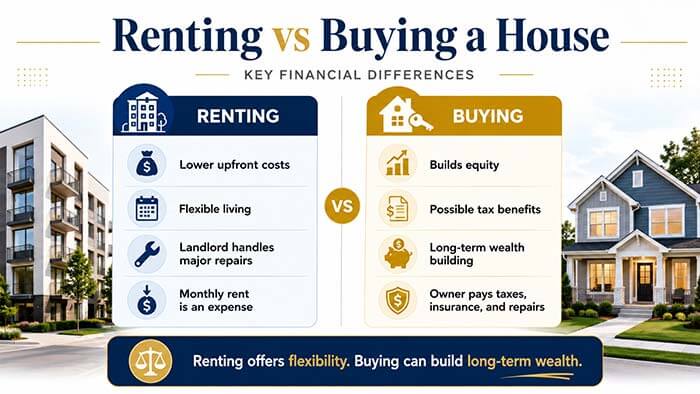
From a short-term perspective, renting is less complicated than renting. You start by signing a lease, then pay the required rent, negotiate what utilities you will pay and move when the lease is up. Besides you, the landlord is responsible for the big unexpected costs (e.g., keeping the roof intact, or structural issues, as well as maintenance and repairs.)
Homeownership is the polar opposite. When you buy a house, your monthly payment will likely include principal and interest (maybe), property taxes, homeowners insurance, (possibly) mortgage insurance, and HOA dues.
You also carry the responsibility of maintenance and repairs, along with tackling the financial surprises property ownership entails. Unlike rent, a portion of your mortgage payment can actually help you build equity, and ownership may even come with tax benefits, depending on what country you live in. For these reasons, renting a house is less about taxes and more about wealth building. Since a mortgage payment can be a housing expense and also a future ownership plus a rent payment is generally just an expense, it further encourages homeownership.
When It Comes to Long-Term Ownership Benefits, the Capital Gains Exclusion is Huge
One of the numerous aspects of homeowner tax benefits vs. renters that goes completely under the radar, is the tax ramifications associated with selling a primary residence.
If the primary residence has appreciated in value, the owner is eligible to exclude a portion of the gain if he or she meets the occupancy and ownership periods.
This is a significant contrast that is often overlooked between a long-term rental and a long-term mortgage. A renter can make housing payments for years with no ownership stake in the property, whereas a homeowner can build equity while enjoying appreciation on the property (potentially, with no tax due on that appreciation) and then benefit from the appreciation when the property is sold.
Homeowner Tax Benefits vs Renting—See Which One Saves You More
The best choice depends on your income, deductions, and how long you plan to stay. Get a simple breakdown of potential tax advantages of homeownership vs the true cost of renting
Home Office Tax Benefits May Apply in Some Cases
Self-employed individuals who own a home may be able to claim a tax benefit for a home office for tax purposes, provided they comply with IRS guidelines. This also may apply to renters in certain situations. However, making a claim may be more practicable for homeowners, as they tend to have greater flexibility in how they use a specific area of their home.
While tax benefits should not be the primary motivator for buying a home, it can be added to the homeowner tax benefits vs renting list.
Why Renters Generally Do Not Receive the Same Tax Benefits
The largest differential federally is a tax law, and it is pretty straightforward. For the most part, rent is not tax-deductible. This is why renters do not enjoy the same tax benefits as homeowners, who can write off mortgage interest and property taxes.
There are a few instances at the state or local levels where a renter may be able to claim a deduction or receive a tax credit, but this is rare at the federal level.
This is why homeowner tax benefits vs renting is almost always about home ownership when tax treatment is concerned.
The potential tax benefits shouldn’t be the only deciding factor. In some cases, a renter can be better off if they save more money, avoid the costs of maintaining a house, and appreciate the flexibility of renting. When deciding whether to rent or buy, looking beyond taxes is always prudent.
Tax Benefits of Homeownership Are Not As Good As You Think
People tend to think that the tax benefits of home ownership guarantee large tax refunds. Unfortunately, that isn’t the case. In fact, many people take the standard deduction. Because of this, the tax benefits of home ownership, including the benefits of home mortgage interest and property taxes, lose a lot of their value.
The tax benefits of renting vs owning a home are easily misunderstood. Many people talk about tax benefits without doing a tax analysis.
The benefits of tax deductions differ greatly, based on interest paid, tax brackets, filing status, property taxes, and the standard deduction. Before buying, many buyers anticipate tax benefits and are disappointed to learn they are far less than expected. That doesn’t mean owning a home is a bad decision. In fact, it shows that people should not fall into tax myths when making decisions. Home ownership is not a bad decision. It demonstrates that people should not make decisions based on tax myths.
The Value of Purchasing Over Renting a Home
To understand the financial benefits of homeowner tax benefits vs renting in the long run, you have to understand equity. With rent, you are paying for a temporary place to stay, while a mortgage builds long-term ownership in the property. With each payment that goes towards the principal of the mortgage, you increase your ownership in that property.
In addition, the owner benefits from the increase in the value of the property. A renter, however, can stay in a home for years, and will never benefit from any increases in the home’s value.
This is one of the most significant barriers to entry for renting vs home ownership in the long run, especially for new homeowners who budget and bought the home to financial plan goals. Renting a home is spending money for a temporary place to stay, whereas purchasing a home builds equity and provides long-term value. It’s safe to say that purchasing a home can provide a significant financial upside when done correctly.
Monthly Payments Only Tell Part of the Story
Many people look at a rent payment vs. a mortgage payment to determine the merits of each option and stop there. That is incredibly narrow. Rent will not include mortgage payments that cover taxes, insurance, and mortgage insurance.
Homeowners have to pay for repairs to their home, pay for landscaping, pay for new appliances, and other random expenses that don’t come up in online calculators for mortgages.
When looking at the benefits of owner taxes vs renting, you have to consider the total monthly and annual costs and what the total costs will be in regards to expenses, repairs, and the homeowner risk.
Home Repair and Maintenance Takes Away the Money Renting Would Have Saved
A large repair job like a new roof, major plumbing issues, new central air, or new heat can completely alter the financial benefits of home ownership. Those things happen to all homeowners, and if you own a house, you cannot write those off. Renters do not decide to do those things because the landlord does that. That means that benefits of homeowner taxes vs renting in terms of owning a home is that you may not consider things like maintenance risk.
Initial Purchase Costs May Be Hurdles
Purchases come with a down payment, closing costs, pre-payments for taxes and insurance, escrow reserves, inspections, appraisals, and moving costs. With renting, there is often a lot less cash needed initially. That difference can be huge for families who are still trying to accumulate money. For those that anticipate moving soon, the initial costs for buying a home can definitely be more expensive than the expected value that buying a home would offer. This is especially true with short time frames.
Renting May Be a Better Option Than Buying
If you anticipate moving in a short time frame, do not want a lot of responsibility, need flexibility for work or family, or are trying to improve your credit and savings, renting is the better option.
Renting may also a be a better option if home prices in the area are high and you would be financially overextended or home prices in the are are high.
It is also a good reminder that the tax advantages of owning a home vs renting cannot be framed as “renting is bad” or “buying is better.” When renting protects your cash flow, reduces your risk, or allows time for a better purchase to be made, it can be a good strategy.
Reasons Why Buying Might Be Better Than Renting
Buying starts to make more sense than renting when you plan to stay somewhere for multiple years, have a steady job, enough savings for the initial costs as well as any future upkeep, and want to create equity for the future.
In situations like these, the upsides of home ownership can really build up. You can build equity, and depending on state and federal laws, you may get tax benefits as well.
Over time, for the right renter, the tax benefits of home ownership vs renting may be very skewed in favor of ownership. This is especially true when a home is purchased that is affordable rather than just qualifying for a home loan on paper.
Looking at the Tax Benefits of Renting vs Home Ownership
In comparing these, the most accurate way is to start with your actual numbers. Look at expected mortgage payments, expected rent payments, expected property taxes, expected insurance, expected maintenance costs, expected starting cash, length of time you expect to be in the home, and likely tax outcomes.
For most people, tax outcomes are not as big of a factor, especially if you are likely to take the standard deduction.
General statements such as “buying is always a tax write off” or “renting is throwing money away” are too reductive. The answer to the homeowner tax benefits versus renting question is more nuanced and is a function of your own tax profile, budget, and long-term goals.
Tax Benefits to Home Ownership v. Rent Myth Debunking
A very common myth is that all of a mortgage payment is tax deductible, but that is incorrect. Generally, principal payments are not tax deductible, and not every cost associated with ownership is going to provide a tax benefit.
Also,, the idea that renting is always wasted money is too reductive. It is possible to rent and not throw money away as renting reduces the financial responsibility of repairs, provides housing and peace of mind as well as the ability to move and is more flexible.
Homeownership in and of itself is not going to provide tax savings that are significant, and some homeowners actually have very little tax value, especially when they take the standard deduction. Realistic analysis is more important than the assumptions.
What We Think About Renting Vs Owner Tax Benefits
While considering renting vs buying it is important to remember that it is not all about the money. It is also a matter about the level of risk/who is assuming what risk, how long you want to stay in a location, what ownership means to you from a financial goals perspective, etc.
Tax benefits to homeownership, growing equity, and potential appreciation means upside to homeownership. Downsides to homeownership are renting means less risk and potentially more flexibility.
Using real numbers and and expectations that are realistic is the best approach to to take. This is the case when comparing owner tax benefits vs renting and considering all factors and costs, tax benefits, etc., before making a decision.
Mortgage Interest Deduction
One of the most significant tax benefits loans is residence. This deduction is subject to certain limitations and is typically claimed on Schedule A of Form 1040. Homeowners can usually deduct a second home. This deduction is also claimed on Schedule A. If you paid points to obtain a mortgage, you can deduct those points over the life of the loan. Each point is equal to 1% of the loan amount. Interest expense on home equity loan may be deductible, but limitations may apply. Some energy-efficient home improvements may qualify for tax credits.
Estimate Your Real Monthly Cost After Tax Benefits
A mortgage payment isn’t just principal and interest—taxes, insurance, and possible deductions matter too. We’ll estimate your payment and show how taxes may affect your net cost
First-Time Homebuyer Credit
Tax benefits from mortgages is one of the biggest identifying factors of home ownership. Homeowners with qualified mortgages can take a deduction on the interest that they pay on their mortgages, as long as they are able to itemize their deductions. In the beginning of a home loan, you are likely to be paying a large amount of interest and this will make a mortgage deduction more noticeable as there will be a larger amount of interest to take the deduction.
While the original first-time homebuyer credit program has expired, other incentives or programs might be available at the state or local level. It’s essential to check for specific credits or programs in your area.
If you use your home as a business office, you may be able to use your home office as a deduction. It’s crucial to remember that tax laws can change, and the specifics of these benefits may vary based on individual circumstances and location. Always consult with a tax professional for personalized advice based on your situation.
Financial Benefits on Top of Tax Benefits in Owning a Home
There are many more benefits to buying a home versus renting. Tax Benefits can save homeowners tens of thousands of dollars. The interest on monthly mortgage payments can be deducted from income tax returns. The Tax Benefits is great savings for every homeowner where it does not benefit renters. The majority of our monthly mortgage payments after getting a home loan will go towards the interest payment of the mortgage.
Mortgage Interest Rate Deductions From Income Tax Returns
Here is how Tax Benefits work with interest expense: Tax Benefits is only available to homeowners and not renters. When purchasing a new home and have a mortgage, the majority of monthly principal and interest payments will go towards the interest of the mortgage.
In the event, if the loan balance exceeds $1,000,000, the Internal Revenue Service will be limited interest deductible. Home equity debts that are up to $100,000 are also deductible on income tax returns.
This means that on a cash-out refinance the mortgage or second mortgage or Home Equity Line Of Credit, those mortgage interest can be deductible as well. Mortgage Interest is also deductible on second and vacation homes as well as other homes a borrower has.
How Is Property Taxes Treated With Deductions of Homeowners
Here is how Homeowner Tax Benefits work with property taxes: Homebuyers who put less than 20% down payment on Conventional Loans need to have their property taxes and homeowners insurance in escrow. Escrows are part of their monthly mortgage payment. Monthly mortgage payments consist of the following:
- Principal payment
- Mortgage interest payment
- Property taxes
- Homeowners insurance
Homeowners can deduct their property taxes on their income tax returns as long as they own the property.
How Discount Points Can Be Homeowner Tax Benefits
Discount Points is when a home buyer pays a premium upfront in order to get a lower mortgage interest rate. One discount point is equivalent to 1% of your mortgage loan amount. Here how Homeowner Tax Benefits work with POINTS:
- A borrower can deduct discount points they have paid to lower their mortgage nterest rates on the year that the borrower paid for
- This can be used only if the mortgage loan was for a primary owner-occupied residential mortgage
- Borrowers who went through a refinance mortgage loan or had to take out a second mortgage or a Home Equity Line of Credit and paid down their interest rates with discount points can deduct the points they paid
- It is recommended that borrowers contact their accountant for clarification and what applies to them
- Not everything is tax-deductible
- Borrowers should not assume that a loan officer’s opinion is right when a loan officer tells you homeowner tax benefits
- Second opinions are always recommended when making such a big financial decision
Qualifying For a Mortgage With The Right Lender
If you have any further questions on this article, please contact Gustan Cho Associates. Gustan Cho Associates at is a national mortgage company licensed in multiple sates. We are a FANNIE MAE, FREDDIE MAC, GINNIE MAE lender licensed in multiple states. We have a national five-star reputation for no lender overlays.
Mortgage Options
- FHA and VA loans with no lender overlays
- FHA and VA loans with bad credit
- FHA and VA loans with 580 Credit Scores
- USDA with no lender overlays
- Conventional loans with no overlays
- Non-QM loans
- Jumbo mortgages with 5% down payment and no mortgage insurance
- Reverse mortgages
- FHA 203k loans
Frequently Asked Questions About Homeowner Tax Benefits Versus Renting
What Are The Main Homeowner Tax Benefits Versus Renting?
- The main homeowner tax benefits versus renting may include the mortgage interest deduction, eligible property tax deductions, and potential capital gains exclusion when selling a primary residence.
- Renters generally do not receive equivalent federal tax deductions for monthly rent payments.
Is Buying A Home Always Better Than Renting For Taxes?
- No.
- Buying a home is not always better than renting for taxes.
- Some homeowners receive meaningful tax advantages, but others may see limited benefit if they take the standard deduction instead of itemizing.
Do Renters Get Tax Deductions Like Homeowners?
- In most cases, renters do not receive the same federal tax deductions that homeowners may qualify for.
- Some states may offer renter credits or deductions, but monthly rent is generally not deductible on a federal return.
How Does Mortgage Interest Affect Homeowner Tax Benefits Versus Renting?
- Mortgage interest can increase the tax value of homeownership for eligible borrowers who itemize deductions.
- This is one reason homeowner tax benefits versus renting may favor owning for some households, especially in the early years of a mortgage.
Do Property Taxes Help Make Buying Better Than Renting?
- Property taxes may help some homeowners if those taxes qualify for deduction under current tax rules.
- However, the benefit depends on the homeowner’s total tax situation and may be smaller than expected for some households.
Is Renting Throwing Money Away Compared To Owning?
- Not necessarily.
- Renting can make sense for people who need flexibility, want lower responsibility, or are not ready for the upfront and ongoing costs of homeownership.
- Renting and buying serve different financial purposes.
Why Do Many Buyers Misunderstand Homeowner Tax Benefits Versus Renting?
- Many buyers assume every homeowner gets a large tax break, but that is not always true.
- The actual benefit depends on whether the homeowner itemizes deductions, how much interest is paid, and the overall tax situation.
Does Homeownership Help Build Wealth More Than Renting?
- Homeownership may help build wealth through equity and appreciation over time.
- Renters usually do not build ownership in the property they live in, which is one of the biggest long-term differences in homeowner tax benefits versus renting.
How Should I Compare Homeowner Tax Benefits Versus Renting?
- You should compare projected mortgage costs, rent, taxes, insurance, repairs, upfront cash needed, likely tax treatment, and how long you plan to stay in the home.
- A full comparison is more accurate than looking only at monthly payment.
When Is Renting Smarter Than Buying?
- Renting may be smarter when you expect to move soon, need flexibility, want fewer maintenance responsibilities, or are still improving your credit, savings, or overall financial readiness.
If you are looking to qualify with a mortgage company licensed in multiple states with no lender overlays, please contact us via Email: gcho@gustancho.com or call us at 800-900-8569. Please Text For Faster Response With Contact Information Including Email Address. The team at Gustan Cho Associates is available 7 days a week, evenings, weekends, and holidays.
Not Sure If You Should Buy or Keep Renting?
Send your price range, rent amount, and timeline. We’ll give you a simple “buy vs rent” recommendation based on your numbers—no pressure