We will be comparing FHA versus non-QM loans for homebuyers with credit/income issues and have you fully understand the comparison of the two. The two most popular programs for homebuyers with bad credit with low credit scores are FHA and Non-QM loans. There are dozens of new and updated non-QM mortgage loan programs that have been launched for 2022. HUD, the government agency is in charge of the Federal Housing Administration (FHA).
FHA loans are the choice for homebuyers with bad credit and low credit scores due to the fact it only requires a 3.5% down payment versus non-QM loans.
FHA loans and Non-QM loans are common options for individuals with poor credit scores. They remain very popular options for individuals with credit issues. But they are not without benefits and downsides. The objective of this guide is to provide an apples-to-apples comparison of the two options, allowing you to choose the best one for your situation.
FHA Versus Non-QM Loans For Bad Credit Borrowers
Non-QM mortgages require a 10% to a 30% down payment versus FHA loans’ down payment requirements of 3.5% down payment on a home purchase. Unlike conventional loans, which come with a lot of rigorous requirements, FHA loans are more accessible and only require a credit score of 580.
FHA loans are a class of mortgage that are federally backed. They are mortgages that give a helping hand to those who might struggle with credit scores and require lower down payments.
The amount of down payment on non-QM loans depends on the borrowers’ credit scores, property type, seasoning after bankruptcy, and/or a housing event. Non-QM loans are great for bad credit borrowers because of their lenient and open-minded lenient guidelines by non-QM wholesale lenders.
Qualify for FHA with lower credit scores
3.5% down from 580+ (10% down for 500–579) with manual underwriting availableFHA Versus Non-QM Loans After Bankruptcy Due To No Waiting Period Requirements
There are instances where homebuyers need to go with non-QM loans when borrowers cannot meet the waiting period requirements after bankruptcy and foreclosure.
FHA loans only require 3.5% for the down payment, unlike conventional loans that require 20% for the down payment. This can be a huge plus as FHA loans allow for higher debt-to-income ratios.
Non-QM loans one day out of bankruptcy and foreclosure do not mandate any waiting period requirements while FHA loans require a two-year waiting period after bankruptcy and/or foreclosure. In this blog, we will go over the mortgage options on FHA versus non-QM loans for bad credit and see what options are best for you.
Housing Market Forecast For 2026
The housing market has been rocking nationwide. Due to the spike in home prices with no sign of a housing correction, HUD and the FHFA have increased FHA loan limits and conforming limits for six years in a row. The housing market forecast for 2026 remains strong despite increasing mortgage rates and high inflation rates.
Certain states have much higher home values than the rest of the nation. Many areas with high home prices have been designated as high-cost areas.
FHA and conventional loans have higher loan limits on FHA and conforming loans. FHA high balance loans and high-balance conforming loans have high-balance loan limit caps at $1.209,750 whereas, in regular areas, the maximum conforming loan limits are capped at $806,500 on conforming loans. The 2025 FHA loan limits in regular areas are capped at $524,225.
High-Balance Jumbo Loans In High-Cost Areas
Non-QM Loans down payment requirements are between 10 to 20%
- FHA Loans: Slightly Higher than Conventional Loans.
- Non-QM Loans: Interest is set higher as there are very high risks for borrowing.
- Flexible Income Verification: Non-QM loans often tend to use alternative methods for loan approval, like self-verification using supporting documents, and paying fees for self-employed individuals.
- No Increments Required: Non-QM loans have no income restrictions, aka no debt-to-income ratio, because most people with high income pay.
- Higher Loan Amounts: More costly properties can be bought with these loans, which are available in the market.
- Higher Interest Rates: Non-QM loans tend to have a greater overall cost with the payment of fees because of the greater risk that comes with them.
Income Verification Requirements
Non-QM Loans: Higher than Non-QM Loans, making them Suitable for More Expensive Properties. Non-QM loans are preferred for people who:
- Are classified as self-employed, or earn income from other unconventional sources.
- They are classified as having atypical financial records, which disqualifies them from a conventional loan.
- FHA Loans: As for all cases, every borrower needs to undergo the basic livelihood affirmation process, which involves the submission of W-2 forms and recent payment receipts.
- Non-QM Loans: Flexible income affirmation procedures simplify the process to the use of a bank statement or the highlighting of liquid assets on the borrower’s financial statement.
California is one of the largest states in the nation. The state of California is also one of the most populous states in the United States. California has one of the highest property values in the country.
California, Hawaii, Oregon, Rhode Island, Vermont, Maryland, Washington DC, New York, New Jersey, Hawaii, Arizona, Virginia, Connecticut, and Alaska are among the states with the highest property values.
Due to the high property values in California, many counties in the state are considered high-cost areas. The average FHA Loans size in the continental U.S. is $490,890. The average loan size in the state of California is $884,700 for a similar and like property. In this article, we will cover and discuss qualifying for FHA versus non-QM loans with bad credit.
FHA Versus Non-QM Loans For Bad Credit: Comparing Mortgage Options
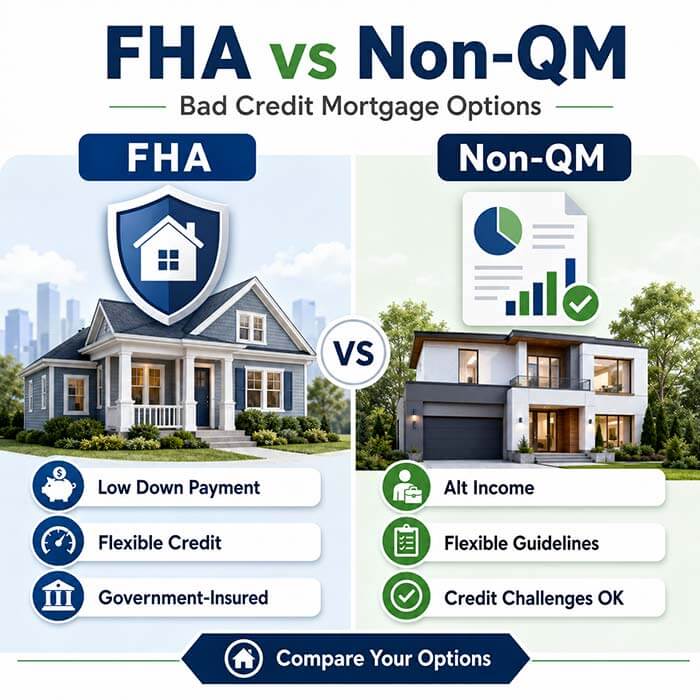
The Federal Housing Administration (FHA) is a subsidiary of the United States Department Of Housing And Urban Development (HUD). Federal Housing Administration, also known as FHA, is not a mortgage company nor does it originate, process, underwrite, fund, or service FHA Loans.
Every FHA loan will have insurance that helps the lender if the loan defaults on payment. A lump sum charge is made upon obtaining the loan, and an annual payment is made for insurance.
Most folks have heard of FHA loans. Most folks do not realize HUD is a government agency that has nothing to do with funding FHA Loans. The mission of HUD is to promote and help hard-working American families become homeowners by making FHA loans easy to qualify with low down payments and less than perfect credit.
The Role Of HUD On FHA Loans
The main function and role of HUD are to insure FHA Loans. HUD insures loans that are originated, processed, underwritten, and funded by private banks and mortgage companies who are HUD-approved lenders. HUD insures lenders against default and losses in the event borrowers default on their FHA loans. In order for HUD to insure FHA Loans from private lenders, the FHA loans need to meet the minimum HUD guidelines for FHA loans. Qualifying for FHA loans with bad credit is definitely doable because FHA has lenient mortgage lending guidelines.
FHA Credit Score Requirements
HUD requires a minimum of a 580 FICO credit score to qualify for a 3.5% down payment home purchase mortgage loan. HUD allows borrowers under 580 FICO are eligible to qualify for an FHA loan. However, borrowers with under 580 credit scores require a 10% down payment versus a 3.5% down payment.
FHA Down Payment Requirements For Borrowers With Under 580 Credit Scores
If the borrower’s credit scores are below 580 credit scores, HUD considers borrowers higher-risk borrowers. This is considered to have an added layered risk. With borrowers with credit scores under 580 FICO, the mortgage rates are higher than those with over 580 FICO or higher. Debt to income ratio requirements is normally lower to get an approve/eligible per automated underwriting system for FHA borrowers with credit scores under 580 FICO.
FHA Debt To Income Ratio Requirements
In general, HUD will cap the front-end debt to income ratio at 46.9% and the back-end debt to income ratio at 56.9%. High debt-to-income ratios are alarming for lenders due to concerns about the borrower’s ability to repay their new mortgage payments. Rental Verification may be required for borrowers by many mortgage underwriters who have concerns about the borrower’s ability to repay their new mortgage payments. VOR (Verification Of Rent) may be required if the Automated Underwriting System conditions it.
Use bank statements instead of tax returns
12–24 months of deposits can qualify self-employed borrowers under Non-QMFHA Loan Requirements With With Late Payments
Borrowers can qualify for FHA loans with bad credit with low credit scores. However, borrowers cannot have late payments in the past 12 months, especially a mortgage late payment. HUD understands that people can have gone through periods of bad credit due to extenuating circumstances such as periods of unemployment, divorce, and medical issues.
Rebuilding Credit To Qualify For a Mortgage
FHA wants to see borrowers who have recovered, re-established their credit. Borrowers need to have been timely on their monthly minimum payments for the past 12 months. One or two late payments in the past 12 months may not be a deal killer with a good letter of explanation. Multiple late payments will be an issue.
For borrowers who had multiple recent late payments and want to qualify for an FHA loan, the best advice I can give is to add new credit such as secured credit cards.
Let the new positive credit drown the negative credit and let it season before applying for an FHA loan. A non-QM loan doesn’t satisfy the requirements the CFPB sets for primary and secondary mortgages. Such loans cater to individuals with unique financial circumstances, such as self-employed individuals or those with non-traditional income streams.
FHA Loans For Bad Credit With Collection Accounts
Homebuyers can qualify for FHA and Non-QM loans for bad credit with low credit scores. Both loan programs do not require borrowers to pay outstanding collection and/or charged-off accounts. On FHA loans, if the unpaid collection accounts are non-medical and total $2,000 or more, then 5% of the unpaid collection account balance will be used to calculate borrowers’ debt to income ratios. This holds true unless a written payment agreement is made with the creditor.
Written Payment Agreement With Creditor on Outstanding Debts
If a written payment agreement is made between the creditor and debtor, the agreed monthly payment will be used to calculate the debt to income ratios. Medical collection accounts and charge offs do not matter and are exempt from this rule.
Depending on the non-QM lender, they may just exclude collections and/or credit disputes or may have their own individual rules on derogatory credit tradelines. Everything is negotiable on non-QM and specialty alternative mortgage loan programs.
FHA and Non-QM loans are thoroughly examined in this detailed consideration, presented in easy-to-understand language. The analysis outlines both the positives and negatives, credit score outcomes, requirements, including down payment, and the scenarios in which FHA versus Non-QM loans are an optimal fit for individuals with bad credit.
FHA Verses Non-QM Loans for Bad Credit Borrowers
Having bad credit does not necessarily mean you will be denied the opportunity to become a homeowner. The mortgage market as of today provides you with the following options when you are a low-credit-score borrower or have had recent late payments, unpaid collections, or a bankruptcy history:
FHA loans
Non-QM (Non-Qualified Mortgage) Loans
- Knowing and understanding the differences between FHA and Non-QM loans for borrowers with bad credit can save you a considerable amount of time, money, and frustration.
- Each program contains its own distinct regulations, advantages, and disadvantages.
- When choosing, consider your credit score, income, the type of property you are purchasing, and the urgency or necessity of the closing time.
- Gustan Cho Associates is a nationally based mortgage company that has no lender overlays on FHA loans, as well as an entire list of Non-QM programs available for credit-challenged borrowers.
- In the following chapters, we answer everything you need to know when comparing FHA vs. Non-QM loans for borrowers with bad credit.
What Is An FHA Loan?
What Is An FHA Loan In Short
An FHA loan is a type of real estate loan protected by the United States Federal government. The Federal Housing Administration sponsors it.
It’s Meant For:
- People are purchasing their first home.
- People with a lower credit score.
- Individuals who are unable to afford a large down payment.
Some Unique Features of FHA Loans Are:
- Available only for primary mortgages (you must reside in the dwelling).
- More lenient credit score requirements than most other mortgage loans.
- High DTI (debt-to-income) ratios are acceptable with strong compensating factors.
- Great for those who limit their down payments and want easy approval.
What Is An Example Of A Non Qualified Mortgage Loan?
What Is An Example Of A Non Qualified Mortgage Loan
- Non-QM means Non-Qualified Mortgage.
These are types of alternative loans that do not adhere to the Fannie Mae, Freddie Mac, or FHA Qualified Mortgage guidelines.Non-QM loans were created specifically for:
- Self-employed individuals who possess considerable cash flow but have minimal taxable income.
- Real estate investors who want to apply using rental income instead of personal income.
- Applicants who have recently declared bankruptcies, foreclosures, and short sales.
- Applicants with bad credit who do not qualify for FHA and conventional loans.
Non-QM Loans Include, But Are Not Limited To, The Following:
- Bank statement loans: These loans are defined as those that qualify based on personal or business bank deposits.
- DSCR loans: Debt Service Coverage Ratio loans for Investment properties.
- Recent credit event loans:Loans that have little or no waiting periods after a bankruptcy or foreclosure.
- Certain programs have interest-only options.
Non-QM Loans Are More Flexible Than Other Loans. However, They Typically Have:
- Higher interest rates.
- A larger down payment.
- Additional reserve requirements (months of mortgage payments in the bank).
Comparison of FHA Versus Non-QM Loans for Bad Credit Borrowers
Minimum Credit Score and Credit Profile
FHA Loans
- Most lending organizations require a credit score of 580 or higher with a 3.5% down payment.
- Scores as low as 500 may be acceptable; however, many banks do not set their floor that low.
- A history of late payments and collections is allowable as long as there is a sufficient explanation for the charge-offs.
- You meet other approval guidelines.
Non-QM Loans
- Many investors accept lower credit scores than those required for conventional loans, sometimes as low as the 500s.
More forgiving of:
- Recent late payments.
- Large collections.
- Recent bankruptcies or foreclosures.
- Your overall story and ability to repay matter more than rigid score cutoffs.
- Big picture: If your credit is bruised but not totally damaged and you can wait out the standard FHA waiting periods, FHA is often a more affordable option.
- If you have very recent credit damage, a Non-QM loan may be your only option.
Avoid monthly MI with certain Non-QM loans
Compare FHA MIP versus Non-QM options that skip mortgage insuranceRequirements for Down Payment
FHA Loans:
- Qualifying scores have 3.5% down.
- Credit scores of 500 and 579 require a 10% down payment.
- Gifts from family, employers, and other approved sources are acceptable.
- The seller can contribute 6% of the purchase price toward the closing costs.
Non-QM Loans:
The range is usually 10% to 30% down, depending on the:
- Program type.
- Credit score.
- Property type.
- Investor loans with a DSCR might require a larger down payment for lower credit scores or weak cash flow.
- Seller contributions towards closing costs for FHA are generally more than for other options.
- Overall, those with poor credit and limited cash generally benefit from the FHA’s down payment requirements.
Mortgage Rates and Monthly Payments
FHA Loans:
- Tend to offer cheaper interest rates than Non-QM.
- Charge upfront and monthly mortgage insurance premiums (MIP) during the life of the loan.
- Although MIP is included, the total monthly payment can still be competitive for borrowers with bad credit.
Non-QM Loans:
Interest rates are almost always more expensive than FHA because:
- There is little to no government-issued mortgage insurance; however, the risk is factored into the rate and terms.
- The guidelines are less strict.
- The lenders take on more risk.
- Abstract: Non-QM loans for primary residences are more expensive to borrowers with bad credit than FHA loans.
- If you qualify for an FHA loan, it offers the lowest monthly payments compared to a Non-QM loan.
- Further, Non-QM loans are still more expensive than FHA loans.
Style Regarding Approval and Documentation of Income
FHA Loans
Requires documentation of income in full:
- W-2s, pay stubs, and tax returns if required.
- Self-employed individuals: Typically, two years of tax returns are required in most situations.
- Underwriters verify the income and employment history to assess stability.
- Loans are required to pass the automated underwriting system (AUS) or are manually underwritten and applied to the strict FHA guidelines.
Non-QM Loans
Designed for situations where traditional income documents do not provide the full picture:
- Bank statement loans assess income using 12 – 24 months of bank deposits.
- DSCR loans base the qualification of investment property buyers solely on rental income.
- Some programs permit a 1-year self-employed income history or income from atypical sources.
- These loans are underwritten on a case-by-case basis and are more common sense.
- Big picture: If income documentation is straightforward, FHA is excellent.
- If you are self-employed, have significant write-offs, or rely on rental or investment income, Non-QM may be a suitable option.
Property Type and Occupancy
FHA Loans:
- Only for primary residence.
- You must live in the home you are buying.
Can Be:
- Single-family homes.
- FHA-approved condos.
- 2–4 unit homes (you must live in one unit).
Non-QM Loans:
Can be used for:
- Primary homes.
- Second homes.
- Investment properties.
- Popular for borrowers building a portfolio of rental properties using DSCR and bank statement options.
- Big picture: If you want to buy an investment property with bad credit, Non-QM loans are usually the only option.
Recent Bankruptcies, Foreclosures, and Major Credit Events
FHA Loans:
Standard Waiting Periods (these can vary by situation and guideline changes), often:
- Chapter 7 bankruptcy: Typically, 2 years from discharge.
- Chapter 13 bankruptcy: Possible while in the plan with on-time payments and trustee approval.
- Foreclosure or short sale: Usually 3 years from the event.
Non-QM Loans:
Some programs allow:
- No waiting period after bankruptcy or foreclosure.
- Or very short waiting periods (like 1 year) with strong compensating factors.
- Expect higher down payments and higher rates when the event is very recent.
- Big picture: If you cannot wait for FHA timelines, Non-QM loans can give you a faster route back into homeownership.
When FHA Is Better for Bad Credit Borrowers
Situations Where FHA Shines
FHA loans are most advantageous to borrowers with bad credit if any of the following are true:
- You are purchasing your first home.
Your credit score is low, but you have a:
- Steady job for quite some time.
- Proof of the above income earmarked for.
- Funds earmarked for a down payment.
- You want a cheaper FHA monthly payment.
- You can, after a set period following bankruptcy, foreclosure, or short sale, FHA waiting periods apply.
Examples
- You have a credit score between 580 and 620.
- You are a W-2 employee, have some aged collections, and want to buy a first home with a 3.5% down payment.
- You, on the other hand, had a Chapter 13 bankruptcy.
- You have made timely scheduled payments and have trustee approval, and now want to buy a home.
- In these FHA and Non-QM loans for borrowers with bad credit, the scale certainly tips in favor of FHA due to its competitive pricing and smaller down payment requirements.
Improve approval odds with compensating factors
Reserves, VOR, and payment-shock control help FHA and Non-QM decisionsNon-QM Loans for Bad Credit and Niche Situations
Situations Where Non-QM Loans are Preferred
Non-QM financing may be the preferred option when:
- You are self-employed and expense all your bank statements.
- You are low-income, classified as low-income based on your tax returns. However, your bank statements indicate a steady inflow of income.
- You are purchasing investment properties or building a rental property portfolio.
- You’ve filed for a bankruptcy, foreclosure, or short sale, and do not want to follow the FHA timelines.
- You have an unconventional income and a complex financial situation.
For instance,
- As a business owner with a score of 620 and strong cash flow, your taxable income is really low.
- A Bank Statement Non-QM Loan lets you qualify without tax returns for a loan.
- You have a score of 600 and are interested in buying a rental property.
- You qualify for a DSCR loan by using the property’s rental income.
- You just came out of Chapter 7 bankruptcy 6 to 12 months ago, even though you have a large down payment. A Non-QM loan may still allow you to buy after rebuilding some credit.
- In the case of FHA Versus Non-QM Loans for Borrowers with Bad Credit, the Non-QM’s high interest rate is offset by the flexible approval process, making the deal possible.
Pros and Cons of FHA Versus Non-QM Loans for Bad Credit Borrowers
Pros of FHA Loans
- More affordable interest rates than most Non-QM options.
- Lower down payment (as low as 3.5%).
- Credit issues are accepted, provided you comply with the applicable waiting periods.
- Backed by the government and readily available.
- Excellent for primary residences and first-time buyers.
Cons of FHA Loans
- MIP (mortgage insurance premium)
- Increases the monthly payment.
- .Owner-occupied only.
- No other investment properties or second homes.
- Complete paperwork – tax returns, W-2s, and pay stubs.
- Credit-related waiting periods.
Pros of Non-QM Loans
- Income documentation with more flexible options (bank statements, DSCR, etc.).
- Available for primary, second, and investment properties.
- No to very brief waiting periods after bankruptcy, foreclosure, or short sales.
- For self-employed and real estate investors.
- More emphasis on the ability to repay, as opposed to only considering credit score and other rigid terms.
Cons of Non-QM Loans
- Interest rates are higher than those for FHA.
- Larger down payment (sometimes 10-30%).
- More rigid reserve limitations.
- Closing costs may be greater.
- Vary with each lender and investor in the program, as well as the terms.
How to Choose Between FHA and Non-QM for Bad Credit
Step-by-Step Decision Guide
- Define Your Goal.
- To purchase a home and live in it?
- Start with the FHA.
- To purchase or to expand rentals?
- Non-QM/DSCR needs to be analyzed.
Review Your Credit and History
- Scoring above 580 with older credit problems? FHA usually wins.
- A major credit event recently occurred, and it is still unresolved.
- Non-QM is something you may need.
Look at Your Income Documentation
- Easiest is W-2 income and uncomplicated returns? FHA is usually best.
- Self-employed with low-taxed income but high deposits?
- Apply for Non-QM on Bank Statements.
Count Your Available Cash
- Small down payment?
- FHA is more realistic.
- Large Down payment with high cash reserves?
- Non-QM is a good option.
Compare Total Payment and Long-Term Plans
- The payment today for FHA may be lower.
- FHA is a payment option for the future.
- Non-QM is for now.
- You, more often than not, have the option to refinance to an FHA or conventional mortgage in the future whenever your credit improves.
Why Partner with a Lender That Provides Both FHA and Non-QM
- Instead of offering a multitude of mortgage products, many banks tend to focus on one lane, offering a strict agency loan or a limited Non-QM menu.
Here at Gustan Cho Associates, we provide many options:
- FHA loans with no lender overlays.
- Full suite of Non-QM programs (bank statement, DSCR, recent credit event, and more).
Since we offer so many options, we can:
- Analyze your full credit and income profile.
- Explain the advantages and disadvantages of FHA versus Non-QM loans with bad credit.
- Provide you with multiple options: what it takes to qualify now and what it would take to qualify at a later time to get better terms.
- You are not a prisoner of having no options.
- A strategy is tailored to your goals and specific situation.
FAQs About FHA Versus Non-QM Loans For Bad Credit
Is it Possible to obtain an FHA Loan For Bad Credit?
Yes, every day borrowers with bad credit are obtaining FHA loans. FHA is designed for borrowers with a lower credit score and past credit issues.
Which is Cheaper, FHA or Non-QM?
The non-QM product, in comparison to the Non-QM loan, is nonexistent.
In all other aspects, borrowers with bad credit who are purchasing a primary residence are generally better off with an FHA loan. This is because the Non-QM product is the only option available to you if you do not meet the income or credit requirements for FHA.
Can I Refinance Out of a Non-QM Loan Later?
Many borrowers consider a Non-QM loan a type of bridge. Refinancing is not a hassle for borrowers with suspended payments after a bankruptcy, and the same applies to other requirements, such as paying off the approved balance, improving credit scores, or stabilizing income. These loans make the transition to an FHA or a conventional loan with better terms much smoother.
Does a Non-QM Loan Require a Mortgage Policy?
FHA does. Non-QM does not use standard government mortgage insurance.
In fact, Non-QM loans include the risk within the interest rate and the down payment requirements. Non-QM loans do not come with the FHA-style MIP, but they do have higher rates and cash-to-close requirements, as funding for Non-QM loans can be more expensive.
Does HUD Allow The Purchase of Investment Properties?
Investment properties are a big no. FHA loans are strictly for primary residences that you will occupy. Suppose you are looking for a loan to buy an investment property with bad credit. In that case, you will need a Non-QM, DSCR, or another loan program specifically designed for investors.
Who is an FHA or Non-QM Loan Better For Among Self-Employed Borrowers?
It’s not a simple answer. FHA can be a significant benefit for borrowers with strong net incomes and low tax payment requirements. If your tax returns are low because of write-offs, you may benefit from a Non-QM bank statement loan because it is much easier to get. A Non-QM loan does not look at tax returns, but rather bank deposits to determine income.
How Long Should I Wait After Filing Bankruptcy Before Applying For a Non-QM Loan?
Some Non-QM programs have no waiting period after bankruptcy or foreclosure. In contrast, others require a period of 6 to 12 months or even longer. The trade-off will always be more money down and a higher interest rate. With Non-QM loans, the waiting period is usually significantly shorter than with other options, and one can expect more recent slip-ups on their credit report to be taken into account.
Will Having Bad Credit Automatically Disqualify Me From Applying For a Non-QM Loan?
No. Many Non-QM lenders work specifically with bad-credit borrowers.
You do not need perfect credit, but you must demonstrate the ability to make the payment. Even without perfect credit, a higher down payment, reserves, and strong income or rental cash flow can make a big difference.
How Will I Know if I Should Choose Between FHA And Non-QM Loans?
You should first reach out to a lender with experience in both FHA and Non-QM loans.
A loan officer can:
- Assist you in reviewing your credit report.
- Look at your income, bank statements, and assets.
- Present FHA and Non-QM case studies on a computer.
- Help you set a timeline and your goals.
- Suppose you have already started working on FHA versus non-QM loans for borrowers with bad credit and need concrete information. In that case, you will not need to guess.
- Find a lender who deals with bad credit, FHA, and Non-QM loans and helps borrowers across the country.
- Let the lender create a program specifically tailored to your needs.
Contact Us To Go Over Mortgage Options On FHA Versus Non-QM Loans For Bad Credit
Homebuyers who need to qualify for bad credit mortgages with lower credit scores with a mortgage company licensed in multiple states with no lender overlays on FHA loans and are mortgage brokers on non-QM loans, please contact us at Gustan Cho Associates at 800-900-8569 or text us for a faster response. Or email us at gcho@gustancho.com.
The team at Gustan Cho Associates is available 7 days a week, on evenings, weekends, and holidays. Gustan Cho Associates has a national reputation for not having lender overlays on government and conventional loans.
We have dozens of lending partnerships with non-QM wholesale lenders so we have many alternative loan programs available for our clients. We have been known to be a one-stop lending shop for being able to do loans other mortgage companies cannot do. Some of our more popular non-QM loan programs are no-doc mortgages, bank statement loans, asset-depletion loans, 90% LTV jumbo loans, and dozens of other non-QM mortgages on owner-occupant homes, and second homes, and investment properties.