Property tax prorations split property taxes between the buyer and seller based on their ownership duration during the tax period. In many areas where taxes are paid in arrears, the seller may provide the buyer with a credit at closing. That credit
can reduce the buyer’s cash-to-close, but how it is treated depends on the loan program, escrow setup, purchase contract, and lender requirements.
What Are Property Tax Prorations?
The seller’s and buyer’s property tax responsibilities are prorated to the new owner when a sale occurs within a given tax period. The seller bears responsibility for payment of taxes for the period the seller owned the property, while the buyer’s responsibility for payment of taxes for the property begins after closing. In the closing disclosure, the proration is shown as a credit against what the buyer must bring to close. The amount of the credit may vary depending on the purchase contract and the locale’s customary closing practices.
Why Property Tax Prorations Matter
A seller’s tax credit, in effect, provides a subsidy to the buyer. However, the credit for the taxes should not be viewed as a subsidy or as a surrogate for the buyer’s obligation to provide funds that the mortgage approval requires to be documented.
How Property Tax Prorations Are Calculated
At closing, the closing agent typically handles the proration of property taxes between the seller and buyer. Generally, the proration is based on the most recent tax bill and the number of days each party retains a responsibility for the property. For example, the proration of the $7,300 annual property tax is $20 per day. If the seller is responsible for 150 days of this period, the seller would owe $3,000. Finally, it should be noted that the actual amount on this year’s tax bill has not yet been determined. Some contracts allow the closing agent to estimate taxes, use the previous year’s taxes, or apply a negotiated percentage. It is important to review the amount prorated on the closing disclosure. In many cases, taxes paid in the previous year will be less than what is actually owed.
Property Taxes Paid in Arrears vs Paid in Advance
How tax adjustments are made largely depends on when taxes are collected within the state or local jurisdiction.
Property Taxes Paid in Arrears
When property taxes are paid in arrears, a bill that arrives after closing may cover the period the seller owned the home. The seller typically gives the buyer a credit at closing for taxes attributable to the seller’s ownership period that the buyer will pay later. The amount depends on the tax period, the closing date, and the purchase contract.
Property Taxes Paid in Advance
When taxes are paid in advance, the seller may have paid taxes for a period beyond the closing date. In this case, the buyer will owe the seller a portion of the taxes paid in advance. For this reason, tax prorations are not always a credit to the buyer. The direction of the adjustment is determined by the tax payment and the closing date.
Can Property Tax Prorations Reduce Cash to Close?
Yes, because a legitimate property tax credit from the seller can reduce the cash a buyer must bring to the closing table. However, decreasing cash to close does not necessarily satisfy a mortgage program requirement for the minimum down payment or the borrower’s required contribution. The distinction between decreasing cash to close and meeting a mortgage program requirement can depend on a program’s rules for verifying a borrower’s contribution.
Example: How a Tax Proration Changes Cash to Close
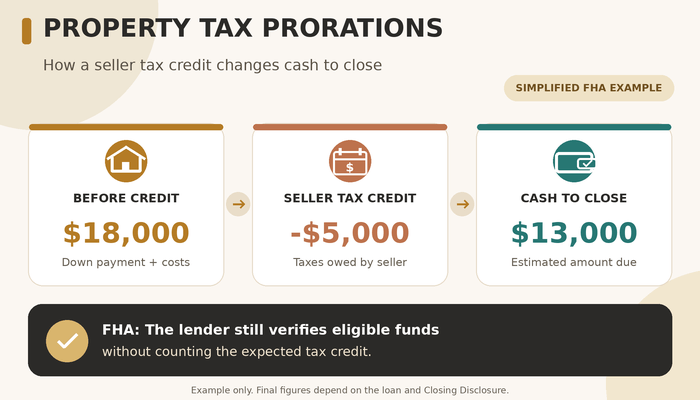
Suppose an FHA buyer has $18,000 due at closing before tax adjustments: $10,500 for the minimum required investment and $7,500 for closing costs, prepaid items, and initial escrow. The seller owes a $5,000 property tax proration, which the buyer will pay after closing. $18,000 otherwise due − $5,000 seller tax proration = $13,000 cash to close. The lower closing amount does not eliminate FHA’s asset check. At underwriting, the lender must document sufficient eligible funds for the minimum required investment, the buyer’s closing costs, and prepaid items, without counting the expected tax credit. The credit can then reduce what the buyer brings to closing. These figures are simplified and assume no earnest-money deposit or other credits.
How Mortgage Programs Treat Property Tax Proration Credits
There is no single rule that applies to FHA, conventional, VA, and USDA loans. The treatment of a tax credit depends on the mortgage program and how the transaction is structured.
Confused by Tax Prorations on the Closing Disclosure?
Property tax adjustments can appear as buyer charges or seller credits depending on timing and local tax practices. Get help reading the numbers before closing day.FHA Property Tax Prorations
In areas where property taxes are paid in arrears, FHA permits the seller’s property tax credit to count toward the borrower’s minimum required investment (MRI). At underwriting, the lender must document that the borrower has sufficient assets for the MRI, closing costs, and other prepaid items without counting the expected tax credit. The borrower may then bring part of the MRI to closing and combine it with the seller’s tax credit to meet the total requirement. A large expected credit does not remove the need to document the required funds.
Fannie Mae Property Conventional Loans
Fannie Mae does not treat a legitimate prorated property tax credit as an interested-party contribution. The lender generally cannot count the credit when deciding whether the borrower has sufficient assets for the purchase. There is an exception when the Closing Disclosure shows an escrow account that includes taxes owed for the seller’s ownership period: the seller’s tax credit may offset all or part of that escrow deposit. The credit may reduce cash-to-close, but it does not replace the lender’s verification of the borrower’s required funds. If escrow taxes for the period of the seller’s ownership are in the escrow, a tax credit for the seller may satisfy all or a portion of this escrow obligation.
Freddie Mac Conventional Loans
Freddie Mac permits a prorated tax credit to be relevant in a particular situation. On the Closing Disclosure, the escrow established for the seller’s real property tax obligation must be shown. The credit may then satisfy this portion of the deposit in escrow.
VA Loans
VA purchase loans normally have no down payment for eligible borrowers as long as the purchase price is lower than the property’s reasonable value. As such, the effect of a tax proration is mostly an issue of closing costs and prepaid expenses. VA allows buyers and sellers to negotiate closing costs, including taxes, but such seller concessions are subject to VA rules. A tax proration should therefore be shown and dealt with in accordance with the closing documents rather than being treated as a seller concession.
USDA Loans
USDA Guaranteed loans: When taxes are paid in arrears, USDA instructs lenders to enter the seller’s prorated taxes in the seller-credit section of the Guaranteed Underwriting System (GUS). USDA treats the amount as a seller credit, not a seller concession, because it covers taxes the seller owes. USDA Direct loans: USDA requires the buyer’s and seller’s taxes to be prorated. Its Direct-loan handbook says the seller’s share is collected at closing to pay the borrower’s closing costs or initial escrow deposit. The prorated funds generally cannot be paid directly to the borrower, except as reimbursement for certain items the borrower paid outside closing. The closing agent records the proration on the Closing Disclosure.
Property Tax Prorations vs. Seller Concessions
 Property tax prorations and seller concessions are not the same thing.
A property tax proration divides the property tax obligation between the buyer and seller based on their periods of ownership. It is an adjustment connected to taxes owed or already paid.
A seller concession is a negotiated contribution from the seller toward eligible buyer costs, such as closing costs or prepaid expenses. Mortgage programs place limits and conditions on seller concessions. For example, Fannie Mae states that a legitimate prorated real estate tax credit in an area where taxes are paid in arrears is not an interested-party contribution. It is therefore treated differently from an ordinary seller concession. Keeping these two items separate is important because they can affect underwriting and cash-to-close in different ways.
Illinois Property Tax Proration Example
Illinois sellers generally pay outstanding property tax bills and provide the buyer with a credit for the time they owned the property before closing, according to the real estate contract. Buyers generally pay bills that come due after closing.
Example of an Illinois Tax Proration
Assume estimated annual taxes are $9,125 and the seller is responsible for 200 days. Using a 365-day year, that is $25 per day, or a $5,000 seller credit. The buyer could receive approximately $5,000 as a tax adjustment at closing. The actual amount may vary depending on the closing date, prior tax bill, contractual proration percentage, exemptions, reassessments, and local closing practices. The purchase contract should determine how the final calculation is made.
How Tax Prorations Appear on the Closing Disclosure
Property tax adjustments should be reflected on the Closing Disclosure so the buyer and seller can see how the taxes affect the transaction. When the seller owes taxes for a period before closing that the buyer will pay later, the adjustment can appear under Adjustments for Items Unpaid by Seller. This reduces the buyer’s final cash-to-close calculation. When the seller has already paid taxes covering a period after closing, the buyer may instead reimburse the seller. Those amounts can appear under Adjustments for Items Paid by Seller in Advance. CFPB rules specifically address prorated city, town, and county taxes in these adjustments.
Review the Final Numbers Before Closing
Buyers should compare the property-tax adjustment on the Closing Disclosure with the purchase contract and the most recent available tax information. A large change in the tax proration can change the amount of money required at closing, even when the mortgage loan amount has not changed.
Can a Buyer Receive Cash Back From Property Tax Prorations?
Sometimes. Both Fannie Mae and Freddie Mac permit cash back from a legitimate seller tax proration in an area where property taxes are paid in arrears. Fannie Mae requires the lender to confirm that the borrower has met any minimum contribution required by the loan product. Freddie Mac likewise requires any applicable minimum borrower contribution to be met at closing; if projected cash back would prevent that, the excess must be applied to reduce the loan principal. A tax credit on the Closing Disclosure does not automatically mean the buyer will receive a check. The lender and closing agent must confirm the amount, the loan program’s rules, and the final settlement figures. Buyers should ask for a reviewed cash-to-close estimate before relying on any expected cash back.
What Buyers Should Verify Before Closing
Property tax prorations are normally calculated near closing, but buyers should review the expected treatment before the final closing disclosure is issued.
Check the Property Tax Amount
Review the most recent tax bill and find out whether the amount is based on the home’s current assessment. A recent sale, new construction, reassessment, or expired exemption can cause future taxes to differ from the amount used for the closing calculation.
Review the Purchase Contract
The contract may specify how taxes are prorated, which tax bill is used, whether an estimated percentage applies, and whether the parties can later recalculate the amount.
Confirm How the Mortgage Program Treats the Credit
Ask the lender how the expected tax credit affects documented assets, escrow requirements, cash to close, and any required borrower contribution. A tax credit appearing on the closing disclosure does not necessarily mean the borrower can use it in the same way under every loan program.
Review the Final Closing Disclosure
Check the tax adjustments, seller credits, escrow deposit, down payment, and final cash-to-close figure before sending funds. The CFPB distinguishes total closing costs from cash to close, which is the actual amount the borrower must provide at settlement. Property tax adjustments can be among the factors that affect the final number.
Final Thoughts on Property Tax Prorations
Property tax prorations can affect a buyer’s out-of-pocket cost at the closing table. This is especially true in places where property taxes are collected after the fact. Reading the fine print on the mortgage is advisable for all buyers, but ultimately, a buyer should know how the particular mortgage program will treat the tax credit. Buyers should carefully examine the purchase contract, expected tax adjustment, how their escrow will be set up, and their Closing Disclosure with their lender and closing agent. Because all loan types treat tax credits differently (particularly regarding required cash, contributions, and cash back), they should carefully examine each of their loans (FHA, conventional, VA, USDA, etc.). If the terms and definitions for prorations are specific and known before closing, the transaction will be much less stressful and be in compliance with the requirements of the mortgage loans.
FAQs About Property Tax Prorations
Can Property Tax Prorations Change After the home closing?
Yes. If the final tax bill was not available at closing, the parties may have used an estimated amount. Whether the buyer and seller later adjust the difference depends on the purchase contract and local closing practices.
Does the Closing Date Affect the Property Tax Proration Amount?
Yes. The closing date determines how many days of the tax period are assigned to the buyer and seller. Therefore, moving the closing date can increase or decrease the tax adjustment.
How do Homestead Exemptions Affect Property Tax Prorations?
A seller’s homestead or exemption may decrease the proration of the tax bill, but the buyer may not qualify for the same exemption. Buyers should not assume the prorated tax amount at closing will equal the proration of future property taxes.
Can Property Taxes Increase After Buying a Home?
Yes. Property taxes can increase for several reasons, including reassessments, the removal of exemptions, new construction, and changes in local tax rates. The buyer’s property tax proration can be higher than the proration for the sale at closing.
Who Calculates the Property Tax Proration at Closing?
The title company, closing attorney, or settlement agent conducts the closing proration based on the purchase agreement and available tax data.
What Happens with a Property Tax Bill that Arrives After the Seller Moves Out?
Generally, responsibility depends on the bill’s coverage period and the purchase agreement’s terms. A tax bill delivered after closing may include taxes for the period of time the seller owned the property. This is one reason the parties make a tax adjustment at settlement.
Can an Escrow Shortage Occur Even After Taxes were Prorated Correctly?
Yes. Prorations for property taxes determine how tax responsibility is divided between the buyer and seller at closing. A mortgage escrow account is separate. If taxes or insurance costs increase in the future, the servicer may determine that the escrow account has a shortage, even if the closing proration was correct.
This article about “Property Tax Prorations at Closing: How Credits Affect Cash to Close” was updated on September 23rd, 2026.