FHA Spot Loans for Non-HUD-Approved Condominiums: 2026 Resource
FHA spot loans allow eligible homebuyers to finance or refinance a single unit in a condominium project that does not have HUD approval. The term “FHA spot loan” is informal; HUD’s official term is FHA Single-Unit Approval. FHA Single-Unit Approval is subject to all FHA condominium guidelines. FHA will not approve a spot loan for any borrower, unit, or condominium project that does not meet these requirements. HUD permits FHA loans for units in approved condo projects and for Single-Unit Approval in projects that are not fully approved.
Can FHA Loans be Used to Finance Condominiums That Do Not Have the FHA’s Approval?
Yes. FHA Single-Unit Approval allows financing of a condominium unit within a project that is not HUD-approved.
The Project Must Meet the Following Criteria:
- Be complete and ready to be occupied.
- Consist of five or more dwelling units.
- Not be an FHA-approved project at the time of the review.
- Not be a manufactured home condominium project.
- Meet HUD requirements for owner occupancy, FHA loan concentration, project and association finances, and insurance.
- Lenders must also assess whether a borrower meets the qualifications for an FHA mortgage and whether the condo unit meets the FHA’s property standards.
What are FHA Spot Loans?
FHA spot loans refer to FHA-insured mortgages for individual condo units in condo projects that lack FHA’s active project approval. This terminology became popular because the review process looks at a single unit rather than approval for the entire condo development.
Prior to 2010, FHA used the former spot-approval process. FHA’s new condo policy, which incorporates the Single Unit Approval process, came into effect on October 15, 2019.
The current process differs from the previous spot-approval program. Even when FHA insurance is requested for a single unit, the lender must review comprehensive information about the entire condominium project.
FHA Spot Loan vs. FHA Single-Unit Approval
Although the terms FHA spot loans and spot approvals are commonly used by borrowers, real estate agents, and mortgage professionals, HUD’s official term is FHA Single-Unit Approval.
A condo project that received FHA’s project-level approval has active approval and is listed in HUD’s eligible condo list. If a project isn’t FHA-approved, Single-Unit Approval can be given for one eligible unit.
The rest of the development stays unapproved for future FHA borrowers’s future borrowers. HUD defines Single-Unit Approval as the approval for a unit within a condo project that does not have an approved condo project. What Changed for FHA Condo CasIn May 2026, FHA updated its processes in May 2026.
As of May 26, 2026, FHA Connection May Automatically Assign Case Numbers for Some Requests for Single-Unit Approval That Pertain to Formerly Registered Condominium Projects with One of the Following Statuses:
- Expired.
- Rejected – Register SUA.
- Prior to this system change, lenders were required to provide unit details for manual case-number assignment in the above situations.
- This change may improve processing efficiency, but it does not expand the FHA condo program or automatically approve any condo project or unit.
- The lender must still complete the full Single-Unit Approval process.
What Are the Requirements for FHA Spot Loans on Non-HUD-Approved Condos?
Not all units in a non-approved condo project are eligible. FHA reviews the unit, the project, and several key factors related to the condominium.
The Condominium Project Must Be Complete
Single-Unit Approval applies to projects that are fully completed and ready for occupancy. Projects that are still under construction or lack key amenities may require different FHA reviews. Buyers should verify the legal and construction status before paying for an appraisal or inspection. For the FHA Single Unit Approval, the condominium project must have a minimum of five dwelling units. Single-Unit Approval generally does not apply to condo projects with only two to four units. The lender should determine if another FHA property type or mortgage is more appropriate.
Manufactured Homes Are Not Applicable for Single-Unit Approval
Manufactured homes are not eligible for FHA Single-Unit Approval on an individual basis. This does not indicate that manufactured homes are ineligible for FHA financing. Instead, it indicates that a manufactured home condominium unit may not use the Single-Unit Approval for a non-participating condo project.
FHA Insurance Concentration Is Restricted
FHA limits the number of units in a non-participating condo project that may be awarded Single-Unit Approval and FHA insurance. For projects that contain 10 or more units, FHA Single-Unit Approvals may be offered for no more than 10% of the total number of units. For projects with fewer than 10 units, the limit is 2 units. An applicant may meet individual qualification criteria but can still be denied if the condominium project has reached the FHA concentration limit.
Occupancy Is Important
FHA reviews the number of owner-occupied units, as projects with mostly rental or investor-owned units may present higher financial or management risk. In certain lower-risk situations, a reduced owner-occupancy threshold may be accepted with additional financial conditions. The lender should calculate occupancy using HUD’s definition rather than the association’s informal estimate. Form HUD-9991 will have the association or lender specify owner-occupied, non-owner-occupied units, and the project’s construction type.
FHA Scrutinizes Individual Unit Ownership
The lender should determine if an individual, organization, investor, or developer owns too many units. A high concentration of unit ownership can place the association in a precarious financial situation. The association may suffer negative financial consequences if the one remaining investor stops paying assessments. The HUD-9991 form asks whether a single owner can own multiple units and whether the project satisfies FHA’s individual owner-concentration standard.
Financial Assessment of the HOA for FHA Financing of Condos
A condominium may be well-maintained and desirable, yet still fail to meet the FHA’s financial review requirements. The lender should determine if the condominium association has sufficient income and reserves to meet its financial obligations, with the necessary insurance to protect the association.
Association Dues and Units Level of Compliance
Units in arrears are those more than 60 days past due on association dues or special assessments. A high rate of delinquent owners can undermine the association’s ability to meet contractual obligations. Form HUD-9991 requires the project to report how many units are in arrears (i.e., past due) by more than 60 days. The lender must verify compliance with the applicable HUD limit rather than accept an oral statement from the listing agent or the seller.
Operating Budgets and Reserve Funds
The Lender Might Examine:
- The association’s currently approved budget.
- Reserve-account balance and operating funds.
- Prior year financial results.
- Year-to-date income and expenses.
- The current balance sheet.
- Annual association dues.
- Existing and/or proposed special assessments.
- HUD currently lists these financial areas in the Single-Unit Approval documentation.
- The lender may seek additional documentation as needed.
- A low reserve balance does not automatically make a project ineligible.
- Underwriters also consider the project’s age, planned repairs, special assessments, reserve studies, and overall financial health.
A Special Assessment Does Not Automatically Make a Condo Ineligible for FHA Financing.Lender Must Consider:
- Why the special assessment was levied.
- The total special assessment.
- The total special assessment paid.
- The balance, if any, remaining for the unit.
- The nature of the work.
- Whether the association has the funds to complete the work.
- The borrower’s ability to make the special assessment and qualify for the associated monthly payments.
- Unresolved structural, safety, or insurance-related special assessments may create significant underwriting concerns.
Insurance Requirements for FHA Spot Loans
Condo insurance is a key part of the Single-Unit Approval review.
Depending on the Property and the Master Policy, the Lender May Require Information Regarding:
- Master hazard insurance, and
- Replacement-cost coverage.
- General liability insurance.
- Fidelity insurance.
- Walls-in or HO-6 insurance
- Flood insurance
- Insurance deductibles
- Coverage for common elements
- HUD’s February 2025 list shows that he requires liability, fidelity, walls-in, and flood insurance among other requirements.
- If the master policy does not cover interior improvements as required by FHA, the borrower must obtain an HO-6 policy covering walls-in Insurance and FHA Condo Loans
More Documents Will be Required if the Condominium is Located in a Special Flood Hazard Area.
The file may require
- A FEMA flood map showing the project.
- A National Flood Insurance Program policy or an acceptable private flood insurance policy.
- A Letter of Map Amendment (LOMA).
- A Letter of Map Revision (LOMR).
- An elevation certificate (if required).
- Flood insurance rules for condos are complex because they apply to both the master policy and the borrower’s unit.
- HUD also requires flood documentation for Single-Unit Approval.
Litigation, Structural Problems, and Deferred Maintenance
The lender shall review pending litigation and physical conditions that may impact the safety, stability, and marketability of the project. Not all litigation will result in an automatic denial.
Litigation to Collect Dues is a Routine Action and Presents a Different Level of Risk than Litigation, Including:
HUD says that litigation, property condition, insurance, and financial coverage all affect whether a condo is eligible. As a result, the lender may need to obtain legal opinions, engineering reports, repair plans, inspection reports, correspondence regarding insurance, and other documents from the association.
What Are the Requirements for FHA Single-Unit Approval?
The requirements differ by project. The review usually starts with at least a signed and dated HUD-9991.
What Is Form HUD-9991?
The HUD-9991 form is the FHA Condominium Loan Level/Single-Unit Approval Questionnaire.
It is a Collection Tool for the:
- condominium project
- the association
- owner occupancy
- concentration of individual owners
- concentration of owners with FHA insurance
- delinquent units
- association dues
- special assessments
- operating funds and reserves
- the commercial space
- insurance
- the status of construction and legal aspects of the project
- This form is to be completed, signed, and dated as required.
What Are the Legal and Association Documents?
Additional Documents May Include:
- the recorded declaration
- the CC&Rs
- the Bylaws and their amendments
- certified project documents
- the current budget
- financial statements
- balance sheet
- reserve documentation
- master insurance and flood coverage
- explanations of litigation
- leasehold documents, if applicable
- According to HUD, the projects may have other requirements beyond the lender’s review.
What Are Borrower Requirements for FHA Spot Loans?
Single-Unit Approval focuses on the condo itself, but it does not replace standard FHA borrower requirements.
Additional Borrower Requirements Include:
- credit history
- income, and its sufficiency
- Employment or other acceptable income sources.
- Debt-to-income ratio.
- Down payment.
- Closing funds.
- History of mortgage payments.
- Federal debt eligibility.
- FHA loan limits.
- Results of automated or manual underwriting.
FHA Credit Scores and Down Payments
Per HUD guidelines, those with a decision credit score of 580 or above may qualify for the maximum FHA financing, with a minimum required down payment of 3.5%. Applicants with credit scores of 500-579 may be eligible to borrow up to 90% of the appraised value and must make a 10% down payment. A credit score of 580 does not guarantee loan approval; applicants must also meet all other FHA requirements, including those specific to the condominium unit.
The Condo Must Be the Borrower’s Primary Residence
FHA financing is primarily intended for principal residences, not for vacation homes or investment properties. It is generally understood that at least one of the borrowers is expected to occupy the condo within 60 days of the execution of the security instrument, and that such occupation is intended to be for at least one year.
FHA Condo Loan Limits for 2026
The applicable limit for an FHA loan is determined by the county where the condo is located. For FHA case numbers assigned in 2026, most lower-cost areas set the one-unit loan-limit floor to $541,287, while qualifying high-cost areas set the one-unit ceiling to $1,249,125. Special limits apply to Alaska, Hawaii, Guam, and the U.S. Virgin Islands. A condominium may be within an applicant’s budget but still exceed the FHA loan limit established for the relevant county.
FHA Spot Loan Approval Process
Step 1: Check HUD’s Approved Condo List
- Project approval status should first be confirmed by the lender or real estate professional.
- If the project is approved, the transaction is processed in accordance with the requirements for approved projects.
- If approval is expired, been denied, or not listed, the lender may then check for the availability of Single-Unit Approval.
HUD offers a search of condominium projects by name, location, and approval status.
Step 2: Preapprove the Borrower
- The lender will assess the borrower’s credit, income, employment, debt, assets, and ability to make a qualifying mortgage payment.
- Applicants should obtain preapproval before the lender conducts a full project review.
- Preapproval is not a final commitment and is contingent upon the project’s eligibility.
Step 3: Perform an Initial Project Screening
Before obtaining the multitude of required documents, the lender should address the eligibility issues of:
- Number of units.
- Construction status.
- Manufactured-home status.
- FHA concentration.
- Owner-occupant status.
- Major litigation.
- Structural issues.
- Association issues.
- Early screening helps applicants avoid unnecessary appraisal expenses if the lender identifies a disqualifying issue.
- Typically, the association or management company is required to answer the questionnaire and furnish financial, legal, and insurance documents.
- This step is often the most time-consuming. Some associations respond promptly, while others may charge a fee, require board approval, or need multiple follow-ups.
Step 5: Obtain the FHA Case Number
- The lender will obtain the FHA case number based on the relevant condominium data.
- As of May 26, 2026, a few of the previously expired and “Rejected – Register SUA” projects will have case numbers automatically assigned via FHA Connection, while other projects will still require manual review.
- Assignment of case numbers does not equate to approval of the condominium by the FHA.
Step 6: Complete the Condo and Mortgage Underwriting
While underwriting the borrower’s mortgage file, the lender assesses the condominium documentation.
Conditions May Include:
- The borrower submits updated financial statements.
- Endorsements to insurance policies.
- Litigation explanation.
- Special assessments.
- Completion of repairs.
- Added owner-occupancy.
- Legal documents.
- Other documents.
Step 7: Complete the FHA Appraisal
- An FHA appraisal evaluates the property’s value, marketability, and condition.
- It does not replace the review of the condo project itself.lf.
- Issues such as an ineligible association, excessive FHA concentration, inadequate insurance, or unacceptable structural conditions cannot be resolved by a satisfactory appraisal.
Step 8: Receive Final Approval and Close
- The mortgage may be scheduled to close once all FHA requirements and all underwriting conditions are satisfied for the borrower, the unit, and the condominium project.
Need FHA Spot Loans on Non-HUD-Approved Condos?
You may not have to wait for full condo approvalWhy FHA Spot Loans Get Delayed or Denied
- Project-level issues are more likely to cause problems with condo loans than the borrower’s credit.
The Association Will Not Cooperate
- A lender cannot perform a proper Single-Unit Approval in the absence of required documents.
- A delayed or incomplete questionnaire may jeopardize the financing contingency and closing date.
Too Many Existing FHA-Insured Units
- The project may have reached the maximum allowable FHA concentration for Single-Unit Approval.
- Obtaining a case number does not eliminate this concern.
Too Many Rental or Investor Units
- The borrower’s owner-occupancy percentage may fall below the FHA requirement.
- The Association’s definition of an owner-occupied unit may differ from the HUD definition.
Weak Association Finances
- Unpaid dues and a high number of delinquent owners can present too much risk.
Inadequate Insurance
Issues like high corporate risk and lagging repairs to flood levees can prevent project approval.
Structural or Safety Concerns
- Issues such as water damage, building failures, or neglected damage render a project ineligible until the concerns are resolved.
Commercial Use is Too Extensive
- Mixed-use projects must meet FHA thresholds for commercial and non-residential space.
- Non-residential space must be under 35% of the total project space, with some exceptions.
FHA Spot Loan Example
Imagine a buyer looking to purchase a primary-residence condo, and the building has 40 total condo units. The buyer can qualify based on FHA credit, income, and purchase metrics, but the project itself has expired FHA approval. The lender determines the project is complete, has more than five total units, and is not a modular project.
The association provides Form HUD-9991, the current budget, financials, insurance, and legal documents, as well as information on owner occupancy and delinquent dues.
The lender confirms that the project is within the limits for FHA Single-Unit Approval and the financial, insurance, and occupancy requirements. The borrower’s unit is authorized for the appraisal and final underwriting. Although eligibility is not guaranteed and depends on the submitted documentation, this example illustrates the typical process.
FHA Spot Loans vs Conventional Condo Loans
FHA spot loans are not always preferable to conventional loans for condos.
FHA Loans Can be Advantageous When a Borrower Has Any of the Following:
- Less savings for a down payment.
- Lower credit scores.
- Higher debt-to-income ratios.
- Gift funds.
- Conventional loans may be preferable for applicants with stronger credit, larger down payments, or when the project qualifies for Fannie Mae or Freddie Mac but not for FHA Single-Unit Approval.
- However, conventional loans also require project review, and ineligibility for FHA approval does not guarantee that conventional financing will be available.
What to Do if FHA Single Unit Approval is Not Given
Depending on the Borrower and the Property, Some of the Financing Options Can Include:
- Conventional condo financing.
- VA financing (if the borrower is a veteran and the project meets VA requirements).
- Full FHA project approval (if an eligible party initiates this).
- Non-QM condo financing.
- Portfolio condo loans.
- A larger down payment.
- Purchasing a unit in a different condo project.
- The most appropriate alternative depends on the specific reason for project ineligibility.
- Changing loan programs may not resolve all issues, particularly when significant structural, legal, or insurance concerns exist.
FHA Spot Loan vs. FHA Single-Unit Approval
Many people still search online for “FHA spot loans” or “FHA spot approvals.” While these terms are often used in the industry, the correct name is FHA Single-Unit Approval.
Here’s The Simple Difference:
An FHA-approved condo project is one that is listed as approved by HUD. On the other hand, an FHA Single-Unit Approval is when a particular condo unit receives the green light for FHA financing, even if the entire project is not approved by FHA. Thus, the term “FHA spot loans on non-HUD-approved condos” is helpful for SEO; it’s also important to use FHA’s official definition
Home Loans for Buyers of Condos
FHA loans can help first-time homebuyers, buyers with small down payments, and those who need flexible credit options. FHA financing lets eligible buyers purchase with a low down payment, but condo financing comes with extra rules. The problem is that many condo projects aren’t FHA-approved. Without Single-Unit Approval, FHA buyers have fewer condos to choose from.
How Can Buyers Purchase a Condominium in a Non-HUD Approved Condo Complex
FHA spot loans allow condominium buyers some exceptions and alternative financing options are available for buyers interested in purchasing units in condominium complexes that are not FHA-approved. Buyers and real estate professionals must stay updated on current FHA guidelines and regulations regarding condominium financing as they may evolve.
The Primary Challenge Facing FHA Condo Buyers
A buyer can qualify for the FHA loan, but the condo project can still be ineligible. This is one of the most frustrating parts of the mortgage process. A buyer might have good credit, enough income and assets, and the right debt-to-income ratio. The purchase contract could be signed, and the condo might have a solid appraisal. Still, without the needed FHA condo approvals, the loan can’t move forward.
The Benefits of FHA Single-Unit Approval
FHA Single-Unit Approval gives eligible buyers another option when the condo project isn’t approved by HUD. The condo association does not have to undertake the full FHA project approval process. The lender has the ability to conduct a review of the unit and the condo project under the FHA’s Single-Unit Approval guidelines. This makes things easier for FHA buyers and means fewer people have to give up on their purchase, put down more money, or look for a different loan.
Criteria for FHA Single-Unit Approval for Condos Not Approved by HUD
Not every condo qualifies for FHA Single-Unit Approval. FHA has established specific eligibility requirements. HUD outlines that to qualify for Single-Unit Approval, the unit must be part of a non-FHA-approved project, the project must be fully built and ready for people to live in, consist of multiple (at least five) dwelling units, and the unit must not be a manufactured home. Additionally, HUD indicates that the project must meet specific criteria regarding FHA-insured concentration, owner-occupancy percentage, and financial condition.
The Condo Project Must Be Complete and Ready for Occupancy
FHA Single-Unit Approval is generally for fully finished condo projects. The project can’t be at a stage where major construction, legal, or occupancy issues create uncertainty. FHA wants to see that the condo is fully built, legally set up, and ready for people to move in.
The Condo Project Must Have At Least Five Units
To get FHA Single-Unit Approval, a condo project needs at least five units. Smaller projects usually don’t qualify. If you’re thinking about buying a condo in a building with two, three, or four units, check if it’s FHA eligible before signing anything.
The Unit Cannot Be a Manufactured Home
You can’t get an FHA Single-Unit Approval for a manufactured home. This doesn’t mean FHA can’t finance manufactured homes. It just means you can’t use the Single-Unit Approval process for them.
Owner-Occupancy Requirements
FHA checks how many units are owner-occupied because projects with too many investor-owned units are riskier. FHA cares about owner-occupancy because it indicates a project’s stability and financial health.
HOA Financial Condition
The homeowners’ association usually needs to show that the project can support itself financially. Lenders might look at the condo’s budget, balance sheet, income and expense reports, reserves, special assessments, insurance, and other documents. A document list for FHA Single-Unit Approval that includes the current approved budget, income and expense statements, balance sheet, reserve information, condo association annual dues, special assessments, insurance documents, and other project documentation.
HOA Delinquencies and Units in Arrears
If several condo owners fall behind on HOA dues, it creates a financial risk for the whole project. FHA lenders review units in arrears because delinquent HOA dues hurt the association’s ability to maintain the property, pay insurance, and keep up reserves. In a condo deal, others can be dealt with. A minor collection matter is categorically different from major construction defect litigation or a lawsuit that can affect the project’s financial stability. A signed, dated explanation is documented in the HUD Single Unit Approval, as no other consideration is needed for litigation.
Documentation Requirements for FHA Spot Loans on Non-HUD-Approved Condos
Compared to a single, an FHA Single-Unit Approval requires more paperwork. Borrowers need a lender that offers flexibility in FHA condo financing.
HUD-9991 FHA Condominium Questionnaire
You’ll need to complete Form HUD-9991 for the FHA condo loan and Single-Unit Approval review. According to HUD’s documentation, HUD-9991 must be completed, signed, and dated in full. The form asks about the condo project and condo unit, including FHA insurance concentration, owner occupancy, units in arrears, reserves, operating funds, reserve funds, commercial space, annual dues, and special assessments.
Recorded Condo Legal Documents
Lenders may ask for recorded condo legal documents, such as signed and filed reservations, restrictions, and other required paperwork. These documents prove the project was legally created and that the unit is part of a valid condo building.
HOA Budget and Financial Statements
Lenders might ask for the current approved budget, year-to-date income and expenses, last year’s finances, and the current financial status. This helps lenders see if the HOA is financially strong enough to support the project.
Master Insurance Policy
Every condo project needs insurance. HUD’s documentation checklist would include hazard insurance, liability insurance, fidelity insurance, walls-in coverage, and, if applicable, flood insurance.
Flood Zone Documentation
Additional flood documentation. If the condo project is in or near a flood zone, you may need to provide extra flood documents. flood map, the flood insurance policy, the elevation certificate, or other flood-related documentation, depending on the property’s location.
Delays and Denials for FHA Spot Loans
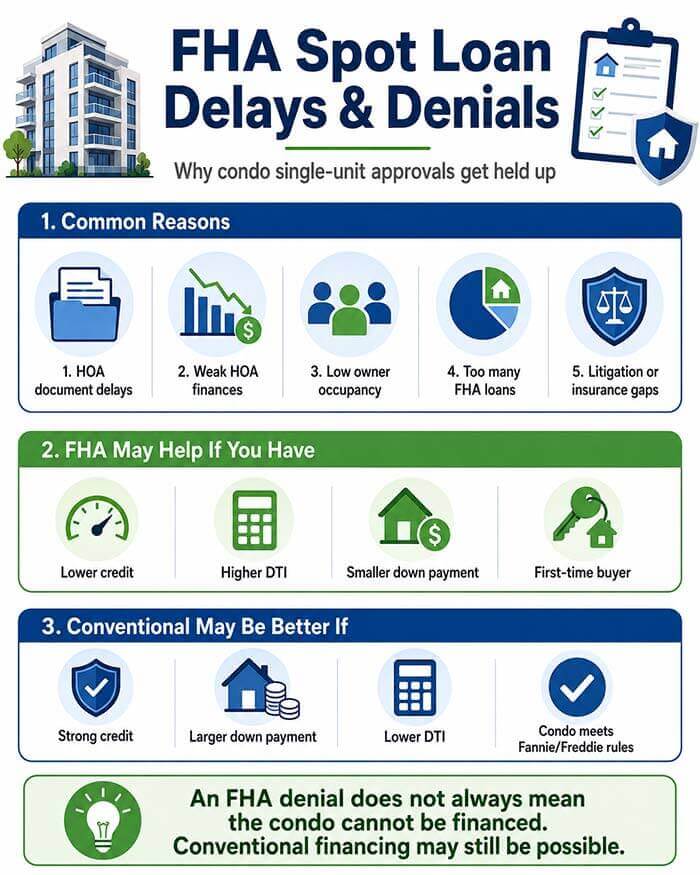 FHA spot loans are possible for non-HUD-approved condos, but they’re more complicated than regular FHA loans. Knowing why FHA spot loans often face delays or denials won’t solve every problem, but it can help you prepare.
HOA Delay In Document Submission
Most condo associations don’t have much experience with FHA Single-Unit Approval. The HOA can delay completion of the questionnaire, sending financial documents, or providing insurance paperwork. FHA may not approve condos with weak budgets, low reserves, significant unpaid dues, or large unpaid assessments.
FHA Owner Occupancy Requirements
If many units are rented or owned by investors, the project might not meet FHA owner-occupancy rules.
Existing FHA Loans In the Condo Project
Because of FHA insurance concentration limits, some projects can’t get more FHA approvals.
Legal Actions Against the Condo, or Insurance Gaps
Substantial litigation, insurance, major lawsuits, missing or inadequate insurance, unresolved flood insurance issues, and gaps in loan coverage can all cause problems. Some borrowers can apply for either an FHA loan or a conventional loan. depend on a variety of factors, including the borrower’s credit score, down payment, debt-to-income ratio, mortgage insurance, eligibility of the condo project, and overall underwriting.
The Case for FHA Loans
FHA loans are often better for people with lower credit scores, higher debt-to-income ratios, or limited savings for a down payment. FHA loans can be especially helpful for first-time homebuyers who need more flexible loan rules.
When Conventional May Be Better
If you have strong credit, a bigger down payment, a low debt-to-income ratio, or a condo that meets Fannie Mae or Freddie Mac rules but not FHA’s, conventional financing might be better. But conventional loans have their own challenges. A condo that doesn’t pass FHA review might still qualify for a conventional loan.
Why Work With Gustan Cho Associates on FHA Condo Loans
Gustan Cho Associates specializes in FHA loans, manual underwriting, and helping with tough mortgage approvals and condo financing. For non-HUD-approved condos, you need a loan officer who knows both borrower underwriting and FHA condo project reviews. Even if you’re fully qualified, you probably won’t get a loan for a condo project that doesn’t meet FHA rules. That’s why it’s important to review everything early, before spending money on inspections, appraisals, or moving.
Conclusion on FHA Spot Loans on Non-HUD-Approved Condos
FHA spot loans let eligible buyers purchase condos in projects that aren’t fully approved by FHA. The terminology for this is Single-Unit Approval. You cannot buy non-warrantable condos. Only warrantable condos qualify.
FHA Spot Loans can be a great option for FHA buyers, but it’s not guaranteed. The condo project must meet FHA rules, the HOA must provide documents, the unit must qualify, and the borrower must meet FHA guidelines.
If you were recently buying a condo in a project that isn’t FHA-approved, don’t assume you can’t buy it. Gustan Cho Associates can check your FHA eligibility, review the condo documents, and help you explore loan options for FHA Single-Unit Approval. To protect a condominium purchase, confirm with the seller whether the project is FHA approved and whether the lender offers FHA Single-Unit Approval.
Ensure the purchase agreement allows sufficient time to:
- Review eligibility for condo FHA Single Unit Approval.
- Obtain the condo association documents.
- Conduct the condo eligibility review.
- Answer any outstanding condo FHA review insurance questions.
- Place the appraisal order.
- Satisfy financing and condo-document conditions.
- It is recommended to begin the project review process as early as possible.
- Preapproval for the borrower does not mean the condominium project is approved.
In addition to HUD requirements, mortgage lenders may impose additional criteria, known as lender overlays.
An example of an overlay is:
- a higher credit score;
- a lower debt-to-income ratio;
- a greater requirement for reserves;
- restrictions for manual underwriting;
- more stringent condo-project qualifications;
- a complete unwillingness to process Single-Unit Approvals.
- When a lender denies the transaction, ask if the denial is due to a HUD requirement, a condo’s FHA eligibility or a lender’s individual overlay.
- If a denial results solely from a lender overlay, it may not reflect an FHA regulation. In such cases, another lender may still approve FHA financing.
In Closing on FHA Spot Loans
When a condominium project lacks FHA project approval, FHA spot loans offer a viable financing option for prospective buyers. The correct process is FHA Single-Unit Approval. The 2026 FHA Connection updates may expedite case number assignments for some expired or registered projects. However, obtaining a case number is only one step and does not indicate HUD approval of the unit or project.
Get Expert Help From An FHA Condo Loan Specialist
Gustan Cho Gustan Cho Associates helps borrowers with FHA financing, manual underwriting, and complex mortgage situations. Regarding FHA spot loans or the FHA Single-Unit Approval, please reach out at 800-900-8569 or via email at gcho@gustancho.com. Our mortgage team can review your condo project early, before you proceed too far into the purchase process. The mortgage is contingent upon credit approval, complete documentation, eligible collateral, and compliance with applicable agency and lender requirements.
FAQs: FHA Spot Loans on Non-HUD-Approved Condos
Can I Use an FHA Spot Loan to Refinance My Condominium?
Yes. As a part of Single-Unit Approval, HUD allows FHA financing to refinance an eligible unit in an FHA-approved or non-FHA-approved project. The refinancing borrower, unit, and project must comply with the applicable FHA guidelines.
Can Investors Utilize the FHA Single-Unit Approval?
FHA loans provide a requirement that the property be the borrower’s primary residence. Single-Unit Approval does not convert an FHA mortgage into an investment-property loan. Generally, at least one borrower must occupy the property within 60 days and must intend to stay for at least one year.
Does Assigning an FHA Case Number Signify Approval of the Condominium?
No. FHA specifically clarified to lenders in 2026 that assigning a case number for Single-Unit Approval does not constitute approval of the condominium unit/project. The lender must complete the full review.
Would a Townhouse be Eligible for an FHA Spot Loan?
Potentially. More than the property’s appearance, the project’s legal ownership structure matters. A townhouse structure that is legally a condominium may require Single-Unit Approval. A townhouse that is legally a fee simple or a planned unit development may be reviewed differently.
Can an HOA request Single-Unit Approval?
Single-Unit Approval is completed for each individual FHA mortgage and processed through the lender. Typically, an HOA or management company completes the condominium questionnaire and submits the required documents. If the HOA wants approval for the entire condominium, the FHA project approval process must be initiated.
Will a Special Assessment Disqualify the Condo?
Not automatically. The assessment amount, its purpose, if the assessment has been paid, and the effect on the project’s financial and physical condition all have to be considered. Assessment of a routine project improvement will likely be of limited concern. On the other hand, an unaddressed assessment for a project involving safety or structural concerns may pose a greater issue.
Can a Condo be Approved if the Project Was Previously Approved by FHA, But the Approval Has Since Expired?
Maybe. Single-Unit Approval may be granted for expired projects if the project concerns meet HUD’s criteria. Starting on May 26, 2026, some expired projects already registered in the FHA Connection will get an automatic case number, but the project will still be subject to the lender’s review.
Who is Responsible for the Cost of the Condominium Questionnaire and Document Package?
Preparation of the questionnaires, along with the financial records, certificates of insurance, and other legal documents, may be charged for by the HOA or management company. Who pays for the preparation may be dictated by the purchase contract, or it may be a matter of local custom and be negotiated among the buyer, seller, and the HOA.
Why Were FHA Spot Loans Discontinued?
FHA spot loans were discontinued in 2009 due to concerns about the financial stability of condominium complexes and the risks associated with insuring individual units within complexes that may not meet FHA standards.
Why Are FHA Spot Loans Back?
FHA spot loans have been reinstated to provide more flexibility for condo buyers. Many condominium complexes need to renew their annual HUD certifications due to the time and cost involved, making it challenging for buyers to obtain FHA loans. The reinstatement allows buyers to purchase condo units in non-HUD-approved complexes using FHA financing.
What Are The Benefits Of FHA Spot Loans For Condo Buyers?
FHA spot loans offer condo buyers several advantages, including the flexibility to purchase units in complexes not approved by HUD, lower down payment requirements, which can be as low as 3.5%, and easier qualification criteria when compared to conventional loans.
How Can Buyers Qualify For An FHA Spot Loan?
To be eligible for an FHA spot loan, purchasers must satisfy the standard FHA loan criteria, such as maintaining a minimum credit score 580 and making a down payment of 3.5%. Buyers can qualify with credit scores between 500 and 579 by putting down a 10% down payment.
What Are The Current FHA Guidelines For Condo Financing?
Under current FHA guidelines, buyers can obtain FHA financing for units in non-HUD-approved condo complexes. This change allows buyers more options and flexibility when purchasing condos.
Are There Restrictions For FHA Spot Loans?
Yes, there are restrictions. Buyers must ensure that the condo unit and the overall complex meet FHA guidelines. This includes aspects like financial stability, maintenance, and owner-occupancy standards.
What Happens If A Condo Complex Is Not HUD-Approved?
Buyers can still use FHA spot loans to purchase individual units if a condo complex is not HUD-approved. However, they must ensure that the unit meets FHA’s minimum property standards.
Can Veterans Use VA Loans For Condo Purchases?
Veterans are eligible to use VA loans to buy condos. VA loans do not require a specific credit score or enforce a maximum debt-to-income ratio limit, provided that the buyer receives approval through the automated underwriting system.
What Credit Score Is Needed To Buy A Condo With an FHA Loan?
The FHA-insured condo mortgage requires a minimum credit score 580, and a 3.5% down payment is mandatory. To qualify, buyers with credit scores between 500 and 579 must provide a 10% down payment.
What Alternative Financing Options Are Available For Non-HUD-Approved Condos?
Besides FHA spot loans, buyers can consider non-QM loans, which offer more flexible qualification criteria. Non-conforming mortgages may be suitable for purchasers with specific financial circumstances, like self-employed people or those with significant assets but lacking a conventional income stream.
If you have any questions about FHA Spot Loans on Non-HUD-Approved Condos or you need to qualify for FHA loans with a lender with no overlays, please contact us at 800-900-8569. Text us for a faster response. Or email us at gcho@gustancho.com. The team at Gustan Cho Associates is available 7 days a week, on evenings, weekends, and holidays.
This Guide About FHA Spot Loans on Non-HUD-Approved Condos Was Updated on July 28, 2026.