
FHA 203(k) Renovation Loan Guidelines: How To Buy Or Refinance A Fixer-Upper
A homebuyer might fix up an older place using a special kind of FHA loan. This option covers purchase costs along with repair bills through just one payment plan. Rather than handling two separate loans – one for the house, another for upgrades – everything rolls together under this setup. The entire amount stays protected by FHA insurance too.
Borrowers might use this loan option when purchasing a home that needs repairs or updating an existing one. A single mortgage covers both the property cost and improvement expenses instead of separate financing. These terms apply only to homes people live in, never vacation houses or rental units.
Rules set by the FHA under section 203(k) guide how renovations get funded through these deals.
A house needing fixes might still be within reach through an FHA 203(k) loan, even if regular financing won’t cover it. Refinancing today’s mortgage while adding renovation costs could happen at once under this option.
Limited and Standard – these define the FHA 203(k) loan options. What works better comes down to repair scope, renovation pricing, if structural changes matter here, also whether a HUD-approved 203(k) advisor gets brought into play.
Home upgrades might fit better with an FHA 203(k) loan if paying everything upfront feels too heavy. Still, approval leans on following FHA standards along with the lender’s own rules. The house itself has to qualify – location matters, contractors need verified paperwork. An official value check is required, just like local borrowing caps set by county lines.
Why FHA 203(k) Loans Help Buyers Purchase Homes That Need Repairs
Some folks spot low-cost houses needing fixes, yet typical loans often fall short if problems touch health, safety, structure, or overall state. Priced under market? That gap might come from a worn-out roof, old wiring, broken pipes, damaged floors, aging heating and cooling, or similar upgrades left undone.
Here’s the catch: most lenders won’t back a standard mortgage unless the house passes basic condition rules. That throws a wrench into buying older homes needing work – despite how good they could become once fixed up.
One way to handle needed repairs? The FHA 203(k) option builds those expenses right into the home loan. Rather than hunting down extra funding – like a second mortgage or paying out of pocket – a qualified buyer might cover both buying and fixing through just one government-backed deal. What looks like two steps folds neatly into a single move.
Homebuyers picking a project house might find this useful, especially when it’s meant to become their main place to live. Refinancing owners too could roll approved upgrades into a fresh mortgage deal. Meeting FHA 203(k) rules matters most – property condition counts, repair types count, even contractor approval plays a role. Borrower fit must line up just right, so does the total loan size.
What Is An FHA 203(k) Renovation Loan?
An FHA 203(k) renovation loan is an FHA-insured mortgage that allows eligible borrowers to finance both the home and the cost of repairs into one loan. Instead of getting a separate mortgage and then paying for renovations out of pocket, the borrower can include eligible repair costs in the same FHA loan.
Homebuyers can use an FHA 203(k) loan to buy a fixer-upper that needs repairs. Homeowners can also use the program to refinance their current mortgage and include eligible renovation costs in the new loan.
This program is helpful when a property needs repairs that will be completed after closing. Many homes that need work may not qualify for standard FHA financing in their current condition. An FHA 203(k) loan can help solve that problem by financing the repairs as part of the mortgage.
The FHA 203(k) loan is only for primary residences. It is not designed for second homes, vacation homes, or investment properties. Borrowers must still meet FHA credit, income, debt-to-income, property, appraisal, contractor, and lender requirements.
Limited FHA 203(k) Loan Guidelines For Smaller Repairs
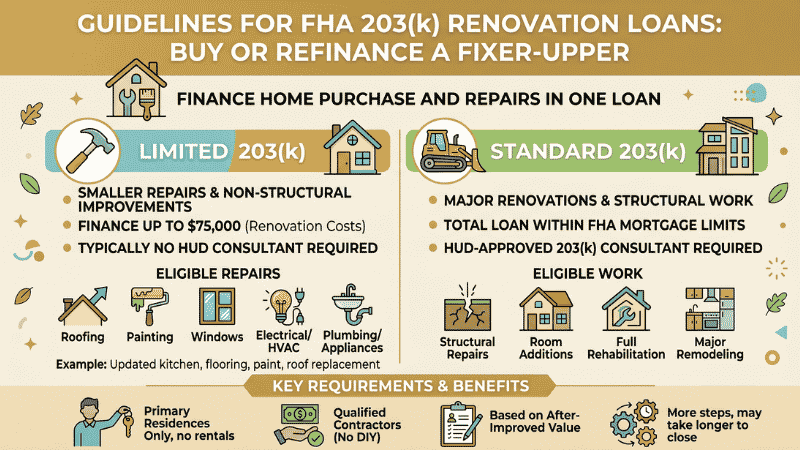
The Limited FHA 203(k), formerly called the Streamline 203(k), is for smaller, non-structural repairs and home improvements. HUD now allows eligible borrowers to finance up to $75,000 in renovation costs with a Limited FHA 203(k). This replaces the older $35,000 repair cap.
This loan may be used for repairs such as roofing, flooring, painting, windows, doors, appliances, HVAC, plumbing, electrical work, and other eligible non-structural improvements. A HUD 203(k) consultant is usually not required for a Limited 203(k), but the lender may still require contractor bids, permits, inspections, and proper documentation.
How FHA 203(k) Repairs Affect The Appraised Value
Not every repair adds the same value to a home. Some improvements may increase the property’s value, while others may mainly improve the home’s condition, safety, or marketability.
When you use an FHA 203(k) loan, the appraiser looks at what the home will be worth after the planned repairs are finished. This helps the lender determine whether the purchase price, renovation costs, and final loan amount comply with FHA requirements.
Standard FHA 203(k) Loan Guidelines For Major Renovations
A Standard FHA 203(k) loan is used for larger renovation projects, structural repairs, additions, major remodeling, and more complex home improvements.
Unlike the Limited FHA 203(k), the Standard 203(k) can be used for major work, including structural repairs and full rehabilitation projects. However, the total FHA loan amount must still stay within the FHA mortgage limit for the county. A HUD-approved 203(k) consultant is required on Standard FHA 203(k) loans. The consultant helps review the scope of work, contractor estimates, repair costs, inspections, and draw requests during the renovation process.
Standard FHA 203(k) loans can be helpful for buyers purchasing a fixer-upper that needs major repairs or homeowners who want to refinance and complete a larger renovation project.
FHA 203(k) Property Eligibility Requirements
FHA 203(k) loans are meant for people who plan to live in the home as their main residence. You cannot use these loans for second homes, vacation homes, or investment properties.
You can use an FHA 203(k) loan for a one-unit home, an approved condo, a townhome, a PUD, or a property with two to four units. If you buy a property with more than one unit, you must live in one of the units as your main home.
Some mixed-use properties may qualify if the living area meets FHA rules. The property, your renovation plans, the appraisal, occupancy, and the final loan amount must all comply with FHA 203(k) requirements.
FHA 203(k) Contractor Requirements
FHA 203(k) loans are not designed for do-it-yourself renovation projects. The lender needs to review and approve the contractor, scope of work, repair estimates, and project documentation before the loan can move forward.
Contractors generally need to be properly licensed, insured, experienced, and acceptable to the lender. They may also need to provide detailed bids, permits, timelines, and proof that they can complete the required work. For Standard FHA 203(k) loans, a HUD-approved 203(k) consultant is required. The consultant helps review the work write-up, inspections, draw requests, and renovation progress.
A HUD consultant is not always required for a Limited FHA 203(k), but the lender may still require contractor approval, inspections, and additional documentation depending on the repairs.
Limited 203(k) vs Standard 203(k): Which FHA Renovation Loan Do You Need?
FHA 203(k) loans come in two options: Limited 203(k) and Standard 203(k).
A Limited FHA 203(k) is for smaller, non-structural repairs such as flooring, painting, roofing, windows, appliances, HVAC, plumbing, and electrical updates. HUD now allows up to $75,000 in renovation costs for Limited 203(k) loans. A Standard FHA 203(k) is for major renovations, structural repairs, additions, and larger rehab projects. A HUD-approved 203(k) consultant is required.
The right option depends on the repair cost, scope of work, property condition, lender requirements, contractor approval, and FHA loan limits.
What Repairs Are Allowed With An FHA 203(k) Loan?
FHA 203(k) loans may be used for many eligible home repairs, improvements, and upgrades. Common allowed repairs may include roof repair or replacement, HVAC systems, plumbing, electrical work, flooring, windows, doors, painting, appliances, and kitchen or bathroom updates.
Borrowers may also use FHA 203(k) financing for health and safety repairs and energy-efficient upgrades. For larger projects, the Standard FHA 203(k) may allow structural repairs, room additions, major remodeling, and full rehabilitation work. The repairs must be approved by the lender and meet FHA 203(k) guidelines.
What Repairs Are Not Allowed With FHA 203(k)?
FHA 203(k) loans generally cannot be used for luxury items, recreational upgrades, or non-permanent improvements.
Examples may include swimming pools, outdoor kitchens, luxury landscaping, detached improvements not allowed by FHA rules, and upgrades that do not become a permanent part of the property. The repairs must be eligible under FHA 203(k) guidelines, approved by the lender, and included in the final scope of work.
How The FHA 203(k) Loan Process Works
The FHA 203(k) loan process has more steps than a regular mortgage because the renovation work must also be reviewed and approved. First, the borrower gets pre-approved with an FHA 203(k) lender. Next, the borrower finds an eligible property and gets contractor bids for the required repairs.
The lender orders an appraisal based on the property’s after-improved value. Once the renovation scope, contractor documents, and loan terms are approved, the loan can close. After closing, the repair funds are usually held in escrow. The contractor completes the work, inspections are completed, draw payments are released, and final completion is verified.
Common FHA 203(k) Loan Problems That Can Delay Closing
FHA 203(k) loans often take more time to complete than standard FHA loans. Lenders need to review the borrower, the property, the contractor, and the renovation plans. Delays can happen for several reasons, like slow contractor bids, missing details in the renovation plan, problems with the property’s condition, appraisal or title issues, or repair costs that go over FHA loan limits.
Other issues can come up, too, such as a high debt-to-income ratio for the borrower, additional lender requirements, contractors who are not approved, or projects that are too complex for a Limited FHA 203(k) loan. To avoid delays, it helps to work with a lender who understands FHA 203(k) loans, pick a qualified contractor, and complete all paperwork as early as possible.
FHA 203(k) Credit Score, Down Payment, And DTI Guidelines
FHA 203(k) loans follow standard FHA mortgage guidelines, but the renovation work must also be approved by the lender.
Eligible borrowers may qualify with as little as 3.5% down if they meet the FHA credit, income, asset, and debt-to-income requirements. Borrowers still need to qualify for the full mortgage payment, including the renovation costs added to the loan. AUS findings and lender overlays also matter.
Some lenders may have stricter credit scores, DTI, contractor, property, or reserve requirements than the FHA minimum guidelines.
Why FHA 203(k) Lender Overlays Matter
Not every FHA-approved lender offers FHA 203(k) renovation loans. Some lenders offer FHA 203(k) loans, but add extra rules called lender overlays.
Lender overlays are additional requirements above the FHA minimum guidelines. These may involve credit scores, debt-to-income ratios, property condition, contractor approval, repair types, reserves, or renovation complexity. This means one lender may deny an FHA 203(k) loan, while another lender may approve the same borrower under FHA guidelines.
Working with an experienced FHA 203(k) lender can make a major difference, especially when the property needs repairs, the borrower has credit challenges, or the renovation project is more complex.
Final Thoughts on FHA 203(k) Renovation Loans
An FHA 203(k) renovation loan can be a smart option for buyers who want to purchase a fixer-upper or homeowners who need to refinance and finance repairs into one mortgage. Instead of paying for improvements out of pocket, qualified borrowers may be able to include eligible renovation costs in the same FHA-insured loan.
The key is choosing the right type of 203(k) loan. A Limited FHA 203(k) loan may work for smaller, non-structural repairs. A Standard FHA 203(k) loan is usually needed for larger projects, structural work, additions, or major renovations that require a HUD-approved 203(k) consultant.
Before moving forward, borrowers should review the property condition, repair estimate, contractor bid, appraisal, FHA loan limits, and lender requirements. FHA 203(k) loans can be powerful, but they require more planning than a regular FHA mortgage.
Gustan Cho Associates can help borrowers compare FHA 203(k) renovation loan options, review eligibility, and determine whether a Limited or Standard 203(k) loan is a good fit for the property and renovation plan. Contact Gustan Cho Associates to discuss your FHA 203(k) renovation loan options and start the pre-approval process.
FHA 203(k) Renovation Loan FAQs
Can I use an FHA 203(k) renovation loan to buy a fixer-upper?
Yes. An FHA 203(k) renovation loan is a great way to buy a fixer-upper and roll the cost of repairs into a single mortgage. HUD says the 203(k) program can cover the purchase or refinance of a home, with repair funds placed into escrow and released as the work is completed.
How much can I borrow for repairs with a Limited FHA 203(k) loan?
A Limited FHA 203k loan allows homebuyers and homeowners to finance up to $75,000 in eligible repairs, improvements, or upgrades. This option is generally used for smaller, non-structural projects.
Is it difficult to meet the qualifications for an FHA 203(k) renovation loan?
It can be more detailed than a regular FHA loan because the lender reviews both the borrower and the renovation project. You need to qualify based on credit, income, debt-to-income ratio, assets, property eligibility, contractor documents, repair costs, and the after-improved value.
Can I do the renovation work myself with an FHA 203(k) loan?
Usually, no. FHA 203(k) renovation work is normally completed by qualified contractors approved by the lender. In limited cases, a lender may allow a borrower to complete some work if the borrower has proper experience and documentation, but borrowers generally cannot pay themselves for labor from loan proceeds.
What is the difference between an FHA 203(b) and an FHA 203(k) loan?
An FHA 203(b) loan is the standard FHA mortgage used to buy or refinance a home that already meets FHA property standards. An FHA 203(k) renovation loan is used when the property needs eligible repairs or improvements that are financed into the mortgage.
Do FHA 203(k) renovation loans take longer to close?
Yes, they often take longer than regular FHA loans because the lender must review the renovation plan, contractor bid, appraisal, repair budget, and sometimes a HUD 203(k) consultant’s documents. The timeline depends on the lender, contractor, property condition, and whether the borrower uses a Limited or Standard 203(k) loan.
This article about “FHA 203(k) Renovation Loan Guidelines for Home Improvement” was updated on May 29th, 2026.