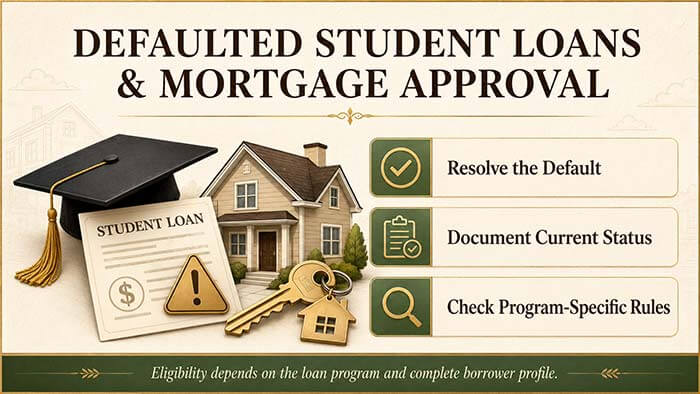
You might still be able to get a mortgage even if you have defaulted student loans. It depends on whether your loans are federal or private, their current status, and the type of mortgage you want. If you have an unresolved federal default, you usually cannot get approved for FHA or USDA loans. For VA loans, you need to bring the account current or set up a payment plan with the federal agency. Conventional loans require a separate review of your account and credit rules.
First, establish what must happen to satisfy the selected program’s federal-debt requirements. The lender must also evaluate your credit history, income, and your qualifying monthly student loan payment. Resolving a default does not guarantee mortgage approval.
Federal vs. Private Defaulted Student Loans
A federal student-loan default can create an eligibility issue for certain government-backed mortgages because the debt is owed to or guaranteed by the federal government. A private student loan default is evaluated under the mortgage program’s credit and debt requirements, without the same federal debt restriction.
Private defaults can still produce serious late payments, collection accounts, judgments, or liens. Whether payment is necessary depends on the account’s status and applicable underwriting rules. Private-loan default timing depends on the loan agreement; there is no single missed-payment deadline that applies to every private loan.
Confirm the loan type rather than relying on the servicer’s name. Federal loans can be serviced by private companies. Review the My Aid section of StudentAid.gov for federal loan information. Defaulted loans held by the Department of Education are generally handled by the Default Resolution Group, while some defaulted FFEL loans are handled by a guaranty agency. Federal Student Aid’s default guidance explains how to identify the holder and review the account’s status.
Government Mortgage Eligibility and CAIVRS
CAIVRS stands for Credit Alert Verification Reporting System. HUD maintains this system for participating agencies and approved lenders to identify certain delinquent federal debts and claims. It is separate from a consumer credit report. FHA, VA, and USDA have different requirements for evaluating its findings.
FHA: Verify the Debt With the Federal Creditor Agency
For FHA financing, the lender must verify a reported federal debt’s validity and current delinquency status with the federal creditor agency to which the debt is owed. When the debt is identified through CAIVRS, the report provides contact information and a debt reference number.
The lender cannot deny an FHA mortgage solely on unverified CAIVRS information. However, a verified delinquent federal non-tax debt must be resolved in accordance with applicable federal requirements. If CAIVRS contains an outdated finding, documentation from the creditor agency may establish an acceptable resolution. A clear CAIVRS report can also provide evidence of resolution. These requirements appear in HUD Handbook 4000.1.
VA: Address the Federal Debt and Document the Finding
VA generally requires CAIVRS screening for borrowers and co-borrowers, subject to applicable exceptions. A non-clear result does not automatically establish ineligibility. The lender must investigate and document it.
A borrower presently delinquent or in default on federal debt cannot be considered a satisfactory credit risk until the account is brought current or satisfactory arrangements are made with the federal agency. The lender must document the arrangement and determine that the borrower otherwise qualifies.
USDA: A Clear CAIVRS Result Does Not Excuse Delinquent Debt
USDA’s guaranteed program requires an acceptable “A” CAIVRS response. Borrowers with verified delinquent federal non-tax debt cannot qualify until the debt is paid in full or a release of liability is provided. A clear CAIVRS result does not override delinquent federal debt discovered through a credit report, public records, or other information.
Simply making payments on a federal student loan that remains delinquent does not establish eligibility. Delinquent federal income taxes are subject to separate requirements, under which an approved repayment arrangement may be acceptable when the specified conditions are met. Do not automatically apply that tax-debt treatment to student loans.
Conventional Loans With Defaulted Student Loans
For a conventional mortgage, the lender must identify whether the student loan is reported as past due, in collection, or charged off, and whether a judgment or lien exists. A high credit score alone does not settle whether the account requires payment.
For loans evaluated through Fannie Mae’s Desktop Underwriter (DU), accounts reported as past due, rather than as collection accounts, must be brought current. Collections and non-mortgage charge-offs follow separate rules. For a one-unit principal residence, Fannie Mae generally does not require those accounts to be paid off. Different payoff requirements apply to two- to four-unit principal residences, second homes, and investment properties. The lender must follow the applicable rules and DU findings in Selling Guide B3-5.3-09.
Manual underwriting has separate payoff thresholds for non-medical collections and non-mortgage charge-offs. A DU exception should not automatically be applied to a manually underwritten loan. Account classification, underwriting method, occupancy, and property type must be established before recommending payment.
Freddie Mac loans must meet its own Guide requirements and applicable Loan Product Advisor findings. Fannie Mae’s collection-account exceptions should not be assumed to apply to Freddie Mac financing.
How to Get a Federal Student Loan Out of Default
Federal Student Aid identifies rehabilitation, consolidation, and payment in full as routes out of default. Entering a repayment agreement may provide collection-related benefits when its requirements and deadlines are met, but signing an agreement or beginning voluntary payments does not automatically remove default status.
Rehabilitation requires completing the agreed qualifying payments and other requirements. Direct Loan and FFEL borrowers generally must make nine on-time, voluntary payments within 10 consecutive months. Defaulted Perkins Loans generally require nine consecutive payments. Confirm completion and the resulting loan status with the holder.
Direct Consolidation involves replacing the eligible defaulted debt with a new consolidation loan once the relevant criteria have been satisfied. It’s typically quicker than rehabilitation, but the fact that you’ve submitted an application does not in itself mean that the consolidation is complete. You’ll need to obtain documentation to confirm both the new loan and the status of the original debt.
For eligible new Direct Consolidation Loans disbursed on or after July 1, 2026, RAP is the only income-driven plan available. That doesn’t mean that every borrower with an older loan has lost access to the other plans. Eligibility is dependent upon the type of loan, the date of disbursement, and any further borrowing or consolidation that may have occurred. Check out the Federal Student Aid repayment plan guidance before making your decision.
RAP has a $10 minimum monthly payment. Parent PLUS loans and consolidation loans containing Parent PLUS debt are not eligible for RAP, according to Edfinancial Services. Borrowers should establish their actual available plan and required payment before assuming consolidation will improve mortgage qualification.
Paying off the debt in full is another way to resolve it. Ask the holder for the current payoff amount and keep proof that you have paid. If you plan to use money set aside for buying a home, ask your mortgage lender to update how much you have left for your down payment, closing costs, and any required reserves.
Rehabilitation vs. Consolidation: Timing and Credit History
Choose between rehab and consolidation based on their requirements, the consequences of repayment, and how they will be reported to the credit bureau. Speed is important when you’re planning a purchase, but the quickest route may not necessarily be the one that gives you the best long-term outcome.
Following the 9th qualifying rehab payment, the DoE will request the default be removed. Late payments previously reported by the prior servicer will still appear on the report. Removing the default does not wipe the whole payment history.
According to Federal Student Aid, when a defaulted federal student loan is consolidated, the default record and late payments reported before default may remain on the borrower’s credit history for up to 10 years. Consolidation therefore does not provide the same default-record removal benefit as successful rehabilitation.
Neither option guarantees a specific increase in credit score. The mortgage lender must evaluate the credit history that remains after the resolution is documented.
How Student-Loan Payments Affect Your Debt-to-Income Ratio
The student-loan payment that counts toward your mortgage depends on the program and your current paperwork. The rules below cover monthly payments, but federal debt eligibility requirements still apply as explained earlier.
FHA Student-Loan Payments
FHA usually uses the payment amount shown in your documents if it is more than zero. If your reported payment is $0, FHA will use 0.5% of your loan balance instead. If a lender wants to use a lower payment than what appears on your credit report, they must provide proof from your loan servicer. Any unpaid loans are still included in the review unless you have documentation for an exclusion.
VA Student-Loan Payments
For loans in repayment or entering repayment within 12 months of closing, VA sets a threshold at 5% of the outstanding balance divided by 12. A $60,000 balance produces a $250 monthly threshold: $60,000 × 5% ÷ 12 = $250.
If the reported credit payment is above the threshold, the lender will use it. If it’s below the threshold, the lender needs a servicer statement with the actual loan terms and payment for each student loan. This statement must be dated within 60 days of the VA loan closing and can be either electronic or printed.
When written evidence confirms repayment will remain deferred for at least 12 months beyond closing, a monthly payment generally does not need to be included.
USDA Student-Loan Payments
USDA uses the reported or actual documented monthly payment where that figure is greater than zero. Where the payment is $0, USDA will use 0.5% of the outstanding balance (regardless of payment status). These are the requirements set out in USDA HB-1-3555, Chapter 11.
Fannie Mae Student-Loan Payments
Fannie Mae will generally accept either the reported monthly payment or a correct payment (supported by the most recent student loan statement). It will accept a documented $0 payment where an eligible income-driven plan is in force. That permission does not in any way create a $0 payment under RAP (which has a $10 minimum).
For deferred loans or loans in forbearance with no qualifying monthly payment, the lender will use either 1% of the outstanding balance or a fully amortising payment which is calculated based on the documented repayment terms.
Freddie Mac Student-Loan Payments
Freddie Mac generally requires a positive payment. If the credit report shows $0, it generally uses 0.5% of the outstanding balance, unless acceptable documentation supports a current payment above zero or a qualifying exclusion applies.
The lender must also address documentation indicating required income recertification or a payment increase before or on the first mortgage payment due date.
Hypothetical Mortgage Qualification Examples
These examples are based on accurate paperwork and still require full underwriting.
A Resolved Federal Default With a Positive Payment
An FHA applicant owes $70,000 in federal student loans. The right paperwork from the creditor agency shows that the previous federal default has been resolved, and both the credit report and the loan servicer confirm that a $175 monthly payment is required.
FHA usually accepts the $175 payment instead of calculating $350 from the loan balance. The lender still needs to check for any recent late payments, review income and other debts, and ensure all other requirements are met.
The Same Balance Under Fannie Mae and Freddie Mac
A borrower has $80,000 in student loans that are no longer in default. The latest paperwork shows a required $0 payment under a qualifying income-driven plan. Fannie Mae may accept the $0 payment shown in the documents. If no special rule applies, Freddie Mac usually counts $400 per month, which is 0.5% of the $80,000 balance. The loan amount is the same, but each program calculates the debt differently. An Outdated CAIVRS Finding
An FHA applicant has completed the rehabilitation process, but CAIVRS still shows the prior default. The lender reaches out to the federal credit reporting agency to check the account’s current status and obtain proof that the issue has been resolved. If the agency confirms the issue is resolved, the lender can record that and keep reviewing the application. An unverified finding alone should not result in denial, and even with proof of resolution, all other underwriting steps still apply.
An Outdated CAIVRS Finding
An FHA applicant completed rehabilitation, but CAIVRS still displays the former default. The lender contacts the federal credit reporting agency to verify the account’s current status and obtain resolution documentation.
If the agency confirms acceptable resolution, the lender can document that finding and continue reviewing the application. An unverified finding alone should not determine denial, and confirmation of resolution does not eliminate the remaining underwriting requirements.
Preparing Your Mortgage File and Avoiding Delays
Get your current account statements, your repayment plan notices, and any documentation that confirms the required monthly payment. If the default has been resolved, then you’ll also need to provide any records of rehabilitation completion, your final consolidation documents, your payoff, and/or any correspondence with the creditor or their agent.
If CAIVRS still shows a prior default, obtain creditor agency verification as early as possible. If the loan has been transferred from one servicer to another, identify the current servicer and obtain the records that establish the current obligation. A submitted consolidation application or initial rehab payment is not a completion document.
If the amount shown on the credit report for the payment differs from the amount on the servicer’s statement, ask the mortgage program which amount it will accept and what verification is missing. Also be sure to mention any upcoming repayment changes or recertification dates so the lender can assess whether they need updated payment information.
An explanation letter can outline the circumstances, but it doesn’t in any way substitute for agency verification or proof of resolution. You’ll need to keep the original records and submit the documents in a legible format via the mortgage company’s secure document system.
If you’re turned down, then ask for the reason. The reason for the rejection could be anything from a federal debt-eligibility issue, a credit history issue, an automated underwriting finding, the qualifying payment, or some other requirement the lender has (what we’d call an overlay). Another lender may well have a different view of that overlay, but they won’t be able to override an applicable agency eligibility requirement.
FAQs About Defaulted Student Loans
Can My Spouse’s Defaulted Student Loan Affect My Mortgage?
- Yes, it can. This depends on whether your spouse is a borrower, the type of mortgage, and your state’s laws. Some government-backed programs look at a non-borrowing spouse’s debts in community-property states. Ask your lender which rules apply before you estimate what you qualify for.
Can a Parent PLUS Loan Default Affect Mortgage Approval?
- Yes. A parent legally responsible for a defaulted federal Parent PLUS loan may face federal debt eligibility issues. The child’s payment arrangement does not automatically remove the parent’s responsibility, and repayment options must be checked for that loan type.
Can a Private Student Loan Judgment Affect Your Approval?
- Yes, a judgment would be subject to review under the relevant mortgage guidelines, and a recorded lien could affect title. The judgment documents and any satisfaction or release documents should be provided so that the lender can determine what action is required.
Does Wage Garnishment Reduce My Qualifying Income?
- Treatment is dependent on the mortgage program and is not automatically a deduction from gross qualifying income. Fannie Mae will generally treat garnishments with more than 10 months of the term remaining as recurring obligations. The underlying federal default will require a separate eligibility review.
Can a Tax Refund Offset be an Indicator of a Mortgage Issue?
- A Treasury offset can indicate that a debt is still outstanding, but the offset itself doesn’t establish the debt’s status. You need to establish which debt it is and get up-to-date records before you can be confident in your eligibility for a government-backed mortgage.
Can I get Preapproved while Sorting the Default?
- A loan officer can review the file and identify any outstanding requirements. Any conditional assessment should be very clear about what remains outstanding. Before making any purchase commitments, you need to establish that the federal debt requirements of the selected program have been met and what other approval conditions are still in place.
Final Thoughts About Defaulted Student Loans
If you have defaulted on a student loan, your mortgage options will depend on your current debt status, the rules of the mortgage program, and your credit history. When looking at ways to resolve your default, consider how each option will affect your repayment and credit report, not just how quickly it promises results.
Before you set a home-buying budget, check your current loan status and payment records. Make sure you know which mortgage program you are considering, and ask your lender to point out any outstanding issues. Keep your resolution documents handy during the application process, and let your lender know right away if anything changes with your student loan payments or servicer. This helps make sure your application is reviewed with the most up-to-date information.
This article about “Defaulted Student Loans and Mortgage Approval: FHA, VA, USDA, and Conventional” was updated on October 20th, 2026.