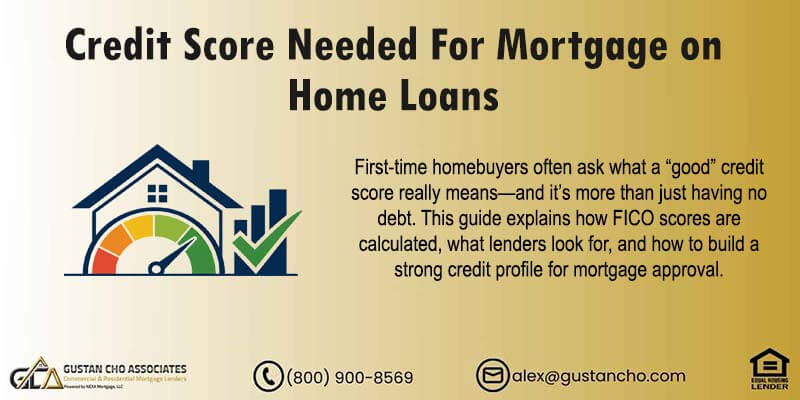
Credit Score Required for Mortgage on Home Loans
This guide covers the credit score needed for mortgage on home loans. We will cover the frequently asked question what is the minimum credit score needed for mortgage? Many home buyers, especially first-time home buyers, often question the minimum credit score needed for a mortgage. John Strange, a mortgage loan originator at Gustan Cho Associates says the following about credit score needed for mortgage on home loans:
Credit Scores and Income are the two most important criteria when a mortgage loan originator qualifies as a borrower. Credit scores and Income determines whether or not borrowers qualify for a home loan.
All mortgage loan programs have minimum credit score requirements. The minimum credit score required for a 3.5% down payment home purchase FHA loan is 580. Home Buyers with under 580 FICO credit scores can qualify for FHA loans. However, a 10% down payment is required for borrowers under 580 credit scores. This guide will cover the credit score needed for mortgage on home loans.
Credit Score Required for Mortgage
FICO scores range from 300 to 850 and are often used by lenders to determine a borrower’s eligibility for a home loan. Most lenders’ minimum score for a conventional mortgage is about 620, but some other loan programs lend to those with lower scores, with larger down payments and more rigorous underwriting.
Credit Score for Different Loans
Conventional loans accept Income-Based Repayment Plans (IBR). FHA loans now offer income-based repayment. You cannot purchase a condominium with an FHA loan if the condominium complex is not FHA Approved. You can only purchase non-FHA Approved Condominiums with Conventional loans. Another reason borrowers can only go with Conventional versus FHA loans is if they need the maximum Conventional loan limit of $832,750. Maximum FHA loan limits in most areas are capped at $541,287 unless the property is located in a high-cost area.
Conventional Mortgage Credit Scores
The minimum credit score needed for mortgage for borrowers needing to qualify for a Conventional Loan is 620 FICO. For various reasons, a home buyer may need a Conventional instead of an FHA loan.
A home buyer needs a Conventional versus FHA loan because they are buying a Condominium, and the Condo is not FHA Approved. Buyers of second homes and investment properties need to use conventional loans.
Conventional loans through Fannie Mae and Freddie Mac will require a borrower to have a minimum credit score of 620. Credit scores in the mid-700s and above will afford a borrower more options for mortgage insurance as well as a lower interest rate and better pricing.
FHA Loan Credit Scores
In the event an applicant has a higher debt-to-income ratio or limited credit history, a user may qualify for FHA financing with a 580-credit score and a minimum down payment of 3.5%. With a more significant down payment and more stringent underwriting, a borrower may score as low as 500.
VA Loan Credit Score Requirements
While VA loans for qualifying veterans committed to active military service have no formal credit score minimum, some lenders impose their own. From our experience at Redfin, this means lenders typically want credit scores in the mid- to high-600s, although some lenders will work with applicants who have slightly lower scores if they have strong compensating factors.
USDA Loan Credit Score Requirements
USDA loans are relatively easier to qualify for than other loans, as they are designed for low-to-moderate income individuals seeking to purchase homes in rural areas, and, as a result, most lenders will have very few requirements beyond the USDA’s 640 credit score for a streamlined approval. Borrowers without a score may also qualify but will have to be prepared for a longer waiting period due to manual underwriting.
What Is A “Good” Credit Score for a Mortgage?
Buying a house typically requires a loan, and the most favorable terms are generally reserved for scores in the low to mid-700s, while the best pricing is generally reserved for borrowers with scores above 740.
Importance of Rental Verification
Homebuyers with credit scores of under 620 FICO may need verification of rent. Rent can only be verified if the renter can provide 12 months of canceled checks to the landlord. Or if the renter can provide 12 months’ bank statements. It needs to be proven that the monthly rental payments are transferred from the borrower’s bank account to the landlord’s bank account. There cannot be any late rental payments in the past 12 months.
If a renter is renting from a registered, licensed property management company, then the property management company property manager signs a verification of rent form, or VOR, which can be used in lieu of canceled checks and 12 months’ bank statements.
Renters paying their rental payments with cash and getting a cash-paid receipt cannot be a valid verification of rent proof. Cash in the mortgage industry is considered non-existent and does not count. Any cash deposits to a borrower’s bank account cannot be used as sourced assets.
See How Your Credit Score Affects Your Rate and Payment
Your credit score can impact interest rate, mortgage insurance, down payment, and monthly payment. Get a realistic estimate before you start house hunting.
How Your Credit Score Impacts Your Mortgage Approval
Interest Rates and Monthly Payment
An inverse relationship exists between risk and interest rates, and since high credit scores indicate lower risk to lenders, lower interest rates result. Even a slight improvement in credit score can result in a 0.25% to 0.5% decrease in the interest rate on a 30-year loan, saving borrowers thousands of dollars over the term of the loan.
Loan Options and Product Availability
Borrowers with higher credit scores also have more favorable (and more competitive) loan options, including more flexible adjustable-rate terms and jumbo financing. Lower scores may limit lenders and programs and may lead borrowers to government programs or larger down payments to balance the risk.
Mortgage Insurance and Fees
Conventional borrowers with low scores pay higher private mortgage insurance (PMI) and are subject to risk-based pricing. Stronger credit profiles decrease or eliminate mortgage insurance and pricing add-ons, making a loan more affordable.
Borrowers Who Cannot Meet Credit Score Needed for Mortgage
As mentioned earlier, all home loan programs have a minimum credit score needed for mortgage.
- HUD requires a 580 FICO credit score need for mortgage.
- Conventional loans require a 620-credit score needed for mortgage.
- VA Loans does not have a minimum credit score needed for mortgage.
- USDA normally requires a 580-credit score needed for mortgage.
If you do not meet the minimum credit score needed for a mortgage, that is fine because there are some quick fixes to boost your credit scores. One great thing about your credit scores is that they can easily be manipulated, and your credit scores fluctuate from month to month.
Improving Credit Score Needed for Mortgage on Home Loans
One of the best ways to maximize credit scores is by paying down all of your credit card balances where the credit card balance is 10% or lower than your credit card limit. Maxed-out credit cards are one of the biggest reasons consumers have low credit scores.
This guide breaks down the credit score you will need for a mortgage, how interest rates and approvals are affected by credit scores, and the credit guidelines for different loan types (FHA, VA, USDA, and conventional).
This guide also offers tips and FAQs to help with faster qualification. Consumers should have three to five secured credit cards with less than a 10% balance of their limit. Consumers maxed out can increase their credit scores by more than 100 FICO points by paying down all their credit card balances to 10% of the credit limit.
Tips and Advice in Increasing Credit Score Needed for Mortgage

Consumers with old outstanding collection accounts and charge-off accounts think that paying off their outstanding collection accounts and charge-off accounts will boost their credit scores. This is not the case unless it is a recent collection or charged-off account. Consumers do not have to pay off outstanding unpaid collection accounts or outstanding charge-off accounts to qualify for FHA loans.
Never pay off an outstanding unpaid collection account or charge-off account. By paying off the prior bad debt, will re-activate the aged bad debt. Credit scores will often drop. This is because the credit bureaus will treat it like a new debt. Plus, the statute of limitations on your old date will re-activate and restart.
If you need to pay off your bad debts, then negotiate with the collection agency that you will make a pay-for-delete payment. Pay for delete is when collection agencies agree to delete the derogatory credit items off the credit report in place of the debt payment. Otherwise, do not pay off your old collection accounts or charge off accounts. This is because you do not have to pay off outstanding unpaid collection accounts or charge-offs to qualify for an FHA loan.
What If Lender Requires You to Pay Outstanding Collection Accounts?
There are so many instances where borrowers are told by the lender they go to and are told that they need to pay off their outstanding unpaid collection accounts and charge-off accounts. This is not sound advice, and you should not listen to them. Most bankers are not licensed. They do not know the FHA Guidelines fully. Paying off outstanding bad debts will often devastate credit scores. Charge-offs and collection accounts do not have to be paid off to qualify for home loans. I had a borrower who recently closed on her home purchase.
How to Improve Your Credit Score Before Applying for a Home Loan
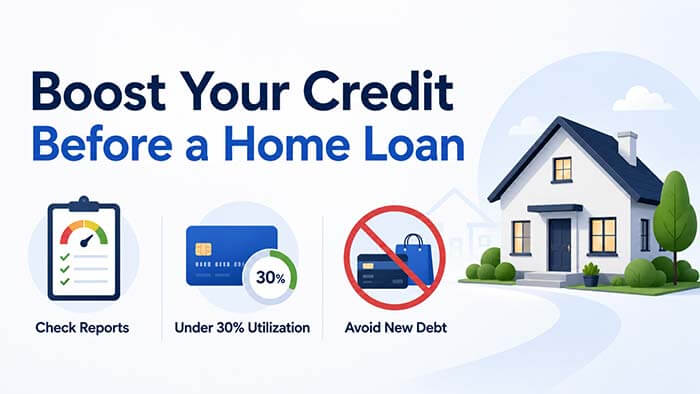
Check And Clean Up Your Credit Reports
The first step is to obtain your credit reports from the three major credit bureaus and review them for errors and outdated derogatory items. Mistakes can be removed and corrected to improve your credit score.
Lower Your Credit Utilization
Credit utilization (the ratio of credit card balances to total available credit) accounts for a large part of a credit score. Balances should be paid down so no credit card is above 30% of the total balance, and the lower the better.
Avoid New Debt and Hard Inquiries
A mortgage is easier to qualify for with a stable credit history. There should be no new debt or hard inquiries. Sourcing should not occur for new credit products in the months leading up to a mortgage application.
Shopping at Different Lenders After Mortgage Denial
She went to different lenders and was told by every single bank and lender she visited that she needed to pay off her second mortgage charge off. My borrower was told that since the second mortgage charge-off had a balance on it, she needed to pay it off. The loan officer that told her was incompetent. This is because most charged-off accounts report a balance on the credit report. You will hardly ever see a charge off accounts with a zero balance. For this borrower, she got lucky because she read one of my blogs about getting a home loan with a mortgage charge off.
The second mortgage charge-off was at least three years old. Borrowers can qualify for an FHA loan after a second mortgage charge-off with an outstanding charge-off balance. This holds as long as the second mortgage charge-off account does not have a lien placed on the property.
There is no waiting period after the second mortgage charge-off settlement date. Luckily, she called me, and we were able to approve her FHA loan and close her home on time. Borrowers with low credit scores or issues with their credit needing a direct mortgage lender with no lender overlays, please contact us at Gustan Cho Associates at 800-900-8569 or text us for a faster response. Or email us at gcho@gustancho.com. The team of loan officers at Gustan Cho Associates is available seven days a week, evenings, weekends, and holidays to take your phone calls and answer any questions you may have.
Frequently Asked Questions About Credit Scores and Mortgages
Can I Get A Mortgage With Bad Credit?
Some lender programs, such as FHA, may accept borrowers with bad credit more readily than standard programs. Though lenders will take on more risk, expect more rigorous underwriting, higher interest rates, and larger down payment requirements.
Will A Higher Credit Score Always Give Me A Better Rate?
Improved rates within a lender’s pricing tier may be available in groups, such as 660–679, 680–699, 700–719, and 740+. More choices and pricing flexibility may be available to a borrower who is in the score range 740+, regardless of minor additional score improvements.
How Long Does It Take To Raise My Credit Score For A Mortgage?
Improving your credit score may take only a few months if you pay down your accounts and/or correct the information on your reports. A serious derogatory credit item, such as a lack of payment or late payment, will take longer to pay off and to improve your credit score.
Do Lenders Use The Same Credit Score I See Online?
Instruction and promotional websites provide credit scores that differ from those used by lenders or mortgage lenders. During the home mortgage application process, lenders commonly pull a tri-merge report and the borrower’s middle mortgage score.
Does My Partner’s Credit Score Matter If We Apply Together?
In the case of a joint mortgage application, the score ranges of all borrowers will be determined, and pricing and/or credit score will be based on the lowest score of the borrowers. When the borrower has a stronger credit history, it may help to structure the application using that borrower alone, based on credit history and underwriting guidelines.
Low Credit Score? You May Still Qualify
A lower score does not always mean denial. We’ll look at your full file, including payment history, DTI, income stability, and compensating factors.