Primary home status means the property you plan to live in as your main residence for most of the year. This matters because lenders use occupancy type to determine which loan programs you qualify for, how much down payment you need, and the mortgage rate you may receive. In most cases, a primary residence gets better loan terms than a second home or investment property.
When applying for a mortgage, lenders generally classify the property as one of three occupancy types: primary residence, second home, or investment property. That classification is a major factor in mortgage approval because it affects the lender’s risk assessment.
Borrowers are usually offered the lowest rates and lowest down payment options when the home will be their primary residence.
Getting a grip on whether your home is your main one is key before you apply. Many government-backed mortgage options, such as FHA, VA, and USDA loans, are only for primary residences. Conventional loans can be used for primary homes, second homes, and investment properties, but the terms are usually best for owner-occupied properties.
This guide covers what counts as your primary home status, how lenders check if you actually live there, and how the rules for your primary home differ from second homes and investment properties. Plus, you’ll find some tips to help you dodge any mistakes that could slow down or mess up your loan approval.
What is Primary Home Status?

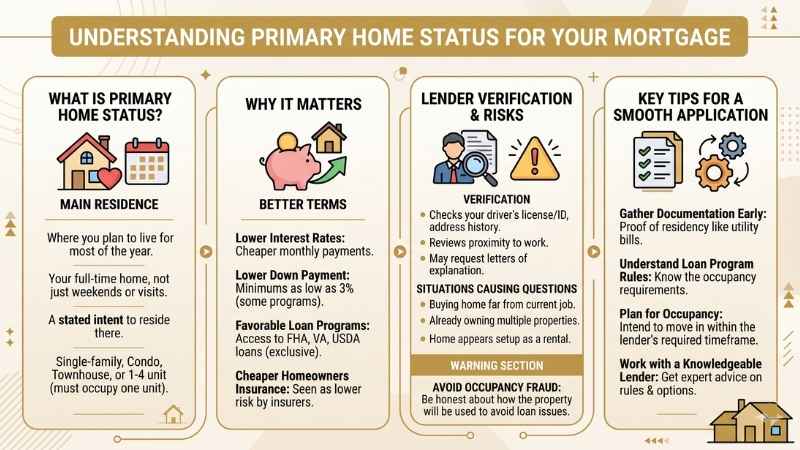
A primary home, a phrase often swapped with primary residence, is where you plan to call home most of the year. Lenders look at your intention to live there full-time, not just weekends or summer visits, to decide whether the property fits this category. By making this judgment, they can distinguish between a primary house, a vacation spot, and a rental investment.
Key Characteristics Of A Primary Home
Primary Home Occupancy
In general, a primary home is where you live most of the year and intend to occupy as your main residence. Lenders want to make sure the property you’re buying is where you actually live, not just a vacation or rental property.
Intent To Live In The Home
When you apply for a mortgage, you are stating that the property will be your main residence. Lenders may review your overall situation, including where you work, where you currently live, and how the new home fits your daily life.
Types Of Properties That Can Be Primary Homes
A property can qualify for primary home status if it is a single-family house, condo, townhouse, or a two- to four-unit property, provided that you reside in one of the units as your main residence.
Why Primary Home Status Matters
Banks see mortgages for primary homes as safer than loans for vacation spots or rental apartments. People tend to pay the bills first for the roof over their heads, so lenders worry less that borrowers will walk away. Because of that extra safety, loans on primary residences usually come with:
- Lower Interest Rates-They cost less each month than a second or investment home loan.
- Lower Down Payment Requirements- Some programs ask for only 3 percent down.
- Access to Favorable Loan Programs: FHA, VA, and USDA funds are mostly reserved for primary homes.
How Lenders Verify Primary Home Status
Lenders may take reasonable steps to confirm that a home will be your primary residence. In most cases, they look at the overall picture rather than relying on just one document. The goal is to make sure the property truly fits your stated occupancy.
Common examples include reviewing your ID, checking your recent address history, looking at how the property relates to your job location, and requesting post-closing occupancy evidence if needed. If anything about the file raises questions, the lender may ask for a simple letter of explanation or additional supporting documents.
Situations That May Cause Lenders To Ask More Questions
Lenders may request additional information when transaction details make the occupancy intent less clear. That does not automatically mean there is a problem. It means the lender may want a better understanding of how the property fits your situation.
Situations that may cause lenders to ask more questions include buying a home far from your current job, already owning multiple properties, or taking steps that make the home look more like a rental than a primary residence.
In these situations, borrowers might need to offer a straightforward explanation along with supporting documents to demonstrate the property’s primary home status.
Your Mortgage Rate Depends on Home Type
Primary, second home, or investment? We’ll help you declare the right occupancy.
How Primary Home Status Affects Loan Options
Primary home status can make a major difference in the financing options available to you. In general, many primary residence programs offer lower down payments and better pricing than second-home or investment-property loans.
For example, government-backed loans such as FHA, VA, and USDA are designed for primary residences. Conventional loans can be used for primary homes, second homes, and investment properties, but the terms are usually most favorable when the property will be owner-occupied. Jumbo loans may also offer better pricing for a primary residence than for a vacation home or rental property.
The key point is simple: when a home will be your primary residence, you may have access to more flexible financing options and better loan terms than you would with a second home or investment property.
Why Primary Home Status Matters
Primary home status matters because it can affect your mortgage rate, down payment, and overall loan costs. In general, lenders offer better terms on primary residences because borrowers are more likely to prioritize the home they live in every day. That can mean lower interest rates, lower down payment requirements, and access to loan programs that are not available for second homes or investment properties.
For conventional loans, primary residence status can also affect mortgage insurance requirements and pricing. The way a property is classified plays a major role in both loan approval and the total cost of financing.
Clear Financial Wins
- Smaller Down Payments: Many FHA and conventional programs trim the down payment to just 3% or even zero when the house is your main address.
- Better Rates: Lenders view primary homes as less risky and price the loan with a lower interest rate.
- Tax Breaks: Owners may still deduct mortgage interest and local property taxes, a benefit usually reserved for the primary residence.
Occupancy Rules For A Primary Home
In most cases, lenders expect you to move into the home within a set time after closing and use it as your primary residence for a reasonable period. The timing can vary depending on the loan program and the details of your situation, but the biggest thing is that you really plan to live in the property as your main home.
If your plans change after closing, that does not automatically mean there is a problem. However, borrowers should be careful not to claim primary residence status on a home they do not truly intend to occupy. When occupancy does not match what was stated in the loan application, the lender may ask questions or require further documentation.
Cheaper Insurance Costs
- Finally, homeowners’ insurance is cheaper on primary houses, meaning your monthly budget benefits again.
- Secondary and rental properties usually carry higher rates because they are seen as riskier for insurers
Challenges and Considerations
Moving For Work
If you are buying a home because of a job move or relocation, the lender may look closely at how the new property fits your situation. In many cases, you may need to explain the move, your timeline for occupying the home, and why the property will become your primary residence.
Buying A 2- To 4-Unit Property
A two- to four-unit property can still qualify as a primary residence if you plan to live in one of the units as your main home. This is a great choice for buyers who want to live in one unit and rent out the others. Just keep in mind that the lender will still require proof that the property will be your primary residence.
Turning Your Home Into A Rental Later
Some borrowers buy a home as their primary residence and later decide to convert it into a rental property. That can be allowed in many situations, but it is important that the original occupancy statement was truthful at the time of closing. If your plans change later, that is different from misrepresenting your intent during the loan process.
Avoiding Occupancy Fraud
Occupancy fraud happens when a borrower claims a home will be a primary residence even though there was no real intention to live there. That is why it is important to be honest about how the property will be used. A clear and accurate application helps avoid problems during underwriting and after closing.
Gather Documentation Early
Track down proof of residency, like a driver’s card or recent utility bills, so everything is on hand when the lender asks.
- Understand Loan Program Rules: Each loan type, plus FHA, VA, or USDA, has its own occupancy rules, so read up before you apply.
- Work with a Knowledgeable Lender: A seasoned mortgage pro knows these quirks and can steer you toward the best program.
- Plan for Occupancy: I plan to move in before the program’s deadline and live there for the required stretch, or the nice terms could disappear.
The status of a home as the place where you live most of the time matters a lot when you apply for a mortgage. It affects the interest rate you get, whether you qualify for the loan, and sometimes even how much money you save over the life of the loan. By learning the basic rules, how lenders check Occupancy, and what it means, you can feel more sure as you move through the mortgage steps.
For the smoothest experience, always talk with a reliable lender or mortgage expert who knows your local market. They will help you meet the occupancy rules and show you the financing options that make the most sense for your new primary home.
Primary Home Vs. Second Home Vs. Investment Property
Lenders generally classify residential properties into three basic categories: primary home, second home, and investment property. The category matters because it can affect your mortgage rate, down payment, and available loan options.
A primary home is the property you plan to live in as your main residence most of the year. This is the home you use as your true home base.
A second home is a property you occupy for personal use part of the year, such as a vacation home. It is not your main residence, nor is it primarily intended to produce rental income.
An investment property is a home purchased mainly to generate income, hold as a rental, or build long-term investment value. In general, lenders view these properties as higher risk than primary residences.
The key issue is not just what the borrower calls the property, but whether the facts support that occupancy type. If the location, usage, or overall situation does not match the occupancy claim, the lender may ask for more explanation or supporting documentation.
How Occupancy Type Affects Financing
Occupancy type plays a major role in mortgage pricing and loan terms. In general, primary homes usually offer the lowest down payment options and the most favorable mortgage rates. Second homes and investment properties often require a larger down payment. They may come with higher rates because lenders view them as higher risk.
That is why it is so important for borrowers to understand how the lender will classify the property before applying. The occupancy type can affect both loan approval and the overall cost of financing.
Down Payment Guidelines On Primary Versus Investment Homes
Mortgage Rates and down payment requirements differ on the above three different types of property type financing. Mortgage rates are the lowest for primary home loans. Second-home loan mortgage rates are slightly higher than primary home mortgage rates. Investment home mortgage rates are normally the highest.
Can You Buy A New Primary Home Before Selling Your Current One?
Yes, you may be able to buy a new primary home before selling your current home. What matters is whether the new property truly will become your main residence. Lenders may look at the reason for the move, the size and function of the new home, the distance from your current property, and whether the overall situation makes sense as a true change in primary residence.
For example, a move may be easier to explain if you are relocating for work, need more space, are downsizing, or are moving into a home that better fits your current household needs. If the lender has questions, you may be asked to provide a simple letter of explanation and supporting documentation.
The key issue is whether the occupancy claim is reasonable and supported by the facts. Buying a new primary residence before selling your current one can be acceptable, but the file should clearly show why the new home will become your main residence.
Can You Buy A New Primary Home Before Selling Your Current One?
In some cases, a borrower may be able to buy a new primary home before selling a current primary residence. The key issue is whether the new property will become the borrower’s primary residence. Lenders may consider the reason for the move, the size and function of the new property, the distance from the current home, and whether the overall situation supports a real change in primary residence.
If questions arise, the lender may request a brief explanation and supporting documents. What matters most is that the occupancy claim is accurate and supported by the facts.
Final Thoughts On Primary Home Status
Primary home status plays an important role in the mortgage process because it affects loan eligibility, pricing, down payment options, and the type of financing available. In general, a primary residence is the home you plan to live in most of the year as your main residence. Because lenders view owner-occupied properties as lower risk, primary homes often qualify for better terms than second homes or investment properties.
For borrowers, the most important step is to be clear and honest about how the property will be used. When your occupancy intent aligns with the transaction facts, the mortgage process is usually much smoother.
Understanding how lenders view primary residence status can help you avoid confusion, compare loan options more effectively, and move forward with greater confidence.
If you have questions about how a lender may classify a property, it helps to speak with a mortgage professional before you apply so you understand your options and any occupancy rules that may affect your loan.
Frequently Asked Questions About Primary Home Status:
What is Considered a Primary Residence for a Mortgage?
- A primary residence is generally the home you occupy as your main residence. In mortgage lending, this usually means the property where you live most of the year and use as your true home base, rather than as a vacation home or rental property. Fannie Mae and Freddie Mac both define a primary residence as the home the borrower occupies as the principal home.
How do Lenders Verify Primary Home Status?
- Lenders may review the overall facts of the transaction to confirm that the home will be your primary residence. That can include your current address history, how the property aligns with your work location, and whether the occupancy claim makes sense given the full file. Sometimes, lenders might ask for extra paperwork to make things clearer.
Can You Have More Than One Primary Residence?
- In general, no. For mortgage purposes, you typically can have only one primary residence at a time. However, there may be legitimate situations in which a borrower is transitioning from one home to another, such as a job relocation or a change in household needs. The lender may review the facts to determine whether the new property qualifies as the borrower’s principal residence.
How Soon Do You have to Move Into a Primary Residence After Closing?
- The exact timing can vary by loan program and lender, but borrowers are generally expected to move into the home within a reasonable period after closing if they are claiming it as a primary residence. Mortgage advice usually says that you can expect to move in around 60 days. But for lenders, the bigger concern is whether the borrower actually plans to live in the home as their main residence.
What is the Difference Between a Primary Home, a Second Home, and an Investment Property?
- A primary home is where you live most of the year as your main residence. A second home is a property you use for personal occupancy part-time, such as a vacation home. An investment property is typically bought mainly to generate rental income or for long-term investment purposes. Lenders treat these occupancy types differently because they carry different levels of risk and may qualify for different loan terms.
This article about “What Is Primary Home Status When Qualifying For A Mortgage?” was updated on April 15th, 2026.
Don’t Misstate Occupancy—It Could Void Your Loan
Occupancy fraud is serious. Make sure you’re classifying your home the right way.