A refinance can lower your payment, shorten your loan term, remove mortgage insurance, or give you access to equity. But a lower rate alone does not make refinancing the right move. Closing costs, loan term, home value, credit profile, and loan type can all affect the final outcome. Refinance mortgage guidelines vary by program. FHA, VA, USDA, and conventional loans each have different rules for credit, equity, mortgage payment history, debt, and documentation. Before applying, compare the full cost of the new loan with what it will actually improve for you.
Should You Refinance Your Mortgage?
Refinancing can make sense when the new loan solves a real problem. You may want a lower monthly payment, a shorter payoff period, cash from your home equity, or a way to remove mortgage insurance. It may also be the right move when you have an adjustable-rate mortgage and want the stability of a fixed rate.
A lower payment is not always a better deal. Extending a mortgage from 20 years to 30 years can reduce the payment but may add years of interest. Cash-out refinancing also increases your loan balance, so the money received should serve a purpose that justifies the added debt.
Before applying, compare your current loan with the proposed one. Look at the new payment, interest rate, closing costs, loan term, mortgage insurance, and how long you expect to keep the home. A refinance should improve your financial position, not simply replace one mortgage with another.
What Lenders Review Before Approving a Refinance
A refinance mortgage is essentially a new loan, so lenders evaluate many of the same factors as with a home purchase loan. While specific requirements vary by loan program, lenders aim to ensure that the new loan is manageable for the borrower, that the property value justifies the loan amount, and that the transaction adheres to the refinance mortgage guidelines. Your mortgage payment history is often one of the first things reviewed. Recent late payments can limit refinance options, especially for streamline or rate-reduction programs. Lenders also review your credit report for scores, balances, collections, recent inquiries, and new debt. Income and employment must support the new monthly payment. Lenders compare your monthly debts with your gross monthly income to calculate your debt-to-income ratio, or DTI. A higher DTI does not always mean denial, but it can affect the loan programs, interest rate, and amount of cash you may be able to receive. The home may need an appraisal to confirm its current value. That value helps determine your equity and loan-to-value ratio. More equity can create more refinance choices, while limited equity may restrict cash-out options or require mortgage insurance. Lenders may also review bank statements and other assets to confirm funds for closing, required reserves, or cash needed to pay off debts. They verify whether the property is your primary home, second home, or investment property, as occupancy affects available loan programs and pricing. Ultimately, the lender obtains the payoff details for your existing mortgage and any liens that must be settled before closing. According to refinance mortgage guidelines, a refinance cannot be completed until the title, payoff amounts, and details of the current loan are verified and accurate.
Rate-and-Term vs. Cash-Out vs. Streamline Refinance
Rate-and-Term Refinance
A rate-and-term refinance replaces your current mortgage with a new loan that changes the interest rate, loan term, or both. Homeowners often use it to lower the monthly payment, pay off the loan faster, or change from an adjustable-rate mortgage to a fixed-rate loan. It is not designed to give you cash from your equity.
Cash-Out Refinance
A cash-out refinance also replaces your current mortgage, but the new loan is larger than the amount you owe. The difference is paid to you at closing and can be used for debt consolidation, home renovations, or major expenses. Because you are borrowing against your equity, cash-out refinancing usually has stricter limits. It may cost more than a standard rate-and-term refinance.
Streamline Refinance
A streamline refinance is available to eligible homeowners with certain government-backed loans, such as FHA, VA, or USDA mortgages. It may involve less paperwork and may not require a new appraisal in some cases. Streamline programs are designed to improve existing loan terms, like reducing the rate or payment, rather than providing cash back. Choosing the right option largely depends on your goals for the new mortgage. When deciding, look at the payment, closing costs, loan term, mortgage insurance, and long-term interest, not just the advertised rate. Be sure to review the refinance mortgage guidelines to ensure that you meet all necessary criteria.
FHA Refinance Mortgage Guidelines
An FHA refinance can help homeowners lower their payments, extend their loan term, switch from an adjustable-rate mortgage to a fixed-rate loan, or access equity. FHA loans may offer more flexible qualifying standards than some conventional refinance options, but approval still depends on the borrower’s credit, income, payment history, debt, property value, and the type of refinance requested.
FHA Rate-and-Term Refinance
An FHA rate-and-term refinance replaces your current mortgage without taking significant cash out of the property. Homeowners may use it to lower their interest rate, reduce the monthly payment, shorten the payoff term, or switch from another loan type to an FHA loan. This option can work for borrowers who need the FHA’s more flexible underwriting approach. However, the new loan should be compared carefully with the existing mortgage. A lower rate may not create meaningful savings if closing costs, a longer loan term, or new mortgage insurance outweigh the monthly payment reduction.
FHA Cash-Out Refinance
An FHA cash-out refinance allows eligible homeowners to borrow against available home equity. The new mortgage will pay off the existing loan, and the leftover funds can be used for home improvements, debt consolidation, major expenses, or other financial needs. Cash-out refinancing is not the same as a standard rate-and-term refinance. Because the loan amount increases, lenders review the borrower’s income, credit, debts, property value, and equity more closely. Borrowers should also remember that converting equity into cash increases the mortgage balance and may raise the total interest paid over time.
FHA Streamline Refinance
An FHA Streamline Refinance is available only to homeowners with an existing FHA-insured mortgage. It may require less documentation than a standard refinance and, in some cases, may not require a new appraisal. It is generally used to improve the terms of the current FHA loan rather than pull equity from the home. A streamline refinance should offer a clear benefit to the borrower, such as lower payments, a reduced interest rate, or a more stable loan structure. “Streamline” does not mean automatic approval or no closing costs. Lenders still review program eligibility, mortgage payment history, and their own underwriting requirements.
FHA Mortgage Insurance Matters
FHA refinances generally include upfront and annual mortgage insurance premiums. This is important for homeowners refinancing from a conventional loan or comparing FHA with another refinance option. FHA mortgage insurance can affect the total monthly payment and the long-term cost of the loan. When considering an FHA refinance, it’s essential to evaluate several factors, including the principal and interest payment, mortgage insurance, closing costs, loan term, and total amount financed. The ideal refinance isn’t one with the lowest advertised rate; rather, it should align with the refinance mortgage guidelines and provide significant financial benefits after all associated costs are taken into account.
VA Refinance Mortgage Guidelines
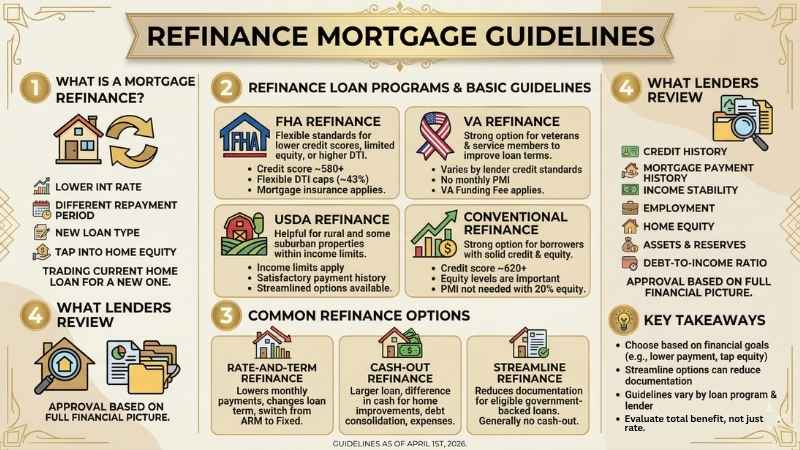 VA refinance loans can help eligible Veterans, service members, and surviving spouses improve the terms of an existing mortgage or use available home equity. The two main VA refinance options are the VA Interest Rate Reduction Refinance Loan (IRRRL) and the VA cash-out refinance. They have different functions and follow different rules.
VA IRRRL Refinance
A VA IRRRL is for homeowners who already have a VA-backed mortgage. It is commonly used to lower the interest rate, reduce the monthly payment, or replace an adjustable-rate mortgage with a fixed-rate loan. An IRRRL is not designed for taking meaningful cash out of the home. It is meant to improve the existing VA loan. Depending on the transaction and lender requirements, the process may involve less documentation than a full refinance. However, a streamlined process does not mean no review, no costs, or automatic approval.
VA Cash-Out Refinance
A VA cash-out refinance replaces the current mortgage with a new VA loan that may be larger than the amount owed. The difference can be paid to the homeowner at closing and used for home improvements, debt consolidation, education costs, or other major expenses. A VA cash-out refinance can also be used to refinance a non-VA loan into a VA-backed mortgage. Unlike an IRRRL, this option generally involves a more complete review of income, credit, debts, occupancy, property value, and available equity. Borrowers should also understand that taking cash out increases the amount secured by the home.
VA IRRRL and Cash-Out Rules Are Not the Same
A homeowner cannot use a VA IRRRL to refinance a conventional, FHA, or USDA mortgage into a VA loan. An IRRRL also is not the right option for someone who wants to access substantial equity. Those situations generally require a VA cash-out refinance. A VA cash-out refinance should not be viewed as a streamlined loan. It may offer more flexibility because it can refinance different loan types and provide cash, but it also involves different underwriting, appraisal, occupancy, and equity requirements.
Net Tangible Benefit and Refinance Disclosures
A VA refinance must create a real benefit for the borrower. That benefit may be a lower interest rate, a lower monthly payment, a more stable fixed-rate loan, or another measurable improvement to the borrower’s financial position. Lenders must provide required disclosures that help borrowers compare the new loan with the current mortgage. For an IRRRL, this generally includes a signed statement explaining the effect of the refinance and how long it may take to recover the costs through monthly savings. Review the new payment, interest rate, loan term, funding fee, closing costs, and total loan balance before moving forward. The best VA refinance is not always the one with the lowest advertised rate. It is the one that creates a clear benefit after the full cost of the new loan is considered.
USDA Refinance Mortgage Guidelines
USDA refinance loans are for homeowners who already have a USDA-financed or USDA-guaranteed mortgage. They are not cash-out loans. The goal is usually to lower the interest rate, reduce the payment, or improve the terms of the existing USDA loan. USDA offers three refinance options: non-streamlined, streamlined, and streamlined-assist. All three generally require the borrower to continue living in the home as a primary residence, meet applicable household-income limits, and refinance into a fixed-rate 30-year loan. The new rate cannot be higher than the rate on the loan being refinanced.
Non-Streamlined USDA Refinance
A non-streamlined refinance is the most complete USDA refinance option. It requires a new appraisal and a fuller review of credit, income, debts, and repayment ability. This option may be needed when the loan amount, property value, or borrower situation does not fit the simpler refinance paths. It can also be useful for certain borrowers with USDA Direct Loans who must address subsidy recapture as part of the refinance.
Streamlined USDA Refinance
A USDA streamlined refinance is simpler than a non-streamlined refinance because a new appraisal is generally not required for existing guaranteed-loan borrowers. Closing costs and the upfront guarantee fee may be included in the new loan when program rules allow. However, streamlined does not mean no underwriting. The lender still reviews the borrower’s eligibility, mortgage payment history, credit, and ability to repay in accordance with USDA refinance mortgage guidelines. This option is often used when the borrower wants a lower rate or better loan terms without the added cost of a new appraisal.
USDA Streamlined-Assist Refinance
A USDA streamlined-assist refinance is the most limited-documentation option. It does not require the same full credit review or debt-to-income calculation used for the other USDA refinance types. A new appraisal is generally not required for an existing USDA-guaranteed loan. The tradeoff is that the borrower must receive a clear payment benefit. The new payment for principal, interest, and annual fees must be at least $50 less than the current payment. The lender still verifies acceptable recent mortgage payment history and confirms that household income does not exceed USDA limits.
What All USDA Refinance Options Have in Common
USDA refinance loans cannot be used to pull cash from home equity. Eligible closing costs may be financed, and borrowers may receive reimbursement for certain prepaid closing costs or an escrow refund, but the refinance is not designed to provide cash back. A USDA refinance can make sense when it creates a meaningful improvement in affordability or loan terms. Compare the new payment, annual fee, closing costs, loan balance, and long-term interest before replacing your current mortgage.
Conventional Refinance Mortgage Guidelines
A conventional refinance is not backed by FHA, VA, or USDA. It is usually a strong option for homeowners with steady income, solid credit, and enough equity to meet the lender’s requirements. Conventional loans offer both limited cash-out and cash-out refinance options, but the rules and costs differ.
Limited Cash-Out Refinance
A limited cash-out refinance is mainly used to replace your current mortgage with better terms. You may lower the interest rate, reduce the payment, shorten the loan term, or move from an adjustable-rate mortgage to a fixed-rate loan. The new loan can pay off the existing mortgage, closing costs, prepaid items, and certain subordinate liens. Small cash-back amounts may be allowed under program rules, but this is not the right option when your goal is to pull a large amount of equity from the home.
Conventional Cash-Out Refinance
A conventional cash-out refinance replaces your current mortgage with a larger loan, providing you with cash at closing. Homeowners may use the funds for renovations, debt consolidation, college expenses, investments, or other major needs. Cash-out refinancing usually requires more equity than a limited cash-out refinance. It may also come with higher rates, larger fees, or stricter underwriting because the loan creates more risk. The amount you can borrow depends on the home’s value, the amount you owe, the property type, occupancy, credit profile, and lender guidelines.
Equity and PMI
Equity is the difference between your home’s value and the mortgage balance you still owe. More equity usually gives you more refinance options and may help you avoid private mortgage insurance, or PMI. A conventional refinance may help cancel PMI when the new loan amount is low enough compared with the home’s current value. However, a new appraisal may be required to support that value. If the refinance leaves you with less than 20% equity, PMI may still be part of the new monthly payment.
Why Credit Can Affect Cost More Than Approval
Credit matters for conventional refinancing, but a borrower does not always need perfect credit to qualify. A stronger credit score may have a greater effect on the interest rate, discount points, closing costs, and PMI cost than on whether the refinance is approved at all. For example, two homeowners may both qualify for the same refinance program, but the borrower with the stronger credit profile and more equity may receive better pricing. That is why it is important to compare the full Loan Estimate instead of focusing only on the advertised rate. A conventional refinance can be a beneficial choice if it reduces your housing expenses, eliminates PMI, enhances your loan terms, or allows you to access cash from your home’s equity for a specific purpose. It’s essential to compare the new payment, interest rate, loan term, closing costs, and total interest, keeping in mind the refinance mortgage guidelines, before making a decision.
Turn Your Equity Into Cash
Use your home’s value to pay off debt, fund renovations, or invest.How To Tell Whether Refinancing Is Worth It
A refinance is worth it when the new loan improves your finances after all costs are included. Do not focus only on the advertised rate or a lower payment. A lower payment may come from starting a new 30-year term, which can increase the total interest you pay.
Evaluate the new payment, APR, closing costs, mortgage insurance, loan term, and total interest in relation to your existing mortgage. When considering cash-out options, consider how much they will increase your loan balance and whether the funds align with a crucial need.
Remember to stay informed about refinance mortgage guidelines while making your comparisons. Review the official Loan Estimate before deciding. A refinance may make sense when the savings, removal of mortgage insurance, improved terms, or cash received clearly outweigh the costs.
What Can Delay a Refinance
A refinance can be delayed when new issues appear during underwriting. Recent late mortgage payments may limit program options or require additional review. A low appraisal can also reduce available equity, which may affect the loan amount, cash-out amount, or ability to remove mortgage insurance. Avoid adding new debt after applying. A new credit card, auto loan, personal loan, or higher credit card balance can change your debt-to-income ratio and affect approval. Large deposits also need to be explained and documented, so keep a clear paper trail for any money moving through your accounts. Title issues and payoff problems can also hold up closing. Old liens, missing releases, incorrect payoff figures, or delays from the current mortgage lender must be resolved before the new loan can fund.
Documents Needed for a Mortgage Refinance
Understanding the refinance mortgage guidelines is important, as most loans will require documentation to verify your income, assets, employment, debts, and current mortgage. Have recent pay stubs, W-2s, tax returns, bank statements, and your homeowners’ insurance policy ready to submit as needed.
Your lender will also request information about your current mortgage, including the latest statement and payoff details. If you are self-employed, receive commission income, own rental property, or have irregular income, expect to provide additional documents.
Send complete, readable records as soon as they are requested. Missing pages, unexplained deposits, or outdated statements can delay underwriting and closing.
Benefits of Refinance Mortgage Before Rates Go Up
Refinancing can lower monthly payments, secure a better interest rate, shorten your loan term, access home equity, or switch from an adjustable-rate to a fixed-rate mortgage. This process replaces your current mortgage with a new one on improved terms. Both government-backed and conventional refinance programs are available, each with unique features. Refinancing may reduce your rate, modify your loan term, convert to a fixed rate, consolidate debt, or use home equity for repairs or to pay off higher-interest debt.
Refinancing is not always beneficial. Consider closing costs, mortgage insurance, and the time needed to recover expenses. The best refinance option is one that provides net savings after all costs are considered.
The recent decision by the Federal Reserve to lower interest rates by 0.25% was anticipated, as they have been gradually shifting towards a tighter monetary policy. As mortgage rates have reached their highest levels since 2008, it’s clear that these rates won’t remain this high for long. The Fed’s intention to keep lowering interest rates means that consumers should act soon. With the likelihood of lower rates on the horizon, now is a great time to refinance your mortgage. By locking in a lower rate today, you can achieve financial stability before potential increases hit the market.
Benefits of Refinance Mortgage with Shorter Amortization Term
Mortgage interest rates are substantially lower than credit card interest, car loan interest, and other interest rates on other debt. Average mortgage rates are in the 6.0% rate whereas average credit cards interest rates are north of 24%. Some credit card annual percentage rates even surpass the 30% interest rate. Besides high interest rates, minimum credit card and installment loan payments can be higher due to shorter amortization terms. Proceeds of cash-out refinance mortgage loans are not taxable. No matter how much to tap into your home equity, you will not pay taxes on the proceeds.
Other Benefits of Refinance Mortgage
Another reason homeowners may consider refinance mortgage is to take out non-occupant co-borrowers. Folks who are divorcing normally want their spouse off the mortgage and may need to do a refinance mortgage. As mentioned earlier, many homeowners with FHA loans may be able to eliminate FHA annual mortgage insurance premiums by refinancing their FHA loans to Conventional loans.
When It May Not Make Sense to Refinance
Refinancing a low-interest first mortgage just to access cash may not be financially wise, especially if a second mortgage is a better option. The best refinancing improves your overall financial situation, not just your interest rate.
Final Thoughts About Refinance Mortgage Guidelines
Refinancing can lower a payment, remove mortgage insurance, change your loan term, or give you access to home equity. But the best choice depends on the full cost of the new loan, not just the interest rate. Before proceeding, compare your Loan Estimate with your existing mortgage to confirm that the refinance meets a genuine financial need. It’s important to review the refinance mortgage guidelines along with your credit, equity, and income. A mortgage professional can help evaluate your situation and determine which refinance options are best for you.
Frequently Asked Questions About Refinance Mortgage Guidelines
Does Refinancing Hurt Your Credit Score?
Refinancing can lead to a slight, short-term dip in your credit score since the lender pulls your credit and sets up a new mortgage account. Keep mortgage shopping within a short period so multiple lender credit checks are generally treated as one inquiry. Avoid opening new credit accounts while your refinance is in process.
How Soon Can You Refinance After Buying a House?
There is no single waiting period for every refinance. The timing depends on the current loan, the new loan program, whether you are taking cash out, and the lender’s requirements. Some government refinancing programs have specific seasoning and payment-history rules, so a lender should review your exact closing date and loan type.
Do You Have To Refinance With Your Current Lender?
No. You can either stick with your current lender for refinancing or go with someone else. Compare Loan Estimates for the same loan amount, term, rate-lock period, and program to see which offer has the lower total cost.
Is a No-Closing-Cost Refinance Really Free?
No. A no-closing-cost refinance usually means the lender covers certain upfront costs through a higher interest rate, lender credit, or a larger loan balance. The fees are not removed; they are paid another way. Review the interest rate, APR, and total cost before choosing this option.
What Happens to Your Escrow Account When You Refinance?
Your old mortgage escrow account will be closed once the existing loan is paid off. Any remaining balance is usually refunded by the current servicer. Your new lender may collect money at closing to establish a new escrow account for property taxes and homeowners’ insurance.
Do You Pay Taxes on Cash-Out Refinance Money?
Cash received from a cash-out refinance is generally loan proceeds, not taxable income. However, whether the interest on the new loan is deductible can depend on how the money is used. Speak with a qualified tax professional about your specific situation.
Can You Refinance After a Mortgage Modification?
It may be possible to refinance after a mortgage modification, but you may need a record of on-time payments under the modified loan. The lender will also review the modified balance, income, credit, property value, and any lien created by the modification.
Can You Remove a Spouse or Co-Borrower Through a Refinance?
A refinance may allow you to remove a co-borrower because the new mortgage pays off the existing loan. The remaining borrower will need to meet the refinance mortgage guidelines to qualify for the new payment independently. However, title regulations and state laws may still require the other spouse or owner to sign specific closing documents.
This article about “Refinance Mortgage Guidelines: What You Need To Know” was updated on June 26th, 2026.