VA Loan Eligibility Requirements in Vermont (2025 Update)
Buying a home in Vermont is more than just owning property—it’s about creating stability after years of service. Whether you’re stationed in Burlington, settling in Rutland, or retiring near the Green Mountains, the VA home loan program can make homeownership easier and more affordable than ever.
The challenge is that many veterans and service members are denied VA loans because lenders apply stricter internal rules called overlays, which are not part of the official VA loan eligibility requirements in Vermont.
At Gustan Cho Associates, we believe that if you meet the VA’s true eligibility standards, you deserve to be approved. That’s why we follow only VA agency guidelines—no overlays, no unnecessary red tape.
This guide explains everything veterans in Vermont need to know about VA loan eligibility requirements, including credit standards, income rules, waiting periods after bankruptcy, and how to qualify even after being denied elsewhere.
Key Takeaways
- No minimum credit score required per official VA guidelines
- No maximum debt-to-income ratio limit
- 100% financing available throughout Vermont
- Deferred student loans (over 12 months) are excluded from DTI
- Gustan Cho Associates offers VA loans in Vermont with no overlays
- Fast closings and high DTI approvals are possible with automated underwriting
Who Qualifies for a VA Loan in Vermont?

To qualify for a VA loan, borrowers must meet service-related and credit/income eligibility guidelines. The VA loan eligibility requirements in Vermont are the same as nationwide standards, but the local housing market and cost of living play an important role in affordability.
Basic Service Eligibility
You may be eligible if you are:
- A service member currently on active duty has served at least 90 days straight during war or 181 days during peace.
- A vet who got an honorable discharge after serving the minimum time needed.
- A National Guard or Reserve member with at least six years of service
- A spouse of a service member who died while on duty or from a service-related disability.
Roughly 35,000 veterans live in Vermont. Many are drawn to small-town communities like South Burlington, Colchester, and Barre for their small-town feel and affordable housing options. VA loans empower them to achieve the American dream without the barrier of large down payments or high credit requirements.
Vermont Veterans: Are You VA-Eligible?
We’ll verify your Certificate of Eligibility (COE) and next steps in minutes.
Understanding the Certificate of Eligibility (COE)
The Certificate of Eligibility—or COE—proves you’re entitled to VA home loan benefits. Without it, lenders can’t verify your eligibility.
How to Obtain a COE:
- Online: Through the VA’s eBenefits portal
- Through Your Lender: Gustan Cho Associates can instantly retrieve your COE
- By Mail: Using VA Form 26-1880
Documents Required:
- Veterans: DD-214 (showing honorable discharge)
- Active Duty: Statement of service signed by a commanding officer
- Guard/Reserves: NGB Form 22 or NGB Form 23
Once verified, your COE gives lenders the green light to process your loan.
VA Loan Eligibility Requirements in Vermont for Credit and Income
Credit Score Guidelines
The Department of Veterans Affairs doesn’t have a minimum credit score you need to hit for VA loans. That means veterans can qualify with credit scores as low as 500 FICO, provided they meet other conditions and receive an Approve/Eligible finding through the Automated Underwriting System (AUS).
However, many lenders add overlays requiring 620 or higher credit scores. At Gustan Cho Associates, we don’t. We base approvals solely on official VA loan eligibility requirements in Vermont, not internal overlays.
Real Example:
Two major banks denied a veteran in Rutland because of a 580 credit score. When he came to Gustan Cho Associates, our team processed his application through the AUS, which approved him instantly. He closed on his home in less than 21 days—with no overlays and no down payment.
Debt-to-Income Ratio (DTI)
Under VA rules, there is no maximum DTI cap. While many lenders cap DTI at 45%–50%, GCA has helped borrowers in Vermont close loans with DTIs above 60%, provided residual income requirements are met.
Residual Income in Vermont
Residual income is the monthly money left over after paying housing and other obligations. It ensures borrowers have enough funds for daily living expenses. Vermont falls under the Northeast Region for VA purposes, which requires approximately $1,025 monthly for a family of four.
This approach helps veterans maintain financial stability without penalizing those with slightly higher debt levels.
VA Loan Eligibility After Bankruptcy, Foreclosure, or Short Sale
Financial setbacks don’t mean the end of homeownership. One of the best parts of the VA loan eligibility requirements in Vermont is the shorter waiting period after major credit events.
| Event | VA Loan | FHA Loan | Conventional Loan |
| Chapter 7 Bankruptcy | 2 years | 2 years | 4 years |
| Chapter 13 Bankruptcy | 1 year into plan (with trustee approval) | 1 year | 2 years |
| Foreclosure / Short Sale | 2 years | 3 years | 7 years |
This flexibility allows veterans to recover faster and re-enter homeownership without waiting years.
Vermont Case Study: From Denial to Dream Home
Meet Staff Sergeant Michael R., a U.S. Army veteran from Burlington, Vermont.
Michael served for eight years before transitioning to civilian life. After medical leave, his income dropped, leading to a Chapter 7 bankruptcy in 2022. By 2024, his credit had improved to 540, but two major banks denied his VA loan because overlays required a 620 score.
He contacted Gustan Cho Associates, where a loan officer reviewed his file and confirmed he met all VA loan eligibility requirements in Vermont—even with his credit history. The AUS issued an Approve/Eligible finding, and he closed on a $345,000 home in Essex Junction within 23 days.
Outcome:
- $0 down payment
- 5.99% fixed rate
- 58% DTI ratio approved
- No overlays, no extra conditions
Today, Michael calls his home “the second chance I didn’t think I’d get.”
VA Loan Eligibility in Vermont for Collections and Student Loans
Collection Accounts
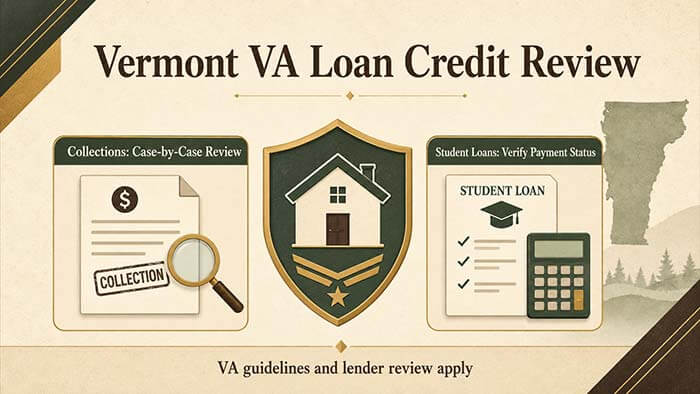
Under official VA loan eligibility requirements in Vermont, borrowers are not required to pay off collection or charge-off accounts to qualify.
If a lender insists that collections be paid before approval, that’s a lender overlay, not a VA rule. GCA ignores overlays—if VA allows it, so do we.
Student Loans
Deferred student loans postponed for 12 months or more are excluded from DTI calculations.
If your student loans are active and not deferred:
- Take 5% of the total balance ÷ 12 months = monthly payment added to DTI
This flexibility makes it easier for veterans managing educational debt to qualify.
VA Loan Property Eligibility in Vermont
VA loans are only meant for primary homes. Borrowers need to move into the property within 60 days after closing.
Eligible Property Types:
- Single-family homes
- VA-approved condominiums
- Multi-unit homes (up to four units, if you live in one)
- Manufactured homes on permanent foundations
Vermont Housing Considerations:
Because Vermont experiences harsh winters, VA appraisers closely review:
- Roof and insulation condition
- Heating and plumbing systems
- Accessibility and safety (stairs, entryways, etc.)
Properties must meet VA Minimum Property Requirements (MPRs) to ensure safety and livability.
VA Loan Limits and Closing Costs in Vermont
Loan Limits
As of 2025, no loan limits exist for borrowers with full VA entitlement. You can purchase homes well above conventional loan limits without a down payment—provided you qualify based on residual income and AUS approval.
Average Vermont Home Prices (2025)
- Chittenden County: $440,000
- Rutland County: $310,000
- Franklin County: $350,000
Funding Fee
The VA charges a funding fee to keep the program sustainable.
- 2.15% for first-time use
- 3.3% for subsequent use
- Exemptions: Veterans with 10%+ disability rating or surviving spouses
Closing costs in Vermont average 2%–4% of the loan amount, but sellers can cover these costs through concessions allowed by VA guidelines.
VA Loan Eligibility vs. FHA and Conventional Loans
| Feature | VA Loan | FHA Loan | Conventional Loan |
| Down Payment | 0% | 3.5% | 3%–20% |
| Mortgage Insurance | None | Required | Required under 20% down |
| Minimum Credit Score | None | 580 | 620 |
| Max DTI | None | 56.9% | 45% |
| Waiting Period After Bankruptcy | 2 years | 2 years | 4 years |
This side-by-side comparison shows why VA loans remain the most forgiving and affordable option for eligible veterans in Vermont.
What Are Lender Overlays—and Why They Matter in Vermont
Lender overlays are extra restrictions that individual lenders add to the VA’s rules. Examples include:
- Requiring higher credit scores
- Capping debt ratios below 50%
- Forcing borrowers to pay off collections
These overlays can unfairly block qualified veterans from buying homes.
At Gustan Cho Associates, we have no overlays. We approve based on the official VA loan eligibility requirements in Vermont, ensuring veterans aren’t turned away due to outdated or unnecessary rules.
“If you’ve been denied by another lender, don’t give up. Call Gustan Cho Associates at 800-900-8569 or text for a faster response.”
How to Apply for a VA Loan in Vermont (Step-by-Step)
- Check your service eligibility and request your COE.
- Gather your documents: pay stubs, tax returns, W-2s, or 1099s.
- Get pre-approved with a no-overlay VA lender.
- Shop for VA-eligible homes in your desired Vermont community.
- Complete the appraisal and meet VA Minimum Property Requirements.
- Receive underwriting approval and be clear to close.
- Sign your documents and move into your new Vermont home!
At Gustan Cho Associates, we streamline this process with 21-day fast-track closings for VA loans.
Why Veterans Choose Gustan Cho Associates for VA Loans in Vermont
At Gustan Cho Associates, we aim to make homeownership achievable for every eligible veteran.
We’re proud to offer:
- No lender overlays
- Fast closings in 21 days or less
- Approvals with low credit scores and high DTI ratios
- Licensed in 48 states
- 7-day availability, including evenings and holidays
Whether you’re buying in Burlington, Stowe, or Brattleboro, our experienced team knows the VA loan eligibility requirements in Vermont inside and out—and we’ll guide you from pre-approval to closing with confidence.
Borrowers who need a five-star national mortgage company licensed in 5o states with no overlays and who are experts on VA loan eligibility requirements in Vermont, please contact us at 800-900-8569, text us for a faster response, or email us at alex@gustancho.com.
Your service deserves the strongest home loan support available.
Frequently Asked Questions – VA Loan Eligibility Requirements in Vermont
Q: What are the Basic VA Loan Eligibility Requirements in Vermont?
A: To qualify, you must be an active-duty service member, veteran, or eligible surviving spouse with a valid Certificate of Eligibility (COE). You also need enough income to afford the loan and meet the VA’s residual income rules.
Q: What Credit Score do I Need to Meet the VA Loan Eligibility Requirements in Vermont?
A: The VA does not impose a minimum credit score requirement. Some lenders ask for 620 or higher, but Gustan Cho Associates approves borrowers with credit scores as low as 500 FICO if they meet other conditions.
Q: Can I Still Qualify for a VA Loan in Vermont if I have Collections or Bad Credit?
A: Yes. The VA loan eligibility requirements in Vermont do not require you to pay off old collections or charge-offs. Many lenders add overlays, but GCA follows only VA’s true guidelines.
Q: How Long After Bankruptcy Can I Qualify Under the VA Loan Eligibility Requirements in Vermont?
A: If you’ve gone through a Chapter 7 bankruptcy, you can get a VA loan two years after that. If you’re in a Chapter 13 repayment plan, you’ll need to wait a year and get the thumbs up from your trustee. VA loans are pretty chill compared to other loan options.
Q: Do the VA Loan Eligibility Requirements in Vermont have an Income Limit?
A: No, there’s no income cap. However, the VA checks your residual income to ensure you have enough left after paying bills to cover living expenses based on Vermont’s cost of living.
Q: Are Student Loans Included in the VA Loan Eligibility Requirements in Vermont?
A: If your student loans are deferred for over 12 months, they are not counted toward your debt ratio. If they’re active, lenders use 5% of the balance divided by 12 to calculate a monthly payment.
Q: Can I Buy a Multi-Unit Property Under the VA Loan Eligibility Requirements in Vermont?
A: Yes. You can use a VA loan to buy a 2- to 4-unit property as long as you live in one of the units as your primary home. This helps veterans build equity and rental income at the same time.
Q: What are the Property Standards Under the VA Loan Eligibility Requirements in Vermont?
A: The home must be safe, sound, and sanitary. Vermont homes must have proper heating, good roofs, and solid structures since winter weather is tough. VA appraisers check for these basics during inspection.
Q: Are There Loan Limits Under the VA Loan Eligibility Requirements in Vermont?
A: No. There are no loan limits for veterans with full entitlement. You can buy a home at any price if you qualify based on residual income and automated underwriting approval.
Q: How do I Start the Process if I Meet the VA Loan Eligibility Requirements in Vermont?
A: Simply contact Gustan Cho Associates. We can help you get your COE, review your credit, and guide you through pre-approval—often closing in 21 days or less with no overlays.
This article about “VA Loan Eligibility Requirements in Vermont” was updated on October 10th, 2025.
Vermont VA Condo & Property Eligibility
We’ll check VA approval status and timeline before you bid.