How does a VA cash-out refinance work?
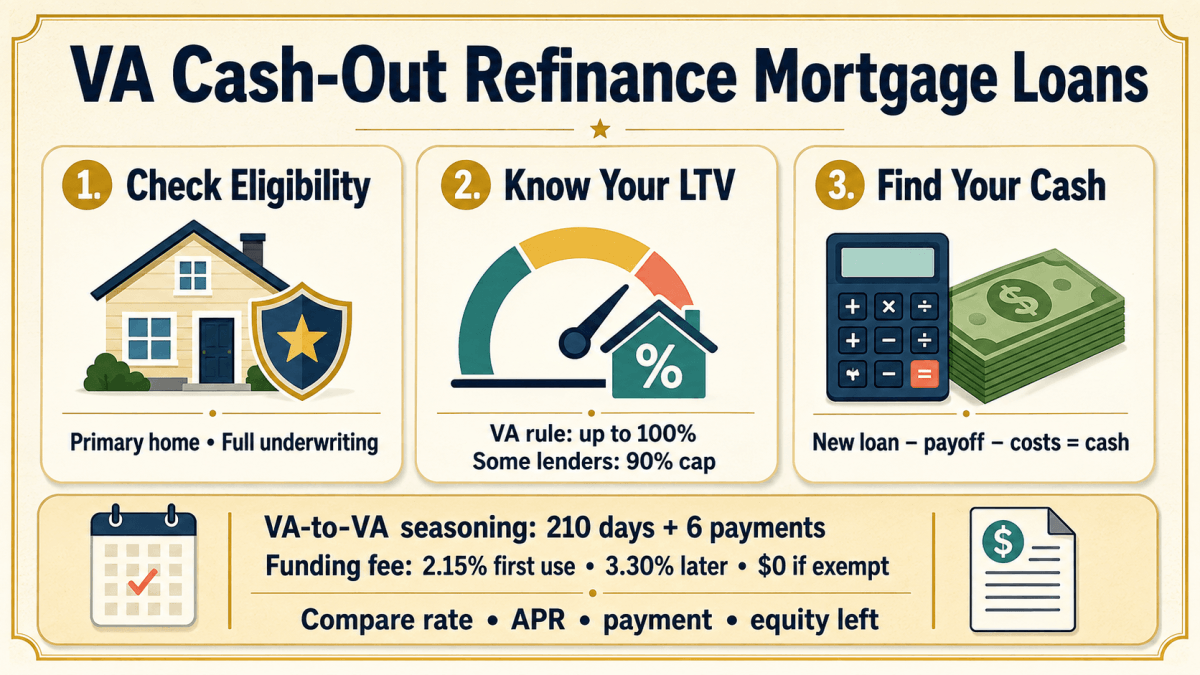
A VA cash-out refinance replaces your current mortgage with a new VA-backed loan and may let you receive part of your home equity in cash. VA cash-out refinance mortgage loans can refinance an existing VA, FHA, USDA, or conventional mortgage. You generally need VA eligibility, sufficient entitlement, primary-residence occupancy, a VA appraisal, and approval based on your credit, income, debts, and residual income. VA rules may permit financing up to 100% of the home’s reasonable value, but lenders can set lower limits. Your proceeds equal the new loan amount minus the existing payoff, closing costs, other required payoffs, and any financed VA funding fee.
What Is a VA Cash-Out Refinance Mortgage Loan?
A VA cash-out refinance replaces an existing mortgage with a new VA-backed loan. Despite the name, the borrower does not always have to receive cash. The loan may be used to access home equity, change the interest rate or loan term, pay eligible closing costs, or refinance a non-VA mortgage into a VA loan. VA cash-out refinance mortgage loans generally require a VA appraisal and full underwriting. The borrower must have an eligible Certificate of Eligibility, intend to occupy the home as a primary residence, and meet VA and lender requirements for credit, income, debts, residual income, and available entitlement.
Refinancing an Existing VA Mortgage
A homeowner may replace an existing VA mortgage with a new VA cash-out refinance. Depending on the transaction, the borrower may:
- Receive part of the home’s equity in cash
- Pay off a second mortgage or other eligible liens
- Change the interest rate or repayment term
- Include eligible closing costs in the new loan
- Consolidate qualifying debts through closing
The available cash depends on the home’s appraised value, the lender’s maximum loan-to-value ratio, the existing mortgage payoff, closing costs, liens, and any VA funding fee that is financed. VA rules may permit financing up to 100% of the home’s reasonable value, but individual lenders and investors may set a lower limit. Refinancing an existing VA loan may also be subject to seasoning and net tangible benefit requirements. The borrower should compare the new payment, interest rate, APR, closing costs, remaining equity, and total interest before proceeding.
Refinancing a Conventional, FHA, or USDA Loan into a VA Loan
An eligible veteran, active-duty service member, or qualifying surviving spouse may use a VA cash-out refinance to replace a conventional, FHA, or USDA mortgage with a VA-backed loan. Receiving cash is not required. This option may help a qualified borrower eliminate FHA mortgage insurance or conventional private mortgage insurance. However, removing mortgage insurance does not automatically make the refinance beneficial. The new interest rate, funding fee, loan term, closing costs, monthly payment, and total borrowing cost must also be considered. The borrower must qualify for VA financing, provide a valid Certificate of Eligibility, meet the occupancy requirement, complete a VA appraisal, and satisfy the lender’s underwriting standards.
VA Cash-Out Refinance Versus an IRRRL
A VA cash-out refinance and a VA Interest Rate Reduction Refinance Loan serve different purposes. A VA cash-out refinance can replace either a VA or non-VA mortgage and may allow the borrower to access home equity. It normally requires a new VA appraisal and a complete review of credit, income, debts, and residual income. An IRRRL, also called a VA streamline refinance, is available only when refinancing an existing VA-backed mortgage. It is designed mainly to lower the interest rate or the monthly payment or convert an adjustable-rate loan to a fixed-rate loan. An IRRRL cannot be used to take home equity out as cash. Borrowers who only want better terms on an existing VA mortgage should compare an IRRRL with a VA cash-out refinance. The better option depends on the borrower’s goals, eligibility, equity needs, closing costs, and long-term financial benefit.
Who Qualifies for a VA Cash-Out Refinance?
Borrowers seeking VA cash-out refinance mortgage loans must qualify for the VA home loan benefit and meet the lender’s underwriting requirements. Eligible applicants may include veterans, active-duty service members, National Guard or Reserve members, and certain surviving spouses. Having VA eligibility does not guarantee loan approval. The borrower must also meet occupancy, credit, income, debt-to-income ratio, residual-income, appraisal, and entitlement requirements.
Certificate of Eligibility and Entitlement
A Certificate of Eligibility, or COE, confirms that the borrower meets the military service requirements for a VA-backed loan. Borrowers can request a COE through VA.gov, ask a VA-approved lender to obtain it, or apply by mail. The COE also shows how much VA entitlement has already been used. Borrowers with another active VA loan may have only partial entitlement available. Limited entitlement does not always prevent refinancing, but it can affect the maximum loan amount or require additional borrower funds. A COE confirms eligibility for the VA benefit. It does not confirm that the borrower meets the lender’s credit, income, appraisal, or loan-amount requirements.
Primary-Residence Occupancy
The home being refinanced must generally be the borrower’s primary residence. The borrower must certify that they live in or intend to occupy the property. A VA cash-out refinance cannot normally be used for a vacation home, second home, or property held solely as an investment. Special occupancy provisions may apply when an active-duty service member is deployed or when an eligible spouse occupies the property. Borrowers should explain any unusual occupancy situation to their lender before applying.
Credit, Income, DTI, and Residual Income
The VA does not establish one universal minimum credit score for cash-out refinancing. However, lenders may set their own minimum scores and review the borrower’s payment history, recent late payments, collections, bankruptcies, foreclosures, and other credit events. Borrowers must also have a stable, reliable income that is expected to continue. The lender generally reviews employment, wages, military income, retirement income, disability benefits, self-employment income, and other eligible sources. The debt-to-income ratio, or DTI, compares monthly debt payments with gross monthly income. The VA commonly uses 41% as an underwriting benchmark, but it is not an automatic maximum. A borrower with a higher DTI may still qualify when sufficient residual income and other compensating factors support the loan. Individual lenders may impose stricter DTI limits. Residual income is the money remaining each month after major debts, housing expenses, taxes, and certain other obligations are paid. The required amount depends on the property’s region, the borrower’s household size, and the loan amount. High residual income can be especially important when the borrower has a higher DTI or other underwriting risks. Final approval depends on the complete loan file, including credit, qualifying income, debts, residual income, available entitlement, the VA appraisal, and the lender’s guidelines.
How Much Cash Can a Veteran Receive?
The amount of cash a veteran can receive depends on the home’s VA reasonable value, the lender’s loan-to-value limit, the current mortgage payoff, other liens, closing costs, and the VA funding fee. The veteran must also qualify based on credit, income, debts, residual income, available entitlement, and the lender’s underwriting guidelines. With VA cash-out refinance mortgage loans, estimated proceeds are generally calculated as follows:
New VA loan amount − mortgage payoff − other required payoffs − closing costs − prepaid expenses − applicable funding fee = estimated cash to the borrower
The final amount may change after the appraisal, payoff statement, title search, insurance review, and closing figures are completed.
VA’s 100% Maximum LTV Rule
VA regulations allow a cash-out refinance loan of up to 100% of the property’s reasonable value. The reasonable value is established through the VA appraisal process. For example, if a home’s VA reasonable value is $400,000, VA rules may permit a new loan amount of up to $400,000. This does not mean the veteran will receive $400,000 in cash. The existing mortgage, liens, closing costs, prepaid expenses, and funding fee must first be paid from the proceeds of the transaction. Consider this simplified example for a funding-fee-exempt veteran:
- VA reasonable value: $400,000
- Maximum loan at 100% LTV: $400,000
- Existing mortgage payoff: $245,000
- Estimated closing costs and prepaid expenses: $10,000
- Estimated cash proceeds: $145,000
This example is for illustration only. Approval for 100% LTV is not automatic, and the veteran must meet all VA and lender requirements. Removing nearly all the home’s equity can also make it harder to sell or refinance later. Under federal regulations, the new loan cannot exceed 100% of the property’s reasonable value. If a financed VA funding fee would cause the balance to exceed that limit, the veteran must pay the excess at closing or reduce the transaction.
Why Some Lenders Limit Cash-Out Refinances to 90% LTV
Although VA regulations permit up to 100% LTV, VA-approved lenders are not required to offer the maximum. Some lenders or investors limit VA cash-out refinances to 90% LTV as part of their own risk, credit, property, or secondary-market requirements. Using the same $400,000 home value, a 90% lender limit would produce a maximum new loan amount of $360,000. For a funding-fee-exempt veteran, the calculation might look like this:
- Maximum loan at 90% LTV: $360,000
- Existing mortgage payoff: $245,000
- Estimated closing costs and prepaid expenses: $10,000
- Estimated cash proceeds: $105,000
In this example, the lender’s 90% limit reduces the estimated proceeds by $40,000 compared with a 100% LTV transaction. Maximum LTV may also depend on the borrower’s credit profile, occupancy, property type, entitlement, loan size, and other underwriting factors. Veterans should ask each lender:
- What is your maximum VA cash-out LTV?
- Does the limit include the financed funding fee?
- Does the credit score or the property type affect the maximum?
- Is the limit a VA rule, an investor requirement, or a lender overlay?
How Closing Costs and the Funding Fee Affect Proceeds
Closing costs reduce the amount of equity available as cash. These expenses may include lender charges, discount points, appraisal and title fees, recording charges, prepaid property taxes, homeowners’ insurance, and interest. Most nonexempt borrowers must also pay a one-time VA funding fee. The current cash-out refinance rate is generally 2.15% for the first use of the VA loan benefit and 3.30% for a subsequent use. Qualifying exempt borrowers pay no funding fee. The funding fee may be paid at closing or financed into the new loan. Financing it does not make the fee free. It increases the mortgage balance and may reduce the amount of cash proceeds available under the applicable LTV limit. The borrower will also pay interest on the financed fee over the loan term. Veterans should review the Loan Estimate and Closing Disclosure carefully. The most important figures to compare are the new loan balance, cash received, monthly payment, APR, closing costs, remaining home equity, and estimated total interest. Current funding, fee rates, and exemption information are available from the Department of Veterans Affairs.
Type 1 Versus Type 2 VA Cash-Out Refinancing
VA classifies cash-out refinances by comparing the new loan amount to the payoff amount of the refinanced mortgage. The difference between Type 1 and Type 2 affects whether the borrower accesses equity and which refinancing protections apply.
What Is a Type 1 VA Cash-Out Refinance?
A Type 1 VA cash-out refinance occurs when a new VA loan replaces an existing VA-guaranteed loan, and the new loan’s principal amount is less than or equal to the current payoff. Despite its name, a Type 1 transaction normally does not provide cash from the home’s equity. The borrower may use it to change the loan’s rate or term through full underwriting, rather than a VA Interest Rate Reduction Refinance Loan. Type 1 refinances of existing VA loans are subject to additional borrower protections, including:
- VA loan-seasoning requirements
- A net tangible benefit test
- Recoupment of eligible refinancing costs within 36 months
- Applicable interest-rate reduction requirements
- Required loan-comparison and home-equity disclosures
A Type 1 refinance should not be confused with an IRRRL. A Type 1 cash-out refinance generally requires a new appraisal and complete underwriting of income, credit, debt, and residual income.
What Is a Type 2 VA Cash-Out Refinance?
A Type 2 VA cash-out refinance occurs when the new VA loan amount exceeds the payoff amount of the refinanced mortgage. It may replace an existing VA, FHA, USDA, conventional, or other eligible mortgage. The amount above the current payoff is not necessarily paid entirely to the borrower. It may be used to cover:
- Cash paid to the borrower at closing
- Eligible closing costs
- Prepaid taxes and insurance
- A second mortgage or other required liens
- Approved debt payoffs
- The VA funding fee, when financed
For example, assume a veteran owes $250,000 and obtains a new VA loan for $320,000. The $70,000 difference may first be used to pay closing costs, liens, prepaid expenses, and the funding fee. The veteran receives only the remaining amount after all required charges and payoffs are deducted. When a Type 2 transaction refinances an existing VA-guaranteed loan, VA seasoning requirements also apply. The federal seasoning rule does not automatically extend to a non-VA mortgage being refinanced into a VA loan. Lenders may still establish their own waiting periods or other requirements.
Requirements That Apply to Both Types
Both types of VA cash-out refinance mortgage loans require the new loan to provide a net tangible benefit to the borrower. They also generally require a VA appraisal, primary-residence occupancy, sufficient entitlement, and full underwriting based on credit, income, debts, and residual income. VA regulations may permit a loan amount of up to 100% of the property’s reasonable value. However, lenders and investors may limit either type to a lower LTV. Borrowers should compare the new balance, rate, APR, payment, costs, equity removed, and total interest before choosing between the options. The lender must provide the required loan comparison and home-equity disclosures within 3 business days of the application and again at closing. The current requirements appear in 38 CFR §36.4306.
VA Cash-Out Refinance Seasoning Rules
Loan seasoning is the minimum period a borrower must wait before refinancing an existing mortgage. For VA cash-out refinance mortgage loans that replace an existing VA-guaranteed or VA-insured loan, the new loan generally cannot receive a VA guaranty until the later of:
- 210 days after the borrower made the first monthly payment on the existing loan
- The date the borrower makes the sixth monthly payment on the existing loan
Both conditions must be satisfied. Reaching 210 days is not enough if the borrower has not made six monthly payments. Likewise, making six payments does not satisfy the rule if 210 days have not passed. The rule applies differently depending on the transaction:
- Type 1 VA-to-VA refinance: Seasoning applies when the new loan amount is equal to or less than the payoff of the existing VA loan.
- Type 2 VA-to-VA refinance: Seasoning applies when the new loan amount exceeds the payoff of the existing VA loan.
- Non-VA-to-VA refinance: The federal seasoning requirement does not automatically apply when refinancing a conventional, FHA, USDA, or other non-VA mortgage into a VA loan.
A lender or investor may impose its own waiting period or payment-history requirements on a non-VA-to-VA refinance. Recent late payments, mortgage forbearance, loan modifications, or unresolved payment arrangements may also affect approval. Meeting the seasoning requirement does not guarantee approval. The borrower must still satisfy the VA’s net tangible benefit requirement and qualify based on credit, income, debts, residual income, occupancy, appraisal, entitlement, and the lender’s underwriting standards. Borrowers should ask whether a required waiting period comes from VA regulations or the lender’s own guidelines.
VA Net Tangible Benefit Requirements
A VA cash-out refinance must provide a net tangible benefit to the borrower. In simple terms, the new loan must offer a clear financial advantage when compared with the mortgage being refinanced. The lender must complete and document this test for all VA cash-out refinance mortgage loans. The new loan must provide at least one of these eight benefits:
- Eliminate monthly private mortgage insurance, FHA mortgage insurance, or another monthly guaranty insurance charge
- Shorten the loan term
- Reduce the interest rate
- Lower the monthly mortgage payment
- Increase the borrower’s monthly residual income
- Refinance an interim loan used to construct, repair, or improve the primary residence
- Keep the new loan amount at or below 90% of the home’s VA reasonable value
- Replace an adjustable-rate mortgage with a fixed-rate mortgage
Meeting one of these conditions satisfies the basic net tangible benefit test. However, it does not automatically mean the refinance is the best financial choice or that the borrower will qualify. For example, a lower payment created by restarting the loan with a longer term could increase the total interest paid over time.
Required Loan Comparison and Equity Disclosures
The lender must provide the borrower with a standardized comparison that highlights key differences between the existing mortgage and the proposed VA loan. This comparison must include:
- The payoff amounts of both loans
- The current and proposed loan types
- The interest rates
- The remaining term of the current loan and the term of the new loan
- The total scheduled principal, interest, and applicable mortgage or guaranty insurance payments
- The current and proposed loan-to-value ratios
The lender must also estimate how much home equity the transaction will remove and explain that having less equity may affect the borrower’s ability to sell the property later. These disclosures must be provided no later than three business days after the loan application and again at closing. The borrower must certify receipt on both occasions. Certain Type 1 VA-to-VA refinances may also need to satisfy separate cost-recoupment and interest-rate reduction rules. Veterans should review the new balance, payment, APR, closing costs, loan term, remaining equity, and total interest—not just the immediate cash received.
VA Funding Fee and Closing Costs
Most borrowers using VA cash-out refinance mortgage loans must pay a one-time VA funding fee plus standard mortgage closing costs. These charges reduce the cash available from the refinance and can increase the new mortgage balance when financed.
Current VA Cash-Out Refinance Funding-Fee Rates
Under the current VA funding-fee schedule, the fee for a cash-out refinance is:
- First use of the VA home loan benefit: 2.15% of the loan amount
- Subsequent use: 3.30% of the loan amount
- Qualifying exempt borrower: No funding fee
Unlike VA purchase loans, the cash-out refinance funding fee rate does not vary with the down payment or equity amount. For example, a first-use borrower with a $300,000 base loan would generally owe a $6,450 funding fee. A subsequent-use borrower with the same base loan would generally owe $9,900. The borrower may pay the fee at closing or finance it into the new mortgage. Financing the fee increases the loan balance and total interest paid. The total loan amount, including a financed funding fee, cannot exceed the applicable VA and lender LTV limit.
Who May Be Exempt From the VA Funding Fee?
A borrower may be exempt if any of the following apply:
- The veteran receives VA compensation for a service-connected disability
- The veteran is eligible for disability compensation but receives retirement or active-duty pay instead
- A qualifying surviving spouse receives Dependency and Indemnity Compensation
- A service member receives an eligible proposed or memorandum disability rating before closing
- An active-duty service member provides evidence before closing of receiving a Purple Heart
Funding-fee status should be confirmed before closing. A borrower who later receives a disability award with an effective date before the loan closing may qualify for a refund. The borrower should contact the lender or the appropriate VA regional loan center for assistance.
Closing Costs on a VA Cash-Out Refinance
Closing costs vary by lender, property location, loan amount, and transaction details. Common expenses may include:
- Lender origination charges
- Discount points
- VA appraisal fee
- Credit report and flood-certification fees
- Title search and title insurance
- Recording charges
- State and local taxes
- Prepaid mortgage interest
- Homeowners insurance premiums
- Property-tax and insurance escrow deposits
- Other allowable settlement services
A cash-out refinance may allow eligible closing costs, discount points, and prepaid expenses to be included in the new loan. However, every financed cost uses part of the available equity and reduces the borrower’s cash proceeds. The final loan must remain within the applicable LTV limit.
How Costs Affect the Veteran’s Cash Proceeds
The amount shown as available equity is not the same as the cash the borrower will receive. Estimated proceeds are calculated by subtracting the following from the new loan amount:
- Existing mortgage payoff
- Second mortgages or other required liens
- Closing costs
- Discount points
- Prepaid expenses
- Approved debt payoffs
- Any VA funding fee paid from the loan proceeds
Financing costs can reduce the amount needed at closing, but they do not eliminate those expenses. The borrower repays the financed costs, including interest, over the life of the mortgage.
How to Compare the Loan Estimate
Borrowers should request Loan Estimates from multiple lenders and compare equivalent loan amounts, rate-lock periods, and loan terms. Focus on:
- Interest rate and APR
- Discount points
- Lender origination charges
- Lender credits
- Total closing costs
- VA funding-fee amount and exemption status
- New principal balance
- Monthly principal-and-interest payment
- Cash received at closing
- Remaining home equity
- Estimated cash needed to close
- Total interest over the expected time in the home
A lower rate does not always mean a lower-cost loan. One lender may advertise a lower rate but charge more points or lender fees. A lower monthly payment may also result from restarting the mortgage with a longer term, which could increase the total interest over the life of the loan. The Consumer Financial Protection Bureau’s Loan Estimate guide can help borrowers compare offers. Before signing, borrowers should compare the final Closing Disclosure with the latest Loan Estimate and ask the lender about any unexpected changes.
Documents Needed for a VA Cash-Out Refinance
The documents required for VA cash-out refinance mortgage loans depend on the borrower’s income, credit history, military status, property, and the lender’s requirements. Providing complete and current documents early can help the lender verify eligibility and identify potential underwriting issues.
VA Eligibility and Identification Documents
Borrowers may need to provide:
- Certificate of Eligibility
- Government-issued photo identification
- Social Security number
- DD Form 214 for eligible veterans
- Statement of Service for active-duty borrowers
- National Guard or Reserve service records, when applicable
- Marriage or eligibility documents for a qualifying surviving spouse
Many VA-approved lenders can obtain the Certificate of Eligibility electronically. A COE confirms eligibility for the VA benefit but does not guarantee loan approval.
Income and Employment Documents
Employed borrowers commonly provide:
- Pay stubs covering the most recent 30 days
- W-2 forms for the previous two years
- Employer contact information
- Documentation of overtime, bonuses, commissions, or other variable income
Depending on the income source, the lender may also request:
- Federal tax returns
- Recent business bank statements
- Year-to-date profit-and-loss statement
- Social Security or pension award letters
- Retirement account statements
- VA disability compensation documentation
- Military Leave and Earnings Statements
- Rental agreements and tax returns for rental income
- Divorce decrees or support orders when alimony or child support is used to qualify
Self-employed borrowers generally need more detailed records to document income stability and show that the business remains active.
Assets and Banking Records
Even when borrowers plan to finance most closing costs, the lender may need to verify available funds and financial reserves. Requested documents may include:
- Recent checking and savings account statements
- Retirement or investment account statements
- Documentation explaining large or unusual deposits
- Proof of funds needed for closing
- Gift documentation, if permitted and applicable
Borrowers should not move large amounts of money or deposit undocumented cash during the refinance process without first discussing it with their loan officer.
Mortgage, Debt, and Property Documents
The lender may request:
- Current mortgage statement
- Statements for any second mortgage or home equity line of credit
- Homeowners insurance declaration page
- Property-tax information
- Homeowners association statement, when applicable
- Payoff information for debts being paid through closing
- Existing title or settlement documents, when available
- Documentation of recent home improvements, if relevant
The lender generally orders the VA appraisal, title search, credit report, flood determination, and formal mortgage payoff. The borrower may need to authorize these services or provide additional information.
Documents for Special Financial Circumstances
Additional records may be required when the file includes:
- Bankruptcy schedules and discharge or dismissal papers
- Foreclosure, short-sale, or deed-in-lieu documents
- Divorce decree or property-settlement agreement
- Mortgage forbearance or loan-modification records
- IRS payment agreements
- Court-ordered judgments
- Letters explaining recent late payments, employment gaps, credit inquiries, or other unusual circumstances
A letter of explanation should be factual, brief, and supported by documentation whenever possible. Document requirements vary by lender and loan file. Borrowers should provide exactly what the lender requests, submit complete pages, and avoid sending duplicate or altered documents. The lender may ask for updated pay stubs, bank statements, or mortgage records before closing because documents can expire during underwriting.
Steps From Application Through Closing
The process for VA cash-out refinance mortgage loans begins with a full mortgage application and ends after closing, any applicable cancellation period, and loan funding. The exact timeline varies based on the appraisal, title work, document completeness, underwriting conditions, and lender workload.
1. Compare Lenders and Loan Options
Before applying, compare offers from several VA-approved lenders. Ask each lender about:
- Maximum cash-out LTV
- Minimum credit-score requirements
- Interest rate and APR
- Discount points and lender fees
- Estimated closing costs
- VA funding-fee exemption status
- Monthly payment and total loan amount
- Estimated cash proceeds
- Expected closing timeline
Confirm whether any restriction comes from VA guidelines or the lender’s own requirements.
2. Complete the Mortgage Application
The borrower provides information about income, employment, debts, assets, military service, the property, the existing mortgage, and the requested loan amount. The lender may also obtain the borrower’s Certificate of Eligibility and credit reports. After receiving a complete application, the lender generally provides a Loan Estimate showing the proposed rate, payment, loan amount, APR, and estimated closing costs. For a VA cash-out refinance, the lender must also provide the required loan comparison and home equity disclosures within 3 business days of the application. These disclosures help the veteran compare the existing mortgage with the proposed loan and understand how much equity may be removed.
3. Submit Supporting Documents
The borrower submits the requested records for income, employment, assets, mortgage, insurance, and military service. Additional documents may be needed for self-employment, rental income, bankruptcy, divorce, mortgage forbearance, or other special circumstances. Borrowers should submit complete, readable documents, including all pages. Avoid opening new credit accounts, increasing credit-card balances, changing jobs, or moving large sums of money without first consulting their loan officer.
4. Complete the VA Appraisal and Property Review
The lender orders a VA appraisal to establish the property’s fair market value and to review applicable property requirements. The borrower normally pays the appraisal fee unless the lender provides a credit. The appraised value helps determine the maximum loan amount and estimated cash proceeds. If the value is lower than expected, the borrower may need to reduce the new loan amount, receive less cash, bring money to closing, or reconsider the refinance. The appraisal is not the same as a complete home inspection. Borrowers may obtain a separate inspection for a more detailed review of the property’s condition.
5. Complete Title, Insurance, and Payoff Work
The lender or settlement provider orders a title search to identify the existing mortgage, second mortgages, tax liens, judgments, or other claims against the property. Formal payoff statements are obtained for all debts due at closing. The lender also verifies homeowners’ insurance, property taxes, flood zone status, and homeowners’ association information, when applicable. Payoff balances can change because of accrued interest, fees, escrow shortages, or payments made during processing.
6. Underwriting Reviews the Complete File
An underwriter evaluates the borrower’s:
- VA eligibility and available entitlement
- Credit and mortgage-payment history
- Income and employment stability
- Debt-to-income ratio
- VA residual income
- Primary-residence occupancy
- Appraised property value
- Title and lien information
- Loan-to-value ratio
- Seasoning requirements, when applicable
- Net tangible benefit
- Available funds needed for closing
The underwriter may issue a conditional approval requesting updated bank statements, pay stubs, explanations, insurance documents, payoff information, or other records. Conditional approval is not final approval. Every required condition must be reviewed and cleared.
7. Receive Final Approval and Review Closing Figures
Once all underwriting conditions are satisfied, the lender may issue a clear-to-close. The lender then prepares the final loan documents and coordinates closing with the title company, escrow agent, or closing attorney. The borrower should receive a Closing Disclosure at least three business days before closing. Review it carefully and compare it with the most recent Loan Estimate. Confirm:
- Final interest rate and APR
- Loan term and monthly payment
- VA funding fee and exemption status
- Discount points and lender charges
- Total closing costs
- Existing mortgage and lien payoffs
- Cash needed from or paid to the borrower
- Remaining equity after closing
Borrowers should ask about any unexpected changes before signing.
8. Sign the Closing Documents
At closing, the borrower signs the promissory note, security instrument, final VA disclosures, Closing Disclosure, occupancy certification, and other required documents. The borrower must provide any verified funds needed to complete the transaction. The final VA loan comparison and home equity disclosures are also provided at closing. Borrowers should take the time to read the documents and should not sign forms that contain blank spaces or figures they do not understand.
9. Wait for the Right-of-Rescission Period
Most refinances secured by a borrower’s primary residence include a three-business-day right of rescission. This period generally allows the borrower to cancel after signing. Saturdays normally count as business days for rescission purposes, but Sundays and federal holidays do not. Cash proceeds are generally not released until this cancellation period expires. After the rescission period ends, the lender funds the loan, the settlement provider pays the existing mortgage and other required debts, and the remaining proceeds are delivered according to the closing instructions. The borrower should continue making payments on the existing mortgage until the lender confirms that it has been paid off.
VA Cash-Out Approval Example
The following hypothetical example illustrates how a borrower might qualify for a VA cash-out refinance mortgage loan. It is for educational purposes only. Loan limits, interest rates, costs, and approval results vary by borrower and lender. A veteran wanted to refinance a conventional mortgage into a VA loan and use part of the home’s equity for home repairs and debt consolidation. The veteran occupied the property as a primary residence, had sufficient VA entitlement, and was exempt from the VA funding fee due to an eligible service-connected disability.
Borrower and Property Profile
- VA appraised value: $400,000
- Existing conventional mortgage payoff: $245,000
- Lender’s maximum cash-out LTV: 90%
- Maximum new VA loan: $360,000
- Estimated closing costs, prepaid expenses, and required payoffs: $12,000
- Estimated cash proceeds: $103,000
- Credit score: 662
- Employment: W-2 employee with more than two years in the same field
- Debt-to-income ratio after refinancing: 45%
- Residual income: $850 above the applicable VA guideline
- Mortgage history: No late housing payments during the previous 12 months
The estimated proceeds were calculated as follows: $360,000 new VA loan − $245,000 mortgage payoff − $12,000 in costs and required payoffs = $103,000 estimated cash to the veteran
Why the Loan Was Approved
Although the borrower’s 45% DTI exceeded the VA’s common 41% benchmark, it did not result in an automatic denial. The underwriter considered the entire file, including:
- Stable employment and qualifying income
- Satisfactory recent credit and mortgage history
- Residual income above the applicable VA requirement
- Primary-residence occupancy
- Sufficient VA entitlement
- A property meeting VA appraisal requirements
- A loan amount limited to 90% of the home’s reasonable value
- No undisclosed debts or liens
The transaction also met the VA net tangible benefit requirement because the new loan did not exceed 90% of the property’s reasonable value. The lender’s 90% maximum was an overlay; VA regulations may permit up to 100% LTV, subject to qualification and lender approval.
Because the existing mortgage was conventional rather than VA-backed, the federal VA-to-VA seasoning rule did not automatically apply. The lender still reviewed the borrower’s mortgage history and its own seasoning requirements.
Approval remained subject to final conditions, including updated pay stubs, employment verification, homeowners’ insurance, final payoff figures, a clear title, and confirmation that the borrower had not opened new debt before closing. The veteran’s final cash proceeds may change due to accrued mortgage interest, updated payoff amounts, taxes, insurance, closing costs, or other settlement adjustments. The borrower also needed to consider the larger mortgage balance, the new monthly payment, the remaining equity, and the long-term interest, not only the cash received.
Questions to Ask Before Refinancing
Before choosing VA cash-out refinance mortgage loans, ask the lender for clear answers about the new loan, costs, cash proceeds, and long-term impact. A refinance should support your financial goals—not simply turn home equity into cash.
Questions About Eligibility and Lender Requirements
Ask the lender:
- Do I have enough VA entitlement for the requested loan amount?
- What credit score, DTI, and residual-income standards must I meet?
- What is your maximum loan-to-value ratio?
- Is your LTV limit a VA rule or a lender overlay?
- Does my loan meet the VA seasoning requirement?
- What net tangible benefit does this refinance provide?
- Are there extra requirements for my property type or credit history?
VA rules may permit up to 100% LTV, but some lenders limit cash-out refinancing to 90% or less.
Questions About the Rate, Payment, and Loan Term
Ask for a side-by-side comparison of your current mortgage and proposed VA loan:
- What are the interest rate and APR?
- Is the rate fixed or adjustable?
- Will my monthly payment increase or decrease?
- How many years remain on my current mortgage?
- Am I restarting a new 30-year term?
- How much total interest could I pay under each loan?
- Am I giving up a low-rate first mortgage to access equity?
- Would a second mortgage or home equity loan cost less overall?
A lower monthly payment is not always a better deal. Restarting the loan term can increase total interest, even when the new rate is lower.
Questions About Fees and Cash Proceeds
Request a written estimate showing:
- The appraised value used for the calculation
- Maximum loan amount
- Existing mortgage payoff
- Second mortgages and other required payoffs
- VA funding fee and exemption status
- Discount points
- Lender and third-party closing costs
- Prepaid taxes, insurance, and interest
- Estimated cash paid to you
- Estimated equity remaining after closing
Ask how much cash you would receive if the appraisal is lower than expected. You should also ask which costs may change before closing and whether any lender credit requires a higher interest rate.
Questions About Debt Consolidation
If you plan to pay off credit cards or other debts, ask:
- How much will my total monthly debt payments decrease?
- How much will my mortgage payment increase?
- How long will it take to recover the closing costs?
- Am I turning short-term debt into 15- or 30-year mortgage debt?
- How much interest could I pay if I keep the new loan for its full term?
- Can I avoid taking on new credit card balances after closing?
- Would a smaller refinance amount meet my needs?
Debt consolidation may improve monthly cash flow, but it also moves unsecured debt onto a loan secured by your home. Missing mortgage payments could place the home at risk.
Questions to Ask Yourself
Before proceeding, consider:
- What will I use the money for?
- Is the refinance solving a long-term need or a short-term cash problem?
- How long do I expect to keep the home and the new mortgage?
- Would I still refinance if I received less cash than expected?
- Will I have emergency savings after closing?
- Am I comfortable with the new payment and reduced equity?
- Could the larger balance make selling or refinancing harder later?
Do not judge the offer only by the interest rate or cash received. Compare the APR, monthly payment, loan term, closing costs, remaining equity, break-even period, and total projected interest. Review the Loan Estimate carefully and ask the lender to explain any charge or requirement you do not understand.
Final Thoughts on VA Cash-Out Refinance Mortgage Loans
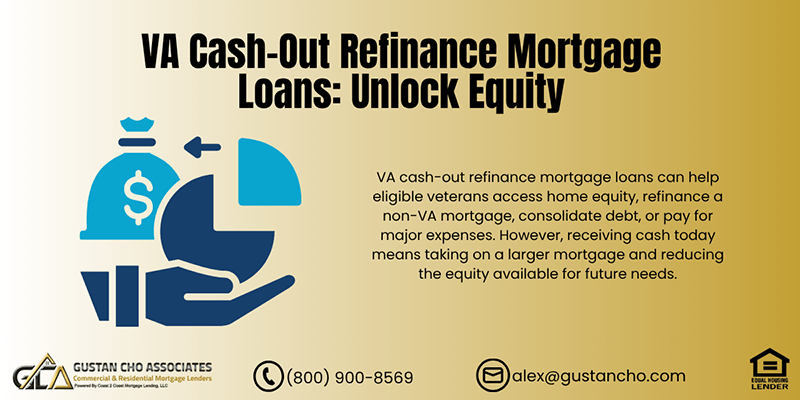
VA cash-out refinance mortgage loans can help eligible veterans access home equity, refinance a non-VA mortgage, consolidate debt, or pay for major expenses. However, receiving cash today means taking on a larger mortgage and reducing the equity available for future needs.
Before refinancing, compare the new interest rate, APR, monthly payment, loan term, closing costs, funding fee, cash proceeds, and total projected interest. Ask whether the lender’s loan-to-value limit comes from VA guidelines or a lender overlay. VA rules may allow up to 100% LTV, but not every lender offers that option.
The right loan should provide a clear financial benefit and leave the borrower with an affordable payment. Veterans should review multiple Loan Estimates and consider whether a smaller cash-out amount, an IRRRL, a home equity loan, or keeping the current mortgage would be more cost-effective. Borrowers who have been denied due to credit scores, debt-to-income ratios, or lender overlays may benefit from a second opinion from another VA-approved lender. Contact Gustan Cho Associates to discuss your goals, compare available VA refinance options, and determine whether a VA cash-out refinance fits your financial plans.
Frequently Asked Questions About VA Cash-Out Refinancing
Is Money From a VA Cash-Out Refinance Taxable?
The funds received are typically not considered taxable income because they are borrowed funds that must be repaid. However, separate tax rules may apply if part of the mortgage debt is later forgiven or canceled. Borrowers should consult a tax professional about their individual circumstances.
Is VA Cash-Out Refinance Interest Tax-Deductible?
It depends on how the money is used and whether the borrower itemizes deductions. Interest on proceeds used to buy, build, or substantially improve the home securing the loan may be deductible, subject to IRS limits. Interest on money used for credit cards, tuition, or personal expenses generally does not qualify as home mortgage interest. Review IRS Publication 936 and speak with a tax professional.
Can a Non-Veteran Spouse Be a Co-Borrower?
Yes. An eligible veteran may generally obtain a VA loan with a non-veteran spouse. A loan with an unmarried non-veteran co-borrower may also be possible, but the VA guaranty normally covers only the veteran’s portion of the loan. Joint loans can require additional review, and not every lender offers them.
Does a VA Cash-Out Refinance Require Cash Reserves?
The VA does not generally require every refinance borrower to maintain a fixed number of monthly mortgage payments in reserve. However, a lender may require reserves based on the borrower’s credit, income type, debt ratio, property count, loan amount, or overall risk profile. Borrowers may also need verified funds for costs that cannot be included in the new loan.
Can You Pay Off a VA Cash-Out Refinance Early?
Yes. VA borrowers may make extra principal payments, sell the home, or pay off the mortgage early without incurring a VA loan prepayment penalty. Confirm that any separate down payment assistance, state housing program, or subordinate financing does not have its own repayment requirements. The VA outlines this protection in its “Rights of VA Loan Borrowers” document.
Can a Buyer Assume a VA Cash-Out Refinance Mortgage?
VA Cash-Out Refinance Mortgage Loans are generally assumable with approval from the loan servicer or VA. The mortgage must normally be current, and the person assuming it must meet VA credit and underwriting requirements. The original veteran should obtain a formal release of liability. VA entitlement stays with the loan unless the eligible veteran substitutes it or pays off the mortgage.
Can a Temporary Rate Buydown Be Used on a VA Cash-Out Refinance?
A temporary interest-rate buydown may be used with an eligible fixed-rate VA cash-out refinance. The borrower must still qualify under VA requirements using the loan’s full note rate rather than the temporarily reduced payment. Availability and funding rules vary by lender, so borrowers should compare the buydown cost with the expected short-term payment savings.
This article about “VA Cash-Out Refinance Mortgage Loans: Unlock Equity” was updated on August 5th, 2026.