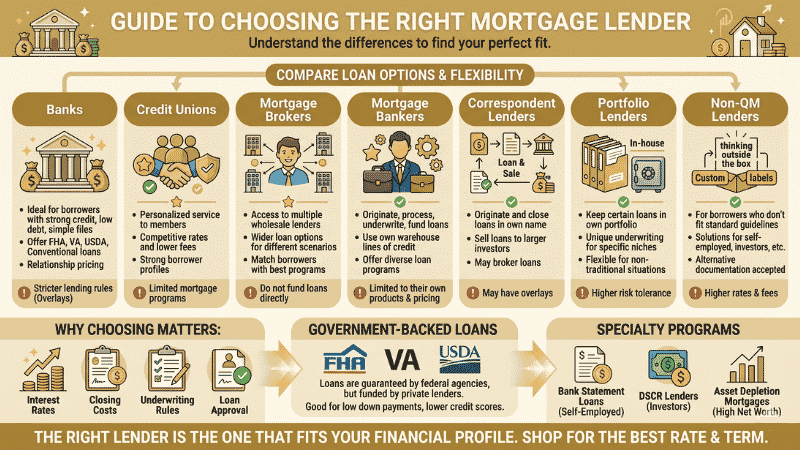
Choosing the right mortgage lender is important for getting your home loan approved. It can affect your interest rate, closing costs, and overall experience with the mortgage. Many homebuyers think all mortgage lenders follow the same rules, but that is not true. Banks, credit unions, mortgage brokers, mortgage bankers, correspondent lenders, portfolio lenders, and non-QM lenders can all offer different loan programs, pricing, underwriting rules, and approval options.
The main types of mortgage lenders include banks, credit unions, mortgage brokers, mortgage bankers, correspondent lenders, portfolio lenders, and non-QM mortgage lenders. Some lenders are best for borrowers with strong credit, low debt, and simple income.
Other lenders may be better for borrowers with lower credit scores, higher debt-to-income ratios, recent late payments, self-employment income, bankruptcy, foreclosure, or prior mortgage denial.
This guide breaks down the different types of mortgage lenders, how they work, and how to decide which lender may be the best fit for your situation. You will also learn why one lender may deny your mortgage application while another lender may approve the same borrower. The difference often comes down to lender overlays, loan program options, underwriting flexibility, and how well the loan officer understands your full credit and income profile.
At Gustan Cho Associates, we help borrowers compare mortgage options, including FHA, VA, USDA, conventional, jumbo, non-QM, bank statement, DSCR, and other specialty mortgage programs. Whether you are a first-time homebuyer, self-employed borrower, real estate investor, or buyer who was denied by another lender, understanding the types of mortgage lenders can help you choose the right path before you apply.
Why Loan Type Matters When Choosing a Mortgage Lender

The types of mortgage lenders you consider can significantly impact which one is the most suitable for your needs. Each lender may provide different loan programs and have varying approval criteria.
As a result, a borrower might qualify with one lender while being denied by another due to factors such as credit score requirements, debt-to-income ratio thresholds, lender overlays, or limited loan program availability.
Government-backed loans, such as FHA, VA, and USDA loans, are popular with homebuyers because they offer low- or no-down-payment options. FHA loans may work well for borrowers with lower credit scores or limited savings. VA loans can be a strong option for eligible veterans, active-duty service members, and surviving spouses because they offer no down payment for qualified borrowers. USDA loans may help eligible buyers purchase homes in approved rural or suburban areas with no down payment.
Conventional loans aren’t supported by any government programs. They follow Fannie Mae and Freddie Mac guidelines. They are often a good fit for borrowers with stronger credit, stable income, and enough savings for a down payment and closing costs. Conventional loans can be used for primary homes, second homes, and investment properties, which gives borrowers more flexibility than most government-backed loan programs.
Jumbo loans are used when the loan amount exceeds the conforming loan limit. These loans usually have stricter credit, income, reserve, and down payment requirements. Borrowers looking for jumbo financing should work with a lender that regularly handles higher loan amounts and understands jumbo underwriting.
Non-QM loans are designed for borrowers who may not fit traditional FHA, VA, USDA, or conventional loan guidelines. These programs may help self-employed borrowers, real estate investors, borrowers using bank statements instead of tax returns, borrowers with recent credit events, or buyers who need alternative income documentation.
This is why choosing the types of mortgage lenders matters. Some banks and credit unions may be a good fit for borrowers with simple files and strong credit. Mortgage brokers and lenders with access to multiple wholesale investors may offer more options for borrowers with lower credit scores, higher debt-to-income ratios, self-employment income, recent bankruptcy, foreclosure, or prior mortgage denial. The right lender is not always the biggest. The right lender is the one that offers the loan program, underwriting flexibility, and approval path that fits your financial profile.
Government-Backed Mortgage Loans
Government loans are guaranteed by the federal government to private lenders. Private lenders originate and fund government-backed loans. Here are the three government-backed mortgage loans.
- FHA loans are guaranteed by the U.S. Department of Housing and Urban Development (HUD)
- VA loans guaranteed by the U.S. Department of Veteran Affairs
- USDA loans guaranteed by the U.S. Department of Agriculture Rural Development
HUD, VA, and USDA do not originate, or fund government-backed loans. Private lenders originate and fund FHA, VA, and USDA loans. The government agencies acts like a mortgage insurer.
Types of Mortgage Lenders: What Are Government Loans
Government loans are owner-occupant home loans originated and funded by private mortgage lenders and banks. The governmental agency insures the individual banks and/or lenders’ losses incurred by lenders in the event the borrower defaults on their government loans.
Government-backed loans has little to no down payment requirements with competitive rates. Homebuyers with prior bad credit and low credit scores are eligible to qualify for government-backed loans. FHA, USDA, and VA loans are the three government-backed loans.
However, in order for the government to guarantee the home loans in default, the lender needs to follow the government mortgage guidelines at the time of originating the loan
Conventional Mortgage Lenders and Conforming Loan Guidelines
Conventional mortgage lenders offer home loans that are not insured or guaranteed by the federal government. Most conventional loans follow guidelines set by Fannie Mae and Freddie Mac. These two major government-sponsored enterprises help keep the mortgage market moving.
Conventional loans are also called conforming loans when they meet Fannie Mae or Freddie Mac requirements. These guidelines can include rules for credit scores, debt-to-income ratios, down payment, income, assets, property type, and mortgage insurance.
However, meeting Fannie Mae or Freddie Mac guidelines does not always mean every lender will approve you. Many mortgage lenders add their own extra rules on top of the standard conventional loan guidelines. These extra lender rules are called lender overlays.
For example, one conventional mortgage lender may require a higher credit score, lower debt-to-income ratio, larger reserves, or stricter documentation than another lender. That is why a borrower may be denied a conventional loan by one lender but approved by another lender, both using the same basic Fannie Mae or Freddie Mac guidelines.
When applying for a conventional mortgage, it’s important to select one of the types of mortgage lenders that understands conforming loan guidelines and avoids imposing unnecessary overlays, which can complicate the approval process. This is particularly vital for borrowers with higher debt-to-income ratios, lower credit scores, limited reserves, self-employment income, or prior credit issues.
Researching Types of Mortgage Lenders For Best Rates and Selection of Loan Options
Borrowers have a wide variety of types of mortgage lenders to choose from in applying for a residential mortgage loan. They can go to their local bank, a national bank like Chase, Wells Fargo, Bank of America, Citibank, or any regional bank. They can also choose their local credit union. Or the hundreds of mortgage bankers or mortgage brokers locally or nationally. Not all lenders have the same mortgage rates on government and conventional loans. It is highly advised for homebuyers to shop for rates.
The team at Gustan Cho Associates highly recommend borrowers to shop for rates to get the best rate and term on a home loan.
Borrowers now can apply for a residential mortgage loan in the comfort of their own homes. They can apply via online mortgage applications instead of visiting a lender face to face like they needed to do. Everything in mortgage lending, from the initial application, to submitting documents is all electronic now and done via email and/or fax.
Agency Mortgage Guidelines Versus Lender Overlays
As mentioned earlier, not all mortgage bankers have the same lending guidelines. Most of them have lender overlays. So if a borrower may meet all federal and/or conventional loan guidelines does not necessarily mean that they will qualify with all mortgage lenders and/or banks. Lender overlays are lending requirements set by the individual lender and not by HUD, VA, USDA, Fannie Mae, or Freddie Mac.
Just because one lender denies a borrower a loan does not mean the borrower cannot qualify and get approved for a mortgage loan by a different lender.
Borrowers need to find out what overlays each lender has and whether or not the overlays will affect them in them getting qualified. Gustan Cho Associates is a mortgage company licensed in 48 states with a national reputation for its no overlays on government and conventional loans.
Choosing The Types of Mortgage Lenders Which Is Best For Me
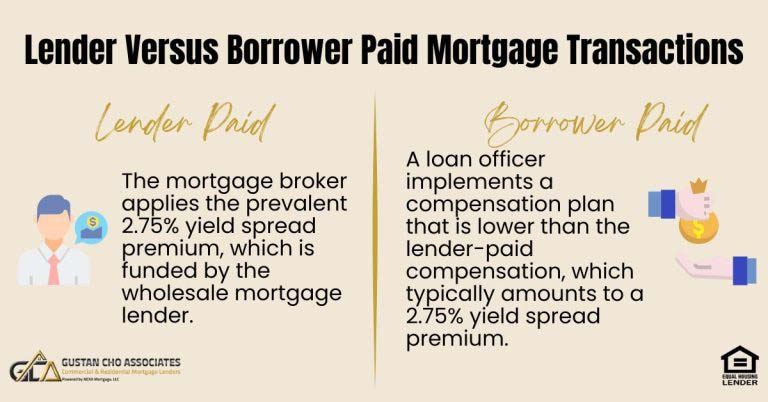
Certain mortgage lenders are direct mortgage loan lenders such as retail banks and have retail brick and mortar locations. The first thought of most home buyers is to go to their local bank when applying for a home mortgage. In general, mortgage brokers offer the best rates to borrowers. Mortgage brokers are capped at 2.75% yield spread premium, which is the total commission. Mortgage brokers need to disclose the yield spread premium. Mortgage bankers normally charge more than 5.00% compensation on the back end.
The compensation by mortgage bankers do not get to get disclosed like mortgage brokers. The higher the compensation, the higher the rates to the borrower.
However, most banks have lender overlays and are very strict when it comes to credit and debt to income ratio requirements. Banks are a good place to get qualified for borrowers with good credit, low debt to income ratios, and no derogatory credit
Types of Mortgage Lenders: Qualifying For Mortgages With FDIC Banks
Banks normally have higher lending requirements than state-licensed mortgage companies. Many banks’ mortgage rates are generally higher than mortgage bankers. This is due to their higher overhead such as advertising and having retail salaried staff in their residential mortgage lending division. Banks rely on advertising and name recognition. Banks do not have to disclose how much they make in yield spread premium like mortgage brokers do. They are exempt from disclosing many fees. Mortgage brokers need to disclose the yield spread premium on the closing disclosure.
The maximum yield spread premium mortgage brokers can charge is 2.75%. Mortgage bankers do not need to disclose their compensation because they use their own money to fund the loan.
Most mortgage bankers make over 5.00% compensation on the back end. The higher the back end compensation, the higher the mortgage rate to the borrower. This is why mortgage brokers has a lower rate for borrowers. Mortgage brokers do not have that luxury and need to disclose their yield spread premium as well as other fees, unlike banks and mortgage bankers. Loan Officers at banks do not have to be licensed. This is since the federal government exempts any loan officer working at an FDIC Bank from licensing. The advantage of banks is they can do business in all states and not be licensed. Loan officers at banks, and credit unions need to registered and NOT licensed.
Types of Mortgage Lenders With No Overlays are Mortgage Brokers
Gustan Cho Associates has over 300 wholesale lending partnerships. Gustan Cho Associates has a national reputation for its no lender overlays on government and conventional loans. We have a reputation for being able to do loans other lenders cannot do.
Gustan Cho Associates are mortgage brokers licensed in 48 states including Washington, DC, and Puerto Rico. The team at Gustan Cho Associates pride itself for having the states, the product, and the best rates for our clients.
Besides FHA, VA, USDA, and conventional loans, the team at Gustan Cho Associates can do non-QM loans, asset-depletion mortgages, bank statement loans, mortgages one day out of bankruptcy and foreclosure, fix and flip loans, and hundreds of other mortgage loan programs.
Banks And Credit Unions As Mortgage Lenders
Banks and credit unions are two of the most common places borrowers check when shopping for a mortgage. Many homebuyers start with a bank or credit union because they already have a checking or savings account, a credit card, an auto loan, or a long-term relationship there.
Banks and credit unions can be great for some borrowers, but they aren’t always the best choice for every mortgage situation. The right choice depends on your credit score, income, debt-to-income ratio, loan program, property type, and whether your file is simple or more complex.
When A Bank May Be A Good Fit
A bank may be a good fit if you have strong credit, stable income, low debt, and a simple loan file. Borrowers with clean credit, W-2 income, money saved for down payment and closing costs, and a straightforward property may have an easier time qualifying through a bank.
Banks may offer FHA, VA, USDA, conventional, and jumbo loans, as well as home equity products. Some banks may also offer relationship pricing or discounts for existing customers. This can be helpful if you already have accounts with the bank and your mortgage file meets their guidelines.
A bank may also be a good option for borrowers who value a familiar name, local branch access, or having several financial accounts in one place. However, borrowers should still compare the Loan Estimate, interest rate, fees, and closing costs with other mortgage lenders before making a final decision.
When A Bank May Not Be The Best Fit
A bank may not be the best fit if your mortgage file has credit, income, or debt-to-income challenges. Many banks have stricter lending requirements than the minimum agency guidelines. These stricter rules are called lender overlays.
For example, a borrower may meet basic FHA, VA, USDA, Fannie Mae, or Freddie Mac guidelines but still be denied by a bank because of the bank’s own credit score requirement, debt-to-income ratio cap, collection account rule, reserve requirement, or manual underwriting policy.
Banks may also be limited in their specialty loan programs. If you are self-employed, have recently had a bankruptcy or foreclosure, have had recent late payments, need a bank statement loan, need a DSCR loan, or do not qualify under traditional mortgage guidelines, you may need a lender with more flexible options.
A mortgage denial from a bank does not always mean you cannot qualify for a home loan. It may only mean that the bank’s overlays or product limits do not fit your situation.
When A Credit Union May Be A Good Fit
A credit union may be a good fit if you are already a member and have a strong borrower profile. Credit unions usually aim to help their members out. They might provide better rates, lower fees, or a more personal touch in their services.
Credit unions can be a strong option for borrowers with good credit, stable income, low debt, and a clean financial history. Some borrowers like credit unions because they may feel more personal than large national banks.
However, credit unions may also have limited mortgage programs or stricter approval rules. Some credit unions may not offer many options for borrowers with lower credit scores, high debt-to-income ratios, recent bankruptcy, foreclosure, self-employment income challenges, or non-QM mortgage needs.
Before choosing a bank or credit union, compare it with other types of mortgage lenders. Ask about credit score requirements, debt-to-income ratio limits, lender overlays, available loan programs, estimated closing costs, and underwriting turn times. The best types of mortgage lenders are not always the one where you already bank. It is the one that can offer the right loan program, fair pricing, and a realistic approval path for your situation.
Get the Best Rate by Picking the Right Lender
We break down all the lender types so you can make a smart, money-saving choice.Mortgage Broker vs Mortgage Banker: What Is The Difference?
Mortgage brokers and mortgage bankers both help borrowers get home loans, but they do not work the same way. The biggest difference is how they access loan programs and how the loan is funded.
A mortgage broker works with multiple wholesale lenders and helps match the borrower with a loan program that fits their credit, income, debt-to-income ratio, down payment, and property type. A mortgage banker usually funds loans in its own name and may offer its own in-house loan products.
No single option is inherently superior for all borrowers. The best choice varies based on your financial profile, loan type, credit history, income documentation, and the level of flexibility you require. This holds true regardless of the types of mortgage lenders you are considering.
What A Mortgage Broker Does
A mortgage broker is like a go-between for people looking to borrow money and the big mortgage lenders. The broker does not usually fund the loan directly. Instead, the broker reviews the borrower’s file and shops with different wholesale lenders to find a loan program that may fit.
Mortgage brokers can be helpful because they often have access to multiple lenders, loan programs, and underwriting options. This can matter if you have lower credit scores, higher debt-to-income ratios, self-employment income, recent late payments, bankruptcy, foreclosure, or a prior mortgage denial.
For example, if one wholesale lender will not approve a borrower because of a credit issue or lender overlay, the broker may be able to submit the file to another lender with different guidelines. This flexibility is one reason many borrowers compare mortgage brokers when they need more options.
What A Mortgage Banker Does
A mortgage banker is a lender that can originate, process, underwrite, close, and fund loans in its own name. Mortgage bankers often use warehouse lines of credit or internal lending channels to fund loans. After closing, the loan may be sold to another investor or servicer.
Mortgage bankers may offer FHA, VA, USDA, conventional, jumbo, and non-QM/specialty loan programs. Some mortgage bankers have strong systems, fast turn times, and direct control over parts of the mortgage process.
However, mortgage bankers may be limited to their own products, pricing, and underwriting rules. If the borrower does not meet their guidelines, the lender may not have another option unless they can also broker loans to outside investors.
Pros And Cons Of Mortgage Brokers
A mortgage broker may be a good fit for borrowers who want more loan options. Since brokers may work with many wholesale lenders, they can often compare programs rather than rely on a single lender’s guidelines.
Mortgage brokers may be especially helpful for borrowers who were denied by a bank, have lower credit scores, need manual underwriting, have higher debt-to-income ratios, are self-employed, need a bank statement loan, or are looking for non-QM mortgage options.
The potential downside is that the broker does not control the wholesale lender’s underwriting, closing, or final funding processes. The broker can package the file, communicate with the lender, and help resolve issues, but the final underwriting decision is made by the lender funding the loan.
Pros And Cons Of Mortgage Bankers
A mortgage banker may be a good fit for borrowers with straightforward files. If you have strong credit, stable W-2 income, low debt-to-income ratios, and a common loan type, a mortgage banker may offer a smooth process.
Mortgage bankers may also have more direct control over their internal process because they fund loans in their own name. This can help with communication, closing timelines, and consistency when the borrower fits their guidelines.
The possible downside is that some mortgage bankers have lender overlays or limited product options. If your file does not fit their credit score, debt-to-income ratio, reserve, income, or property requirements, you may need to find another lender with more flexible guidelines.
Which One May Be Better For Your Situation?
A mortgage banker may be a good choice if your loan file is simple, your credit is strong, your income is easy to document, and you qualify under standard FHA, VA, USDA, conventional, or jumbo loan guidelines.
A mortgage broker may be a better choice if your file needs more flexibility. This may include borrowers with lower credit scores, higher debt-to-income ratios, self-employment income, recent late payments, prior bankruptcy, foreclosure, collections, charge-offs, or a recent mortgage denial.
When selecting a mortgage lender, it’s essential to remember that the best choice isn’t solely based on the lender’s label. The ideal mortgage lender should provide the right loan program, competitive pricing, transparent communication, and an approval process tailored to your financial circumstances. Before deciding between different types of mortgage lenders, take the time to compare the Loan Estimate, inquire about lender overlays, assess available loan programs, and ensure that the lender has experience working with borrowers in situations similar to yours.
Best Mortgage Lenders With No Overlays With Best Rates
Over 75% of the borrowers of Gustan Cho Associates are folks who have either gotten a last-minute mortgage loan denial or who are stressed with their current lender and mortgage process. There is no reason for any borrower to stress over the mortgage process.
The main and only reason why borrowers get a last-minute loan denial and/or stress during the mortgage process is that they were not properly qualified initially by their loan officer. They were issued a pre-approval letter when they did not qualify.
What Is A Correspondent Mortgage Lender?
A correspondent mortgage lender is a lender that can originate and close a mortgage loan in its own name. After the loan closes, the correspondent lender may sell the loan to a larger lender, investor, or mortgage servicer.
For borrowers, this process usually happens behind the scenes. The most important thing is not whether the lender sells the loan after closing. The most important thing is whether the lender offers the right loan program, fair pricing, strong communication, and a realistic path to approval.
Correspondent lenders may offer FHA, VA, USDA, conventional, jumbo, and specialty loan programs. Some correspondent lenders may also be able to broker loans to outside lenders when a borrower does not meet their in-house guidelines.
Before choosing a correspondent lender, compare the same items you would compare with any other mortgage lender. Review the interest rate, lender fees, closing costs, loan options, underwriting requirements, and estimated closing timeline. Also, ask whether the lender has overlays that could make it harder to qualify.
A correspondent lender might be a suitable choice if they offer the loan program you require and can clearly outline the approval process. However, if your financial situation is more complicated due to factors such as lower credit scores, higher debt-to-income ratios, self-employment income, recent late payments, bankruptcy, foreclosure, or a previous mortgage denial, it’s wise to compare different types of mortgage lenders, including mortgage brokers, non-QM lenders, and no-overlay lending options.
Types of Mortgage Lenders For The Best Rates
The key is what types of lenders offer the best rates. The key to getting the lowest rates possible is how much the lender makes on the back end. The more the lender makes on the back end means the higher the mortgage rates to consumers.
Mortgage brokers are capped at how much they can make by law. Mortgage bankers do not have a cap on how much they can make. We will explain the mechanics of mortgage brokers versus mortgage bankers and what types of lenders can yield the best rates and terms for you, the consumer. The best rates are offered by mortgage brokers.
Types of Mortgage Lenders With Most Loan Products
Mortgage brokers can offer hundreds of different types of mortgage options whereas most mortgage bankers are captive and can only offer government and/or conventional loans. Mortgage bankers will only offer FHA, VA, USDA, and conventional loans. However, mortgage bankers can offer wholesale mortgage products such as non-QM and alternative financing loan programs.
How Mortgage Lenders Make Money And Why It Can Affect Your Rate
Different mortgage lenders are paid in different ways. That is one reason different types of mortgage lenders may quote different interest rates, closing costs, or loan terms for the same borrower. The lender type, loan program, credit profile, down payment, loan amount, and compensation structure can all affect the final mortgage offer.
Mortgage brokers are paid by connecting borrowers with wholesale lenders. The broker does not fund the loan directly. Instead, the broker shops for loan options through wholesale lending partners and is paid after the loan closes. Mortgage brokers must disclose their compensation, often called yield spread premium or broker compensation, on the loan documents.
Banks, credit unions, mortgage bankers, and correspondent lenders may price loans differently because they often fund loans in their own name or through their own lending channels. Their compensation may be built into the rate, fees, servicing value, or sale of the loan after closing. This does not automatically mean one lender type is always cheaper or better than another. It means borrowers need to carefully compare the full loan offer.
The most important document to review is the Loan Estimate. Do not compare mortgage lenders by the advertised interest rate alone. A low advertised rate may come with higher points, lender fees, or closing costs. A slightly higher rate may sometimes come with lower upfront costs. The best lender is the one that gives you the best overall combination of rate, fees, approval strength, loan program, and service.
Before choosing a mortgage lender, ask these questions:
- What is the interest rate?
- What are the lender fees?
- Are there discount points?
- What are the total estimated closing costs?
- Is the rate locked or floating?
- Are there any lender overlays?
- Can the lender explain the Loan Estimate in plain English?
Understanding how mortgage lenders make money can help you avoid surprises and make a better decision. The goal is not just to find the lowest rate online. When you’re looking for a mortgage lender, aim to find one that gives you reasonable rates, easy-to-understand terms, solid communication, and the right loan option that fits your financial needs.
Where Do I Get More Options of Loan Programs
There are mortgage brokers who are middlemen between borrowers and lenders. There are full eagle mortgage bankers who are the actual lender where they have relationships with other larger mortgage bankers. Correspondent lenders are lenders who use their money from their warehouse lines of credit. Mortgage bankers fund loans with their own money with a partnership of a full eagle lender. Mini-correspondent lending is smaller types of mortgage lenders that originate and fund the loans under their own company name.
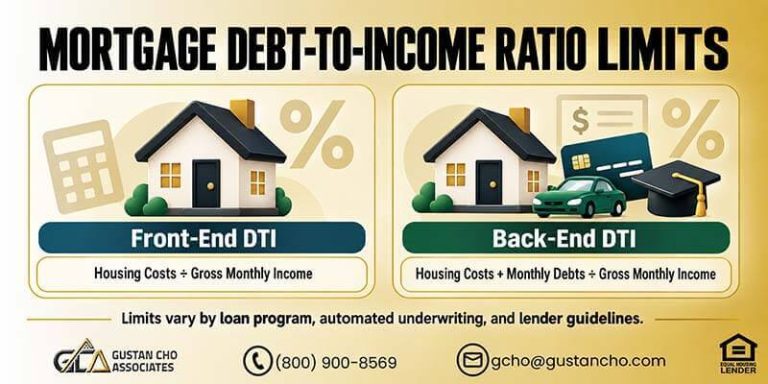
Calculate Your Debt to Income Ratios
Choose the Right Lender for the Best Deal
Not all lenders are created equal. Learn the differences and find the best rate for your situation.What Types of Mortgage Lenders are Mortgage Brokers
Mortgage Brokers are licensed mortgage professionals. Brokers are licensed professionals who act as a go-between between a wholesale mortgage lender and a borrower. Brokers are not stuck with one particular mortgage lender’s processing and underwriting team. Brokers do have their own mortgage processors who are trained to be familiar with the actual wholesale lenders’ mortgage guidelines and requirements. Mortgage Brokers get paid a commission after the loan closes.
Benefits of Using Mortgage Brokers For a Variety of Mortgage Options
Mortgage Brokers may have over a dozen or more lenders they do business with. Mortgage brokers can also have hundreds of wholesale lenders.
Types of Mortgage Lenders: Licensed Loan Officers Versus Non-Licensed Registered Loan Originators
Loan Officers at banks do not have to be licensed. Bank loan officers are exempt from NMLS Licensing. They just need to be registered with the NMLS. Most loan officers who work at banks can do business in all states without being licensed. One disadvantage of working with a loan officer employed by a bank is banks have many overlays. For example, to qualify for an FHA loan with a 3.5% down payment, the minimum credit score required is 580 FICO.
Why One Mortgage Lender May Deny You While Another Approves You
One of the most confusing parts of the mortgage process is getting denied by one lender and then approved by another. Many borrowers believe all mortgage lenders follow the exact same rules. That is not true.
FHA, VA, USDA, Fannie Mae, and Freddie Mac set the basic mortgage guidelines for many loan programs. However, individual lenders can add their own stricter rules on top of those guidelines. These extra rules are called lender overlays.
A lender overlay can make it harder to qualify even when the borrower technically meets the minimum agency guidelines. For example, FHA may allow a borrower to qualify with a 580 credit score and a 3.5% down payment, but one lender may require a 620 or 640 credit score. That higher credit score requirement is not an FHA rule. It is the lender’s own overlay.
Lender overlays can affect many parts of the mortgage approval process, including credit scores, debt-to-income ratios, collections, charge-offs, late payments, bankruptcies, foreclosures, reserves, employment history, and manual underwriting. This is why two lenders can look at the same borrower and give two different answers.
For borrowers with strong credit, low debt, stable income, and a simple loan file, overlays may not create many problems. But for borrowers with lower credit scores, higher debt-to-income ratios, recent late payments, bankruptcy, foreclosure, self-employment income, or prior mortgage denial, lender overlays can be the difference between approval and denial.
This highlights the significance of choosing the types of mortgage lenders. A borrower who is denied by a bank, credit union, or mortgage company may still qualify with a lender that adheres to agency guidelines without imposing unnecessary overlays. The crucial factor is collaborating with a mortgage professional who is well-versed in FHA, VA, USDA, conventional, and non-QM loan options and can effectively match the borrower with the right lender.
At Gustan Cho Associates, many borrowers come to us after being told they do not qualify somewhere else. A prior denial does not always mean you cannot get approved. It may mean the first lender had overlays, limited loan programs, or did not fully understand your approval options.
Types of Mortgage Lenders: Mortgage Bankers
Mortgage bankers are companies who use their own money to fund home loans. Mortgage Bankers have warehouse lines of credit they use to originate and fund government and conventional loans.
They tap into their warehouse lines of credit to fund the loan. After the loan funds, the mortgage banker then sells the loan they funded on the secondary market and/or to a larger mortgage banker that pools loans together and sells them to the secondary market.
What Are Correspondent Lenders
Other types of lenders are correspondent lenders. Correspondent Lenders use their own money to originate and fund government and conventional loans. However, they partner up with a full eagle mortgage banker. The mortgage banker will underwrite the file. The correspondent lender will then close the loan under their name. The correspondent lender will prepare closing docs and fund the loan.
The correspondent lender will use their own warehouse line of credit to fund the loan. After the loan funds, the correspondent lender will sell the loan to the mortgage banker who has underwritten the loan. The mortgage banker will pay the correspondent lender. The correspondent lender will then pay down their warehouse lines of credit so they can originate and fund more mortgage loans
Non-QM And Portfolio Mortgage Lenders For Borrowers Who Do Not Fit The Box
Non-QM and portfolio mortgage lenders may help borrowers who do not fit standard FHA, VA, USDA, conventional, or jumbo loan guidelines. These lenders are often used by borrowers with unique income, recent credit events, high debt-to-income ratios, investment property needs, or alternative documentation.
Non-QM stands for non-qualified mortgage. This does not mean the loan is bad or unsafe. It simply means the loan does not follow the traditional qualified mortgage rules used by many standard lending programs. Portfolio lenders are lenders that may keep certain loans in their own portfolio rather than sell them, as traditional mortgage loans are.
Non-QM and portfolio lenders can be helpful to borrowers who are financially able to make a mortgage payment but do not fit the narrow approval criteria of many traditional lenders.
Bank Statement Mortgage Lenders
Bank statement mortgage lenders can be a solid choice for self-employed folks, business owners, freelancers, and independent contractors who might not have enough income on their tax returns to get approved for a regular mortgage.
Instead of using tax returns, a bank statement lender may review personal or business bank statements to calculate qualifying income. This can help borrowers whose tax returns show lower taxable income because of business deductions, write-offs, or fluctuating income.
Bank statement loans are commonly used by self-employed borrowers who have strong cash flow but do not qualify under standard conventional or government loan income rules.
DSCR Lenders For Real Estate Investors
DSCR lenders are designed for real estate investors. DSCR stands for debt service coverage ratio. Instead of qualifying primarily on the borrower’s personal income, the lender checks whether the property’s rental income can support the mortgage payment.
A DSCR loan may be a good fit for investors buying or refinancing rental properties. These loans are often used for single-family rentals, multi-unit properties, and other investment properties.
DSCR lenders can be helpful when an investor has high rental income but does not want to qualify using tax returns, W-2 income, or traditional debt-to-income ratio calculations.
Asset Depletion Mortgage Lenders
Asset-depletion mortgage lenders may help borrowers qualify by including assets in the income calculation. This can be useful for retirees, high-net-worth borrowers, business owners, or borrowers with significant savings but limited traditional monthly income.
Instead of relying solely on employment income, the lender may consider eligible assets such as savings, investments, or retirement accounts, as well as other documented funds. The lender takes those assets and runs them through a formula to figure out what counts as qualifying income.
Asset depletion loans can be helpful for borrowers who have the money to support the mortgage but do not fit a standard income-documentation model.
Recent Bankruptcy Or Foreclosure Mortgage Options
Certain borrowers may require mortgage options after events such as bankruptcy, foreclosure, a deed-in-lieu of foreclosure, a short sale, or other significant credit issues. Conventional loans, along with FHA, VA, and USDA loans, typically impose waiting periods after such occurrences. However, various types of mortgage lenders, including non-QM and portfolio lenders, may provide more flexible solutions for those looking to buy or refinance sooner.
These programs may allow borrowers to qualify after a recent credit event if they meet the lender’s down payment, income, asset, credit, and property requirements. The approval terms may differ from those of traditional loans, and borrowers should carefully compare rates, costs, and program guidelines.
For borrowers who were denied by a bank, credit union, or traditional mortgage lender, non-QM and portfolio lenders may provide another path. These loans are not for every borrower, but they can be valuable when a borrower can repay and needs a lender that can look beyond standard mortgage guidelines.
At Gustan Cho Associates, non-QM and portfolio mortgage options may help borrowers with self-employment income, bank statement income, rental property income, asset-based income, recent bankruptcy or foreclosure, lower credit scores, or prior mortgage denials. The key is matching the borrower with the right lender type and loan program based on the full financial profile.
Final Thoughts On The Different Types Of Mortgage Lenders
Choosing the right types of mortgage lenders is not just about finding the lowest advertised interest rate. The right lender can affect your approval, loan options, closing costs, underwriting experience, and how smoothly your mortgage process goes from application to closing.
Banks and credit unions may be a good fit for borrowers with strong credit, stable income, low debt, and simple loan files. Mortgage bankers may be a good fit for borrowers who meet standard loan guidelines and prefer a direct lending process. Mortgage brokers may be helpful for borrowers who want access to multiple lenders, more loan options, or more flexibility after a prior denial. If you’ve got a special financial situation—like unique income, recent credit issues, or need financing for investment properties—correspondent lenders, portfolio lenders, and non-QM lenders might be better options for you than traditional lenders. They can handle files that don’t fit the usual mold.
The most important thing is to choose a lender that understands your full financial picture. A borrower with lower credit scores, higher debt-to-income ratios, self-employment income, recent late payments, bankruptcy, foreclosure, or past mortgage denial may need a very different lender than someone with perfect credit and a straightforward W-2 income file.
Before choosing a mortgage lender, compare more than the rate. Review the Loan Estimate, lender fees, discount points, closing costs, available loan programs, underwriting requirements, lender overlays, communication style, and closing timeline. One lender may say no, while another lender may have the right program and approval path.
At Gustan Cho Associates, many borrowers come to us after being denied by another lender or told they do not qualify. A mortgage denial does not always mean homeownership is out of reach. You may need a lender with more flexible guidelines, more loan program options, and experience working with borrowers who do not fit a one-size-fits-all approval model.
The ideal mortgage lender provides straightforward answers, clearly outlines your options, and helps you select the right mortgage program based on your credit, income, down payment, property type, and long-term objectives. This includes considering various types of mortgage lenders to find the best fit for your needs.
FAQs About Types Of Mortgage Lenders
What Are The Main Types Of Mortgage Lenders?
The main types of mortgage lenders include banks, credit unions, mortgage brokers, mortgage bankers, correspondent lenders, portfolio lenders, online lenders, and non-QM lenders. Each lender type works differently. Some lend directly, others connect borrowers with wholesale lenders, and others offer specialty loan programs for borrowers who do not meet standard guidelines.
Is It Better To Use A Mortgage Broker Or A Bank?
It depends on your financial situation. A bank may be a good fit if you have strong credit, stable income, low debt, and a simple loan file. A mortgage broker may be a better fit if you want access to multiple lenders or need more flexibility because of credit issues, high debt-to-income ratios, self-employment income, or a prior mortgage denial. The CFPB explains that a lender makes direct loans, while a broker helps borrowers find lenders or mortgage loan options.
What Is The Difference Between A Mortgage Lender And A Mortgage Broker?
A mortgage lender directly provides or funds the home loan. A mortgage broker does not lend money directly. Instead, the broker works with different lenders to help match the borrower with a mortgage program. This difference matters because a broker may have access to multiple wholesale lenders. In contrast, a direct lender usually offers its own loan products.
Which Type Of Mortgage Lender Is Best For Bad Credit?
Borrowers with bad credit may want to compare mortgage brokers, no-overlay lenders, FHA lenders, VA lenders, and non-QM lenders. Some banks and credit unions may have stricter credit score requirements, even when agency guidelines allow more flexibility. The best lender for bad credit is usually the one that understands lender overlays, manual underwriting, compensating factors, and alternative loan options.
What Type Of Mortgage Lender Is Best For Self-Employed Borrowers?
Self-employed borrowers may benefit from working with mortgage lenders that offer conventional, FHA, bank statement, asset depletion, or non-QM mortgage programs. If tax returns do not show enough qualifying income, a bank statement mortgage lender may be an option. The right lender will review income, deposits, business structure, assets, credit, and debt-to-income ratio before recommending a loan program.
Why Do Different Mortgage Lenders Give Different Rates?
Different types of mortgage lenders may offer different rates because they use different pricing models, loan programs, fees, points, compensation structures, and underwriting rules. That is why borrowers should compare the full Loan Estimate, not just the advertised interest rate. Review the rate, lender fees, discount points, closing costs, loan terms, and whether the lender has overlays before choosing a mortgage lender.
This article about “Types of Mortgage Lenders and How To Choose The Right One” was updated on April 30th, 2026.