
Mortgage Loan Underwriting Process: Simple, Step-by-Step Guide
The mortgage loan underwriting process is the lender’s review of your income, credit, assets, job, and property to decide if your loan meets rules and can close. Expect document checks, conditions to clear, and a final “clear to close.”
Key Takeaways
- The mortgage loan underwriting process follows seven steps: Application → Processing → AUS → Underwriter Review → Conditions → Final Review → Clear to Close (CTC).
- Most delays come from missing pages, unsourced deposits, appraisal issues, and slow replies. Answering all conditions at once speeds things up.
- “Refer” AUS findings don’t end the road—manual underwriting can keep the underwriting process moving with the right lender.
- Clean bank statements (all pages), simple LOEs, steady income, and early insurance selection are the biggest time savers.
- After CTC, you’ll confirm the Closing Disclosure, wire safely, complete a final VOE, and fund—this wraps the mortgage loan underwriting process.
Why this matters
Mortgage Underwriting Steps (Start to Clear-to-Close)
Application & Disclosures
- You complete the loan app, sign disclosures, and get your document list.
- This is the foundation for the mortgage loan underwriting process because everything that follows checks the information you provided.
Processing: File Build & Verifications
- A processor orders your credit report, VOE/VOR, title work, insurance, and the appraisal.
- Strong processing shortens the underwriting process by reducing back-and-forth later.
AUS Findings (DU/LP)
- Your file runs through an Automated Underwriting System (Desktop Underwriter/Loan Product Advisor).
- AUS returns Approve/Eligible or Refer.
- These results guide the mortgage loan underwriting process and set documentation levels.
Underwriter Review & Conditional Approval
- An underwriter checks income, assets, credit, debts, and the property against agency rules and lender policies.
- If the file fits, you will get conditional approval.
- This is the heart of the underwriting process, and it’s normal to receive a short list of “conditions.”
Satisfying Conditions
- You provide updated pay stubs, bank pages, letters of explanation (LOEs), or clarifications.
- Clearing conditions moves the mortgage loan underwriting process toward final approval.
Final UW Review → Clear to Close (CTC)
- The underwriter signs off on every condition.
- Once complete, you get CTC.
- This is the successful finish of the mortgage loan underwriting process and the hand-off to the closing team.
Closing & Funding
- The closing department balances numbers with the title, sends the package, you sign, and funds are released.
- While this is post-underwriting, it’s still connected to the underwriting process because last-minute checks (like a verbal VOE) can still occur.
Avoid Last-Minute Underwriting Delays
Before you change jobs, open credit, finance furniture, move money, or make large deposits, get a quick review so you do not create new conditions before closing.
What Underwriters Look for (and How to Prepare)
Underwriters follow agency rules (FHA, VA, USDA, Fannie Mae, Freddie Mac) and lender policies. Use this checklist to keep the mortgage loan underwriting process smooth:
Income
- W-2s, pay stubs, and sometimes written VOE
- Self-employed/1099: tax returns or program-specific docs (e.g., bank statement programs)
- Stability and likelihood to continue
- Prep tip: If income is variable, add a brief LOE. Clear income stories make the mortgage loan underwriting process easier.
Assets
- Two months of bank statements (all pages)
- Large deposits sourced and explained.
- Reserves when required
- Prep tip: Keep funds stable. Clean statements speed up the underwriting process.
Credit
- Scores, history, and tradeline depth
- Derogatory items, disputes, and recent inquiries
- Prep tip: If you have had late payments or collections, write a short LOE now to streamline the underwriting process later.
Debts & DTI
- Monthly debts vs. income (debt-to-income ratio)
- Prep tip: Avoid opening new debt during the mortgage loan underwriting process.
Collateral (Appraisal)
- Value supports price/loan amount.
- Condition and required repairs (if any)
- Prep tip: Respond quickly if the appraiser needs access; delays here slow the underwriting process.
Title & Insurance
- Clear title, correct vesting, and policy
- Homeowner’s insurance bound before closing.
- Prep tip: Choose insurance early. It keeps the mortgage loan underwriting process on schedule.
Automated vs. Manual Underwriting (Why It Matters)
Automated (AUS) Approval
The Automated Underwriting System (AUS) helps speed up the mortgage loan process when it finds that a borrower is “Approve/Eligible.” When this happens, the documentation needed is simpler, which makes the underwriting process quicker. This means lenders can review mortgage applications more efficiently and provide approvals faster. By using AUS, lenders reduce their workload, and borrowers can get financing options more quickly. Overall, AUS improves the mortgage process by making it faster and easier for everyone involved.
Manual Underwriting
If AUS returns Refer—or your profile is unique—manual underwriting is still possible with the right lender. Expect closer review of payment history, reserves, and compensating factors. With experts, the mortgage loan underwriting process can still move efficiently even on a manual file. Pro tip: A Refer doesn’t mean decline. A lender specializing in manual files can keep your mortgage loan underwriting process moving.
Common Underwriting Conditions (and Fast Fixes)
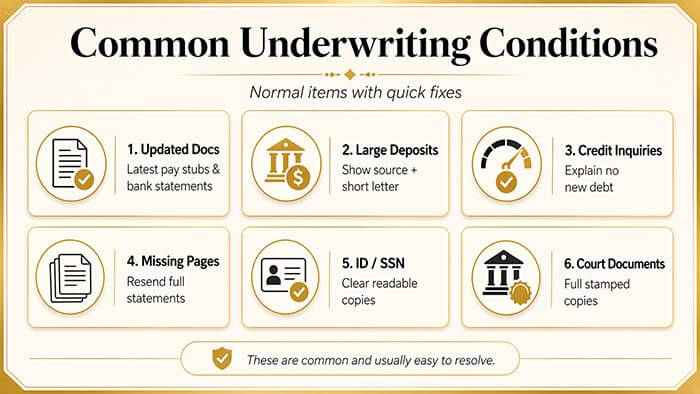
These are Normal in the Underwriting Process:
- Updated pay stubs or bank statements: Send the latest copies, including all pages.
- Large deposits: provide documents showing the source of the money and a short explanation letter.
- Credit inquiries: Explain that there is no new debt or share the terms of new accounts.
- Missing document pages: Scan and resend full statements, even if there are blank pages.
- ID or SSN card: Provide clear, readable copies.
- Divorce decree, child support, or bankruptcy pages: Send full, stamped copies of all relevant documents.
LOE tip: Keep it short, factual, and dated. A crisp LOE can shave days off the mortgage loan underwriting process.
Red Flags That Trigger Extra Review
Avoid These to Protect Your Mortgage Loan Underwriting Process:
New Credit Accounts or Hard Inquiries:
- Opening new credit accounts or having recent hard inquiries can signal financial instability or increased risk to lenders.
- These actions may indicate that a borrower is taking on more debt shortly before applying for a mortgage, which can raise red flags during underwriting.
Non-Payroll Cash Deposits with No Paper Trail:
- Large cash deposits that cannot be traced back to a legitimate source can create suspicion for underwriters.
- Lenders might question a borrower’s financial stability and overall reliability without proper documentation verifying the funds’ origin.
Overdrafts or NSF Fees in the Last 60 Days:
- Recent overdrafts or non-sufficient funds (NSF) fees can highlight potential cash flow issues.
- Such occurrences may indicate that a borrower is struggling to manage their finances, which can raise concerns about their ability to make timely mortgage payments.
Job Changes or Income Gaps Without Documentation:
- Jumping from job to job or having gaps in your work history can make it seem like you might not have a steady income.
- If these changes are not properly documented, underwriters may question the reliability of a borrower’s income, which is crucial for loan approval.
Big Last-Minute Purchases (Cars, Furniture):
- Making significant purchases shortly before applying for a mortgage can affect a borrower’s debt-to-income ratio and overall creditworthiness.
- Lenders may view these last-minute expenses as risky behavior, leading to increased scrutiny during the underwriting process.
Typical Timeline & What Can Delay Things
The timeline for processing to an initial underwriting decision typically ranges from about 3 to 7 business days. However, this can vary based on the lender and the specifics of the file. Once conditions are met, the clearance to a clear to close (CTC) status usually takes 2 to 5 business days, depending on how quickly the required documents are received.
Biggest Slowdowns in the Mortgage Loan Underwriting Process:
- Waiting on appraisal or revisions
- Unsourced deposits or missing pages
- Slow responses to condition requests
- Title issues or late insurance binder
Speed tip: Ask your team for a single, consolidated condition list. One complete response usually shortens the mortgage loan underwriting process more than sending items piecemeal.
From “Refer” to Clear to Close in 9 Days
Maria, a W-2 nurse with variable overtime, aimed to purchase a $395,000 home with a 5% down payment. However, she encountered a significant roadblock when the Automated Underwriting System (AUS) returned a “Refer” status due to her fluctuating overtime income and two recent credit inquiries. Despite this challenge, the goal was to move from the “Refer” status to a clear-to-close in just nine days.
Day 1–2: Intake & Processing
During the first two days of the intake and processing phase, the processor compiles a clean file that includes the last 30 days of pay stubs, year-to-date earnings, and all pages of the past two months’ bank statements. A significant deposit of $2,800 is flagged, prompting Maria to provide a bill of sale and a mobile deposit slip for clarification. Additionally, an insurance agent is selected early in the process, and the premium is added to the estimates to help stabilize the debt-to-income ratio during the mortgage loan underwriting phase.
Day 3: Manual UW Submission
On Day 3 of the manual underwriting submission, the loan officer (LO) provides a brief letter of explanation (LOE) detailing the occupational therapy (OT) pattern and verifies the base hours with a written verification of employment (VOE). The credit inquiry letters indicate that no new debts have been opened. This led to the decision to send the file to manual underwriting.
Day 4: Conditional Approval (Manual)
On Day 4, the mortgage loan received conditional approval, which is subject to several requirements. The necessary conditions include an updated pay stub, an appraisal, proof of the source of earnest money, and a request from the underwriter for a more robust paper trail regarding assets. To expedite the underwriting process, the team has requested that all documentation be consolidated into a single upload.
Day 6: Appraisal In, Conditions Delivered
Value meets contract price. Maria uploads one complete packet: newest pay stub, full bank PDFs, and LOEs. No piecemeal emails
Day 8: Final Review
The underwriter clears the sourced deposit, confirms DTI with final premiums, and issues a minor title curative item (a typo in vesting) to the title.
Day 9: Clear to Close
On Day 9, the mortgage loan process reached a significant milestone with the issuance of the Clear to Close (CTC) after completing the final Verification of Employment (VOE). The Closing Disclosure was signed on the same day, marking a smooth conclusion to the underwriting process, even after encountering a refer. This success came from having complete documents, sourcing deposits properly, and efficiently bundling responses. Lesson: Even complex files can reach CTC fast when you use clean statements, short LOEs, and a lender experienced in manual underwriting.
Mortgage Loan Underwriting Process on Quality Control Underwriting Review
Every mortgage company has a QC Underwriting Review Process where another underwriter reviews the loan application to ensure the original underwriter has not missed anything. Some mortgage companies do a QC Underwriting Review before the original mortgage underwriter issues a clear to close. All mortgage lenders will run a file through the national pubic records background search during the mortgage process, according to Marga Jurilla, national operations manager at Gustan Cho Associates.
Any public records such as bankruptcies, foreclosures, judgments, and federal tax liens that do not show up on the three credit reporting agencies will get discovered during the national public records search by mortgage lenders.
Other mortgage companies will do a QC Underwriting Review right after the underwriter issues a clear to close. QC Underwriter will order a third-party search through Lexis Nexis or Data Verify to ensure no public records, such as judgments and liens, are not showing up on the borrower’s credit report. Once the QC Underwriter feels comfortable and signs off on the mortgage file, the mortgage loan is ready to fund, and docs are ready to be sent to the title company for closing.
What Happens After Clear-to-Close (CTC)
Even after CTC, a few items wrap up the mortgage loan underwriting process:
- Closing Disclosure (CD): Review and sign ASAP
- Wire instructions: Verify verbally with the title to avoid fraud
- Final employment check (VVOE): Don’t change jobs now
- Funding/recording: Money disburses, deed records, keys change hands
Printable Prep Checklist
Use this before you enter the mortgage loan underwriting process:
- ✅ Last 30 days of pay stubs
- ✅ Last 2 years W-2s (and returns if requested)
- ✅ The last two months of bank statements, every page.
- ✅ Photo ID and Social Security card
- ✅ Insurance agent selected
- ✅ Source letters/LOEs for large deposits
- ✅ Full, stamped legal docs (BK, divorce, child support, if applicable)
Pro Tips to Improve Approval Odds
- Keep credit card balances low (utilization under ~30%) before and during the mortgage loan underwriting process.
- Don’t move money between accounts unless needed; document it when you do.
- Answer condition requests in one complete package. That single habit can cut days from the underwriting process.
Ready to Get Underwritten Fast?
Gustan Cho Associates specializes in tough files, manual underwriting, and no lender overlays. If you’re stuck in conditions or just want a faster, cleaner mortgage loan underwriting process—call 800-900-8569 or email alex@gustancho.com. The team at Gustan Cho Associates is available 7 days a week, on evenings, weekends, and holidays.
Frequently Asked Questions About Mortgage Loan Underwriting Process:
What do Underwriters Look for Most?
Stable income, clean assets with paper trails, workable DTI, acceptable credit history, and an appraisal that supports value.
Can I Get Approved if AUS Says “Refer”?
Yes—manual underwriting may work. Choose a lender that handles manual files so the mortgage loan underwriting process doesn’t stall.
Should I Open a New Credit While in Underwriting?
No. New debt or inquiries can change your DTI and pause the mortgage loan underwriting process.
What if I Changed Jobs?
Tell your loan officer early. When available, provide offer letters and your first pay stub to keep the mortgage loan underwriting process on track.
What Happens at Clear to Close?
The underwriter signs off on everything, closing is scheduled, and the loan moves from the mortgage loan underwriting process to funding.
How Can I Speed Things Up?
To smooth the mortgage loan underwriting process, send complete, legible documents quickly, write short LOEs, avoid new credit, and pick your insurance early.
Make Your Mortgage File Underwriter-Ready
Missing documents, large deposits, unclear income, or new debt can slow approval. Get a simple checklist to prepare your file correctly before underwriting begins.
This Gude About “Mortgage Loan Underwriting Process for Home Buyers” Was Updated on June 29, 2026.