Eliminating FHA Mortgage Insurance Premium

Eliminating FHA Mortgage Insurance Premium

This guide covers eliminating FHA mortgage insurance premium by refinancing FNMA. Borrowers taking out an FHA insurance mortgage loan, besides paying an upfront mortgage insurance premium of 1.75%, borrowers need to pay an annual FHA mortgage insurance premium of 0.55% for the life of the FHA Loan.

Understand exactly how FHA upfront MIP (1.75%) and annual MIP work on 15‑year and 30‑year fixed FHA loans, including current percentage factors by loan‑to‑value (LTV), loan amount, and term.

FHA mortgage insurance premium can be a substantial amount for any mortgage loan borrower. Eliminating FHA mortgage insurance premium will greatly save any homeowner money that can be allocated somewhere else. Homeowners who have owned their homes for the past several years are sitting on equity where they can refinance their FHA loan to a conventional loan and eliminate their annual FHA mortgage insurance premium. Many homeowners have built up substantial equity in their homes where they can qualify for a cash-out refinance on a conventional loan and still eliminate the FHA MIP.

The Hefty FHA Annual Mortgage Insurance Premium

YouTube player

The Federal Housing Administration has changed rules concerning FHA mortgage insurance premiums. Before, an FHA mortgage holder’s FHA mortgage insurance premium was eliminated if the borrower paid on the FHA mortgage insurance premium for 5 years and had at least a 78% loan to value in their home. Refinancing your FNMA (Fannie Mae) mortgage to eliminate FHA (Federal Housing Administration) mortgage insurance premium (MIP) is possible. However, there are some important factors to consider:

Now, the FHA mortgage insurance premium is effective for the life of the 30 year FHA mortgage loan. The only way out of it is by either selling home or refinancing the current FHA-insured mortgage loan into a conventional loan.

The housing market has been booming for the past several years. Home prices have hit all-time highs without any sign of a housing correction. Average home prices have increased by over 34% in 2023. Both HUD and the Federal Housing Finance Agency have increased FHA and Conforming loan limits for the past five years due to skyrocketing home prices.

15‑Year vs. 30‑Year Fixed FHA Loans With MIP Numbers

Whether you choose a 15-year or 30-year fixed FHA loan, you will pay two types of mortgage insurance: an upfront mortgage insurance premium (UFMIP) and an annual MIP paid monthly. The UFMIP is usually 1.75% of your base loan amount and is often added to your loan for most buyers and those refinancing. The annual MIP is a percentage of your remaining loan balance, recalculated each year, and split into 12 monthly payments. The exact rate depends on your loan term, loan amount, starting LTV, and whether you have a standard FHA loan or a special program.

Upfront FHA Mortgage Insurance Premium:

fThe FHA upfront mortgage insurance premium is a one-time fee equal to 1.75% of your base loan amount. Although it is due at closing, most people add this cost to their loan instead of paying it up front.
  • This 1.75% rate applies to most new FHA purchase and refinance loans, regardless of loan term or down payment.
  • if your base FHA loan amount is $300,000, your UFMIP would be $5,250 (that’s 300,000 × 1.75%).
  • If you add this to your loan, your total FHA loan balance becomes $305,250.
  • Because most people add the UFMIP to their loan, you will pay interest on it over the life of the loan, which means you pay more overall if you keep the loan for a long time.
  • For FHA loans longer than 15 years, such as the standard 30-year fixed, HUD sets the annual MIP based on your base loan amount and your starting LTV.

Annual FHA MIP for 30-Year Fixed (Term > 15 Years)

For FHA loans with terms greater than 15 years (standard 30-year fixed), annual MIP factors are determined by your base loan amount relative to the 2025 conforming loan limit threshold of $726,200 (not updated to 2026’s $832,750 yet) and your initial LTV.

Here Are The Current HUD-Standard Brackets For Most Purchase And Typical FHA Refinance Transactions:

Base loan ≤ $726,200 (standard-balance FHA), term > 15 years:

  • Initial LTV ≤ 90%: 0.50% annual MIP, paid for 11 years.

  • Initial LTV > 90% to ≤ 95%: 0.50% annual MIP, paid for full term.

  • Initial LTV > 95%: 0.55% annual MIP, paid for full term.

Base loan > $726,200 (high-balance FHA), term > 15 years (even if within your 2026 county FHA limit):

  • Initial LTV ≤ 90%: 0.70% annual MIP, paid for 11 years.

  • Initial LTV > 90% to ≤ 95%: 0.70% annual MIP, paid for full term.

  • Initial LTV > 95%: 0.75% annual MIP, paid for full term.

These percentages are applied to your current principal balance annually (divided by 12 for monthly payments) and decline as you pay down the loan. Always verify via the latest HUD Mortgagee Letter at closing, as mid-year policy changes can occur.

Annual FHA MIP for 15‑Year Fixed (Term ≤ 15 Years)

If you choose an FHA loan with a term of 15 years or less, you will get lower annual MIP rates than with a longer loan. These rates still depend on your loan amount and LTV.
Here are the current HUD brackets for standard and high-balance loans:
  • If LTV is 90% or less: annual MIP is 0.15%, paid for 11 years.
  • If the initial LTV is more than 90%, the annual MIP is 0.40% for the entire term.

For base loan amounts above $726,200 with a term of 15 years or less:

  • If LTV is 78% or less: annual MIP is 0.15%, paid for 11 years.
  • If the initial LTV is 78% or more up to and including 90%, the annual MIP is 0.40%, paid for 11 years.
  • If the initial LTV is greater than 90%, the annual MIP is 0.65% and is paid for the loan term.
  • Because rates are lower and the loan term is shorter, you will usually pay less in total MIP costs with a 15-year FHA loan than with a similar 30-year loan.
  • To find your monthly MIP, multiply your current balance by the annual rate and divide by 12. Your payment will decrease as you pay off your loan.
  • Your starting loan-to-value (LTV) ratio affects both your annual MIP rate and how long you have to pay it.
  • For most new 30-year FHA loans with the minimum 3.5% down payment (about 96.5% LTV), the annual MIP rate is 0.55% and lasts for the entire loan term unless you refinance out of FHA.
If you make a larger down payment and your starting LTV is at or below the set limits, you could get a lower annual MIP rate and only have to pay MIP for 11 years instead of the entire loan term. For example, a 30-year FHA loan with an LTV of 90% or less has a 0.50% annual MIP for 11 years. Some 15-year FHA loans with LTV at or below 90% may have annual MIP rates of 0.15% or 0.40%, also limited to 11 years.

Qualify for FHA loans, click here

Conventional Loan Eligibility

Loan-to-Value (LTV) Ratio: The key to eliminating FHA MIP through refinancing is to reduce your LTV ratio below 80%. FHA MIP is required for loans with an LTV ratio greater than 80%. You might be eligible if your home’s value has increased or you have paid down your mortgage balance significantly.

To eliminate FHA MIP, you would typically refinance into a conventional loan (not backed by the government). Your credit score, income, and debt-to-income ratio will significantly determine your eligibility for a conventional loan.

You’ll likely need a new appraisal to determine the current value of your home. If the appraisal value supports a lower LTV ratio, you will likely qualify for a conventional loan without MIP. There are closing costs on refinancing your home loan, which can be substantial. You’ll need to consider whether the potential savings from eliminating MIP outweigh these costs.

Private Mortgage Insurance (PMI)

Before proceeding with refinancing, it’s essential to consult with a mortgage professional who can assess your specific circumstances and provide guidance on whether refinancing to eliminate FHA MIP is a viable option for you. Additionally, the rules and regulations regarding FHA and conventional loans can change, so staying up-to-date with the latest information is crucial.

While conventional loans don’t have FHA MIP, they may have PMI, which is private mortgage insurance, if your down payment is less than 20%. Be sure to understand the costs and requirements of PMI if it applies.

Your credit score and financial stability will be closely examined by lenders during the refinancing process. Ensure your credit is in good shape and your financial situation is stable to increase your chances of approval. Different lenders may have varying requirements for refinancing. It’s a good idea to shop around and compare offers from multiple lenders to find the best terms for your situation.

Private Mortgage Insurance Requirements

Conventional loans with more than an 80% loan to value require private mortgage insurance. With conventional loans, the mortgage insurance is not a fixed factor-like FHA’s 0.55%. For borrowers with over 700 credit scores, it can be lower than FHA mortgage insurance premiums. There is no set percentage of the mortgage loan amount like FHA MIP.

Normally, conventional private mortgage insurance premiums can be higher or lower than FHA mortgage insurance premiums depending on borrowers’ credit scores, loan to value, and type of property.

Another advantage of conventional loans is that private mortgage insurance can be eliminated once the loan to value drops to 80% loan-to-value. Any borrower who puts a 20% down payment on a conventional mortgage loan purchase is not required to have private mortgage insurance.

Qualify for Non-Qm mortgage loans, click here

Eliminating FHA Mortgage Insurance Premium

Which means the elimination of the FHA mortgage insurance premiumWe now offer conventional mortgage loans that have greater than 80% loan to value with no mortgage insurance. It is called LPMI, lender-paid mortgage insurance, and it is geared towards borrowers with good credit and lower debt to income ratios. This means that anyone with less than 20% equity on their home can now qualify for the LPMI conventional mortgage loan program. Mortgage rates are slightly higher.

Conventional mortgage loan program is a phenomenal loan program. FHA mortgage loan homeowners can refinance their current FHA-insured mortgage loan and eliminate paying their FHA mortgage insurance premium.

Homeowners need to get a net tangible benefit to be able to refinance. Check the current interest rates to see if refinancing makes financial sense. If the mortgage rates are significantly lower than your current rate, it could be a good time to refinance. Homeowners who are thinking of eliminating FHA Mortgage Insurance Premium by refinancing conventional can contact us at Gustan Cho Associates at 800-900-8569. Text us for a faster response. Or email us at gcho@gustancho.com. Gustan Cho Associates Mortgage Group is a five-star national mortgage company with no mortgage overlays on government and conventional loans.

Summary: 15-Year vs. 30-Year FHA

Both 15-year and 30-year FHA loans require a 1.75% upfront MIP. The annual MIP rates depend on your loan term and LTV. Most 30-year FHA borrowers with small down payments pay a 0.55% annual MIP for the entire loan term, while 15-year FHA borrowers with more equity might get rates as low as 0.15% for just 11 years. A 15-year FHA loan is paid off faster, so you pay less total interest and MIP compared to a 30-year loan. If you prefer the lower monthly payments of a 30-year FHA loan but want to reduce MIP and interest costs, you might consider making extra payments or refinancing into a regular loan once you have enough equity and good credit.

Strategies for Eliminating FHA Mortgage Insurance Premiums

FHA mortgage insurance premiums, including the upfront 1.75% fee and annual MIP, can be eliminated by increasing your down payment, building equity, or adjusting your loan term. Options differ between 15-year and 30-year FHA loans. With less than a 10% down payment on a 30-year loan, annual MIP remains for the life of the loan unless you refinance. Larger down payments or shorter loan terms allow automatic MIP termination after 11 years, per current HUD regulations. Refinancing to a conventional loan after reaching 20% equity is the most common way to eliminate MIP, since FHA does not permit MIP cancellation, unlike PMI on conventional loans.

Auto-Cancellation After 11 Years

The most straightforward way to limit FHA MIP duration is to make a down payment of at least 10% on a 15-year or 30-year FHA loan. This qualifies the borrower for an 11-year MIP term instead of life-of-loan coverage for standard-balance loans of $726,200 or less, with terms of 15 years or more and loan-to-value ratios at or below 90%. After 11 years of timely payments, the annual MIP is automatically canceled without an appraisal or borrower action, though the upfront MIP is still due at origination.

Refinance FHA to Conventional Loan

For borrowers making the minimum 3.5% down payment, refinancing from an FHA loan to a conventional loan is often the fastest way to eliminate both upfront and annual MIP, usually once the loan-to-value (LTV) ratio reaches 80%, or sometimes 97% through certain streamlined programs. Fifteen-year FHA loans amortize faster, often reaching 20% equity within five to seven years, allowing earlier qualification for conventional refinancing and avoiding prolonged MIP payments.

Extra Principal Payments Impact

In contrast, 30-year FHA loans build equity more slowly, so additional principal payments or property appreciation are needed to reach the required threshold within 5 to 10 years. Some streamlined FHA-to-conventional refinances may waive appraisals if recent pay stubs and statements show enough equity. However, new closing costs (2% to 5% of the loan amount) apply and should be weighed against potential MIP and interest rate savings to ensure a break-even point within two to three years.

Faster Equity on Shorter Terms

Another option is to pay off the FHA loan in full, which automatically ends all MIP obligations, or to sell the property. FHA loans are assumable, so a buyer can take over the existing loan terms, including the interest rate and MIP structure, but this does not eliminate the original borrower’s MIP unless the FHA loan is fully exited.
For FHA-to-FHA refinances, such as the FHA Streamline program, MIP requirements depend on the new base loan amount and LTV, and usually do not reduce insurance costs unless the borrower moves to a 15-year term with substantial equity.
Some lenders impose additional requirements, such as a seasoning period of more than 21 days and credit checks, even for refinances intended to remove MIP. In some regions, such as Dallas, lenders may require stricter equity verification for high-balance FHA loans above the $726,200 MIP threshold.

FAQs Focused on FHA MIP Numbers

What Is The Current FHA Upfront MIP On 15‑Year And 30‑Year FHA Loans?

  • The standard FHA upfront mortgage insurance premium is 1.75% of the base loan amount for most new purchases and refinances, whether you choose a 15-year or 30-year term.
  • You can pay this premium at closing or add it to your loan balance.
  • Most borrowers choose to include it in their FHA loan.

What Annual MIP Percentage Will I Pay On A Typical 30‑Year FHA Loan With 3.5% Down?

  • For a standard 30-year FHA loan with an initial LTV above 95%, which typically requires a 3.5% down payment, the annual MIP rate is 0.55% of the loan balance.
  • This amount is paid over the entire loan term in 12 monthly installments, and the payment decreases as the loan balance decreases.

How Does The Annual MIP Change If My 30‑Year FHA LTV Is 90% Or Less?

  • If a 30-year FHA loan is $726,200 or less and the initial LTV is 90% or less, the annual MIP rate is 0.50% instead of 0.55%, and you pay it for 11 years.
  • For high-balance loans over $726,200 with an LTV at or below 90%, the annual MIP is 0.70% for 11 years.

What Annual MIP Percentages Apply To A 15‑Year FHA Loan?

  • For 15-year FHA loans with a base loan amount up to $726,200, the annual MIP is 0.15% if your LTV is 90% or less, or 0.40% if your LTV is above 90%.
  • High-balance 15-year FHA loans can have annual MIP rates of 0.15%, 0.40%, or 0.65%, depending on whether your LTV is at or below 78%, between 78% and 90%, or above 90%.
  • The MIP lasts for 11 years or the full term, depending on the loan.
  • To estimate the monthly FHA MIP, multiply the current loan balance by the annual MIP rate and divide by 12.
  • For example, a $250,000 30-year FHA loan with a 0.55% annual MIP rate results in an initial monthly MIP of about $114.58 (250,000 × 0.0055 ÷ 12).
  • This payment decreases as the loan balance decreases.
  • For loans with a down payment of less than 10%, annual MIP is required for the entire loan term.
  • If the down payment is at least 10%, MIP may end after 11 years under current regulations.
  • Fifteen-year FHA loans usually have shorter MIP periods, often 11 years if the LTV is at or below the specified limits, though higher-LTV 15-year loans may still require MIP for the full term.

Are These MIP Factors Fixed Forever?

  • FHA MIP rates are set by HUD and have changed several times, with updates as recent as 2023.
  • Before getting a quote or finalizing a loan, check the latest official MIP tables in HUD Mortgagee Letters or your lender’s FHA pricing guide, since the figures here may be different from current rates.

Is It Possible To Cancel FHA MIP In The Same Manner As Conventional PMI After Achieving 20% Equity?

  • No, the FHA annual MIP cannot be canceled through automatic termination or by request, as is possible with PMI.
  • Borrowers must refinance into a conventional loan once the LTV reaches 80% or meet the lender’s specific criteria.
  • A 15-year loan term meets this threshold more quickly due to accelerated principal reduction, whereas a 30-year FHA loan with a down payment of less than 10% requires lifelong MIP unless refinanced.

Does Making A Down Payment Of 10% Or More Immediately Eliminate FHA MIP?

  • No, but it limits annual MIP to 11 years on qualifying loans (LTV at or below 90%, standard-balance).
  • After 11 years, MIP auto-cancels without refinancing.
  • The upfront 1.75% MIP is still required at closing, often financed, so total insurance costs are reduced but not eliminated.

How Soon Is It Possible To Refinance A 30-Year FHA Loan To Eliminate MIP?

  • Typically, refinancing is possible after a seasoning period of six to twelve months, depending on lender requirements, once equity reaches a 20% LTV through regular payments, additional principal contributions, or property appreciation.
  • It is advisable to use a mortgage calculator to project eligibility based on the amortization schedule.
  • Closing costs will apply, so it is recommended to seek interest rates at least 0.5% lower than the current rate to ensure cost savings.

Is FHA Streamline A Good Way To Eliminate MIP?

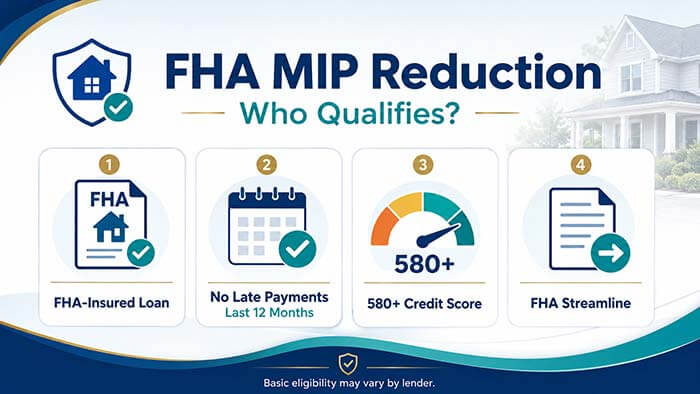
  • FHA Streamline maintains FHA MIP rules, with only basic credit and equity checks, so it rarely eliminates insurance and is better suited for lowering your interest rate.
  • Consider switching to a 15-year term if affordable, which can help you qualify for a conventional refinance sooner.

Click here to contact with us for mortgage loans even in weekend and holidays

Similar Posts

Leave a Reply

Your email address will not be published. Required fields are marked *