Mortgage Approval With Bad Credit And Late Payments: How To Qualify For A Home Loan
This guide covers mortgage approval with bad credit and late payments. Many consumers have had a period in their lives. Borrowers must meet minimum credit score and debt-to-income ratio requirements to qualify for particular mortgage programs. Just because borrowers meet credit score and DTI requirements does not mean that they automatically qualify for mortgages.
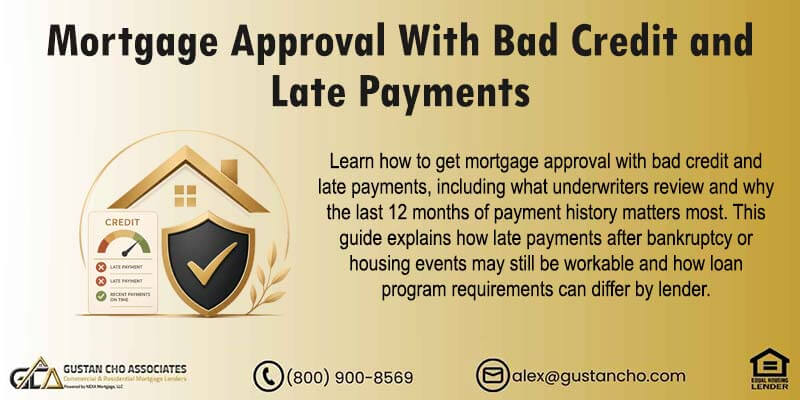
Mortgage underwriters will thoroughly review the borrower’s credit reports and payment history. Special emphasis will be placed on the payment patterns of the past 12 months.
Also, most lenders will not want borrowers to have any late payments after bankruptcy or foreclosure. Late payments in the past 12 months are not a deal-killer. Also, late payments after bankruptcy or housing events are not a deal-killer either. Gustan Cho Associates are lenders with no overlays on government or conventional loans.
Understand Your Credit Score
Different mortgage lenders have different criteria for what is considered “bad credit.” Understand your credit score and where you stand. Not all mortgage lenders have the same lending requirements on government and conventional loans. Lenders need to meet the minimum lending guidelines of HUD, VA, USDA, Fannie Mae, or Freddie Mac but lenders can have their own overlays.
Mortgage approval with bad credit is possible. Learn how late payments, credit scores, FHA loans, VA loans, and overlays affect approval.
A larger down payment may offset the risk for lenders, making them more willing to work with you. Having a co-signer with a better credit score or applying jointly with a partner may improve your chances. If there are reasons for bad credit, such as medical issues or job loss, provide a written explanation to accompany your application.
Show Stable Employment and Income
A steady job history and reliable income can strengthen your mortgage application. Consider government-backed loans. FHA (Federal Housing Administration) loans, VA (Veterans Affairs) loans, and USDA (U.S. Department of Agriculture) loans may have more lenient credit requirements.
Different lenders have different criteria, so it’s essential to shop around and explore various options. Some lenders specialize in working with individuals with less-than-perfect credit.
Keep in mind that these loans may come with higher interest rates. Reducing outstanding debts can improve your debt-to-income ratio, making you a more attractive borrower.
How To Get Mortgage Approval With Bad Credit

- Unemployment
- Loss of business
- Medical reasons
- Divorce
- Death in the family
Extenuating circumstances often stop the flow of household income streams. This interruption of income prevents consumers from paying their bills on time, which affects their credit scores. Some folks were forced to file bankruptcy; others lost their homes through foreclosure due to extenuating circumstances.
Finding a Lender That Specializes With Bad Credit Mortgages
Mortgage lenders understand that people go through financial problems, and everyone who has had a period of bad credit can qualify for mortgage approval with bad credit. Remember, while securing a mortgage with bad credit is possible, it often comes with higher interest rates and less favorable terms.
Some sellers may offer lease-to-own arrangements, giving you time to improve your credit before obtaining a mortgage.
The team at Gustan Cho Associates specializes in helping home buyers get mortgage approval with bad credit. Improving your credit over time can open up better options for you in the future. Additionally, seeking advice from a financial advisor or mortgage professional can provide personalized guidance based on your circumstances. Unfortunately, not every person can get mortgage approval with bad credit, which we will explain in this blog.
How Can I Get a Mortgage Approval With Bad Credit?
Mortgage applicants who were victims of the real estate and financial collapse of 2008 and lost their jobs or businesses have suffered because they could not pay their bills on time. Chances are they fell behind and may have late payments, charge-offs, or even judgments. Some borrowers might be in bankruptcy or foreclosure.
Other borrowers just let the bad debt linger, hoping the collection agencies will not force a wage or bank account garnishment or take the matter to court for judgment.
Those with prior bad credit can get mortgage approval with bad credit. Late payments after bankruptcy and foreclosure are not always deal-killers. Not all lenders have the same mortgage guidelines. Just because a borrower does not qualify for an FHA loan with one bank does not mean they do not qualify with another lender.
Mortgage Approval With Bad Credit And Late Payments
Even with bad credit, getting a mortgage is possible. Knowing how lenders weigh your credit score, late payments, collections, charge-offs, debt-to-income ratio, and recent payment history can make all the difference. One late payment, a low score, or past financial setbacks do not always slam the door on your homeownership dreams.
Gustan Cho Associates steps in for borrowers who have been turned away elsewhere due to bad credit, recent late payments, high debt-to-income ratios, bankruptcy, foreclosure, collections, or other hurdles.
Finding a lender who sticks to official guidelines—without piling on extra rules—can open new doors. When your credit is less than perfect, lenders look at the whole picture: your credit score, income, job stability, payment habits, assets, debt-to-income ratio, down payment, and any credit hiccups. Sometimes, a borrower with bad credit but a solid payment track record gets the green light over someone with a higher score but recent slip-ups.
Mortgage Approval with Bad Credit is Achievable
Bad credit does not always spell mortgage denial. Still, extra rules from some lenders—known as overlays—can block your path, even when official guidelines say yes. This means you might get a no from one lender and a yes from another. Each lender’s decision can be as unique as your financial story. To lenders, bad credit signals higher risk. Trouble spots might include low scores, late payments, collections, charge-offs, maxed-out cards, or bankruptcy. Other warning signs are foreclosure, short sales, repossessions, judgments, tax liens, or disputed accounts. Mortgage lenders do not just look at your credit score. They review your whole credit history. For example, some borrowers have poor credit.
FHA loans are frequently the most accessible government-backed option for individuals with lower credit scores. Veterans, active-duty service members, and their spouses may find that VA loans offer even greater flexibility.
Lenders each have their own playbook. Some bend the rules within official guidelines, while others stick to them tightly. For instance, a lender might see a 620 score with recent late payments as riskier than a 580 score with old late payments and a current streak of on-time payments. For late payments that occurred two or more years ago, the lender will determine if the incident was isolated or part of a pattern.
Credit Score Melts Mortgages
A credit score is important. For example, Fannie Mae considers recent late payments a higher risk than older ones, but lenders also review other factors.
Mortgage Lenders Look At:
- Length and type of employment
- Stability of income vs. variable income
- Ratio of debt to income
- History of rental vs mortgage payment
- Foreclosure vs. bankruptcy filing
- Charge-offs and Collections
- Stability and Timeframe of Underwriting Reserves
- Pattern of recent credit activity
- Automated judgment
Even with bad credit, strengths in other parts of your financial profile can tip the scales in your favor when it comes to mortgage approval. Late payments can throw a wrench in your mortgage plans. Lenders look closely at how recent, frequent, or patterned your missed payments are. One 30-day slip might not sink your chances, but several recent late payments, a single 60-day miss, or repeated mortgage payment issues in a year can make approval much tougher.
Lenders Worry Most About Recent Payment Stumbles
Recent late payments raise red flags for lenders. Showing you have bounced back and are now paying on time is crucial. Any slip-ups after your recovery period will be put under the microscope.
Fannie Mae considers prior mortgage payment failures excessive if one or more of the previous late payments were 60, 90, or 120 days late within the 12 months preceding the lender’s credit report run.
From Fannie Mae’s perspective, the lender must assess the mortgage’s prior payment failures and use the most recent one. This is why lenders take late mortgage payments very seriously, even if your late payments on other loans were not as severe.
Credit Card Late Payments Are Not as Serious as Mortgage Late Payments
Lenders view late mortgage payments as a significant risk, since your home is on the line. Late credit card payments can hurt, too, but if they are old or one-offs caused by hardship, you may be able to explain them. Mortgage late payments, though, demand stronger explanations, a spotless payment record, and extra paperwork.
Take First Step Toward Making Your Dream A Reality
Apply Now And Get recommendations From Loan ExpertsBad Credit Mortgage Approval
Most lenders see bad credit as a low score, but FHA loans are more forgiving than traditional options. They allow lower scores and higher debt-to-income ratios. Even with a low score, you could qualify if the rest of your financial story is strong.
Applicants with a credit score of 580 or higher may qualify for an FHA loan. However, some lenders require higher minimum scores due to overlays. FHA loans require a 3.5 percent down payment.
Gustan Cho Associates can help. While some lenders may reject FHA loans due to credit score limits, FHA guidelines may allow approval with lower scores.
FHA Loans and Credit Scores 500-579
Applicants with credit scores between 500 and 579 typically need a 10 percent down payment to qualify for an FHA loan. Many lenders, however, impose overlays and may not offer FHA loans to those with scores below 580. Lenders look beyond your credit score. They weigh the recency of your late payments or collections, any charge-offs, and your debt-to-income ratio. If your score is low, you will need stronger compensating factors to balance things out.
FHA Approval After Late Payments
If your late payments are in the distant past and your recent credit history shines, you stand a better chance of FHA approval. Automated underwriting looks at your whole profile, and getting an ‘Approve/Eligible’ result can move your application ahead.
For veterans or active-duty military members with poor credit, VA loans are a strong option because of flexible credit standards, no down payment requirement, and no monthly mortgage insurance.
However, many lenders, including those offering VA loans, usually place overlays on minimum credit scores, such as 580, 600, 620, or 640. Some lenders are more flexible than others. You might get turned down for a VA loan by one lender, only to be approved by another.
VA Loans After Recent Credit Problems
Even with bad credit, VA loan applicants can qualify by proving steady income, enough money left over after bills, and a good explanation for past credit bumps. VA underwriting zeroes in on your ability to repay and what is left after your monthly expenses.
Late payments, especially recent ones, can still pose a challenge. Still, VA loans often offer more flexibility than conventional loans if you have strong compensating factors.
Conventional loans are usually less flexible than FHA or VA loans for applicants with bad credit. They follow Fannie Mae or Freddie Mac guidelines and are generally approved through automated underwriting systems like Desktop Underwriter or Loan Product Advisor. Fannie Mae explains that significant derogatory credit events include bankruptcies, foreclosures, deeds-in-lieu, short sales, and charge-offs of mortgage accounts. These events may require waiting periods and re-established credit before approval.
Conventional Loans Usually Need Stronger Credit
Most conventional mortgages require a credit score of at least 620, but hitting that number is not a golden ticket. Automated systems also check your late payments, debt-to-income ratio, savings, down payment, and overall risk. A spotless payment history and strong compensating factors can tip the odds in your favor.
How Late Payments Affect Mortgage Approval
Conventional loans are tough on recent late payments. Even if your credit score meets the minimum, several recent late payments can trigger a denial from automated underwriting. In these cases, FHA or VA loans may offer better odds—if you qualify.
Mortgage Approval With Collections And Charge-Offs
Collections or charge-offs are not automatic deal-breakers. Many people get approved even with unpaid collections or charge-offs. What matters is whether your loan program requires payments, how it affects your debt-to-income ratio, and the additional risk to the lender.
Medical Collections Are Often Treated Differently
Medical collections often receive special treatment because they can stem from unexpected health issues, insurance snags, or billing delays. They might lower your credit score, but paying them off is not always needed for loan approval. Some programs may offer payment plans or a payoff option if the balance is high. FHA, conventional, and non-QM lenders all handle collections their own way. Always check with a mortgage pro before paying off old collections, as it could update the account and temporarily drop your score.
Mortgage Approval With High Debt-To-Income Ratio And Bad Credit
 Debt-to-income ratio, also called DTI, is one of the most important factors in mortgage approval. The CFPB explains that DTI is calculated by dividing monthly debt payments by gross monthly income, and lenders use it to measure the borrower’s ability to manage monthly payments. If you have bad credit and a high debt-to-income ratio, your application is riskier—but not impossible. Lenders want to see steady work, enough income, a good rental history, savings, minimal payment shock, or a bigger down payment to boost your chances.
Bad Credit Plus High DTI Needs Strong Compensating Factors
- Bad credit or a high debt-to-income ratio alone can be managed, but having both means you need a solid plan—and, if you can, lower those monthly debts.
- Add a qualified co-borrower
- Use FHA or VA financing
- Document extra income
- Show reserves
- Avoid new debt before closing
- Improve recent payment history
- The stronger your compensating factors, the better your odds of getting that mortgage approval.
Lender Overlays Are A Major Reason Borrowers Get Denied
Lender overlays are extra rules that individual lenders add to standard FHA, VA, USDA, conventional, or non-QM guidelines. For example, FHA may allow a borrower with a 580 credit score, but a lender may require 620.
Automated underwriting checks your credit score, late payments, income, assets, job, debts, housing history, and overall risk. If you get the green light, the lender still needs to verify your paperwork and ensure all guidelines are met.
VA may not have a strict universal minimum score, but a lender may require 640. FHA may allow higher debt-to-income ratios with automated underwriting approval, but a lender may cap DTI at a lower number.
Agency Guidelines Versus Lender Overlays
Agency guidelines are the baseline rules set by FHA, VA, USDA, Fannie Mae, and Freddie Mac. Lender overlays are additional restrictions created by the lender.
This difference is important: you might meet agency guidelines but still get turned down because of a lender’s extra rules. Many people wrongly assume they are ineligible after just one denial.
Gustan Cho Associates specializes in helping borrowers who were turned down by other lenders due to overlays. Gustan Cho Associates specializes in assisting borrowers who were turned down by other lenders due to overlays. FHA loans use the FHA TOTAL Scorecard. Conventional loans use Desktop Underwriter or Loan Product Advisor. VA loans are also commonly run through automated underwriting.
Approve/Eligible Does Not Mean Clear To Close
Getting an Approve/Eligible result is a great sign, but it is not the finish line. You still need to meet all underwriting requirements. The lender will double-check your income, assets, credit, identity, job, property, title, insurance, and any explanations needed.
Refer/Eligible May Require Manual Underwriting
A Refer/Eligible result might mean your file goes to manual underwriting, which is more detailed and asks for stricter paperwork. This route is open to some FHA and VA borrowers, especially if your credit profile is unique. Manual underwriting can be a backup plan if automated systems say no, but you will need solid paperwork and a recent streak of on-time payments.
How To Improve Mortgage Approval Odds With Bad Credit
If your credit is shaky, focus on the areas lenders care about most. You do not need perfect credit—just a mortgage file that gets the green light.
Make All Payments On Time Before Applying
Your recent payment history is key. Try to avoid late payments for at least a year before you apply. The closer the late payment is to your application, the bigger the impact.
Lower Credit Card Balances
High credit card balances can drag down your score and bump up your monthly debt. Paying them down often gives your score a quicker lift than paying off old collections. Hold off on new debt—like a car or furniture—before closing. New loans can drop your score, raise your debt-to-income ratio, and force your loan back to underwriting.
Do Not Dispute Accounts Without Mortgage Guidance
Disputing credit accounts can throw a wrench in your mortgage approval. Some loan programs require you to resolve certain disputes before you can proceed. Always talk to a mortgage pro before disputing anything. Also, steer clear of cash deposits, unexplained transfers, overdrafts, or big deposits you cannot document during the process.
Borrowers can qualify for a mortgage after bankruptcy or foreclosure, but waiting periods may apply. The waiting period depends on the loan program, the type of derogatory event, and whether the borrower has re-established credit.
Fannie Mae treats bankruptcy, foreclosure, deed-in-lieu, short sale, and mortgage account charge-off as significant derogatory credit events that may require waiting periods and reestablished credit.
Mortgage Agency Guidelines Versus Lender Overlays
Most mortgage lenders have overlays. If denied at one lender due to their overlays, please contact us at Gustan Cho Associates. Getting mortgage approval with bad credit can be challenging, but it’s not impossible.
Gustan Cho Associates are mortgage lenders with zero overlays on government and conventional loans. We are licensed in 48 states including Washington, DC, Puerto Rico, and the U.S. Virgin Islands.
There are some steps you can consider to improve your chances. Obtain a copy of your credit report from the major credit bureaus (Equifax, Experian, and TransUnion). Review the report for errors or inaccuracies and dispute any discrepancies. Over 80% of our borrowers at Gustan Cho Associates were denied or could not qualify at other lenders due to their lender overlays.
Qualifying For a Mortgage With Bad Credit
If this is the case and borrowers are fully employed, and the financial situation has stabilized, borrowers can qualify for a mortgage loan. Borrowers can get mortgage approval with bad credit. Borrowers do not have to pay off old bad debts or charge-offs.
Judgments are a separate matter, and I will discuss how to qualify for a mortgage loan with a judgment later and on later mortgage blogs.
One of the most important things about securing a mortgage approval with bad credit is that the mortgage lender wants to see re-established credit for at least one year. No late payment history or overdrafts in the past year. No late payments after bankruptcy or housing events.
Minimum Credit Scores Needed To Qualify For Mortgage Approval With Bad Credit
Borrowers with credit scores between 500 and 579 FICO need a 10% down payment to qualify for an FHA loan. If your credit scores are between 580 FICO and 619 FICO, the minimum down payment required is 3.5%. Maximum debt-to-income ratios are capped at 43% DTI for borrowers with 620 credit scores. For borrowers with credit scores above 620 FICO, the minimum down payment is 3.5%, but the debt-to-income ratio goes up to 56.9% at the back end. Front-end DTI is capped at 46.9% to get approve/eligible per AUS.
Multiple Recent Late Payments
There will be issues for borrowers who meet the credit score requirements but have a habit of recent late payments. Lenders will require detailed letters of explanation as to why they have recently made late payments. Borrowers’ payment history is a reflection of how financially responsible they are. Most lenders want to see timely payments in the past 12 months. It will be difficult to get an approve/eligible per Automated Underwriting System (AUS) with multiple late payments in the past 12 months.
Lender Overlays Versus Mortgage Guidelines
Many mortgage lenders have what are called lender overlays. There are two types of mortgage guidelines.
- Government and Fannie or Freddie mortgage guidelines
- Lender overlays
All lenders require that borrowers meet federal mortgage guidelines. However, every lender can have their lender overlays.
Lender Overlays Explained
Overlays are mortgage lending requirements that are above and beyond those of minimum federal mortgage guidelines.
Lender overlays are additional mortgage qualification requirements that a mortgage lender adds to the minimum FHA VA, USDA, or Fannie Mae or Freddie Mac guidelines.
For example, borrowers can qualify for a 3.5% down payment mortgage loan with bad credit and a credit score of 580. However, a lender may require a minimum credit score of 640 to do the mortgage loan. The higher credit score required is called a lender overlay on credit scores.
Take First Step Toward Making Your Dream A Reality
Apply Now And Get recommendations From Loan ExpertsTypical Overlays By Lenders
Lenders can have overlays on almost everything. In this section, we will cover the common mortgage lender overlays. Overlays on credit scores. Overlays on collections and debt-to-income ratios. Overlays on debt-to-income ratios. Lenders overlay on gift funds.
Lenders can have overlays on the verification of rent, and overlays on late payment after bankruptcy or after a housing event (foreclosure, deed-in-lieu of foreclosure, short sale)
Gustan Cho Associates is a mortgage company licensed in multiple states with no lender overlays on government and conventional loans. Homebuyers who need to qualify for FHA, VA, USDA, or conventional loans with a lender with no overlays can contact us at Gustan Cho Associates at 800-900-8569 or text us for a faster response. Or email us at gcho@gustancho.com. We are available evenings, weekends, and holidays seven days a week.
FHA After Bankruptcy
FHA loans may allow borrowers to qualify after a Chapter 7 bankruptcy once the required waiting period has been met. FHA may also allow borrowers in Chapter 13 bankruptcy after enough on-time trustee payments, court approval, and manual underwriting.
VA After Bankruptcy
VA loans can be flexible for eligible borrowers after bankruptcy. The borrower must meet VA, lender, and underwriting requirements. Recent credit after bankruptcy is very important.
Non-QM Loans After Major Credit Events
Non-QM loans may be an option for borrowers who do not meet the waiting period requirements of FHA, VA, USDA, or conventional loans. Non-QM loans may allow borrowers to qualify sooner after bankruptcy, foreclosure, short sale, or deed-in-lieu, but they often require larger down payments and higher rates.
Can You Get Mortgage Approval With Recent Late Payments?
Yes, you can sometimes get approved for a mortgage even with recent late payments. It all comes down to the type of late payment, when it happened, the loan program, and your full financial picture.
A recent 30-day late payment on a small credit card is usually less serious than a 60-day late payment on your mortgage. Multiple recent late payments are much harder to overcome than a single slip.
Lenders are more forgiving if you have just one late payment and a good reason. But a pattern of late payments makes approval much harder, since it signals ongoing financial difficulties. A clear, honest letter explaining your late payment can help your case, but it will not erase the late mark. You need to prove the problem is behind you and that you can handle the new mortgage payment.
One Late Payment Versus A Pattern Of Late Payments
Lenders are usually more understanding if you have just one late payment and a good reason for it. But if you have a history of late payments, it is much harder to get approved, as it can look like you have ongoing financial problems. Writing a clear letter to explain your late payment can help, but it will not remove it from your record. You will also need to show that the problem is behind you and that you can afford the new mortgage payment.
Best Loan Options For Mortgage Approval With Bad Credit
The right loan program for you depends on your credit score, history of late payments, income, down payment, the type of property you want, and whether you qualify.
FHA Loans
FHA loans are often a good choice if you have a lower credit score, a higher debt-to-income ratio, a small down payment, or past credit issues.
VA Loans
VA loans are a great option for eligible veterans and service members. They do not require a down payment, have flexible credit requirements, and do not charge monthly mortgage insurance.
USDA Loans
USDA loans may work for eligible rural and suburban properties. Borrowers must meet income and property eligibility requirements.
Conventional Loans
Conventional loans are usually best if you have a higher credit score, a lower debt-to-income ratio, and any past credit problems are from a while ago.
Non-QM Loans
Non-QM loans can help if you have recent credit issues, use bank statements to show your income, have investment properties, have recent late payments, or need to use alternative income documentation.
Why Gustan Cho Associates Helps Borrowers With Bad Credit
Gustan Cho Associates is known for helping people who have been turned down by other lenders. Many of our clients come to us after being told they do not qualify due to bad credit, late payments, high debt-to-income ratios, bankruptcy, foreclosure, collections, or additional lender requirements.
We know that a credit report does not always show your whole story. Many people have faced a temporary hardship, medical problem, job loss, divorce, business trouble, or a one-time financial setback.
What matters most is whether you can and want to make your new mortgage payments now. Gustan Cho Associates focuses on agency guidelines, no unnecessary lender overlays, and practical mortgage solutions for borrowers who need a second chance.
How To Improve Mortgage Approval Odds With Bad Credit
Having bad credit or late payments does not always mean you cannot buy a home. The right lender will consider your entire situation, explain your options, and help you get approved. If you need help getting approved for a mortgage with bad credit, reach out to Gustan Cho Associates at www.gustancho.com. We can review your credit, income, debts, and loan options so you know what you have before you start looking for a home.
FAQs About Mortgage Approval With Bad Credit
Can I Get Mortgage Approval With Bad Credit?
Yes, you can get mortgage approval with bad credit if you meet the loan program requirements and have enough compensating factors. FHA, VA, USDA, conventional, and non-QM loans all have different credit rules. The right loan program depends on your credit score, late payment history, income, debts, and down payment.
Can I Get Approved For A Mortgage With Late Payments?
Yes, some borrowers can get approved for a mortgage with late payments. Older late payments are usually easier to overcome than recent late payments. Mortgage late payments are more serious than credit card late payments because they involve housing history.
What Credit Score Do I Need For An FHA Loan?
Borrowers with a 580 or higher credit score may qualify for FHA’s 3.5% down payment option. Borrowers with scores between 500 and 579 may need 10% down, depending on the lender and approval findings. Some lenders require higher scores because of overlays.
Can I Get A Mortgage With A 500 Credit Score?
FHA guidelines may allow borrowers with credit scores between 500 and 579 with a larger down payment, but not all lenders offer FHA loans at those scores. Borrowers with very low scores need strong compensating factors and a lender that does not add strict overlays.
Do Late Payments Have To Be Removed Before Mortgage Approval?
No, late payments do not always have to be removed to get mortgage approval. However, recent late payments can make approval harder. Lenders will review the type, severity, frequency, and timing of the late payments.
Are Mortgage Late Payments Worse Than Credit Card Late Payments?
Yes, mortgage late payments are usually more serious because they show a history of missing housing payments. Lenders want to know that the borrower can handle the new mortgage payment.
Can I Qualify For A Mortgage With Collections?
Yes, many borrowers qualify for a mortgage with collections. Whether collections need to be paid depends on the loan program, collection type, balance, automated underwriting findings, and lender requirements.
Should I Pay Off Collections Before Applying For A Mortgage?
Do not pay off collections without speaking to a mortgage professional first. Paying an old collection can sometimes update the account activity and temporarily lower your credit score. A mortgage professional can help determine whether payment is necessary.
Can I Get A Mortgage After Bankruptcy With Bad Credit?
Yes, borrowers can qualify for a mortgage after bankruptcy if they meet the required waiting period, show re-established credit, and meet loan program guidelines. FHA, VA, conventional, and non-QM loans each have different rules.
Why Did One Lender Deny Me When Another Lender May Approve Me?
Different lenders have different overlays. One lender may require higher credit scores, lower DTI, or cleaner credit than the actual agency guidelines require. A borrower denied by one lender may still qualify with another lender that follows FHA, VA, USDA, conventional, or non-QM guidelines without unnecessary overlays.