In this blog, we will cover the mortgage guidelines with a prior home loan in bankruptcy. There are instances when people file bankruptcy but include their current home loan in bankruptcy.
A frequently asked question is when does the waiting period start if you have a prior home loan in bankruptcy? Is it the discharged date of the bankruptcy or is it the finalization of the housing event?
We will be answering these questions in this guide on mortgage guidelines with a prior home in bankruptcy. We will cover the waiting period start date on qualifying for a mortgage if you had a prior home loan included in bankruptcy. In this guide, we will discuss and cover the mortgage guidelines with a prior home loan in bankruptcy on conventional and FHA loans. If a mortgage loan debt was discharged through a Chapter 7 bankruptcy, the mandatory waiting period after a bankruptcy discharge date is the waiting period start date.
Guidelines With a Prior Home Loan in Bankruptcy
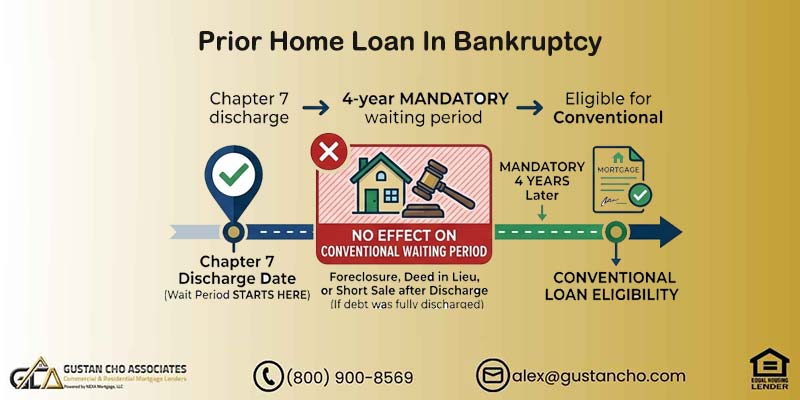
Mortgage guidelines with a prior home loan in bankruptcy are different for each individual mortgage loan program. HUD has its own mortgage lending guidelines on FHA loans with regards to mortgage guidelines with a prior home loan in bankruptcy. Fannie Mae has just come up with new mortgage lending guidelines with regards to guidelines on having a prior home loan in bankruptcy. The date of the foreclosure, deed in lieu of foreclosure, or short sale after the bankruptcy does not matter. The mortgage cannot be reaffirmed after the bankruptcy. There is a four-year waiting period after the discharge date of the bankruptcy to qualify for a conventional loan. This is a great benefit with conventional versus FHA loans.
Mortgage Regulations With A Prior Mortgage In Bankruptcy
If you had a mortgage included in bankruptcy, getting a new home loan can be confusing. Many people believe the waiting period begins when bankruptcy ends, but some lenders count from the date of foreclosure, sheriff’s sale, short sale, or deed-in-lieu instead. Your best path depends on your loan type, the kind of bankruptcy you filed, whether you kept or canceled the mortgage, and each lender’s specific rules. This is especially important if you included a mortgage in bankruptcy, whether Chapter 7 or 13, and continued living in your home for a long time.
Sometimes, people move out after bankruptcy ends, but the foreclosure sale happens years later, which can cause extra problems for both borrowers and lenders.
Many people turn to Gustan Cho Associates after being turned down by banks, credit unions, or mortgage companies because of a previous home loan in bankruptcy. Often, it’s not the official rules that cause issues, but extra, stricter rules known as lender overlays. This guide explains how underwriters review prior home loans in bankruptcy, what documents you’ll need, and how you can qualify for a mortgage after bankruptcy.
What Does Prior Home Loan in Bankruptcy Mean?
When a borrower is denied a prior home loan in bankruptcy, it means they had mortgage debt that they included in their bankruptcy. That home loan may have been filed during a Chapter 7, Chapter 13, or another bankruptcy chapter. The crux of the matter is whether the mortgage debt was forgiven in bankruptcy. If forgiven, the borrower may no longer be liable. However, the mortgage burden can remain on the property until sold, foreclosed, or removed. ceeding will nullify the borrower’s liability on the mortgage debt, but it doesn’t eliminate the mortgage burden.
Dischargeable Mortgage Debt in Bankruptcy
Once a mortgage debt is discharged in bankruptcy, the borrower is under no further obligation to repay it. The mortgage lender, however, is still allowed to pursue the borrower’s property through foreclosure; the mortgage lien remains attached to the property unless and until it is extinguished by some other means. Borrowers may say their mortgage bankruptcy was discharged five years ago, but the credit report may show a foreclosure less than a year old. Some lenders focus on the foreclosure completion date, while others consider the bankruptcy waiting period if supported by documentation. It will be used by lenders unless documentation proves the mortgage debt was discharged. Otherwise, the longer bankruptcy or foreclosure waiting period applies.
Mortgages – Prior Home Loan in Bankruptcy
Mortgage lenders and servicers may voluntarily decide to defer a foreclosure for months or years. In many cases, borrowers have “surrendered” the property for an extended period and received the bankruptcy discharge, yet the lender’s foreclosure will not be executed for a long time. This also, unfortunately, causes one of the most significant challenges in mortgage underwriting.
Confusions Regarding Prior Home Loan in Bankruptcy
Every loan program has different guidelines on prior home loan in bankruptcy. The borrower might think the waiting period begins with the discharge from bankruptcy. The borrower may think the waiting period starts at bankruptcy discharge, while the lender may say it starts at foreclosure completion. It depends on the mortgage program, the investor, the documentation, and the lender’s policies. distinction between a reaffirmed mortgage and a mortgage that was fully discharged in bankruptcy.
Reaffirmed Mortgage Debt vs. Non-Arrears Mortgage Debt
Reaffirming the mortgage means the borrower chose to remain personally liable for the mortgage debt after the bankruptcy was finalized. This can impact the lender’s internal underwriting review. If the borrower reaffirmed the mortgage and it subsequently terminated, the new lender can pursue the borrower for derogatory behavior under the new loan document.
A lender may use the bankruptcy waiting period to their advantage, provided the mortgage was discharged in bankruptcy. If the lender does not have that advantage, the lender must apply the longer of the applicable waiting periods.
If the mortgage was discharged in bankruptcy, the borrower might be able to argue that the bankruptcy waiting period be imposed, especially in the case of conventional loans, where the lender complies with Fannie Mae/Freddie Mac guidance and the relevant bankruptcy documentation supports the file.
What is Confusing About a Prior Home Loan in Bankruptcy for the Borrowing Public
A prior home loan in bankruptcy can be confusing because many dates may appear in the file, such as the bankruptcy filing, discharge, foreclosure start, sale, deed transfer, short sale, or charge-off.
Mortgage underwriters are not entirely reliant on information provided by borrowers. Instead, mortgage underwriters do not rely solely on borrower information.
They verify by reviewing bankruptcy records, credit history, public documents, title records, and foreclosure paperwork. They vary. For example, a Chapter 7 bankruptcy could have been. Bankruptcy and foreclosure dates often differ. For example, a Chapter 7 bankruptcy discharged in 2020 may be followed by foreclosure in 2023. This causes many lenders to decline borrowers despite proper documentation. same mortgage section.
Misleading Credit Report Reporting
Credit reports may list bankruptcy, foreclosure, deed-in-lieu, short sale, and charge-off, but often lack clarity. Fannie Mae notes that derogatory events may not be clearly communicated. Lenders use credit reports to request documentation. Therefore, it’s poor practice for a borrower to rely solely on a credit report when applying for a loan. For example, a mortgage underwriter may need to see the full bankruptcy.
If Credit Reporting is Confusing
Borrowers should not rely solely on credit reports when applying for a loan. Underwriters may need the full bankruptcy petition, schedules, and foreclosure documents. While the borrower may qualify for a loan under FHA, VA, USDA, or even Fannie Mae or Freddie Mac guidelines, the borrower is still denied the loan due to the Lender’s self-imposed, more stringent policies.
Common Issues When a Mortgage Is Included In Bankruptcy
For example, a lender may impose a seven-year waiting period on a borrower after a foreclosure, regardless of whether the mortgage is discharged in bankruptcy. For example, one lender may require a 7-year wait after a foreclosure, regardless of a bankruptcy discharge. Another may apply the bankruptcy waiting period if the mortgage debt was discharged.nd Freddie Mac guidelines. Unlike the FHA, VA, and USDA loans, these loans are not backed by the federal government. When the file is documented correctly, a borrower with a prior home loan in bankruptcy may qualify under conventional mortgage guidelines.
Fannie Mae Guidelines for Foreclosure
With proper documentation, a borrower with a prior home loan in bankruptcy may qualify under conventional guidelines. of a Chapter 7 or Chapter 11 bankruptcy, and then wait two years after discharge or four years after dismissal in a Chapter 13 bankruptcy. Fannie Mae provides special treatment for the foreclosures and bankruptcies of the same loan. Based on the lender’s processes, the Bankruptcy waiting periods can be used if Fannie Mae offers special treatment for foreclosures and bankruptcies on the same loan.
Conventional Loan Requirements – Prior Home Loan in Bankruptcy
Lenders may use bankruptcy waiting periods if they document the discharge of mortgage debt. Typically, lenders need considerable evidence to rely on the bankruptcy waiting period instead of foreclosure. This includes the bankruptcy discharge, petition, creditor schedules, mortgage details, and proof that the mortgage was included in bankruptcy. Clarity, in this case, is everything. A borrower may appear to meet all requirements, but if the underwriter is left with a time of discretion and has no evidence in the file describing the discharged home loan, they may, in effect, be forced to impose the foreclosure waiting period.
When the Foreclosure Waiting Period May Still Apply
The need for a waiting period stemming from a foreclosure may still be seen, in this case, if the lender is left without the needed evidence that the mortgage obligation was discharged in bankruptcy.
Fannie Mae’s minimum term on a foreclosure waiting period is seven years from the final judgment and sale, although there may be limited circumstances that can be described as extenuating.
This may result from the reaffirmation of the mortgage, insufficiencies in the bankruptcy papers, or, in the circumstances, the loan program requiring the term on a foreclosure to be seasoned. For this reason, borrowers should engage a qualified and informed mortgage team to review their case, rather than simply jumping to the conclusion that there is no eligibility.
HUD Guidelines on Prior Home Loan In Bankruptcy
To qualify for an FHA loan if you have a prior home loan in bankruptcy, the waiting period starts from the recorded date of the foreclosure and not the discharge date of the bankruptcy. For example, if you filed for bankruptcy in June of 2010. And you included your mortgage as part of your bankruptcy.
FHA’s Policies – Prior Home Loan in Bankruptcy
The discharge date of your bankruptcy was October 2010 but your foreclosure did not get recorded until October 2012. The waiting period to qualify for an FHA loan starts 3 years from the October 2012 recorded date of your foreclosure. Even though the loan balance was wiped out from the Chapter 7 bankruptcy, the waiting period does not start from the recorded date the deed was transferred out of your name into the name of the lender.
Ready to Move Forward? Start Your Pre-Approval
Complete a quick application or send your scenario. We’ll confirm the best program and guide you step-by-step to closing—even with a prior home loan in bankruptcyRestrictions on FHA Loans After Home Loan Bankruptcy
One of the biggest advantages of the FHA loan is the flexible requirements. Many forms of bankruptcy leave the borrower with few mortgage options. Improved home loans may offer lower interest rates than FHA loans, but the requirements are much stricter. Credit scores and debt-to-income ratios are among the factors that FHA loans overlook, but many traditional loans would deny borrowers based on them. Other factors that would create roadblocks on many traditional loans that the FHA loans would overlook are prior bankruptcy and foreclosure.
Waiting Period for an FHA Loan After Chapter 7 Bankruptcy
Chapter 7 bankruptcy requires a waiting period before obtaining an FHA loan. An older HUD directive states that two years post-discharge from Chapter 7 bankruptcy, a borrower is not considered disqualified as long as the borrower has avoided new loans, has re-established some credit, and has effectively controlled their finances. Some restrictions would apply to a borrower considered sooner based on a very strong case. This is not likely.
FHA Rules Governing Chapter 13 Bankruptcy
FHA also has flexible rules in place for those in Chapter 13 bankruptcy. One year of the Chapter 13 bankruptcy repayment period must have passed, and all monthly payments must be made for the borrower to qualify for an FHA loan. The court must also provide the borrower permission to secure the loan. This is a prevalent option for many borrowers.
FHA Manual Underwriting After Bankruptcy
Typically, a borrower in Chapter 13 bankruptcy is manually underwritten. Manual underwriting means a human underwriter reviews the file, as opposed to an automated underwriter. A manual underwrite involves the consideration of the borrower’s complete profile post-bankruptcy.
Manual underwriting takes into account rent history, trustee payments, income, job history, sustainable income, debt-to-income ratio, changes in credit, and a bankruptcy explanation.
Many lenders have an aversion to underwriter manual Chapter 13 files. Gustan Cho Associates fully embraces borrowers in manual Chapter 13 and FHA Chapter 13 Bankruptcy.
Conventional Loan Guidelines on Prior Home Loan In Bankruptcy
The mandatory waiting period to qualify for a conventional loan is 4 years from the date of the bankruptcy discharge date. The great news with Fannie Mae conventional loan programs is that if you had a prior home loan in bankruptcy, the waiting period starts from the discharge date of your bankruptcy and not the recorded date of the foreclosure.
VA Loan Guidelines With A Previous Home Loan In Bankruptcy
VA loans are extended to individuals, including veterans, active service members, and surviving spouses. VA loans are typically considered the most flexible mortgage options. A home loan that has been placed in Bankruptcy will NOT fully remove a veteran from consideration of a VA loan. The lender will consider the bankruptcy itself, foreclosure history, entitlement, credit recovery, residual income, and ability to repay the loan.
VA Loans After Chapter 7 Bankruptcy
A majority of VA lenders require a wait period post Chapter 7 Bankruptcy Discharge. The exact approval will depend on the automated system, the borrower’s credit, and the lender’s discretion. VA loans are less rigid than most other loans that advertise a minimum credit score requirement. Although the VA program is flexible, lenders can still apply credit score overlays. It is common for them to impose a minimum credit score of 620 or 640, even though VA is designed to be more flexible than most other loans.
VA Loans After Chapter 13 or During Chapter 13
For veterans who declare VA financing after Chapter 13, there are four requirements that must be met: (1) sustained payments to the Trustee, (2) Trustee or court-approved Turnover for Trustee’s Sale, and (3) related to the separation and financing of the VA. Like most lending institutions that offer FHA financing, Chapter 13 borrowers are often classified as manual underwriting files. In most instances, the underwriter is responsible for determining if the ______ (borrower) meets the requirements of making timely payments, and if the borrower’s ability to make the new housing payment, along with ______ (borrower) receiving ______ (borrower) is sufficient.
VA Lender Overlays After BK
Most lender overlays remain in place for 4 to 6 months after bankruptcy, foreclosure, a VA loan short sale, or a prior loan default. Often,, denials are due to a lack of required credit, a recent bankruptcy, Manual Underwriting, or the borrower’s prior loan being qualified for inclusion or written off due to bankruptcy. Our mission at Gustan Cho Associates is to provide every eligible veteran who has been denied by every bank with the financing options that meet their criteria. It is more common that a borrower can be qualified by a different VA lender than the one they were previously denied by.
USDA Loan Guidelines With a Prior Home Loan in Bankruptcy
USDA loans are government-backed mortgages for eligible rural and suburban properties. USDA loans can offer no-down-payment financing to eligible borrowers, but they also have credit and underwriting requirements.
USDA Bankruptcy Waiting Periods
USDA guidelines can be stricter than FHA or VA for borrowers with recent bankruptcy, foreclosure, or serious derogatory credit. Borrowers with a prior home loan in bankruptcy may need to meet seasoning requirements, show re-established credit, and receive an acceptable automated underwriting finding or meet manual underwriting standards. Because USDA overlays are common, borrowers should have the full file reviewed before assuming they are ineligible.
USDA Credit Reestablishment Requirements
USDA underwriters want to see that the borrower has recovered financially after bankruptcy. This includes on-time housing payments, no recent late payments, stable income, manageable debts, and no pattern of new derogatory credit. If the prior home loan was included in bankruptcy, the lender may ask for bankruptcy papers, discharge documents, foreclosure documents, and a written explanation.
Buying a House After a Foreclosure

The foreclosure can be recorded past the discharge date of the bankruptcy. For example, if you filed for bankruptcy in January 2010. And the bankruptcy was discharged in May 2010 and had a prior home loan in bankruptcy. And the foreclosure was not recorded until January 2013. The 4-year waiting period starts from the discharge bankruptcy date of May 2014. This is a new Fannie Mae guideline on a prior home loan in bankruptcy which will enable home buyers who had their foreclosures recorded at a later date than the date of their discharged bankruptcy dates.
| Derogatory Event Status | Waiting Period Requirements to Qualify for Conventional Loan | Waiting Period with Extenuating Circumstances per Fannie Mae Guidelines |
| Bankruptcy — Chapter 7 or 11 Filing | 4 years from Bankruptcy Discharge Date | 2 years from the bankruptcy discharge date |
| Bankruptcy — Chapter 13 Filing | 2 years from the discharge date of the Bankruptcy 4 years from the dismissal date of the Chapter 13 Bankruptcy | 2 years from the discharge date of the bankruptcy. 2 years from the dismissal date of the Chapter 13 date of the Bankruptcy |
| Multiple Bankruptcy Filings | 5 years if more than one filing BANKRUPTCY within the past 7 years | 3 years from the most recent discharge or dismissal date of bankruptcy |
| Foreclosure | 7 years from the recorded date of the foreclosure which is reflected on the county records or the date of the sheriff’s sale | 3 years from the recorded date of the foreclosure which is reflected on county records or the date of the sheriff’s sale. Additional requirements after 3 years up to 7 years: 90% maximum LTV ratios Purchase, principal residence Limited cash-out refinance, all occupancy types |
| Deed-in-Lieu of Foreclosure, Pre-foreclosure Sale, or Charge-Off of Mortgage Account | 4 years from the recorded date of the deed in lieu of foreclosure or the 4 years from the date of the short sale which is reflected on the HUD-1 Settlement Statement. | 2 years |
Mortgage Guidelines With a Prior Home Loan in Bankruptcy
Bankruptcy can be a major financial setback, especially when it involves a home loan. However, a prior mortgage discharged through bankruptcy does not necessarily disqualify you from obtaining a new home loan in the future. Lenders have specific guidelines depending on the loan type, and understanding these can help you prepare for homeownership again. 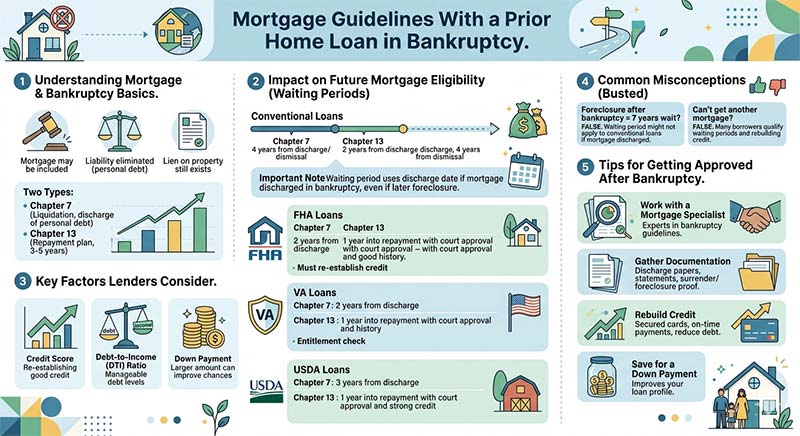
Understanding Mortgage and Bankruptcy Basics
When a borrower files for bankruptcy, they may include a mortgage. This means the legal obligation to repay the loan (personal liability) is eliminated if the bankruptcy is discharged, but the lien on the property still exists. Foreclosure may still occur unless the home is reaffirmed and payments continue.
Two Primary Types Of Consumer Bankruptcy Affect Mortgages:
- Chapter 7 Bankruptcy: Liquidation of assets. Typically includes a discharge of personal debt, including mortgage liability.
- Chapter 13 Bankruptcy: A court-approved repayment plan usually lasts 3 to 5 years.
- Borrowers may continue paying the mortgage during this time.
Impact on Future Mortgage Eligibility
Different types of mortgage loans have different waiting periods and guidelines after a bankruptcy involving a home loan.
Conventional Loans (Fannie Mae/Freddie Mac)
- Waiting Period After Chapter 7: 4 years from discharge or dismissal.
- Waiting Period After Chapter 13: 2 years from discharge; 4 years from dismissal.
- Important Note: If the mortgage was discharged in the bankruptcy but the foreclosure happened later, lenders use the bankruptcy discharge date—not the foreclosure date—for waiting period calculation, if properly documented.
FHA Loans
- Waiting Period After Chapter 7: 2 years from discharge.
- Waiting Period After Chapter 13: 1 year into the repayment plan with satisfactory payment history and court approval.
- Credit and Capacity: Must re-establish good credit and demonstrate ability to repay.
VA Loans
- Waiting Period After Chapter 7: 2 years from discharge.
- Waiting Period After Chapter 13: 1 year into the repayment plan with court approval.
- Entitlement Consideration: Remaining VA entitlement must be available, or prior entitlement must be restored.
USDA Loans
- Waiting Period After Chapter 7: 3 years from discharge.
- Waiting Period After Chapter 13: 1 year into repayment with court approval and strong credit performance.
Key Factors Lenders Consider
Even after the waiting periods, lenders will evaluate:
Common Misconceptions
- Credit Score: Re-establishing good credit is crucial.
- Debt-to-Income Ratio (DTI): Lenders want to see manageable debt levels.
- Down Payment: Larger down payments can improve chances of approval.
Documentation:
Proof that the mortgage debt was included in bankruptcy can affect waiting period calculations, especially with conventional loans.
- “I had a foreclosure after bankruptcy, so I must wait 7 years.”: Not always true for conventional loans. If the mortgage was discharged in bankruptcy, the foreclosure timeline might not apply.
- “I can’t get another mortgage after bankruptcy.”: False. Many borrowers qualify for new loans after completing the required waiting period and rebuilding credit.
Tips for Getting Approved After Bankruptcy
- Check Your Credit Reports: Ensure discharged debt can’t be reported.
- Work with a Mortgage Broker or Specialist: They can help find lenders familiar with bankruptcy guidelines.
- Gather Documentation: Include discharge papers, mortgage statements, and evidence of property surrender or foreclosure.
- Rebuild Credit: Use secured credit cards, make on-time payments, and reduce debt.
- Save for a Down Payment: This improves your loan profile.
How Underwriters Review a Prior Home Loan in Bankruptcy
Mortgage underwriters do not only look at one date. They review the entire story. The goal is to determine what happened, when it happened, whether the borrower is legally responsible for the prior mortgage debt, and whether the borrower has recovered financially.
Bankruptcy Discharge Papers
The bankruptcy discharge confirms the date the bankruptcy was completed and discharged. This is one of the most important documents in the file. For conventional loans, the discharge date may be critical when the borrower is trying to use the bankruptcy waiting period instead of the later foreclosure date.
Schedule of Debts
The bankruptcy schedules show which debts were included in the bankruptcy. If the prior home loan appears on the bankruptcy schedules, it helps prove that the mortgage debt was part of the bankruptcy case. The lender may need to verify the mortgage account number, creditor name, property address, and whether the mortgage was discharged.
Foreclosure, Short Sale, or Deed-in-Lieu Documents
If the home was later foreclosed, sold short, transferred by deed-in-lieu, or charged off, the lender may request documents showing the completion date. Even if the borrower hopes to use the bankruptcy waiting period, the underwriter may still need to understand what happened to the property.
Payment History After Bankruptcy
Credit reestablishment is very important. Fannie Mae states that after bankruptcy, foreclosure, deed-in-lieu, pre-foreclosure sale, or mortgage charge-off, the borrower’s credit must be re-established, and the waiting period requirements must be met. Underwriters want to see responsible payment behavior after bankruptcy. Recent late payments, new collections, overdrafts, high credit card balances, or unpaid judgments can weaken the file.
Prior Home Loan in Bankruptcy? You May Still Qualify for a Mortgage
Having a previous mortgage included in bankruptcy doesn’t always prevent homeownership. Get a quick review of your bankruptcy dates, housing history, and current credit to confirm the best path to approvalCommon Problems When a Prior Mortgage Was Included in Bankruptcy
Borrowers with a prior home loan who file for bankruptcy often face the same problems during the mortgage process. The issue is usually not just the bankruptcy. The issue is how the prior mortgage is documented and how the lender interprets the file.
The Mortgage Still Shows on the Credit Report
A discharged mortgage may still appear on the credit report. It may show a zero balance, included in bankruptcy, discharged through bankruptcy, foreclosure started, foreclosure completed, charge-off, or transferred. If the reporting is unclear, the lender may request additional documents. Borrowers should not panic if the old mortgage still appears on the credit report. The key is whether the reporting is accurate and whether the file can prove what happened.
The Foreclosure Happened Years After Bankruptcy
This is one of the most common issues. A borrower files Chapter 7 bankruptcy, the mortgage debt is discharged, but the lender does not complete foreclosure until years later. Some lenders incorrectly tell borrowers they must wait seven years from the foreclosure date. For conventional loans, that may not always be true if the mortgage debt was discharged in bankruptcy and the lender obtains proper documentation.
The Borrower Stayed in the Home After Bankruptcy
Some borrowers continue living in the home after bankruptcy. Others keep making payments for a period of time. Some later stop making payments and allow the home to go into foreclosure. This can complicate the review. The underwriter may need to determine whether the mortgage was reaffirmed, whether payments were made after discharge, and whether any later default creates a separate credit issue.
The Borrower Reaffirmed the Mortgage
If the borrower reaffirmed the mortgage, they may have remained personally liable for the loan after bankruptcy. If the mortgage later went into default, the lender may treat the later foreclosure or mortgage delinquency differently from a mortgage that was fully discharged and not reaffirmed. Borrowers should provide the reaffirmation agreement if one exists. If no reaffirmation agreement exists, the lender may need documentation confirming the mortgage was discharged.
How Gustan Cho Associates Helps Borrowers With Prior Home Loans in Bankruptcy
Gustan Cho Associates helps borrowers who have been told they cannot qualify because of a prior home loan in bankruptcy, prior foreclosure, Chapter 7 bankruptcy, Chapter 13 bankruptcy, or lender overlays. Many borrowers are not denied because they are ineligible under agency guidelines. They are denied because the lender does not want to deal with the complexity of the file.
No Lender Overlays on Government and Conventional Loans
Gustan Cho Associates is known for helping borrowers with no lender overlays on FHA, VA, USDA, and conventional loans. This matters because agency guidelines may allow a loan, but many lenders add stricter credit scores, waiting periods, manual underwriting, or bankruptcy rules. A borrower with a prior home loan in bankruptcy needs a lender that understands the difference between agency guidelines and overlays.
Manual Underwriting Experience
Manual underwriting is often needed for borrowers with Chapter 13 bankruptcy, recent credit events, or complex mortgage histories. Not every lender offers manual underwriting. Some lenders only want clean automated approvals. Gustan Cho Associates works with borrowers who need a deeper file review. The goal is to document the loan correctly, explain the bankruptcy properly, and match the borrower with the right mortgage program.
Helping Borrowers Turned Down by Other Lenders
Many borrowers come to Gustan Cho Associates after being denied elsewhere. Common denial reasons include:
- The lender counted the foreclosure date rather than verifying whether the mortgage was discharged in bankruptcy.
- The lender required a higher credit score than the agency guidelines.
- The lender refused to underwrite the loan manually.
- The lender did not understand Chapter 13 mortgage guidelines.
- The lender applied overlays after bankruptcy.
- The lender did not properly review the bankruptcy schedules.
- A prior home loan in bankruptcy does not automatically mean a borrower cannot buy another home.
- The file needs to be reviewed by a lender experienced with bankruptcy mortgage guidelines.
Best Mortgage Options With a Prior Home Loan in Bankruptcy
The best mortgage option depends on the borrower’s current credit, income, down payment, bankruptcy type, discharge date, foreclosure status, and property goals.
- FHA loans may be a strong option for borrowers with lower credit scores, higher debt-to-income ratios, or Chapter 13 bankruptcy.
- VA loans may be the best option for eligible veterans because of flexible credit guidelines, no down payment, and no monthly mortgage insurance.
- Conventional loans may work well when the borrower has reestablished credit and can document that the prior mortgage debt was discharged in bankruptcy.
- USDA loans may be available to eligible borrowers buying in USDA-approved areas, but credit and bankruptcy requirements must be carefully reviewed.
- Non-QM loans may help borrowers who do not meet agency waiting periods, have a recent bankruptcy or foreclosure, use bank statement income, have DSCR rental income, or have other non-traditional qualification needs.
Documents Borrowers Should Prepare
Borrowers with a prior home loan who are filing for bankruptcy should prepare the necessary documents early. The more complete the file is, the easier it is for the lender to determine eligibility. Important documents may include the bankruptcy discharge, full bankruptcy petition, schedule of creditors, mortgage statement from the prior home loan, credit report, foreclosure deed or sheriff’s sale record, short sale closing statement, deed-in-lieu paperwork, reaffirmation agreement (if applicable), and a written letter of explanation. Borrowers should also be prepared to document rent history, employment history, income, assets, and recent credit activity.
How to Improve Approval Chances After a Prior Home Loan in Bankruptcy
The best way to improve approval chances is to keep credit clean after bankruptcy. Underwriters want to see that the borrower has recovered financially and is ready for a new mortgage. Pay all bills on time. Keep credit card balances low.
Avoid overdrafts and unexplained deposits. Save money for reserves. Keep employment stable. Be honest about all debts, past properties, and bankruptcy details.
Avoid opening too many new accounts. Do not dispute accounts during the mortgage process unless instructed by the loan officer. A prior home loan in bankruptcy is not always the problem. The bigger problem is often incomplete documentation, recent late payments, high debt-to-income ratios, or working with a lender that has overlays.
Final Thoughts on Mortgage Guidelines With a Prior Home Loan in Bankruptcy
A prior home loan in bankruptcy can complicate mortgage approval, but it does not automatically prevent a borrower from buying another home. The most important issues are whether the mortgage debt was discharged, whether the mortgage was reaffirmed, when the bankruptcy was discharged, when the foreclosure was completed, and whether the lender follows agency guidelines without overlays. Borrowers should not assume they are ineligible just because one lender said no.
Mortgage guidelines are not the same as lender overlays. A bank, credit union, or online lender denial does not always mean the borrower cannot qualify.
Gustan Cho Associates helps borrowers with prior bankruptcy, prior foreclosure, prior home loan in bankruptcy, Chapter 13 manual underwriting, FHA loans, VA loans, conventional loans, USDA loans, and non-QM loans. The right documentation and the right lender can make a major difference. A prior home loan included in bankruptcy does not permanently bar you from owning a home again. With time, planning, and a solid understanding of current mortgage guidelines, it is entirely possible to re-enter the housing market. Each loan program offers different timelines and requirements, so working with a knowledgeable lender is key to finding the right path forward.
Additional Considerations for Mortgage Guidelines After Bankruptcy with a Prior Mortgage
Surrender vs. Foreclosure After Bankruptcy
- If the mortgage was discharged through bankruptcy and the property was surrendered (i.e., the borrower gave up ownership), the foreclosure process might occur months or even years later.
- Fannie Mae & Freddie Mac (Conventional Loans) recognize the bankruptcy discharge date as the start of the waiting period, as long as the mortgage was included in the bankruptcy.
- However, lenders often request documentation showing the mortgage was discharged and no reaffirmation occurred.
Tip: Be ready to provide the full bankruptcy petition, discharge papers, and a letter of explanation.
Short Sale or Deed-in-Lieu of Foreclosure in Bankruptcy
If you completed a short sale or deed-in-lieu after a mortgage was discharged in bankruptcy, here’s how the guidelines may apply:
- Conventional loans may still use the bankruptcy discharge date, not the property transfer date, as the start of the waiting period.
- FHA, VA, and USDA treat short sales or deeds-in-lieu separately, potentially imposing a longer waiting period (often 3 years from the completion of the transfer).
Reaffirmed Mortgages
If a borrower reaffirmed the mortgage during bankruptcy:
- They remain personally liable for the debt.
- Future underwriting treats the mortgage as active rather than discharged.
- Any late payments after bankruptcy on a reaffirmed mortgage can harm future loan approval.
Pro tip: If unsure whether your mortgage was reaffirmed, check your bankruptcy documents or ask your attorney.
Non-Discharged Junior Liens (Second Mortgages or HELOCs)
Sometimes, second mortgages or HELOCs aren’t properly discharged in bankruptcy or may be pursued for collection after the first mortgage is resolved.
- Even if the home was foreclosed, an undischarged junior lien may still negatively affect your credit.
- This can affect your DTI, credit score, and perceived creditworthiness.
Rebuilding Credit After Bankruptcy
Re-establishing credit is just as important as waiting out the timelines. Lenders want to see:
- At least 3 new trade lines (credit cards, auto loans, etc.)
- A minimum credit score (typically 620+ for conventional, 580+ for FHA, and 640+ for USDA)
- No recent delinquencies or collections
Caution: “Credit repair” services often do more harm than good. Focus on responsible use of secured credit and timely payment of all accounts.
Manual vs. Automated Underwriting
- Automated Underwriting Systems (AUS) like DU (Desktop Underwriter) or LP (Loan Product Advisor) may approve a borrower sooner than the standard waiting period if other risk factors are favorable.
- Manual underwriting is more conservative and often requires:
- Lower DTI
- More cash reserves
- Strong documentation of income and stability
Documentation You May Need
To ensure smooth underwriting with a past mortgage in bankruptcy, gather the following:
- Bankruptcy discharge documents (including full schedules)
- Proof of mortgage was included in the bankruptcy (Schedule D or A)
- Final foreclosure or deed-in-lieu documents (if applicable)
- Credit report showing zero balance or discharge
- Letter of explanation (LOE)
Getting a mortgage after bankruptcy is entirely possible — even with a prior home loan involved — but success hinges on two things:
- Understanding lender-specific guidelines and how they treat discharged mortgages
- Rebuilding a clean, creditworthy profile that proves financial readiness
Frequently Asked Questions (FAQs)
Is It Possible For Me To Obtain A Mortgage Following A Bankruptcy Filing?
Yes, getting a mortgage after bankruptcy is possible, but the timing and specific requirements may hinge on the type of bankruptcy and the specific criteria set by the lender.
How Long Do I Wait After Bankruptcy To Apply For A Mortgage?
The waiting period after bankruptcy before applying for a mortgage varies depending on the type of bankruptcy (Chapter 7 or Chapter 13) and the type of loan (FHA, VA, or Conventional). Generally, the waiting period can range from 1 to 4 years.
What Documentation Must I Provide When Applying For A Mortgage After Bankruptcy?
You’ll typically need to provide documentation related to your bankruptcy discharge, including the bankruptcy petition, discharge papers, and any relevant court documents. Additionally, you’ll need to provide standard financial documents such as income statements, bank statements, and employment verification.
What Are The Credit Score Requirements For Getting A Mortgage After Bankruptcy?
You’ll typically need to provide documentation related to your bankruptcy discharge, including the bankruptcy petition, discharge papers, and any relevant court documents. Additionally, you’ll need to provide standard financial documents such as income statements, bank statements, and employment verification.
Can I Qualify For Government-Backed Loans Like FHA or VA After Bankruptcy?
Yes, qualifying for FHA or VA loans after bankruptcy is possible. Still, you’ll need to meet specific waiting period requirements and demonstrate that you’ve re-established good credit since the bankruptcy discharge.
Do I Need A Down Payment To Get A Mortgage After Bankruptcy?
The necessity for a down payment may differ depending on the loan type and your financial situation. Government-backed loans like FHA and VA may have low or no down payment options. In contrast, conventional loans generally mandate a down payment spanning from 3% to 20% of the property’s purchase price.
Can I Refinance My Existing Mortgage After Bankruptcy?
Yes, it’s possible to refinance your existing mortgage after bankruptcy. Still, you’ll need to meet the lender’s requirements, including credit score, income, and equity in the home.
What Steps Can I Take To Improve My Chances Of Getting A Mortgage After Bankruptcy?
Enhance your likelihood of securing a mortgage post-bankruptcy by prioritizing credit restoration, sustaining steady employment and income, accumulating funds for a down payment, and collaborating with an informed mortgage lender who comprehends your circumstances.
For more information on this blog and/or other mortgage-related topics, please contact us at Gustan Cho Associates, at (800) 900-8569 or text us for a faster response. Or email us at alex@gustancho.com. The team at Gustan Cho Associates is available 7 days a week, on evenings, weekends, and holidays.