Many homebuyers worry that a low credit score will automatically stop them from qualifying for a home loan. The lowest credit score allowed for mortgage approvals can vary by loan program, and some options may be available even when your credit is less than perfect. Meeting a minimum score does not guarantee approval. Mortgage lenders also review your recent payment history, inc
ome, debts, down payment, savings, and the overall strength of your application.
What Is the Lowest Credit Score Allowed for Mortgage Approvals?
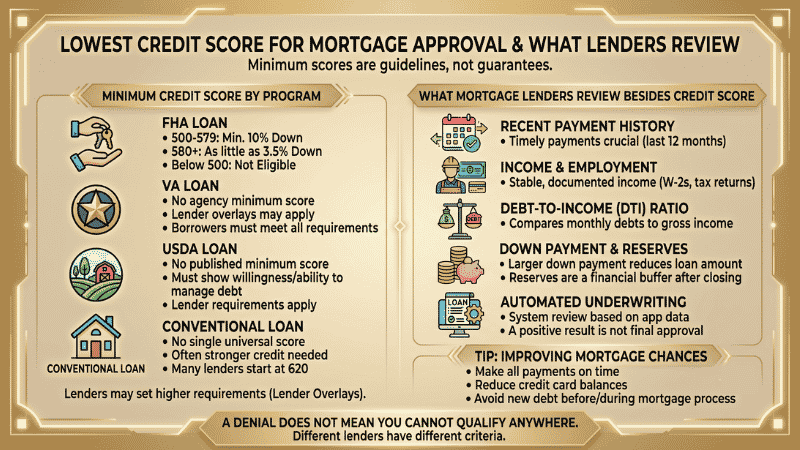
The lowest credit score allowed for mortgage approvals is generally 500 for an FHA-insured loan. Individuals with credit scores ranging from 500 to 579 might qualify with a minimum of 10% down payment, whereas those with scores of 580 or above could be eligible with just 3.5% down. VA and USDA loans do not set an agency minimum credit score, but lenders may impose their own requirements. Conventional loan score requirements also vary by lender and loan type. Meeting the lowest credit score allowed for mortgage approvals does not guarantee a mortgage approval. Lenders also review your recent payment history, income, monthly debts, down payment, available savings, property, and underwriting results before making a final decision.
Minimum Credit Score by Mortgage Program
FHA Loan Minimum Credit Score
FHA loans have the lowest published credit-score threshold among the main mortgage programs. Borrowers with a credit score between 500 and 579 may be eligible with at least 10% down. Borrowers with a score of 580 or higher may be eligible with as little as 3.5% down. FHA-insured financing is not available when the qualifying score is below 500. These are FHA’s baseline guidelines, not a promise of approval. Some lenders use higher internal credit-score requirements, so a borrower who meets FHA’s minimum may still need to find a lender willing to review the full file.
VA Loan Minimum Credit Score
The VA does not set a minimum credit score for VA-backed home loans. However, borrowers must meet both VA and lender requirements for credit, income, occupancy, and the overall loan file. Individual lenders may require a minimum score or apply stricter underwriting standards. That is why a VA borrower may receive different answers from different lenders, even with the same credit report.
USDA Loan Minimum Credit Score
USDA does not publish a minimum credit score requirement for its Single Family Housing Guaranteed Loan Program. Instead, applicants must show a willingness and ability to manage debt. Lenders may still set their own credit standards, and approval also depends on household income limits, property eligibility, debt, repayment history, and the strength of the complete application.
Conventional Loan Minimum Credit Score
Conventional loans often require stronger credit than FHA financing, but there is no single universal credit score for every borrower. Requirements can vary by lender, down payment, occupancy type, property type, loan purpose, and whether the loan receives automated underwriting approval or is manually underwritten. Many lenders use 620 as a practical starting point for certain conventional loans, but a higher score may be needed depending on the transaction. A borrower should focus on the full approval picture rather than assuming a single score applies to every conventional mortgage.
Can You Get a Mortgage With a 500 Credit Score?
Yes, it may be possible to get a mortgage with a credit score of 500. FHA financing is usually the primary option at this score range. Borrowers with a score between 500 and 579 may be eligible for an FHA loan with at least 10% down payment. However, many lenders set higher credit score requirements, so meeting the FHA’s minimum does not guarantee approval from every lender. A 500 credit score is just one aspect of the evaluation process. Lenders also consider factors such as stable income, monthly debt obligations, recent payment history, available savings, and the overall underwriting findings. A borrower with recent late payments, significant debt, or insufficient documentation may struggle to qualify, even if they meet the lowest credit score allowed for mortgage approval and have the required down payment.
Why a Qualifying Credit Score Does Not Guarantee Approval
Just because you meet the lowest credit score allowed for mortgage approval doesn’t mean you’ll get approved. Lenders often have stricter requirements, known as lender overlays. This can include a higher credit score, a lower debt-to-income ratio, more reserves, or a better recent payment history.
Lenders review automated underwriting findings to assess loan risk based on income, debts, credit history, down payment, reserves, occupancy, and property type. A positive result can help advance the loan process, but it doesn’t constitute final approval.
Before closing, the lender must verify the documents supporting the application. This may include pay stubs, tax returns, bank statements, gift documentation, and explanations for large deposits or credit issues. The property must also meet the loan program’s requirements for value, condition, occupancy, and eligibility. A borrower can have an acceptable credit score but still face denial or delay due to missing documents, high debt, income issues, appraisal issues, or property concerns.
Low Credit Score? You May Still Have Home Loan Options
FHA, VA, USDA, Conventional, and Non-QM loans all use different credit standards. We’ll review your score, income, debts, and down payment to find the best path.What Mortgage Lenders Review Besides Your Credit Score
Recent Payment History
Lenders look closely at how you have handled credit recently. Late payments, collections, charge-offs, and past-due accounts can raise concerns, especially when they happened within the last 12 months. An older, isolated issue may be easier to explain than a pattern of recent missed payments. A low credit score does not always prevent approval, but recent credit problems can make the file harder to approve. Lenders may ask for an explanation when there are significant late payments or other recent negative accounts.
Income and Employment
Mortgage lenders need to verify that you have stable, documented income to support the new mortgage payment. This may include pay stubs, W-2s, tax returns, bank statements, or other documents based on how you are paid. A steady employment history can strengthen an application, especially when credit is limited or recovering. Changing jobs does not always prevent approval, but the lender may need to confirm that the new income is stable and likely to continue.
Debt-to-Income Ratio
Your debt-to-income ratio, often called DTI, compares your monthly debt payments with your gross monthly income. Lenders include car loans, credit cards, student loans, personal loans, and the proposed housing payment. A lower DTI can show that you have more room in your budget for a mortgage. A higher DTI does not always mean denial, but it may require higher income, more reserves, a larger down payment, or a favorable underwriting result.
Down Payment and Cash Reserves
A larger down payment may strengthen a mortgage file because it reduces the amount you need to borrow. It can also lower the loan-to-value ratio, which may make the loan less risky for the lender. Cash reserves are the money left over after your down payment and closing costs. Keeping money available after closing demonstrates that you have a financial buffer for unforeseen expenses or changes in income.
Automated Underwriting Findings
Many lenders use an automated underwriting system, often called AUS, to review the information in your loan application. The system considers factors such as credit, income, debts, assets, down payment, and loan details to determine whether the file may meet program guidelines. A favorable AUS finding can help move the loan forward, but it is not final mortgage approval. The lender must still verify your documents, review the property, confirm the appraisal, and make sure the loan meets all program and lender requirements.
How Recent Late Payments Can Affect Mortgage Approval
Late payments can make it harder to get a mortgage. Lenders want to see that you can handle your current debts before taking on a new loan. A late payment from the last few months is more serious than one from years ago, especially if you have a history of late payments or recent collection activity. One late payment does not always lead to a mortgage denial. Lenders may look at why it happened, how recent it is, your payment history since then, and how strong your overall application is. Provide a written explanation only if the lender asks for one, and include any supporting documents if you have them.
How To Improve Your Chances of Securing a Mortgage Despite Having Low Credit
If you have the lowest credit score allowed for mortgage approval, it’s crucial to make all account payments on time. Recent payment history is often more impactful than older credit issues, particularly when applying with a lower score. Reduce your credit card balances when possible, especially if they are close to their limits. High balances can negatively impact your credit profile and debt-to-income ratio. Avoid opening new credit accounts, financing a vehicle, or taking on new monthly debt before or during the mortgage process. Review your credit reports early for errors, and keep clear records of income, bank deposits, rent payments, gift funds, and large transfers. Do not pay off collections, close credit accounts, or dispute items without mortgage-specific guidance, as those steps may not always improve your chances of approval.
What To Do If One Lender Denies Your Mortgage Application
A mortgage denial does not always mean you cannot qualify anywhere. Ask the lender why the application was denied and whether the issue came from a loan program rule, a lender overlay, an automated underwriting finding, or missing documentation. These are different problems, and the answer can affect what steps make sense next. A lender might demand a higher credit score or a lower debt-to-income ratio than what the mortgage program specifies. Another lender could evaluate an eligible application based on different internal criteria. Before reapplying, it’s essential to determine whether you need to boost your credit score, reduce your debt, provide additional documentation, correct an error, or explore another mortgage program, especially regarding the lowest credit score allowed for mortgage approval.
Final Thoughts About the Lowest Credit Score Allowed for Mortgage Approval
The lowest credit score allowed for mortgage approvals is only the starting point. Your recent payment history, income, monthly debts, down payment, available savings, and lender requirements can all affect whether you can move forward. Before assuming you cannot qualify, have your mortgage file reviewed against available loan programs and current lending guidelines. A mortgage-specific review can help you understand your options and identify any steps that may strengthen your application.
FAQs About the Lowest Credit Score Allowed for Mortgage Approval
Which Credit Score Do Mortgage Lenders Use?
Mortgage lenders may use a different credit score than the one shown in a consumer app. For loans sold to Fannie Mae or Freddie Mac, approved lenders may use either Classic FICO or VantageScore 4.0 during the current interim phase. Other lenders may still use Classic FICO, so ask which credit report and scoring model will apply before you authorize a credit pull.
Why Is My Mortgage Credit Score Different From the Score in My Banking App?
Consumer apps may use a different scoring model, different credit-bureau data, or information that updates at a different time than the lender’s report. Mortgage lenders commonly obtain a report based on data from all three major credit bureaus, so it is normal for the mortgage score to differ from a score you see online.
Does Mortgage Preapproval Hurt Your Credit Score?
A formal mortgage preapproval usually involves a hard credit inquiry, which may have a small effect on your credit score. However, credit-scoring models generally recognize that buyers compare mortgage offers and may treat several mortgage inquiries made within a short shopping period as a single inquiry.
What Credit Score Do I Need To Buy a $300,000 House?
There is no separate credit-score requirement tied to a $300,000 purchase price. The minimum score varies by loan program and lender, while the home price affects the loan amount, down payment, monthly payment, property taxes, insurance, and debt-to-income ratio. A lower score may also affect the interest rate or mortgage costs available to you.
Do Mortgage Lenders Use the Lower Credit Score When Two People Apply Together?
Often, yes. For many conventional loans using Classic FICO, the lender selects a representative score for each borrower and then uses the lower applicable score for the loan. Some manually underwritten loans use a different calculation, and program or lender rules can vary, so borrowers should ask how their joint application will be evaluated.
Can I Buy a House With No Credit Score?
It may be possible, although the process can be more limited. Some loan options allow lenders to review nontraditional credit references or other proof of payment history when a borrower does not have enough traditional credit to generate a score. The available options depend on the loan program, lender, income, debts, and documentation.
Can a Higher Credit Score Lower My Mortgage Interest Rate?
A higher credit score can help you get a lower interest rate or better loan terms. It is not the only pricing factor, though. Your down payment, loan type, occupancy, debt-to-income ratio, property, and market conditions can also affect the rate and costs you receive.
This article about “Lowest Credit Score Allowed For Mortgage Approvals” was updated on June 30th, 2026.