How important is job stability for mortgage approval?
The importance of job stability in mortgage approval comes from a lender’s need to verify that your qualifying income is dependable and likely to continue. However, job stability does not mean staying with the same employer for two years. Underwriters review your overall employment pattern, type of income, earnings history, and recent changes. A new job with a fixed salary or regular hourly pay may be acceptable. Variable, declining, commission, part-time, or self-employed income may require a longer history and additional documentation. Credit, debts, assets, and the loan program also affect approval.
Job Stability Does Not Mean Staying With One Employer
You do not need to remain with the same company for years to demonstrate job stability. Borrowers regularly change employers to earn more money, receive better benefits, relocate, or advance their careers. A reasonable job change may strengthen the application when the new position provides dependable income. The importance of job stability lies in the reliability of the borrower’s earnings, not in loyalty to one employer. An underwriter may look favorably on a borrower who has changed companies while continuing in the same occupation with equal or higher pay. Education, training, professional licenses, and prior experience may also support a move into a new field. Lenders generally look for an employment pattern that shows:
- Documented and verifiable earnings
- Consistent or increasing income
- Skills or experience that support the current position
- No unexplained employment interruptions
- A reasonable expectation that the income will continue
Remaining with one employer does not automatically make income stable. A borrower may have years of employment at the same company but still face concerns due to declining income, reduced hours, seasonal work, or heavy reliance on overtime and bonuses. The lender evaluates the complete income pattern. The employer’s name and the borrower’s start date are only parts of that review.
Employment History Versus Income Stability
Employment history and income stability are related, but they are not the same. Employment history shows where you worked, how long you held each position, and whether you had gaps between jobs. Income stability determines whether your earnings are dependable enough to qualify for a mortgage. A borrower can have a long employment history but still have unstable income. For example, someone may work for the same company for several years while experiencing reduced hours, declining commissions, or inconsistent overtime. The lender may not be able to use all of those earnings, even if the borrower has remained continuously employed. Another borrower may have changed employers several times but maintained a regular salary or hourly income in the same occupation. That pattern may demonstrate greater income stability because the earnings remained consistent or increased. The importance of job stability is therefore not measured only by the number of years at a job. Underwriters also review:
- The type of income received
- Whether earnings are fixed or variable
- Recent increases or decreases
- The frequency of job changes
- Employment gaps
- Whether the income is expected to continue
Lenders may evaluate each income source separately. Base salary may qualify while newer overtime, bonuses, commissions, or second-job income is excluded. A stable employment record supports the application, but only income that meets the loan program’s requirements can be used to calculate the debt-to-income ratio.
What Makes Employment Income Stable and Predictable?
Employment income is considered stable and predictable when it has a documented history, can be verified, and is reasonably expected to continue. The importance of job stability comes down to whether the lender can confidently use your earnings to calculate your ability to repay the mortgage. Underwriters generally review:
- How long have you been receiving the income
- Whether your earnings are consistent, increasing, or declining
- Whether your hours and pay rate are guaranteed
- The likelihood that your employment and income will continue
- Whether the income can be verified through reliable documents
- Whether any part of your compensation changes from month to month
A fixed salary or consistent hourly schedule is usually easier to evaluate than variable income. Overtime, bonuses, commissions, tips, and seasonal earnings may still qualify, but the lender may need a longer history to calculate a dependable monthly average. A recent drop in earnings could also lead the lender to use a lower amount or exclude that income. Changing employers does not automatically make income unstable. Moving to another company for a similar position, equal or higher pay, and continued full-time employment may support a stable income pattern. However, switching from salaried employment to commission-based work, self-employment, temporary work, or another less predictable pay structure may require additional review. Lenders may verify employment with recent pay stubs, W-2 forms, tax returns, bank statements, or direct confirmation from the employer. If the documents do not demonstrate that the income is stable and likely to continue, the lender may request additional information or exclude some earnings from the application. Requirements vary by loan program, income type, and lender. Fannie Mae describes stable and predictable income as a foundational part of mortgage underwriting and requires lenders to document its history and expected continuance. Borrowers should provide complete, accurate records so the underwriter can determine which earnings qualify.
Ready to Qualify With Your Current Job History?
Complete a quick application or send your scenario. We’ll review your employment, income, debts, credit, assets, and best mortgage path toward approval.
How Underwriters Evaluate Salary and Hourly Income
Underwriters begin by determining whether the borrower receives a fixed or variable base income. The importance of job stability is reflected in whether those earnings are consistent, properly documented, and likely to continue after the mortgage closes.
Salaried Income
A fixed salary is generally straightforward to calculate. The underwriter usually divides the borrower’s annual gross salary by 12 to determine the monthly qualifying income. The lender may review:
- Recent pay stubs
- W-2 forms
- A written or electronic verification of employment
- Year-to-date earnings
- The borrower’s position and current employment status
The salary shown on the application must be consistent with the pay stubs and employment verification. If the borrower recently received a raise, the lender may need proof that the higher salary is already effective or will meet the loan program’s requirements.
Hourly Income With Regular Hours
Hourly income may be treated as fixed when the borrower has a set hourly rate and guaranteed minimum hours. Minor changes between pay periods do not always make the income variable. Monthly income is generally calculated by multiplying the hourly rate by the average number of hours worked each week, multiplying that amount by 52, and dividing the result by 12.
Hourly Income With Fluctuating Hours
When work hours change significantly from one pay period to another, the income may be treated as variable. In that case, the underwriter may average the borrower’s earnings or hours over the required period rather than using the most recent paycheck alone. For Fannie Mae conventional loans, variable base income generally requires at least a 12-month history. Stable or increasing income may be averaged using current and previous earnings. If income is declining, the lender must determine whether it has stabilized before using it to qualify. A borrower earning $25 per hour does not automatically qualify under a 40-hour workweek if documented hours regularly fall below that level. The underwriter must use an amount supported by the borrower’s actual earnings and the applicable loan guidelines. Salary and hourly income can both be acceptable. The deciding factors are how reliably the income is received, whether it can be verified, and whether the lender can reasonably expect it to continue.
How Variable Income Is Evaluated
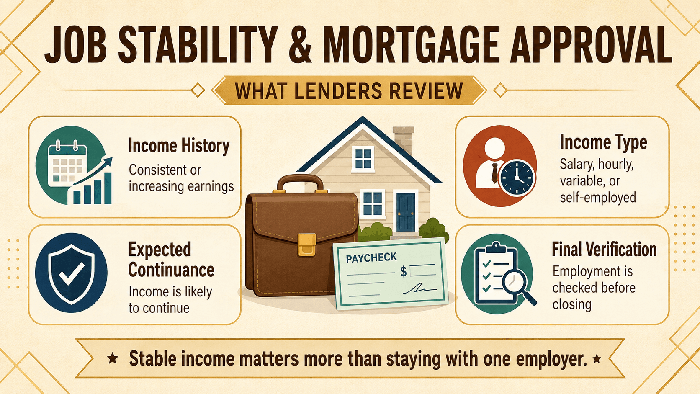
Variable income can include overtime, bonuses, commissions, tips, piece-rate pay, and hourly earnings when the number of hours changes. This income may be used for mortgage qualification, but the underwriter must determine that it is stable, properly documented, and likely to continue. The importance of job stability becomes especially clear when a borrower’s pay changes from one month to the next. The underwriter will not simply use the borrower’s highest paycheck or most recent bonus. Instead, the lender reviews the history and overall trend of the income. The evaluation may include:
- How long the borrower has received the income
- Year-to-date earnings
- Earnings from prior years
- Whether the income is stable, increasing, or decreasing
- Whether the employer expects the income to continue
- Whether the borrower recently changed positions or pay structures
- The frequency of bonuses, commissions, or overtime payments
If the income is stable or increasing, the lender may calculate a monthly average using the required earnings history. When income is declining, the underwriter may use a lower amount, require proof that earnings have stabilized, or exclude the income if the decline is continuing. For example, a borrower who earned $18,000 in overtime last year may not qualify with $1,500 per month in overtime income if current earnings show a significant reduction. The underwriter must compare the current year-to-date amount with the previous earnings and determine which figure is reasonably expected to continue. For Fannie Mae conventional loans, a two-year history of bonus, commission, overtime, or tip income is recommended. Income received for at least 12 months may still qualify if positive factors support a shorter history. Documentation may include recent pay stubs, W-2 forms, tax returns when required, and verification of employment. Requirements vary by loan program, income type, and lender. Variable income does not have to be identical every month. It must have enough history and consistency for the lender to calculate a reasonable monthly amount without depending on temporary or unusually high earnings.
Overtime, Bonus, Commission, and Tip Income
Overtime, bonuses, commissions, and tips can help a borrower qualify for a larger mortgage when the earnings are documented and likely to continue. However, the lender evaluates each income source separately. Base pay may qualify even when some variable earnings cannot be used. The importance of job stability is not limited to keeping the same employer. Underwriters also examine whether each source of additional income has been received consistently and remains available under the borrower’s current pay structure.
Overtime Income
Overtime may qualify when the borrower has an established history of receiving it. The underwriter will compare the current year-to-date overtime with prior earnings. It may confirm that the employer still offers overtime. Occasional overtime caused by a temporary staffing shortage, holiday rush, or one-time project may not be considered dependable.
Bonus Income
Bonuses may be paid monthly, quarterly, or annually. The underwriter must account for the payment schedule when calculating a monthly average. A recurring performance or production bonus may be easier to use than a one-time signing, retention, or relocation bonus. Even when bonuses are not guaranteed, the borrower may still qualify if they have sufficient history and earnings are expected to continue.
Commission Income
Commission income often changes with sales volume, market conditions, and individual performance. The lender will review whether commissions are stable, increasing, or declining. A borrower who recently changed from a salary to commission-based pay may need additional time to establish a usable income history. W-2 commission income is evaluated as employment income. A borrower paid through Form 1099 may be treated as self-employed and may need to provide tax returns and business-related documentation.
Tip Income
Tip income may qualify when it is reported and can be verified through pay stubs, W-2 forms, tax returns, or other acceptable records. Cash tips that are not reported generally cannot be used for mortgage qualification. A lender may review whether the amount of tip income is reasonable for the borrower’s occupation and whether current earnings support the historical average. For Fannie Mae conventional loans, a two-year history of overtime, bonus, commission, or tip income is recommended. A history of at least 12 months may sometimes be acceptable when positive factors support the use of the income. The exact amount used for qualification may be lower than the borrower’s current earnings. Underwriters must rely on a reasonable and supportable monthly figure rather than assuming the borrower will continue earning at a temporary peak.
Part-Time and Secondary Employment Income
Part-time and secondary employment income may be used for mortgage qualification when the lender can document a dependable history and determine that the earnings are likely to continue. Working fewer than 40 hours per week does not automatically make income unacceptable. The importance of job stability is especially relevant when a borrower depends on two or more jobs to qualify. The underwriter must evaluate each job and income source separately rather than combining all earnings without reviewing their histories.
Part-Time Income
Part-time income may come from a borrower’s primary job or an additional job. If the hourly rate and scheduled hours are fixed, the lender may calculate the monthly income using the documented rate and average hours. When the hours change, the lender may treat the earnings as variable income. The underwriter will then review pay stubs, W-2 forms, year-to-date income, and previous earnings to establish a reasonable monthly average. A temporary increase in hours should not be assumed to continue. For example, a borrower who usually works 20 hours per week may not qualify due to a recent 35-hour schedule resulting from seasonal demand or short-term staff shortages.
Secondary Employment Income
Income from a second job may qualify when the borrower has shown the ability to maintain both jobs. The lender may consider:
- How long the borrower has held the second job
- Whether there have been recent gaps
- The number and consistency of hours worked
- Whether earnings are stable, increasing, or declining
- Whether the job is seasonal or temporary
- Whether the income is likely to continue
For Fannie Mae conventional loans, a two-year history for each income source is recommended when a borrower qualifies with multiple jobs. A history of at least 12 months may be considered when positive factors support the shorter period. Fannie Mae also limits recent employment gaps when income from multiple jobs is used, except in qualifying seasonal employment situations. A newly started second job may not immediately increase the borrower’s qualifying income. However, the borrower may still qualify using income from the primary job alone. Requirements differ among conventional, FHA, VA, USDA, and Non-QM loans. A lender should review each income source before the borrower relies on part-time or secondary employment earnings to meet the required debt-to-income ratio.
Self-Employed and 1099 Income Stability
Self-employed and 1099 income can qualify for a mortgage, but it is evaluated differently from W-2 wages. The lender must determine how much income is available to the borrower after ordinary business expenses and whether the business is likely to keep producing that income. The importance of job stability for a self-employed borrower is measured by the strength and consistency of the business, rather than by a guaranteed salary or set work schedule. Underwriters may review:
- Personal and business tax returns
- IRS tax transcripts
- Year-to-date profit-and-loss statements
- Business balance sheets
- Business and personal bank statements
- Business licenses or registration records
- The borrower’s percentage of ownership
- The history and nature of the business
- Current income compared with prior years
Gross business revenue is not the same as qualifying income. The lender must account for business expenses, losses, and other adjustments shown on the tax returns. Some noncash expenses may be added back when the loan program permits, while recurring obligations can reduce the income available for qualification. Income trends are also important. Stable or increasing earnings can support the likelihood that income will continue. Declining revenue, falling profits, shrinking distributions, or growing business debt may require further explanation. A serious downward trend could reduce the income available for use or prevent the lender from using it. For Fannie Mae conventional loans, borrowers with 25% or more ownership in a business are considered self-employed. A two-year earnings history is generally required. A borrower with less than two years of self-employment may sometimes qualify after completing at least 12 months in the current business if prior income and experience in the same or a similar field support the application. Borrowers paid through Form 1099 are commonly evaluated as independent contractors or self-employed workers. The underwriter may use the net income reported on the borrower’s tax returns rather than the total amount shown on the 1099 forms. Traditional mortgage guidelines may not work well for borrowers who report substantial business deductions. Depending on the circumstances, bank statements or other Non-QM loan programs may offer an alternative method of documenting income.
How Declining Income Can Affect Approval
Declining income can make mortgage approval more difficult because lenders must use earnings that are reasonably expected to continue. An underwriter generally cannot rely on an older, higher income average when recent documents show that the borrower now earns less. The importance of job stability includes the direction of the borrower’s income. Holding the same job or operating the same business does not automatically establish stability when hours, commissions, profits, or other earnings are falling. Signs of declining income may include:
- Fewer scheduled work hours
- Reduced overtime or bonus earnings
- Lower commissions or tips
- A pay cut or a move to a lower-paying position
- Falling business revenue or net profit
- Loss of a major customer or contract
- Year-to-date earnings below the previous year’s level
- A change from fixed pay to a variable pay structure
When the decline appears temporary, and the income has returned to a consistent level, the lender may use the lower stabilized amount. The borrower may need to provide an employer letter, updated pay stubs, a year-to-date profit-and-loss statement, or other documents explaining the change. If income continues to decline, the lender may exclude it from the application. This can increase the borrower’s debt-to-income ratio, reduce the available loan amount, or prevent approval. For example, suppose a borrower averaged $7,000 per month over the previous two years but is currently earning $5,000 per month because work hours were permanently reduced. The lender is unlikely to use the old $7,000 average when current earnings show that the higher income is no longer available. Fannie Mae requires lenders to confirm that declining variable base income has stabilized before it can be used. If the income has not stabilized, it is not eligible for qualification under those guidelines. A decline does not always result in a denial. The borrower may still qualify with a lower income amount, another eligible income source, a smaller loan amount, fewer monthly debts, or a different mortgage program. The key is to identify the decline before preapproval, so the application is based on income the underwriter can support.
How Lenders Verify Employment Before Closing
Mortgage approval is based on the borrower’s financial position through the closing date. For this reason, lenders usually verify employment again near the end of the mortgage process. This final check confirms that the borrower remains employed and that no major change has occurred. The importance of job stability does not end when the borrower receives a preapproval or conditional approval. A job loss, resignation, reduction in hours, unpaid leave, or change to a lower pay structure could affect the borrower’s ability to qualify. A lender may complete the final verification by:
- Calling the employer
- Requesting written confirmation
- Contacting the employer through a verified work email
- Using an approved third-party employment database
- Reviewing a recent pay stub or payroll deposit when permitted
- Verifying that a self-employed borrower’s business remains active
The lender should obtain the employer’s contact information directly rather than relying solely on a phone number provided by the borrower. The person completing the verification may document the employer’s name, the borrower’s employment status, the date of contact, and the name and title of the person providing the information. For Fannie Mae conventional loans, employment income generally must be reverified within 10 business days before the note date. The existence of a self-employed borrower’s business generally must be verified within 120 calendar days before the note date. Fannie Mae also permits certain written, electronic, payroll, and third-party alternatives when their requirements are met. If the lender becomes aware of an employment change, the loan must be reevaluated. A new job does not always cause a denial, but the borrower may need to provide a new offer letter, employment contract, pay stub, or verification of the updated pay structure. Borrowers should tell their loan officer about any planned or unexpected changes in employment before closing. They should not assume that an approved loan will remain eligible if the income used for qualification is no longer available.
Denied Because of Job Stability? Get a Second Opinion
Some lenders apply overlays or misunderstand employment history. We’ll review your income, job timeline, credit, DTI, and loan program options to see what may still work.
What Happens if Your Employment Changes During Underwriting?
An employment change during underwriting does not automatically cause a mortgage denial. However, the lender must review the new situation and confirm that the income used to approve the loan remains stable, predictable, and properly documented. The importance of job stability continues through closing. Borrowers should tell their loan officer immediately about any job change, even when the new position pays more. Changes that may require the loan to be reevaluated include:
- Starting with a new employer
- Receiving a promotion or pay increase
- Moving from salary to hourly or commission pay
- Becoming self-employed or an independent contractor
- Reducing scheduled work hours
- Taking unpaid or temporary leave
- Losing a job or resigning
- Accepting seasonal or temporary employment
- Ending a second job used for qualification
Moving to Another W-2 Job
A move to another W-2 employer may be acceptable when the new income can be documented and is expected to continue. The lender may request an employment offer, a contract, a verification of employment, or a pay stub. A lateral move or promotion with fixed salary or hourly income is generally easier to evaluate than a change to commission-based or variable pay. The loan may be delayed until the lender receives the required documents.
Changing to Variable or Self-Employed Income
Switching from fixed W-2 pay to commissions, 1099 income, or self-employment can create a larger problem. These income types often require an established history before they can be used. Even if the borrower expects to earn more, the new income may not immediately qualify. The lender may need to approve the loan using another eligible income source or a lower loan amount.
Losing or Leaving a Job
If the borrower loses or leaves the job providing the qualifying income, the lender must remove that income unless an acceptable new source can be documented. This may increase the debt-to-income ratio, reduce purchasing power, delay closing, or result in a denial. Certain loans may allow qualification upon presentation of a fully executed employment offer or contract when program requirements are met. For example, Fannie Mae provides options for qualifying eligible borrowers with future fixed-base employment income, subject to documentation, transaction, start-date, and reserve requirements. Borrowers should speak with their loan officer before changing employers, pay structures, or work hours. Early notice gives the lender time to review the change and determine whether the existing approval can remain in place.
Job Stability Versus Your Personal Homebuying Budget
Stable employment can help you qualify for a mortgage, but loan approval does not prove that the payment will fit comfortably within your household budget. A lender determines how much you may be eligible to borrow. You must decide how much you can safely afford. The importance of job stability extends beyond underwriting. Consider whether your income could support the mortgage if your hours were reduced, commissions slowed, bonuses stopped, or your employer experienced financial problems. Your personal housing budget should account for:
- Monthly take-home pay
- Mortgage principal and interest
- Property taxes
- Homeowners and flood insurance
- Mortgage insurance when required
- Homeowners association dues
- Utilities and routine maintenance
- Major repairs and replacements
- Credit cards, auto loans, and other debts
- Childcare, medical, and transportation expenses
- Emergency savings and retirement contributions
Lenders generally calculate the debt-to-income ratio using qualifying gross monthly income. Your actual budget depends on net income after taxes, insurance, retirement deductions, and other payroll expenses. This difference can make a lender-approved payment feel less affordable in daily life. Variable-income borrowers should be especially cautious. An underwriter may approve the loan based on an average of overtime, bonuses, commissions, tips, or business income. However, the borrower still needs a plan for months when earnings fall below that average. A financial reserve can provide protection against temporary income loss, unexpected repairs, or higher ownership costs. Borrowers with less predictable employment may feel more comfortable choosing a lower payment and keeping additional savings after closing. The Consumer Financial Protection Bureau explains that the amount a lender is willing to lend may differ from the amount that fits comfortably within the borrower’s complete household budget. A strong mortgage decision balances approval with long-term affordability. Buying below the maximum qualification amount may provide valuable flexibility if employment or income changes after closing.
Building Emergency Reserves Before Buying
An emergency fund can help homeowners continue making mortgage payments when income falls or an unexpected expense occurs. This protection becomes especially valuable for borrowers with variable hours, commissions, seasonal work, self-employment income, or employment in an unpredictable industry. The importance of job stability should be considered together with the amount of savings remaining after closing. A borrower with dependable income may need a smaller financial cushion than someone whose earnings change significantly from month to month, but every homeowner can benefit from accessible emergency savings.
Mortgage Reserves and Emergency Savings Are Not the Same
Mortgage reserves are assets that the lender counts after the down payment, closing costs, and other required expenses have been paid. Certain loan programs or property types may require a specific number of months of housing payments to be kept in reserve. A personal emergency fund is money the homeowner chooses to keep available for real-life financial problems. It may be needed for:
- Temporary unemployment
- Reduced work hours
- Medical expenses
- Vehicle repairs
- Insurance deductibles
- Heating or air-conditioning repairs
- Plumbing or electrical problems
- Major appliance replacement
- Higher property taxes or insurance premiums
Borrowers should avoid using every available dollar for the down payment when doing so would leave no money for emergencies. A larger down payment may reduce the loan balance, but keeping part of the savings after closing can provide greater financial security. The Consumer Financial Protection Bureau suggests maintaining an emergency cushion of approximately 3 to 6 months of expenses when deciding how much cash is available for closing. The right amount depends on household expenses, income reliability, insurance coverage, and other financial obligations. Buyers can start by setting a realistic savings goal, opening a separate account, and making automatic deposits each payday. Tax refunds, bonuses, commissions, and other occasional income may also help build the fund. Emergency reserves do not replace stable qualifying income, but they can strengthen the overall mortgage profile and help the borrower handle income changes without immediately falling behind on the new home payment.
Mortgage Examples Involving Different Income Patterns
The following hypothetical examples illustrate why job stability is important: it depends on the pattern and expected continuation of income, not simply on the number of years spent with one employer.
Example 1: Recent Job Change With Stable Salary
A borrower worked as an accountant for one company for three years and recently accepted an accounting position with another employer. The annual salary increased from $72,000 to $78,000, and the new job provides fixed full-time income. The employer change may not pose a problem because the borrower has continued to earn a predictable income. The lender may use the new salary after verifying the position, pay rate, and employment status.
Example 2: Long-Term Job With Declining Overtime
A borrower has worked for the same manufacturer for six years. Base pay is $4,800 per month, but overtime has dropped from an average of $1,200 per month to approximately $400 per month. The long employment history supports the base income, but it does not guarantee that the previous overtime average can be used. The lender may use a lower overtime amount or exclude it if the earnings have not stabilized.
Example 3: Increasing Commission Income
A sales employee earned $60,000 in commissions two years ago and $72,000 last year. Current year-to-date earnings support another increase. The lender may average the documented commission income when the history, current earnings, and expected continuation meet the loan program’s requirements. The underwriter will not automatically use the borrower’s best month as the qualifying amount.
Example 4: New Secondary Job
A borrower earns a stable salary income from a primary job and recently started working weekends for a second employer. The borrower needs both sources of income to qualify for the desired loan amount. The primary salary may qualify, but the new second-job income may not have enough history to be used. The borrower might need a smaller loan, lower monthly debt, or more time to establish additional income.
Example 5: Self-Employed Revenue Is Up, but Profit Is Down
A business owner reports higher gross revenue than the previous year, but rising payroll, inventory, and operating expenses caused net income to decline. The lender focuses on income available to the borrower after business expenses. Higher sales alone do not establish a stable qualifying income. The underwriter may use a lower amount or request updated financial documents to determine whether the business has stabilized. These examples show why two borrowers with similar gross earnings can receive different underwriting decisions. Lenders must document that the income used for qualification is stable, predictable, and reasonably expected to continue. Actual results depend on the loan program, lender requirements, documentation, debt-to-income ratio, and complete borrower profile.
Steps to Prepare for an Income Review
Preparing income documents before applying can help the lender identify problems early and calculate a more accurate mortgage qualification. The importance of job stability is easier to demonstrate when your records show a clear and consistent earnings pattern.
Gather Documents for Every Income Source
Start by collecting documents for each income source you want the lender to consider. Depending on how you are paid, these may include:
- Recent pay stubs showing year-to-date earnings
- W-2 forms from the most recent one or two years
- Federal personal and business tax returns
- 1099 forms
- Employment contracts or offer letters
- Year-to-date profit-and-loss statements
- Business balance sheets
- Documentation of bonuses, commissions, overtime, or tips
- Records for part-time or secondary employment
The exact requirements depend on the loan program, income type, automated underwriting findings, and lender.
Compare Current Income With Prior Years
Review your year-to-date earnings and compare them with previous W-2 forms or tax returns. If income has declined, determine why before the lender asks. A temporary reduction caused by illness, unpaid leave, seasonal work, or another documented event may be treated differently from a continuing decline. The explanation should match the dates and amounts shown on your income records.
Identify Changes in Your Pay Structure
Tell your loan officer if you recently moved from salary to commission, became self-employed, started a second job, received a promotion, or experienced reduced hours. These changes may affect which income can be used. Do not assume that higher current earnings will automatically increase your qualifying income. Variable or newly established income may require additional history.
Confirm That Employment Can Be Verified
Make sure your employer’s human resources or payroll department knows how to respond to an employment-verification request. If the company uses a third-party verification service, provide the lender with accurate instructions or access information.
Keep the Lender Updated
Continue sending current pay stubs and other requested documents during underwriting. Notify your loan officer before changing employers, reducing hours, taking leave, or changing how you are paid. Fannie Mae permits employment and income verification through borrower documents, the employer, or an eligible third-party verification provider. Documents must be complete, legible, and sufficient to calculate the qualifying income. A complete income review before house hunting can prevent the borrower from relying on earnings that the underwriter may later reduce or exclude.
Final Thoughts on the Importance of Job Stability in Mortgage Underwriting
The importance of job stability in mortgage underwriting is not measured by how long you have stayed with one employer. Lenders focus on whether your income is documented, dependable, and reasonably expected to continue. Changing jobs may be acceptable when you continue to earn a stable salary or hourly income. A long-term job may still require additional review when hours, commissions, bonuses, business profits, or other earnings are declining. Every income source must meet the requirements of the selected mortgage program before it can be included in the debt-to-income ratio.
Borrowers can prepare by gathering complete income documents, reviewing recent earnings for changes, maintaining emergency savings, and notifying their loan officer of any employment changes before closing. Early review is especially important for borrowers with variable pay, multiple jobs, 1099 income, or self-employment.
Mortgage guidelines can differ by loan program and lender. If one lender cannot use part of your income, that does not always mean every mortgage option is unavailable. Contact us at Gustan Cho Associates to discuss your employment and income profile. A loan officer can review your documents, identify which earnings may qualify, and help you compare available mortgage programs before you begin shopping for a home.
Frequently Asked Questions About the Importance of Job Stability
Can You Get a Mortgage While in a Probationary Period at Work?
Yes, you may qualify while completing a probationary period. The importance of job stability is based on whether your income is verifiable and reasonably expected to continue. A lender may review your employment offer, pay rate, work history, and current pay stubs. Some lenders may require you to complete the probationary period as an additional underwriting condition.
Does Working Remotely Affect Mortgage Approval?
Remote employment does not usually prevent mortgage approval. If you are buying a home far from your employer’s physical office, the underwriter may request confirmation that your remote arrangement is permanent or expected to continue. The lender must also verify your income and current employment under the selected loan program’s requirements.
Can Union Workers Qualify When They Move Between Assignments?
Yes. Union workers may qualify even when their occupation involves a series of short-term assignments. The lender may review the borrower’s earnings history, union membership, placement pattern, and likelihood of continued work. Under certain Fannie Mae employment-offer rules, the union may provide documentation for future assignments.
Can Income From a Family-Owned Business Be Used for a Mortgage?
Yes, but additional documentation may be required due to the relationship between the borrower and the employer. For Fannie Mae conventional loans, a borrower employed by a family member generally must document at least 12 months of employment and provide the most recent signed federal tax return. A borrower with 25% or more ownership is treated as self-employed.
Can Restricted Stock Units Be Used as Mortgage Income?
Restricted stock units may qualify when they have vested, been distributed without restrictions, and meet the applicable history and continuance requirements. The lender may review vesting statements, brokerage records, pay stubs, W-2 forms, and the employer’s award agreement. Unvested sign-on awards generally cannot be used under Fannie Mae guidelines.
How Do Lenders Calculate Income for Teachers Paid During the School Year?
The lender reviews the employment contract and pay schedule. When the teacher receives a fixed annual salary, the lender may divide the annual gross salary by 12 to calculate the monthly qualifying income. If the amount changes or the employment is seasonal, the lender may need to review and average prior earnings.
Can Foreign Employment Income Be Used for a U.S. Mortgage?
Foreign employment income may qualify when it is documented, reported as required, and expected to continue. For Fannie Mae conventional loans, the lender generally reviews two years of federal tax returns containing the foreign income. Foreign documents must be translated into English, and the income must be converted to U.S. dollars. Requirements may differ for other mortgage programs.
This article about “Job Stability for Mortgage Approval: What Lenders Actually Review” was updated on September 1st, 2026.
Changed Jobs Recently? You May Still Qualify
A recent job change does not always stop mortgage approval. We’ll review your work history, new position, income type, offer letter, and pay structure.