How to Improve Credit to Qualify for VA Loans in 2026
How to increase credit to become eligible for a VA loan in 2026 would help potential borrowers understand how to utilize their options to strengthen their VA loan applications and qualify for lower interest rates. An advantage of VA financing is that the
The Veterans Administration (VA) establishes no VA-wide minimum credit score. However, as mentioned, prospective lenders assess applicants’ credit risk and set their own rules.
Because of this, a lower credit score does not preclude obtaining a VA loan. However, it is generally better to address issues with your credit and score before applying, as this can help you avoid potential increases in costs associated with securing a loan. This article explains what lenders evaluate, what options borrowers have to strengthen their credit reports, how collections and other adverse credit history are addressed, and why borrowers may wish to consider applying now.
How to Improve Credit to Qualify for VA Loans
To improve credit and qualify for a VA loan, make all payments on time, bring all accounts current, pay down credit card balances, correct errors on credit reports, avoid unnecessarily taking on new debt, and create new positive payment history. VA does not have a minimum credit score, but individual lenders may. A stronger credit report can offer more approval options and can help you qualify for more favorable mortgage rates.
What Credit Score Do You Need for a VA Loan?
The Department of Veterans Affairs does not have a minimum credit score to qualify for a VA loan. This is one of the most misunderstood VA loan guidelines. When making a mortgage loan, the credit standards and minimum credit scores lack a VA guarantee for the lender.
Why Do Some VA Lenders Require a Minimum Credit Score?
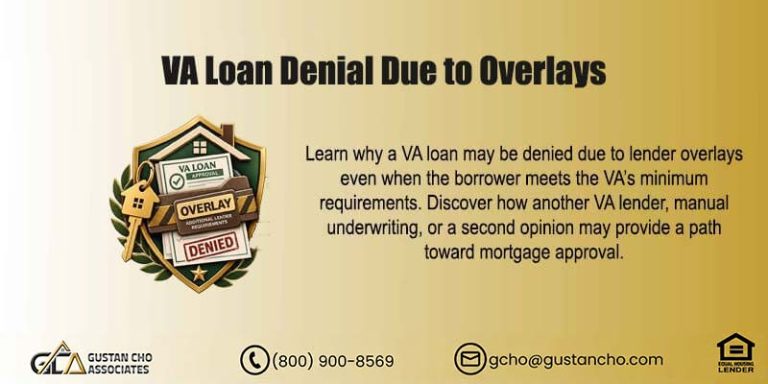
The Department of Veterans Affairs does not originate direct loans. The VA guarantee reduces lender risk, but the lender still has to evaluate whether the borrower can and will repay the mortgage. A lender may thus have additional, stricter standards for borrower review beyond VA’s basic requirements. These additional requirements are known as lender overlays. A borrower might not meet specific credit-score criteria at one lender but might at another. Because of this, getting denied by one VA lender does not mean you are ineligible for a VA loan. Does Your Credit Score Affect Your VA Mortgage Rate? Your credit score is one factor lenders consider when determining your rate, but VA mortgage rates do not have a minimum credit score. The Consumer Financial Protection Bureau reports that credit scores can affect a borrower’s mortgage approval and the rate offered. Stronger credit histories will often be offered lower rates. While there is no “best” VA credit score, the other factors mentioned below will also affect your rate.
Your Rate Will Also Be Impacted By:
- Current mortgage-market conditions
- Loan amount
- Loan purpose
- Property type
- Loan term
- Discount points
- Overall credit and financial profile
The Veterans Affairs department also states that VA does not set the mortgage rates; it’s the responsibility of the lender. Because of this, increasing your credit is worthwhile, but borrowers should shop around at multiple VA lenders.
How VA Lenders Evaluate Your Credit History
VA underwriting considers a credit score, but other factors will also be considered. According to the VA Lender’s Handbook, past repayment behavior indicates a borrower’s willingness to repay future financial obligations. VA instructs lenders to evaluate a borrower’s overall payment pattern rather than individual payments. This may be particularly relevant to borrowers who have experienced credit issues on a case-by-case basis.
An isolated previous late payment is not as significant as regular late payments, newly delinquent accounts, unresolved financial problems, etc. VA underwriting is particularly involved with an applicant’s housing history.
According to the VA Lender’s Handbook, the borrower’s recent rental history and currently unpaid, assumed, or recently satisfied mortgages are to be assessed. Housing payment history can be a clear reference point for how a borrower is likely to handle the proposed mortgage payment. A borrower’s rent or mortgage history should be one of your top priorities if you intend on applying for a VA loan. Avoid creating a new late payment on your housing account while trying to improve your credit.
Low Credit Score? VA Financing May Still Be Possible
Eligible veterans and service members may still have VA loan options with lower scores, especially with stable income, acceptable DTI, and strong recent payment history.How to Improve Credit to Qualify for VA Loans Step by Step
Increasing credit is a straightforward process. There is no one secret that can increase your credit. The most effective method is behavior associated with good financial practices.
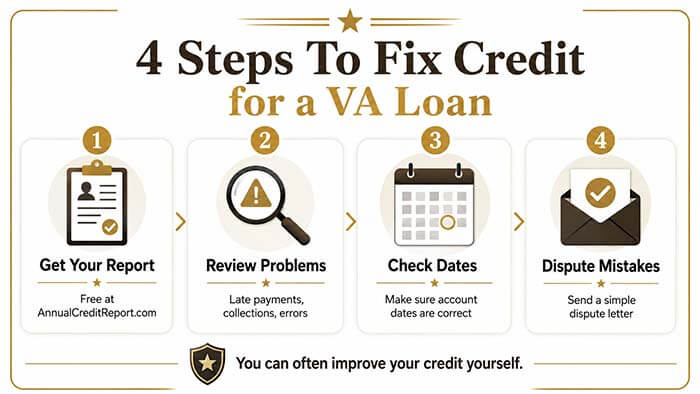
Review All Three Credit Reports
Begin by reviewing your credit reports from Equifax, Experian, and TransUnion.
Look For:
- Accounts that are not yours
- Incorrectly reported late payments
- Collections that have been reported multiple times
- Incorrect balances
- Incorrectly reported accounts that are open
- Incorrect personal information
- Fraudulent accounts
- Accounts that should have been updated
- A credit report and a credit score are not the same thing. Incorrect information in your credit report can adversely affect your mortgage score.
Dispute Legitimate Credit-Report Errors
- You have the right to dispute incorrect information.
- The CFPB advises that you contact both the credit reporting company and the company that submitted the information.
- If possible, you should include supporting documentation.
- Do not dispute negative information, as it is accurate.
- If you are already in the process of applying for a mortgage, let your loan officer know about any planned disputes.
- VA underwriters take into consideration unpaid debts that are being disputed in good faith.
- However, disputed accounts may require further documentation.
Pay Every Account on Time
- Your credit profile is heavily reliant on your payment history.
- Concentrate on getting current on any missed payments.
- Payments set to occur automatically, or payment reminders, are good ideas.
- Even if you are unable to pay your credit card in full, paying it before the due date will help prevent a second delinquency.
- According to the CFPB, making on-time payments is crucial for credit rebuilding, but paying down credit card balances can improve scores even if the payments were on time.
Pay Down Credit Card Balances
Credit scores can be negatively affected by balances on credit cards that are paid on time. When scoring systems are calculating revolving scores, they are considering the amount of credit that has been extended to you versus the amount that you are using. This is called credit utilization.
The CFPB recommends staying below the limit, as credit experts recommend avoiding the 30% utilization mark, and some suggest even lower amounts.
Addressing revolving balances is one of the better options to address prior to applying for a mortgage. There is no hard-and-fast rule that says your credit score will increase if your credit utilization falls to 30% or 10%, for that matter, but from a lending perspective, balances closer to zero often carry less risk.
How to Increase Credit to Become VA Loan Eligible in 2026

Do Not Close Credit Cards to Increase Your Score
- If you pay off a revolving account, you decrease the amount of credit available to you.
- This increase in overall credit utilization can negatively affect your score.
- Additionally, closing a revolving credit account can lower the average age of your accounts.
- If you pay off a credit card with no annual fee, there is no reason to close the account.
- Closing older accounts will not automatically improve your mortgage credit score.
Don’t Create New Accounts Unnecessarily When Applying for a Mortgage
Applying for multiple credit accounts, purchasing a new car, financing new furniture, or opening store credit accounts can create a number of issues when you apply for your mortgage.
New Debts Will:
- Increase your monthly obligations
- Increase your debt-to-income ratio
- Lower the amount you are eligible to borrow
- Increase the number of credit inquiries
- Adversely impact your credit score
- Change the outcome of your mortgage approval
- The CFPB (Consumer Financial Protection Bureau) suggests applying for credit only when it is absolutely necessary, such as when applying for a mortgage.
- You should check with your mortgage professional to see if you are already pre-approved, if you are financing anything new.
Can Building Credit With a Secured Credit Card Help Me Qualify for a VA Loan?
A secured credit card can help someone with little or no credit, or with poor credit, rebuild their credit. A secured credit card is funded by a deposit that is secured against the account.
Secured credit cards are specifically mentioned by the CFPB as one option for a consumer to rebuild or establish their credit. You can build good credit by not carrying a credit card balance and paying the account in full each month.
The deposit is used by the cardholder like a normal revolving credit account. This card can build credit as long as the creditor reports the account to the credit bureaus. Keep your account deposit secured by limiting credit card use and making payments on time.
Do You Have To Pay Off Collections in Order to Qualify for a VA Loan?
No, you don’t have to do that. This is another area of contention for borrowers due to the incorrect advice they receive. Per VA guidelines, not all collection accounts must be paid to successfully close a loan.
Medical Collections and VA Loans
For the purposes of VA credit guidelines, the VA is generally able to disregard medical collections and medical charge-offs that have not resulted in judgments or liens, and does not require VA loan approval to be made subject to the payment of those debts. This is the result of VA underwriting guidelines and is not the same as the credit bureaus’ policies regarding whether medical debts appear on a borrower’s credit report.
Non-Medical Collections and VA Loans
An unpaid non-medical collection would not need to be paid. However, those collections would need to be evaluated along with the other collections as part of the individual borrower’s credit history when determining the debt-to-income ratio and residual income.
Regarding VA loan guidelines, payments are to be included in a borrower’s credit profile where applicable and generally include non-medical collections that do not have a formal payment arrangement.
For that reason, it is not necessary to pay off every collection account before applying for a VA loan. However, it is prudent to let your loan officer review the credit report first. Paying a collection is warranted in some situations, although the overall loan file, including credit scores, cash resources, the required payment, and the collection account, plays a role in whether the collection account will improve the mortgage application.
Do Charge-Offs Have to Be Paid for a VA Loan?
A charge-off does not necessarily warrant the rejection of a VA loan application. VA mandates that underwriters consider entire credit histories, including the circumstances surrounding non-medical charge-offs. Medical charge-offs are addressed separately in VA guidelines.
Not all lenders or underwriters will expect payment of an old charge-off. Before paying to improve a mortgage application, confirm that the charge-off is expected.
This article should not state that collections or charge-offs over a month old will always impact the credit score. Different scoring models and credit files react differently to old debts.
How Recent Charge-Offs Impact Your Ability to Get a VA Loan
VA underwriting will consider recent charge-offs. Recent collection accounts and charge-offs may demonstrate you have trouble meeting your financial obligations and may hurt your VA loan application. VA underwriting is generally not concerned with one collection account. The underwriter is concerned with the big picture. If your credit situation has improved and you have resolved previous financial problems, then VA guidelines state that satisfactory credit has been re-established following a period of satisfactory payments following certain adverse credit situations. A good credit history will help an underwriter determine that a past event no longer is a true reflection of your finances.
VA Loans After Chapter 7 or Chapter 13 Bankruptcy
Bankruptcy does not permanently prevent someone from qualifying for a VA mortgage. VA specifically states that the existence of a bankruptcy does not, by itself, disqualify the loan. The lender must review the circumstances and determine whether satisfactory credit has been re-established.
VA Loans After Chapter 7 Bankruptcy
A Chapter 7 bankruptcy discharged more than two years before the VA loan closing may generally be disregarded under VA credit guidance. When the discharge occurred between one and two years earlier, favorable consideration may be possible when the borrower has re-established credit, and the bankruptcy resulted from documented circumstances beyond the borrower’s control. A discharge within the preceding 12 months will generally make it difficult to establish satisfactory credit risk under standard VA guidance.
VA Loans During Chapter 13 Bankruptcy
VA financing may also be possible during an active Chapter 13 repayment plan. When the borrower has made at least 12 months of satisfactory Chapter 13 payments and the trustee or bankruptcy judge approves the new credit, VA guidance permits the lender to give the application favorable consideration. Individual lender requirements and manual-underwriting standards still apply.
VA Loans After Foreclosure or Short Sale
A prior foreclosure does not automatically disqualify someone from obtaining another VA loan. VA guidance generally allows a foreclosure completed more than two years before closing to be disregarded for credit purposes.
A foreclosure within one to two years can require re-established credit and documentation showing that the event resulted from circumstances outside the borrower’s control.
Short sales and deeds-in-lieu are also evaluated according to the circumstances surrounding the event. When the prior foreclosure involved a VA-guaranteed mortgage, available VA entitlement must also be reviewed before determining how the new loan can be structured.
Why Residual Income Matters With Lower Credit Scores
Credit score is only one part of VA underwriting. VA places significant emphasis on residual income, which is the income remaining after qualifying debts, housing expenses, taxes, and certain other obligations are considered.
VA describes its debt-to-income ratio as a guide that is secondary to residual income and says it should not automatically determine whether a loan is approved or denied.
Residual-income requirements vary according to factors such as family size, geographic region, and loan amount. This is one reason borrowers should not assume that a higher debt-to-income ratio or lower credit score automatically makes VA financing impossible.
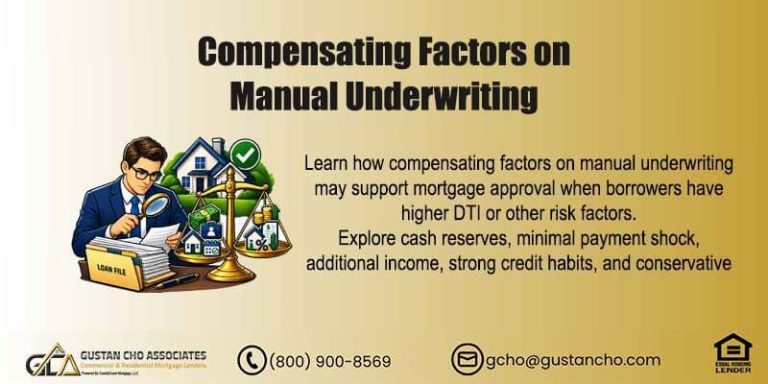
A Strong Overall File May Contain Compensating Factors Such As:
- Strong residual income
- Stable employment
- Established housing payment history
- Cash reserves
- Limited discretionary debt
- Re-established credit
- A documented explanation for a past financial hardship
- The complete file matters.
How Automated Underwriting Affects VA Loan Approval
Most VA mortgage applications are initially evaluated through an automated underwriting system, commonly called an AUS. VA has approved certain automated underwriting systems for use with VA-guaranteed loans. An important point is that the computer system does not actually approve or deny the mortgage. VA explains that the system provides a risk classification, while the lender ultimately decides whether to approve the loan.
What If the AUS Does Not Issue an Approval?
A borrower who does not receive an automated approval may still have options. Depending on the lender, the loan program, the findings, and the borrower’s complete financial profile, the file may be evaluated using manual underwriting.
Manual underwriting allows the underwriter to examine the complete circumstances rather than relying solely on an automated risk classification.
However, manual underwriting is not a waiver of VA guidelines. Income, credit, residual income, debts, housing history, and other underwriting requirements still need to support the loan.
Can You Get a VA Loan With a 500, 580, or 600 Credit Score?
Potentially. VA itself does not prohibit a borrower from obtaining a VA loan simply because the credit score is 500, 580, 600, or another specific number. But that does not mean every lender will approve those scores. Private lenders can establish their own minimum score requirements, underwriting standards, investor requirements, and pricing policies. A borrower with a lower score may need a stronger overall loan file and may have fewer lender choices.
Instead of Asking Only, “What Score Do I Need?” Ask:
- What is preventing my loan from being approved today, and what specific changes would make the biggest difference?
- That question can save months of unnecessary credit repair.
How Long Does It Take to Improve Credit for a VA Loan?
 There is no guaranteed timeframe. Some credit changes may appear after creditors update their reporting. Correcting a legitimate reporting error or reducing revolving balances may affect a score sooner than rebuilding after serious late payments, bankruptcy, or foreclosure.
The CFPB emphasizes that rebuilding credit takes time and that consumers should be skeptical of companies promising instant credit-score improvements.
Do not base a home purchase on promises that a particular action will increase your score by 40, 60, or 100 points. Every credit profile is different.
Should You Improve Your Credit Before Applying for a VA Loan?
Not always. You may already qualify. One of the biggest mistakes borrowers make is spending months trying to reach an arbitrary credit score before allowing an experienced VA loan officer to review the file.
An Initial Review May Determine That:
- Your current score already meets the lender’s requirements
- An AUS approval is available
- Manual underwriting is possible
- One or two revolving balances should be reduced
- A collection should not be paid
- A reporting error needs correction
- Additional positive payment history is needed
- Waiting could improve your interest-rate options
- The goal should not simply be to obtain the highest possible credit score.
- The goal is to create a mortgage-ready credit profile while preserving enough money for the home purchase and maintaining financial stability after closing.
How to Improve Your Chances of Getting a Better VA Mortgage Rate
Once your credit profile is ready, compare VA mortgage offers. The CFPB recommends shopping with multiple lenders because interest rates, points, and fees can vary. It suggests comparing at least three mortgage offers. Mortgage rate shopping also does not necessarily mean taking a separate full credit-score hit every time you speak with another lender. Credit-scoring models generally account for consumers shopping for the same type of loan within a relatively short period.
Compare:
- Interest rate
- Annual percentage rate
- Discount points
- Lender fees
- Total closing costs
- Monthly principal and interest
- Required cash to close
- Rate-lock period
Common Credit Mistakes to Avoid Before a VA Loan
When preparing for a VA mortgage, take steps to prevent new credit issues. Avoid financing a vehicle shortly before closing unless you have consulted your loan officer. Do not open several new credit cards. Do not stop paying an account because you intend to dispute it. Do not close revolving accounts solely to improve your credit profile.
Do not pay collections or charge-offs without first understanding how the payoff will impact underwriting. Do not use funds required for closing in an attempt to achieve a minor increase in your credit score.
Most importantly, avoid making late payments while your mortgage application is being processed. Your financial profile may be reviewed again before closing; therefore, continue to manage your credit responsibly until the mortgage is fully funded.
Getting a VA Loan With Bad Credit
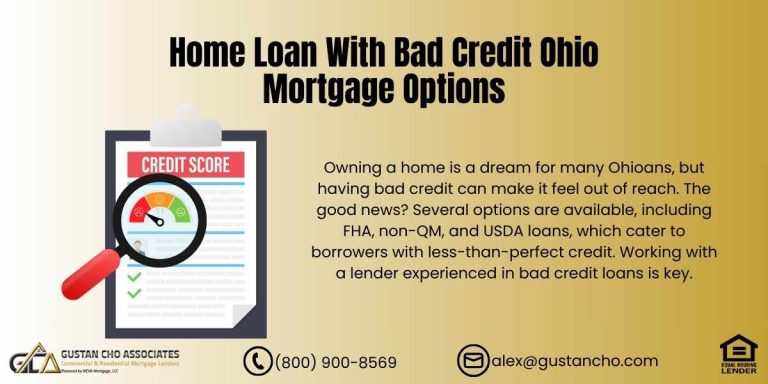
Having poor credit does not automatically disqualify you from utilizing your VA home loan benefit. VA’s underwriting system is designed to evaluate the borrower’s overall willingness and ability to repay rather than rely exclusively on a credit-score cutoff.
A borrower with previous credit issues but a strong recent payment history may present a different risk profile than an individual with a higher score but multiple recent delinquencies.
If another mortgage company has denied your VA loan due to a credit-score overlay, recent bankruptcy, collections, debt-to-income ratio, or an AUS Refer finding, seeking a second review may be beneficial.
Why Work With Gustan Cho Associates on a VA Loan?
Gustan Cho Associates assists borrowers with complex credit histories or those who have encountered challenges meeting additional underwriting requirements from other lenders.
VA Borrowers May Need Help With:
- Lower credit scores
- Manual underwriting
- Chapter 13 bankruptcy
- Prior Chapter 7 bankruptcy
- Foreclosure or short sale
- Collections and charge-offs
- Higher debt-to-income ratios
- AUS Refer findings
- Re-established credit
- Lender overlays
Every mortgage application must satisfy all applicable VA, lender, investor, income, credit, property, and underwriting requirements. Importantly, a denial from one lender does not mean you are ineligible to qualify with another lender. For assistance reviewing your VA loan options, contact Gustan Cho Associates at 800-900-8569 or submit a request through email at gcho@gustancho.com.
Final Thoughts on How to Improve Credit to Qualify
The most effective approach to improving credit for VA loan qualification is typically straightforward: maintain a strong payment history, reduce revolving debt, correct genuine reporting errors, avoid unnecessary new obligations, and allow positive credit history to accumulate over time. Build over time. However, do not assume that perfect credit is required before applying.
VA does not establish a minimum credit score, and the program requires lenders to evaluate the borrower’s complete credit and financial picture.
Before paying collections, closing accounts, opening new credit, or delaying your home purchase, have your mortgage credit profile professionally reviewed. The optimal strategy is not merely to pursue a higher credit score. Instead, identify the factors preventing approval, address the relevant issues, and build the strongest possible VA mortgage application.
Frequently Asked Questions About How to Improve Credit to Qualify for VA Loans:
What Credit Score Do I Need for a VA Loan?
The Department of Veterans Affairs does not establish a minimum credit score for VA-guaranteed mortgages. Individual lenders may impose their own credit-score requirements. Your overall credit history, income, debts, residual income, housing history, and underwriting findings also affect qualification.
Can I Get a VA Loan with a 500 Credit Score?
VA does not prohibit a VA loan solely because the borrower has a 500 credit score. However, many lenders establish their own minimum score requirements, so finding a lender willing to evaluate a lower-score loan can be more difficult. Approval depends on the entire application and is not guaranteed by the score alone.
Can I Get a VA Loan with Bad Credit?
Yes, it may be possible. VA instructs lenders to evaluate overall payment patterns rather than relying entirely on isolated credit problems. Recent payment history, housing history, residual income, debts, and the circumstances surrounding previous derogatory credit can all affect the decision.
How Can I Raise My Credit Score Before Applying for a VA Loan?
Start by paying every account on time, bringing delinquent accounts current, lowering revolving credit card balances, reviewing all three credit reports, correcting genuine errors, and avoiding unnecessary new credit. There is no legitimate method that can guarantee a specific increase in score within a particular number of days.
Do I Have to Pay Collections Before Getting a VA Loan?
Not always. VA does not automatically require all collections to be paid before closing. Medical collections that have not become judgments or liens receive particularly favorable treatment under VA guidance. Non-medical collections must still be evaluated as part of the overall credit profile and may affect debt and residual-income calculations.
Will Paying Off Collections Improve My VA Loan Credit Score?
It depends. Paying a collection does not guarantee that your mortgage credit score will increase, decrease, or remain unchanged. Different scoring models and individual credit profiles can react differently. Before paying an old collection solely to qualify for a mortgage, have your lender determine whether the account actually needs to be paid.
Can I Qualify for a VA Loan After Bankruptcy?
Yes. VA guidelines allow borrowers to qualify after bankruptcy when applicable credit requirements have been satisfied. Chapter 7 bankruptcies discharged more than two years before closing may generally be disregarded. VA may also give favorable consideration to borrowers in an active Chapter 13 case after at least 12 months of satisfactory plan payments, with required trustee or bankruptcy court approval.
Can VA Loans Be Manually Underwritten?
Yes. Some VA loans that do not receive a favorable automated underwriting risk classification may be eligible for manual underwriting, depending on the lender and the complete loan profile. VA notes that automated underwriting systems provide risk classifications; they do not themselves approve or deny the mortgage.