
The Federal Reserve does not set mortgage rates directly, but understanding how the Fed stabilizes the mortgage market can be crucial for borrowers. When the Fed takes actions to promote stability, it creates calm in the markets, allowing lenders to price loans more consistently. This consistency helps borrowers compare their options more effectively, lock in their rates with greater confidence, and avoid any last-minute surprises before closing.
TL;DR
- How the Fed stabilizes the mortgage market: The Fed can help stabilize the mortgage market during uncertain times, making it easier for lenders to keep offering home loans.
- What it means for you: Mortgage pricing may become more consistent, rate locks may feel less volatile, and you may have fewer surprises during the loan process.
- What to do next: Get fully pre-approved, ask about your rate-lock options, and keep a little extra cash available for closing costs.
In This Guide
You’ll see how the Fed can influence mortgage rate stability, why lenders react to market changes, and what practical steps borrowers can take before locking a loan.
Why This Still Matters
Mortgage rates can change quickly when financial markets become uncertain. When that happens, borrowers often see changing rate quotes, tighter loan pricing, and more pressure around timing. Understanding how the Fed stabilizes the mortgage market can give you more context when deciding when to lock, how to budget, and how to prepare for closing.
How the Federal Reserve Stabilizes the Mortgage Market
What Is an MBS?
A mortgage-backed security, or MBS, is a group of home loans bundled together and sold to investors. After a mortgage closes, the lender often sells the loan into this market to free up cash and keep making new loans. When that market is stable, lenders can price mortgages more consistently.
The Main Fed Actions That Matter to Borrowers
Support for mortgage bonds: When the Fed helps support this market, lenders may be able to price loans more consistently.
Interest-rate policy: Fed decisions can influence the broader direction of borrowing costs, even though mortgage rates are not set directly by the Fed.
Market stability: When financial markets become calmer, lenders often face less pricing pressure, and borrowers may see fewer sudden rate swings.
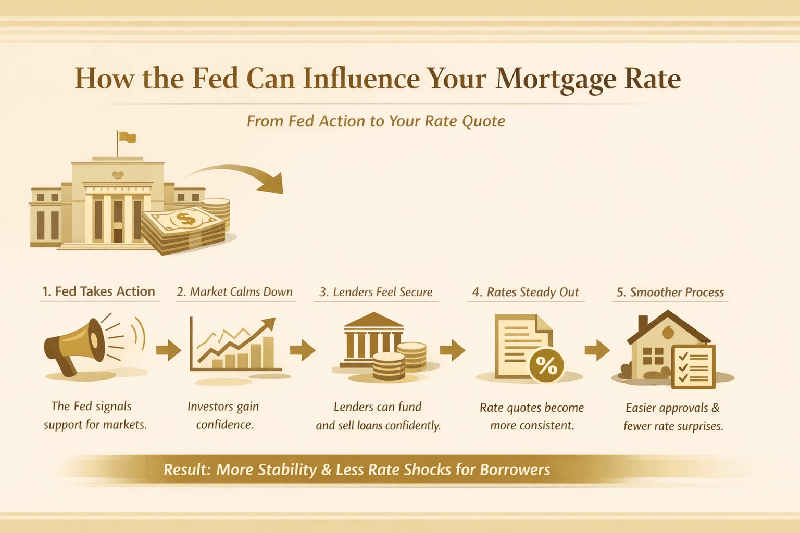
From Fed Action to Your Rate Sheet: The 5-Step Chain
- The Fed takes action or signals support for financial markets.
- Investors feel more confident, and the mortgage market becomes more stable.
- Lenders gain more confidence that they can fund loans and sell them into the market without sudden disruption.
- Mortgage pricing becomes more consistent, so rate quotes are less likely to swing sharply.
- Borrowers may experience steadier approvals, fewer last-minute pricing changes, and a smoother path to closing.
What This Means for You Today
How the Fed stabilizes the mortgage market translates into concrete decisions you can make now.
If You’re Buying a Home
- Get fully pre-approved, not just pre-qualified. A stronger pre-approval means your income, assets, and credit have already been reviewed in more detail, which can help you move faster and with fewer surprises when you find a home.
- Lock strategically. Ask about float-downs or extension costs before you lock so you know your flexibility if markets move.
- Budget for the cash-to-close variance. Title, insurance, or lock changes can shift totals, so keep a 1–2% cushion.
- Compare lender overlays. Agency rules are one thing; overlays can be stricter. A lender with no overlays expands your options.
If You’re Refinancing
- Know your breakeven. Compare monthly savings to total costs to find your breakeven month.
- Mind appraisal dynamics. Discuss PIW/waiver odds or comps early to avoid surprises.
- Check seasoning and payoff rules. Timing matters for FHA/VA/Conventional streamline or cash-out.
If You’re Facing Short-Term Payment Trouble
- Call early. Talk to your servicer before you miss a payment to review options.
- Clarify terms. Forbearance ≠ forgiveness. Understand deferral vs. repayment plan vs. modification.
- Protect your credit. Document agreements and resume on time to preserve future refi/purchase options.
Why Bond Prices and Mortgage Pricing Matter
Mortgage rates are closely tied to the market for mortgage bonds, which raises the question of how the Fed stabilizes the mortgage market. When investors are confident, mortgage pricing tends to be steadier. However, if investors become nervous, that market can weaken, prompting lenders to respond by raising rates or adjusting pricing more frequently. The Fed has an important role in keeping investors confident, which helps keep mortgage rates steady.
Why it Matters (3 Quick Hits):
- Rate volatility can change eligibility. A small rate move can push your DTI over program caps.
- Closing timelines matter. If markets jump, extensions or repricing may be needed.
- Product access widens or tightens. Stable MBS markets keep more loan programs on the shelf.
Borrower Checklist Before You Lock
□ Get fully pre-approved, not just pre-qualified
□ Ask how long your rate lock lasts
□ Review extension costs before you lock
□ Keep extra cash available for possible closing-cost changes
□ Make sure your appraisal, title, and closing timeline fit your lock period
□ Ask your lender how market changes could affect your pricing before closing
Practical Next Steps for Borrowers
If you are planning to buy a home or refinance, focus on the steps you can control. Strengthen your pre-approval, ask your lender how long your rate lock lasts, review extension costs in advance, and keep a small cash cushion for possible changes in closing costs. Even when the market feels uncertain, good preparation can make the mortgage process more manageable.
Final Takeaway
The Federal Reserve does not directly set mortgage rates, but understanding how the Fed stabilizes the mortgage market is essential for borrowers. Its actions play a vital role in fostering calmer market conditions, allowing lenders to price loans more consistently. This stability helps borrowers compare their options more effectively, lock in rates with greater confidence, and avoid unexpected surprises before closing.
For most borrowers, the best next step is straightforward: get fully pre-approved, understand your rate-lock options, and leave room in your budget for possible changes in closing costs. If you want assistance reviewing your mortgage options, Gustan Cho Associates can help you understand your next steps.
Drop PMI sooner with improved valuations and rates
Pair a new appraisal with lower pricing to cut your monthly costs.
Frequently Asked Questions About How the Fed Stabilizes the Mortgage Market:
Does the Federal Reserve Directly Set Mortgage Rates?
- No. The Federal Reserve does not directly set mortgage rates. It sets a short-term benchmark rate, while mortgage rates are influenced more by the bond market, investor expectations, inflation, and the performance of mortgage-backed securities. That is why mortgage rates can move even when the Fed does nothing at a meeting.
Why do Mortgage Rates Change Even When the Fed Keeps Rates the Same?
- Mortgage rates respond to more than just Fed announcements. They can move in response to inflation expectations, Treasury yields, investor demand for mortgage bonds, and general market volatility. So even if the Fed holds its benchmark rate steady, lenders may still raise or lower mortgage pricing.
What Does the 10-year Treasury have to Do with Mortgage Rates?
- Mortgage rates often move in the same general direction as the 10-year Treasury yield because both reflect long-term investor expectations about inflation, economic growth, and risk. They do not match exactly, but the 10-year Treasury is one of the clearest market signals influencing mortgage pricing.
What are Mortgage-Backed Securities, and Why Do They Affect My Rate?
- Mortgage-backed securities are bundles of home loans sold to investors. When investors are willing to buy those securities at favorable prices, lenders can often offer more stable mortgage pricing. When demand weakens, rates may rise or become more volatile. Federal Reserve research has found that Fed purchases of agency MBS helped reduce mortgage rate risk premiums during past periods of stress.
Will Mortgage Rates Automatically Fall if the Fed Cuts Interest Rates?
- Not always. A Fed cut can influence the broader rate environment, but mortgage rates do not automatically drop in lockstep. Markets often price in expected Fed moves in advance, and mortgage rates may remain elevated if inflation, Treasury yields, or mortgage-bond pricing remain unfavorable.
Should I Wait for the Fed to Cut Rates Before Buying a Home?
- Waiting only for a Fed cut is risky because mortgage rates may not fall as much or as quickly as expected. A better approach is to focus on your own readiness: credit profile, down payment, monthly budget, and rate-lock strategy. If the payment works for you now and the home fits your goals, it may be smarter to act based on affordability rather than trying to time the Fed perfectly.
This article about “How the Fed Stabilizes the Mortgage Market: Simple Guide” was updated on March 20th, 2026.
Compare points vs. lender credits in this environment
Find the sweet spot between cash to close and monthly savings.