

Credit scoring plays a major role in the mortgage process by helping lenders assess risk. When you apply for a home loan, lenders review your credit report and credit scores to decide whether you qualify, what loan programs may be available, and what interest rate you may receive. In most cases, a higher credit score gives borrowers more options and better pricing, while a lower score can limit choices or lead to stricter requirements. Understanding how credit scoring works in the mortgage process can help you prepare before applying. Mortgage lenders do not look at your score alone. They also review your payment history, current debt, and the overall pattern of your credit use. Knowing how these factors work together can help you improve your profile and strengthen your mortgage application.
What Is Credit Scoring and Why Should You Care?
Credit scoring tells lenders how reliable you are with borrowed money. It looks at your credit history, which shows:
- How many bills do you pay on time?
- How much debt do you carry?
- How long have you had credit accounts?
- What kinds of accounts do you have?
- How often do you ask for new credit?
When you want a mortgage, lenders check your credit score to determine whether to give you a loan and what interest rate to charge.
What Mortgage Lenders Mean by Credit Scoring

- on-time payments
- credit card balances
- length of credit history
- types of credit used
- recent credit activity
A higher score usually suggests lower risk. A lower score can signal more risk, which may affect approval, interest rate, and loan options.
In the mortgage process, lenders typically do not rely on a single score from a single bureau. They review a tri-merge credit report with scores from Experian, Equifax, and TransUnion. In most cases, they use the middle score. If there are two borrowers, they usually use the lower of the two middle scores. That is the basic idea of how credit scoring works in the mortgage process: lenders use credit scores and credit history together to help decide eligibility and pricing.
How Lenders Use the Tri-Merge Report
When you apply for a mortgage, lenders usually pull a . This report combines credit data from the three major credit bureaus:
- Experian
- Equifax
- TransUnion
The tri-merge report helps lenders see a fuller picture of your credit history. Since each bureau may show slightly different information, lenders review all three instead of relying on just one. To understand how credit scoring works in the mortgage process, it is important to know that lenders usually use the middle credit score from the three bureaus. For example, if your scores are 680, 700, and 720, the typical qualifying score is 700. If there are two borrowers on the loan, lenders typically use the lower of the two applicants’ middle scores. This helps them measure overall risk more consistently. The tri-merge report does more than show scores. It also gives lenders details about:
- payment history
- credit card balances
- loan accounts
- collections or charge-offs
- recent credit inquiries
In short, lenders use the tri-merge report to review both your credit scores and your full credit profile before making a mortgage decision.
Why the Middle Score Matters
Mortgage lenders usually do not use your highest score or your lowest score. Instead, they use the middle score from the three major credit bureaus: Experian, Equifax, and TransUnion. The middle score matters because it gives lenders a more balanced view of your credit profile. One bureau may report slightly different information than another, so using the middle score helps avoid giving too much weight to an unusually high or low score. Here is a simple example:
- Experian: 660
- Equifax: 680
- TransUnion: 700
In this case, the qualifying score is 680. This matters because that score is often used to help determine:
- Whether you qualify
- Which loan programs are available
- What interest rate you may receive
When two people are borrowing, lenders typically go with the lower of the two middle scores. That is another key part of how credit scoring works in the mortgage process and why even small score changes can affect mortgage options.
What Makes Up Your Credit Score
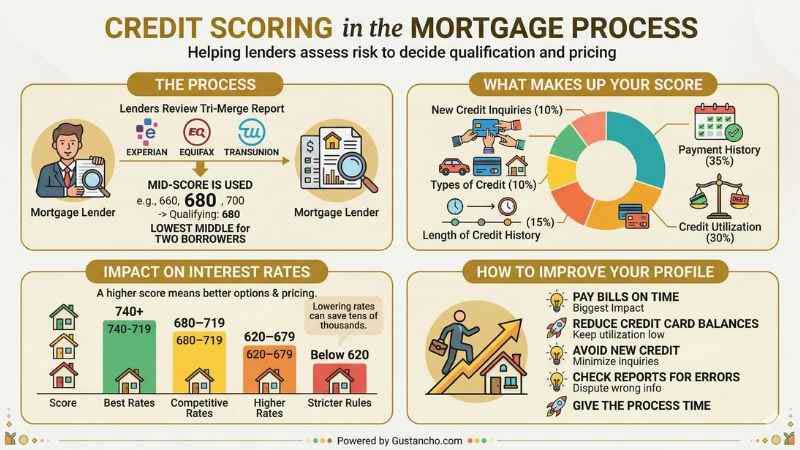 Understanding credit scores begins with knowing what affects them:
- Payment History (35%): Most important is whether you pay your bills on time.
- Credit Utilization (30%): This is how much credit you currently owe compared to your allowed amount.
- It is best to keep this ratio low.
- Length of Credit History (15%): The older your credit accounts are, the better your score will be.
- Types of Credit (10%): A mix like credit cards, car loans, and mortgages looks good to lenders.
- New Credit Inquiries (10%): Applying for too many loans or cards quickly can ding your score.
How Credit Scoring Affects Mortgage Interest Rates
Your credit score is vital for loan approval and interest rate.
- 740 or higher: Best rates on loans.
- 680–719: Rates that are still competitive.
- 620–679: Higher rates and fewer loan products.
- Below 620: Fewer mortgage options and stricter rules.
Changing even a few points can mean saving or spending tens of thousands over the loan’s term.
How Credit Scores Affect Approval and Interest Rates
Credit scores affect both mortgage approval and mortgage pricing. If you have a higher credit score, you get more choices when it comes to loans and usually score better interest rates. On the downside, a lower score can mean fewer choices and higher prices.
Lenders assess your credit score to determine your likelihood of repaying a loan. A higher score can help you qualify for different loan programs, like FHA, VA, USDA, conventional, and jumbo loans. A lower score doesn’t always mean you will be denied, but it may lead to stricter checks, bigger down payments, or fewer lenders to choose from.
Credit scores also affect the interest rate you are offered. Borrowers with higher scores are usually viewed as lower risk, so they often receive lower rates. Borrowers with lower scores may still qualify, but the rate is often higher to reflect the added lending risk. Even a modest score increase can make a difference. A higher score may help you qualify for better pricing, lower monthly payments, and lower long-term borrowing costs. That is why improving your score before applying can be an important part of how credit scoring works in the mortgage process.
What Score Ranges Matter for Common Loan Types
Credit score guidelines can vary by lender, but there are common ranges borrowers should know when learning how credit scoring works in the mortgage process. For FHA loans, many borrowers look at 580 or higher for 3.5% down. Some lenders might accept credit scores as low as 500 if you’re willing to put down a bigger down payment. For VA loans, the VA does not set a national minimum credit score, but many lenders prefer scores between 580 and 620, or higher. This is why lender guidelines can matter as much as the loan program itself. For USDA loans, many lenders look for a credit score of 620 or higher, though some may have different requirements. For conventional loans, a 620 credit score is a common minimum. Higher scores usually help borrowers qualify more easily and get better pricing. The main takeaway is simple: lower scores may still qualify for some programs, but higher scores usually mean more choices, lower rates, and smoother underwriting. That is a key part of how credit scoring works in the mortgage process.
Myths About Credit Scores
Some credit beliefs can hurt your mortgage chances. Let’s fix them:
Myth 1: Checking your credit score drops your score.
- Not true.
- Only hard pulls by lenders count against you.
Myth 2: Canceling old credit cards boosts your score.
- Wrong.
- It can shrink your available credit and raise your utilization.
Myth 3: Paying off a collection makes it disappear.
- Not always.
- Paid collections can still show up on your report.
How Borrowers Can Improve Scores Before Applying
Borrowers can often improve their credit scores before applying for a mortgage by focusing on a few basic steps. The most important thing is making every payment on time, since payment history has the biggest impact on credit.
Another smart move is lowering credit card balances. Keeping revolving debt low can help improve utilization, an important factor in how credit scoring works in the mortgage process. In many cases, paying balances down before the statement date can help more than waiting until after.
Borrowers should also avoid opening new credit accounts right before applying. New inquiries and new debt can lower scores and change debt-to-income ratios at the same time. It is also important to review credit reports for errors. Incorrect late payments, duplicated accounts, or wrong balances can hurt scores and should be disputed as early as possible. In short, the best ways to improve scores before applying are to:
- Pay all bills on time
- Reduce credit card balances
- Avoid new credit applications
- Check reports for mistakes
- Give the process time
Even small improvements can make a difference in approval options and interest rates.
Unlock the Power of Your Credit Score
Learn how your score impacts loan approval and interest rates.
Key Credit Score Ranges in the Mortgage Process
Different loan programs have unique credit score needs. Here’s a breakdown of how credit scores impact the most common mortgage types:
FHA Loans
- Minimum credit score: 580 with 3.5% down.
- A score of 500 may qualify with a 10% down payment.
VA Loans
- No set minimum, but most lenders prefer 580–620.
- Flexible for active-duty service members and veterans.
USDA Loans
- Recommended score: 620 or higher.
- Aimed at rural and low-income buyers
Conventional Loans
- Minimum score: 620.
- A score of 740 or above helps secure the lowest rates
Boost Your Mortgage Chances with Better Credit
Discover the steps to qualify for the best home loan programs.Final Thoughts on How Credit Scoring Works in the Mortgage Process
Understanding how credit scoring works in the mortgage process can help borrowers prepare before they apply. Mortgage lenders use credit scores to measure risk, review payment history, and decide which loan programs and interest rates may be available. In most cases, stronger credit scores lead to more options and better pricing, while lower scores may result in stricter guidelines or fewer choices.
The great thing is that you can usually boost your credit score over time with some smart planning and effort.
Paying bills on time, lowering credit card balances, avoiding new debt, and checking credit reports for errors can all help strengthen a mortgage application. When borrowers understand how lenders view credit, they can take practical steps to improve their position before buying a home or refinancing. If you are planning to apply for a mortgage, reviewing your credit early can help you avoid surprises and better understand your loan options.
Common Questions About How Credit Scoring Works in the Mortgage Process:
What Credit Score Do Mortgage Lenders Use?
Most mortgage lenders use mortgage-specific credit scores pulled from the three major credit bureaus. In many cases, they review a tri-merge report and use the middle score to help determine qualification and pricing.
Do Mortgage Lenders Look at All Three Credit Scores?
Usually, yes. Mortgage lenders commonly review scores from Experian, Equifax, and TransUnion rather than relying on a single bureau. That is a major part of how credit scoring works in the mortgage process.
What Credit Score Do I Need to Buy a House?
The answer depends on the loan program and the lender. Many conventional loans start around 620, while some government-backed loans may allow lower scores, but stronger scores usually give borrowers more options and better rates.
Can I Get a Mortgage with Bad Credit?
Yes, in some cases. A lower credit score does not always mean you cannot qualify, but it may limit your loan choices, increase your interest rate, or require stronger compensating factors such as stable income, lower debt, or more cash reserves.
Does My Credit Score Affect My Mortgage Interest Rate?
Yes. Credit scores can affect both approval and pricing. In general, higher scores tend to help borrowers qualify more easily and receive better mortgage rates, while lower scores can lead to higher borrowing costs.
How Long Does it Take to Improve a Credit Score Before Applying for a Mortgage?
It depends on what is hurting the score. Some borrowers may see improvement within a month or two after paying down credit card balances or correcting reporting errors. At the same time, more serious issues, such as late payments, can take longer to recover from.
This article about “How Credit Scoring Works in the Mortgage Process” was updated on April 6th, 2026.