This guide covers health insurance special enrollment. If you missed the open enrollment or went through a big life change, you might not have to wait for the next special enrollment. Health insurance special enrollment rules, qualifying life events, deadlines, proof requirements, and when coverage begins.
A Special Enrollment Period (SEP) lets you sign up for or change your health coverage after certain events like losing your insurance, moving to a new place, getting married, or welcoming a new baby, following the Health Insurance Special Enrollment Rules.
Important: This guide focuses primarily on Affordable Care Act Marketplace coverage. Employer health plans, Medicaid, CHIP, and Medicare have separate enrollment rules. Eligibility is determined by the Marketplace, your state exchange, your employer’s plan, or the government agency administering the coverage.
What You’ll Learn
In This Guide, You’ll Learn:
- What counts as a qualifying life event (QLE)
- How long you usually have to enroll (common deadlines and exceptions)
- What documents you may need to prove eligibility
- When your coverage typically starts after you pick a plan
- How SEPs work for the Marketplace, employer plans, Medicare, Medicaid, and CHIP
Start Here: Do You Qualify for a Special Enrollment Period?
You May Qualify if You:
- Lost health coverage (job-based plan ended, aged off a parent’s plan, etc.)
- Had a household change (marriage, birth, adoption)
- Moved and now have different plan options
- Were affected by a disaster or a Marketplace enrollment error
Don’t wait: SEP deadlines can be short, and missing the window is the #1 reason people lose the chance to enroll. Next Step: Check your SEP eligibility and deadline using your Marketplace’s SEP screener, then gather your proof documents so you can choose a plan on time. Note: This guide is for educational purposes only and isn’t meant to be legal, tax, or medical advice. Keep in mind that SEP rules can change depending on where you are and your specific situation.
How Does Health Insurance Special Enrollment Work?
A health insurance Special Enrollment Period, or SEP, lets you enroll in or change health coverage outside the normal Open Enrollment Period after certain qualifying life events. Common events include losing qualifying health coverage, getting married, having or adopting a child, moving to an area with different plans, turning 26, or leaving incarceration. Depending on the event, you generally have up to 60 days before or after it to select a Marketplace plan. People who lose Medicaid or CHIP may have up to 90 days after their coverage ends. You may also need to provide documents and pay the first premium before using the coverage.
What Is Health Insurance Special Enrollment?
Health insurance special enrollment is a limited enrollment opportunity outside the annual Open Enrollment Period. It becomes available when a person experiences an approved change in coverage, household, residence, or eligibility. The life change that opens the enrollment window is known as a qualifying life event, or QLE. Applying does not automatically guarantee eligibility. The Marketplace or state exchange reviews the application and issues an eligibility determination.
Special Enrollment Period Rules Vary According to:
- The type of health insurance
- The qualifying event
- The date the event happened
- Whether the applicant had prior qualifying coverage
- Whether documents are required
- Whether the person is enrolling for the first time or changing an existing plan
What Qualifies for a Health Insurance Special Enrollment Period?
Several types of life changes may create an ACA Marketplace Special Enrollment Period.
Loss of Qualifying Health Insurance Coverage
Losing Qualifying Coverage is One of the Most Common Reasons for Special Enrollment. You May Qualify After Losing:
- Employer-sponsored health insurance
- Coverage through a spouse or parent
- An individual or Marketplace plan that was discontinued
- A qualifying student health plan
- Eligibility for Medicaid or CHIP
- Premium-free Medicare Part A
- Coverage after turning 26 and aging off a parent’s plan
Leaving a job can qualify even when you quit or were fired, as long as the job change causes you to lose qualifying employer health insurance. Losing coverage because of unpaid premiums, fraud, or intentional misrepresentation generally does not create a Special Enrollment Period.
Marriage, Birth, Adoption, and Household Changes
You may qualify after:
- Getting married
- Having a baby
- Adopting a child
- Receiving a foster-care placement
- Gaining a dependent through a court order
- Getting divorced or legally separated and losing coverage
- Losing coverage after the death of a household member
Divorce or legal separation, by itself, does not qualify unless it results in the loss of health insurance. Coverage following birth, adoption, foster placement, or an applicable court order can generally be retroactive to the date of the event.
Moving to an Area With Different Health Plans
A permanent move may qualify when it gives you access to different Marketplace plans. Eligible moves can include:
- Moving to a new ZIP code or county
- Moving to the United States from another country or territory
- A student moving to or from school.
- A seasonal worker moving to or from a work location
- Moving to or from a shelter or transitional housing
For many domestic moves, you must show that you had qualifying health coverage for at least one day during the 60 days before moving. This prior-coverage requirement generally does not apply when moving to the United States from another country or U.S. territory. A vacation, temporary stay, or move made only to receive medical treatment does not qualify.
Other Qualifying Life Events and Exceptional Circumstances
Other Events That May Qualify Include:
- Becoming a United States citizen
- Leaving incarceration
- Gaining membership in a federally recognized tribe
- Receiving an Individual Coverage HRA or QSEHRA offer
- Starting or ending certain AmeriCorps service
- Domestic abuse or spousal abandonment
- Marketplace misinformation or enrollment errors
- A FEMA-declared disaster that prevented timely enrollment
- A delayed Medicaid or CHIP eligibility decision
- Not receiving a timely notice of another qualifying event.
Complex cases are evaluated individually. Applicants should keep letters, notices, screenshots, dates, and other evidence showing why they could not enroll on time.
Had a Major Life Change? Don’t Miss Your Enrollment Window
Special Enrollment periods are time-sensitive. Learn what documents may be needed and how to choose coverage before your deadline passes.Who Qualifies? The Most common Qualifying Life Events (QLEs)
Below are the everyday situations that usually unlock a SEP on the Marketplace. These are the backbone of health insurance special enrollment rules:
Loss of Qualifying Coverage
Examples: you lost job-based coverage, COBRA ended, you aged off a parent’s plan at 26, or you lost individual coverage. Most people get a 60-day window before or after the loss to enroll. If you recently lost Medicaid or CHIP, you also may qualify.
Change in Household
Marriage, birth, adoption, or placement for adoption. These changes typically qualify you for a SEP.
Move That Changes Your Plan Options.
You moved to a new ZIP code, county, or state, or returned from living abroad. Moves often open a SEP because your available plans have changed.
Complex Cases: Disasters, Marketplace Errors, and Unusual Situations (What to Do)
Sometimes life doesn’t fit neatly into a standard qualifying event. If a disaster, system issue, or unusual circumstance kept you from enrolling on time (or caused you to lose coverage unexpectedly), you may still be able to request Special Enrollment help. These cases are handled individually, and the key is to document what happened and act quickly following the health insurance special enrollment rules.
Step 1: What to Gather
Collect Anything That Supports What Happened + When it Happened, Such As:
- Dates: the event date, your last day of coverage, and when you tried to enroll
- Official notices: Marketplace letters, denial letters, eligibility notices, plan termination notices
- Disaster-related proof (if applicable): FEMA disaster declaration info for your county/ZIP, evacuation orders, utility outage notices, insurance claims, repair invoices, or temporary relocation proof
- System/error proof: screenshots of error messages, confirmation numbers, emails showing attempted enrollment, chat transcripts, or call logs
- Identity/address proof: documents showing your name and current address (lease, utility bill, government mail)
Step 2: What to Write
Use this script when you request help—keep it simple and date-based:
Template: Copy and Paste
My qualifying situation occurred on [DATE]. I attempted to enroll on [DATE], but [brief reason: disaster impact / Marketplace error / incorrect information/system issue] prevented me from completing enrollment on time. My last day of coverage was [DATE] (or I became uninsured on [DATE]). I can provide supporting documents, including [list 2–4 items]. Please advise what documentation is needed and what effective date options are available.”
Step 3: Where to Request Help
Use the channel that matches how you enroll:
- HealthCare.gov (federal Marketplace): contact Marketplace support via the help options listed in your account/help center (phone or chat).
- State Marketplace: contact your state exchange support (phone, chat, or “request help with SEP” form if available).
- Employer plan: contact your HR/benefits administrator and ask specifically about HIPAA special enrollment rules and deadlines.
- Medicare: contact Medicare support or your plan (Medicare Advantage / Part D) and request the SEP for your situation.
Step 4: How to Avoid Delays
- Don’t wait until the last few days—complex cases often take back-and-forth.
- Be ready to provide exact dates and clear documents (blurry uploads are a common reason for slowdowns).
- If you’re told you’re not eligible and you believe you are, ask what documentation would change the outcome and whether an escalation/review is available.
How Long Is My SEP Window? Timing Rules (Rule vs. Reality)
Special Enrollment Period deadlines can feel strict because they often are—but the exact window depends on the event, the type of coverage, and where you’re enrolling (HealthCare.gov vs. a state Marketplace vs. an employer plan vs. Medicare).
Rule vs. Reality: SEP Deadlines at a Glance
Most Common Window
- Marketplace plans (HealthCare.gov / state Marketplace): Often, you can enroll within 60 days of a qualifying life event (and for some events, you may be able to enroll up to 60 days before you lose coverage to avoid a gap).
- Employer plans (group coverage): Typically, you have at least 30 days to request enrollment after certain life events (like marriage, birth/adoption, or loss of other coverage).
- Medicaid & CHIP: Year-round enrollment (no SEP window). If you qualify, coverage can start quickly, depending on your state and timing.
- Medicare (Advantage/Part D changes): Timing varies by SEP type, but changes often take effect on the first day of the month after the plan receives your request.
Common Exceptions
- Losing Medicaid/CHIP: Some situations can allow a longer enrollment window than the standard Marketplace timeframe. The exact timing depends on why coverage ended and your Marketplace/state rules (for example: redetermination/renewal outcomes, eligibility changes, or program transitions).
- In disaster or emergency situations, extra time may be available only if an official SEP or flexibility is announced for your area/situation. Not every disaster automatically creates an extension.
- Marketplace errors or system issues: If you were prevented from enrolling due to an error, you may be able to request an exception or a corrected effective date—but you’ll usually need to explain what happened and provide dates.
What to do if You’re Unsure
- Identify your coverage type first (Marketplace, employer, Medicare, or Medicaid/CHIP).
- Use the Marketplace SEP screener (or your state Marketplace site) to confirm the exact deadline for your event.
- Document your dates (event date, last day of coverage, move date, marriage date, etc.).
- Choose a plan before the deadline (then upload proof promptly if requested).
- If you think you qualify for an exception (disaster/error), contact support immediately and ask what proof they need.
Pro tip: Set a calendar reminder the day your event happens. SEP windows can be short, and deadlines are easier to miss than people expect.
How Long Is the Special Enrollment Period for Health Insurance?
Most Marketplace Special Enrollment Periods provide a 60-day enrollment window, but the starting point depends on the qualifying event.
Losing Health Coverage
You may generally apply:
- Up to 60 days before qualifying coverage will end.
- Up to 60 days after qualifying coverage ends
Applying before the old plan ends can reduce the risk of a coverage gap.
Losing Medicaid or CHIP
A person who loses Medicaid or CHIP may qualify for a Marketplace SEP for up to 90 days after the coverage ends. A person who receives a delayed Medicaid or CHIP denial under certain circumstances may have 60 days after the denial to report it.
Employer-Sponsored Health Plans
Job-based health plans must generally provide at least a 30-day special enrollment window after certain events, such as marriage, birth, adoption, or loss of other coverage. Some Medicaid- and CHIP-related employer-plan events have a 60-day window.
Medicaid and CHIP Enrollment
Medicaid and CHIP do not require a Marketplace Special Enrollment Period. Eligible applicants can apply year-round. (cms.gov)
Important Special Enrollment Period Changes
Consumers should not rely on older articles because several Marketplace policies have changed.
The Monthly Low-Income Special Enrollment Period Ended
The monthly SEP, which previously allowed certain applicants with household incomes at or below 150% of the federal poverty level to enroll year-round, ended on August 25, 2025. It is not available for the 2026 plan year. CMS has also finalized rules continuing the prohibition beyond 2026. Low income may still affect eligibility for premium assistance, Medicaid, or CHIP, but low income alone no longer creates this broad monthly Marketplace enrollment opportunity.
Loss-of-Coverage Verification Continues
Consumers using the federal Marketplace who request an SEP after losing minimum essential coverage may be required to submit proof before they can use the new plan. A court stayed the proposed expansion of mandatory pre-enrollment verification to additional SEP categories for the 2026 plan year. However, applicants may still be asked to provide documents. The Marketplace Eligibility Notice provides the controlling instructions and deadline for each application. CMS has finalized broader pre-enrollment SEP verification requirements for federal platform exchanges beginning with plan year 2027.
Regular SEP Coverage Generally Begins the Following Month
For many Special Enrollment Periods, coverage begins on the first day of the month after plan selection. Since January 1, 2025, state exchanges have generally been required to follow the same regular effective-date rule. This means selecting a plan after the 15th of the month no longer automatically pushes the start date out an additional month under the regular SEP rule.
What Documents Are Needed for Special Enrollment?
The Marketplace may ask for documents proving both the qualifying event and its date.
Proof of Lost Health Coverage
Possible Documents Include:
- Employer or insurance company termination letter
- COBRA election or exhaustion notice
- Medicaid or CHIP termination notice
- Letter showing the final day of coverage
- Pay stub showing the loss of an insurance deduction
- Benefits statement showing coverage dates
Proof of Marriage or Household Change
Possible Documents Include:
- Marriage certificate
- Court order
- Birth certificate
- Adoption records
- Foster-care placement papers
- Divorce or legal-separation order
- Proof showing that the household change caused coverage loss
Proof of a Permanent Move
Possible Documents Include:
- Lease or mortgage document
- Utility bill
- Change-of-address confirmation
- Government correspondence
- School or employment records
- Proof of prior qualifying coverage
Your eligibility notice will identify which documents are acceptable. Do not assume that one document proves every part of the qualifying event. HealthCare.gov generally advises applicants to select a plan first and then submit any requested SEP documents. Applicants normally have 30 days after selecting a plan to submit the required proof.
When Does Special Enrollment Coverage Start?
The coverage start date depends on the event.
Loss of Existing Health Insurance
When you select a plan after losing coverage, the new plan generally begins on the first day of the following month. When you know that coverage will end and select a new plan by the last day of the prior coverage, the Marketplace can generally start the new coverage on the first day of the month after the prior plan ends.
Marriage or Permanent Move
Coverage generally begins on the first day of the month after plan selection.
Birth, Adoption, Foster Care, or Court-Ordered Dependents
Coverage can generally begin retroactively on the date of birth, adoption, foster placement, or court order. Consumers who do not want retroactive coverage may need to contact the Marketplace to request a prospective effective date.
Marketplace or Enrollment Error
When a Marketplace error prevented proper enrollment, coverage may be made retroactive to the date that would have applied without the error. Eligibility and effective dates are decided on a case-by-case basis. Selecting a plan does not by itself activate coverage. You must complete any required verification and pay the first premium.
What If I Don’t Have Proof Yet? (And What If My Documents Are Rejected?)
Many Marketplace Special Enrollment Periods (SEPs) require documents to confirm your qualifying event. The good news: you can often choose a plan first and upload proof afterward—but you still need to meet the deadline and respond quickly to avoid delays or loss of coverage.
What if I Can’t Upload Documents Yet?
- Don’t miss your plan selection deadline. If you qualify for an SEP, you should usually pick a plan within your window first, then upload documents as soon as you can.
- If you’re waiting on paperwork (like an employer letter), request it immediately and upload any acceptable alternative in the meantime (for example, a termination letter, an insurance cancellation notice, or official mail showing the dates).
How Long Can Verification Take?
- Verification timelines vary. In many cases, documents are reviewed within days to a couple of weeks, but it can take longer during high-volume periods or if your documents are unclear.
- The Marketplace may ask for additional information if the document doesn’t show the right name, address, or dates.
What if My Documents are Rejected?
A Rejection Usually Means One of These Issues:
- The document doesn’t show the date of the event (or the last day of coverage)
- The document doesn’t match your application details (name/address)
- The file is unreadable or incomplete (blurry photo, missing pages)
- The document type isn’t accepted for that event
What to Do Immediately:
- Read the notice and identify what was missing (date, address, page, etc.).
- Re-upload a clearer copy or another accepted document that includes the required details.
- Upload the document(s) as soon as possible and keep screenshots/confirmation.
How to Avoid Losing Your Effective Date
- Pick your plan before the SEP deadline (don’t wait for approval first).
- Upload proof immediately after selecting your plan.
- Make sure documents clearly show:
- your name (or household member name)
- the event type (move, loss of coverage, marriage, etc.)
- the relevant date(s)
- Watch your inbox (Marketplace messages and email) and respond fast.
- Pay the first premium on time—coverage generally won’t start until it’s paid.
If You’re Close to the Deadline
If You’re Within a Few Days of Your SEP Deadline and Still Don’t Have Proof:
- Select the plan now (if eligible) and upload whatever acceptable proof you can obtain quickly.
- If you believe you qualify but can’t meet requirements due to a Marketplace error or extraordinary circumstance, contact support and ask about an exception/extended verification option (availability depends on your situation).
When Does Coverage Start? (Simple Effective Date Rules)
Under the health insurance special enrollment rules, your start date depends on (1) what type of SEP you’re using and (2) when you select a plan. In many cases, Marketplace coverage starts on the first day of the next month—but some events (like having a baby) can start on the date of the event.
Most Common Scenario: Regular SEPs (moves, marriage, loss of coverage, etc.)
- Choose a plan by the end of this month → coverage usually starts on the 1st of next month.
- Example: Pick a plan on March 10 → coverage typically starts in April
Birth, Adoption, or Foster Placement (often retroactive)
- Coverage can start on the event date (so your newborn or newly adopted child is covered immediately).
- Example: Baby born on April 5 → the plan can be effective on April 5 (retroactive to the event date).
- In some situations, you can choose a next-month start date instead, depending on the Marketplace rules and your preference.
Losing Coverage: How to Avoid Gaps
- If you know your coverage is ending, you can enroll before it ends so your new plan begins right after it ends.
- If you enroll after the loss, your start date is often the first of the next month—which can create a gap if you wait too long.
Disaster or “Complex Case” Situations
- If an emergency, disaster, or Marketplace error prevented you from enrolling on time, you may be able to request a start date that matches when coverage would have started if you had enrolled during your original window.
- These situations usually require an explanation and supporting details.
Quick “Enroll by → Starts on” Guide
- Enroll on any day this month → coverage usually starts the 1st of next month
- Birth/adoption/placement → coverage can start on the event date
- Known loss of coverage → enroll early to line up start dates and avoid gaps
Starting January 1, 2025, state-based Marketplaces generally follow the federal Marketplace approach for regular SEP effective dates (often the first of the month after plan selection), with exceptions for certain events like birth/adoption.
Step-by-Step: How to Use Your SEP
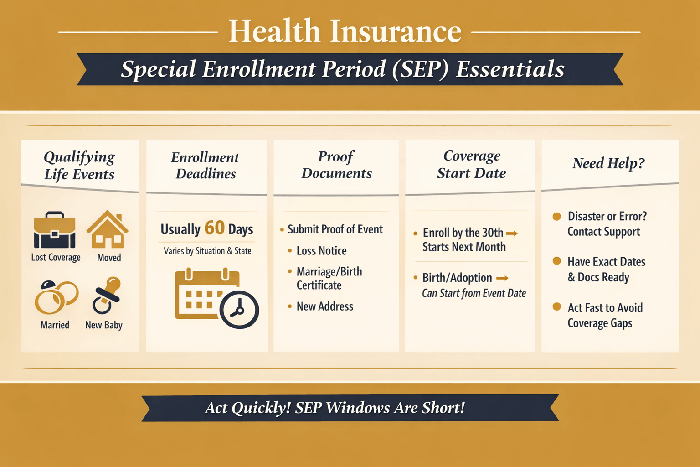
Follow This Quick Checklist to Stay on Track with Health Insurance Special Enrollment Rules:
- Confirm your qualifying event. Use the Marketplace screener if you’re unsure.
- Mark your deadline. 60 days for Marketplace, at least 30 days for employer plans.
- Gather proof. Get letters, certificates, or bills that show dates and details.
- Compare plans. Check the monthly premium, deductible, out-of-pocket maximum, your doctors’ in-network status, and your prescriptions on the formulary.
- Pick a plan before the deadline. Don’t wait for document approval to choose—select first and upload quickly.
- Watch your inbox. Respond promptly if the Marketplace requests additional information.
- Pay your first premium on time. Coverage won’t start until your payment is made.
Marketplace vs Employer Plans vs Medicare vs Medicaid/CHIP
Health insurance special enrollment rules depend on the type of coverage you’re talking about. Here’s the plain-English version:
Marketplace (HealthCare.gov or your state marketplace)
- Great if you don’t have affordable employer coverage and you’re not eligible for Medicare or full-scope Medicaid.
- SEPs cover moves, life changes, and loss of coverage, with most windows set at 60 days.
Employer plans (group coverage)
- Governed by HIPAA/ERISA special enrollment protections.
- Plans must allow at least 30 days to enroll after certain life events (marriage, birth/adoption, loss of other coverage). Some CHIP/Medicaid events allow for a 60-day period.
Medicare (age 65+ or specific disabilities)
- Medicare has its own SEPs for moves, losing other coverage, or exceptional situations. Rules and timing vary by event. If you qualify for a Medicare SEP, your Medicare Advantage or Part D changes usually start the first day of the month after the plan gets your request.
Medicaid & CHIP
- Year-round enrollment. If your income or situation qualifies, you can enroll any time and often start coverage right away.
Picking the Right Plan During Your SEP
Because SEPs are short, focus on what actually drives your total cost and care:
- Premium vs deductible vs out-of-pocket max: Add up what you’ll pay each month and what you could pay in a bad year.
- Network: Make sure your doctors and nearby hospitals are in-network.
- Formulary: Check that your medications are covered at a reasonable tier.
- HMO vs PPO vs EPO vs HDHP/HSA:
- HMO: lower cost, referrals required, in-network only.
- PPO: higher cost, more freedom to see out-of-network providers.
- EPO: similar to HMO, but with no referrals; still mostly in-network.
- HDHP/HSA: lower premium, higher deductible; HSA lets you save pre-tax for medical costs.
The goal under health insurance special enrollment rules is not just to “get something.” It’s to get the right plan for your care and budget.
Exceptions, Extensions, and “Complex Case” Help
Sometimes life gets messy. If a disaster, Marketplace error, or other complex issue kept you from enrolling, you may still qualify for an SEP or an adjusted start date. Disaster SEPs usually give you 60 days after the FEMA incident period to finish enrollment, and you can often request a start date as if you had enrolled on time. Health insurance special enrollment rules are flexible in these cases, but you must explain the situation and follow instructions carefully.
Recent Policy Updates to Keep in Mind
Rules evolve. For example, CMS guidance notes that starting January 1, 2025, state exchanges have to align their regular SEP effective date rules with the federal Marketplace (generally, coverage begins the first of the month after plan selection). Health insurance special enrollment rules can change in other ways, too, so always check the latest CMS/Marketplace updates when you enroll.
Common Mistakes (and Easy Fixes)
- Waiting for documents before choosing a plan. Don’t wait—pick the plan first, then upload proof.
- Assuming you can’t enroll until open enrollment. If you moved, had a baby, got married, or lost coverage, health insurance special enrollment rules may already allow you to enroll.
- Missing employer deadlines. Group plans often allow 30 days—shorter than the Marketplace’s 60. Mark your deadline on day one.
- Forgetting Medicaid/CHIP. If income is tight, check year-round options—many families qualify.
- Not paying the first premium. Coverage isn’t active until you make the initial payment.
Why This Matters for Homebuyers and Homeowners
Health insurance isn’t just a medical decision—it’s a financial protection decision. A single unexpected injury or hospital visit can lead to large bills, which can drain emergency savings quickly. Staying covered helps protect your household budget so you’re not forced to rely on high-interest credit cards, payment plans, or collections to handle medical costs. If you’re planning a major financial goal—like buying a home, moving, or rebuilding savings after a life change—having steady health coverage can reduce the risk of surprise expenses that throw off your plans. The main takeaway: when life changes, don’t wait for open enrollment if you don’t have to. If you qualify for a Special Enrollment Period, acting quickly can help you avoid a gap and get back to stability.
Note: This section is general financial education and not legal, tax, or medical advice.
Final Takeaway
Life happens. Moves, marriages, new babies, job changes, and disasters can all shake up your coverage. Every homeowner should not just have homeowners insurance but medical insurance as well. Thanks to health insurance special enrollment rules, you can still get a plan, often within 60 days, and sometimes with a start date that avoids a gap. Know your event, mark your deadline, choose your plan, and send your proof. If you’re unsure, use the Marketplace screener or call the help line for assistance. The sooner you act, the sooner you’re protected. Borrowers who need a five-star national mortgage company licensed in 48 states with no overlays and who are experts on health insurance special enrollment rules, please contact us at 800-900-8569, text us for a faster response, or email us at alex@gustancho.com.
Frequently Asked Questions About Health Insurance Special Enrollment Rules:
What are Health Insurance Special Enrollment Rules?
Health Insurance Special Enrollment Rules are the guidelines that let you enroll in or change coverage outside Open Enrollment when you have a qualifying life event (like losing coverage, getting married, having a baby, or moving).
How Long do I have to Enroll After a Qualifying Life Event?
When it comes to Marketplace coverage, you usually have 60 days before or after an event to sign up, depending on the type of Special Enrollment Period (SEP). For job-based plans, they usually give you at least 30 days for certain events.
I Lost Medicaid or CHIP—Do I Get a Special Enrollment Period, and How Long is it?
Yes. If you lost Medicaid or CHIP, you may qualify for a Marketplace SEP and have up to 90 days in many cases (rules vary by state and circumstances).
Do I Need Proof for a Special Enrollment Period—and What if I Don’t Upload Documents?
Often, yes. The Marketplace may ask you to send documents to confirm you qualify for an SEP, and you generally need to submit them before you can start using coverage. If you’re asked for proof, upload clear documents that show what happened and the date (and respond quickly to any follow-up requests).
When Does Coverage Start After I Enroll Through an SEP?
For many Marketplace SEPs, coverage commonly starts the first day of the month after you pick a plan—while some events (like birth/adoption) can have different effective-date handling. For Medicare Advantage/Part D SEPs, timing depends on the SEP type and the plan change you’re making.
This Guide About “Health Insurance Special Enrollment Rules You Must Know” Was Updated on July 30, 2026.