Quick Answer
Mortgage loan programs for homebuyers include Conventional, FHA, VA, USDA, Jumbo, and Non-QM options. Picking the right option really comes down to a few key factors: your credit score, how much cash you’re putting down, your income, your debt-to-income ratio, where the property is, and the size of the loan. Sometimes, a lender who sticks to basic guidelines without extra hoops to jump through can approve people that other lenders might turn away.
What You’ll Learn
- The main mortgage loan programs for homebuyers, and which program fits best
- Minimum down payment ranges by loan type (0% to 20%+)
- How credit score and DTI guidelines differ across programs
- Which loans work best after bankruptcy, foreclosure, or credit issues
- When you’ll need a jumbo vs. a conforming mortgage
- How Non-QM loans help self-employed and unique income borrowers
- A simple way to choose the right loan program based on your situation
What Are Mortgage Loan Programs for Homebuyers?

Mortgage loan programs are the different types of loans you can use to buy a home. Some are backed by the government (FHA, VA, USDA), while others are conventional or specialty loans.
Each program is designed to help different types of buyers:
- First-time buyers with limited savings.
- Veterans or active-duty military members.
- Borrowers with lower credit scores or past credit issues.
- Families buying in rural or suburban areas.
- Buyers of high-cost or luxury homes.
- Self-employed borrowers who need alternative documentation.
Understanding your options is the first step to finding the right program. Let’s dive in.
“Which loan is right for you?” Decision Guide
Start here (fast pick):
- Are you eligible for VA benefits (veteran/active-duty/surviving spouse)? → Choose: VA Loan (often $0 down, no monthly mortgage insurance)
- Do you want $0 down, and the home is in a USDA-eligible area, AND your household income fits USDA limits? → Choose: USDA Loan (often $0 down for eligible rural/suburban areas)
- Is your credit score below ~680, your down payment is limited, or your DTI is on the higher side? → Choose: FHA Loan (low down payment options, more flexible underwriting
- Do you have a 620+ score and want the lowest long-term cost (especially if you can put 20% down or plan to remove PMI later)? → Choose: Conventional Loan (3% down options for qualified buyers; PMI can often be canceled)
- Is your loan amount above the conforming loan limit for your county? → Choose: Jumbo / Non-Conforming Loan (typically higher credit, reserves, and down payment expectations)
- Are you self-employed, have major tax write-offs, irregular income, recent credit events, or need alternative documentation? → Choose: Non-QM Loan
- Examples: Bank Statement, DSCR (investors), Asset Depletion, P&L-only (programs vary)
Quick “If this is you → start with this” Cheat Sheet
- First-time buyer + small down payment → FHA or Conventional 3%
- Veteran/active duty → VA
- Rural/suburban area + income fits limits → USDA
- Great credit + stable income → Conventional
- High-priced home above conforming limits → Jumbo
- Self-employed or investor → Non-QM (Bank Statement or DSCR)
- Recent credit hardship → FHA (or Non-QM if you need a faster path, program-dependent)
Next Step (What We Evaluate to Confirm the Best Fit)
To match you to the right program, a lender will review: credit scores, down payment funds, DTI, income type (W-2 vs self-employed), property type (primary/second/investment), and loan amount/location.
Can I buy a house with bad credit?
Yes—FHA, VA, USDA, and Non-QM programs all allow low credit scores.
Conventional Loans: The Standard Choice for Many Buyers
Conventional loans are the most common type of mortgage loan programs for homebuyers. They do not have government backing, but they adhere to the guidelines established by Fannie Mae and Freddie Mac.
Benefits of Conventional Loans
Conventional loans have some great perks for homebuyers, especially if you’re a first-time buyer, since you can get started with down payments as low as 3%. If you can put down 20% or more, you can skip the whole private mortgage insurance (PMI) thing, which saves you a good chunk of change over time.
These loans are flexible too; you can use them for your main home, a second getaway pad, or even rental properties. With loan terms that range from 10 to 30 years, you can pick a plan that fits your budget and long-term plans just right.
Requirements
- Minimum 620 credit score.
- The debt-to-income (DTI) ratio is usually capped at 50%.
- Standard waiting periods after bankruptcy or foreclosure:
- 4 years after Chapter 7 bankruptcy.
- 2 years after Chapter 13 discharge.
- 7 years after foreclosure.
Best for: Buyers with solid credit and some savings for a down payment.
Overall, understanding these aspects can greatly enhance the home buying experience and ensure that buyers select the most beneficial mortgage loan programs.
FHA Loans: The Go-To for First-Time Buyers
FHA loans are one of the most popular mortgage loan programs for homebuyers, especially first-time buyers or those with lower credit scores. With the Federal Housing Administration backing, FHA loans offer adaptable guidelines.
Benefits of FHA Loans
FHA loans offer significant advantages for homebuyers, making them an attractive option for many. If you’ve got a credit score of 580 or more, you can snag a mortgage with only a 3.5% down payment. For those with credit scores as low as 500, a slightly higher down payment of 10% is required. Additionally, these loans permit a higher debt-to-income (DTI) ratio of up to 56.9% for borrowers with strong credit, allowing for greater financial flexibility.
Another noteworthy benefit of FHA loans is their accommodating approach toward individuals with a history of financial difficulties, such as bankruptcies or foreclosures. This leniency makes it easier for more borrowers to access home financing and achieve their dream of homeownership, even after past credit challenges.
Requirements
- Mortgage Insurance Premium (MIP) required.
- Only available for primary residences.
- Waiting periods:
- 2 years after Chapter 7 bankruptcy.
- 1 year into Chapter 13 with trustee approval.
- 3 years after foreclosure or short sale.
Best for: Buyers with low credit scores, high DTI, or limited savings.
VA Loans: Zero Down for Veterans
VA loans are a great mortgage option for active-duty service members, qualified veterans, and some surviving spouses. They provide many benefits and are one of the best mortgage loan programs for homebuyers. VA loans don’t have a program-level minimum credit score, but individual lenders may set their own requirements (often called a lender overlay).
Benefits of VA Loans
VA loans offer several key benefits, making them an attractive option for eligible borrowers. One of the most significant advantages is that they don’t require a down payment, making homeownership more accessible. Additionally, these loans do not require monthly mortgage insurance, helping to reduce overall costs. People can save on interest rates with these loans compared to FHA or conventional ones, which helps keep those monthly payments more manageable.
VA loans don’t have a program-level minimum credit score, but individual lenders may set their own requirements (often called a lender overlay).
Requirements
- A valid Certificate of Eligibility (COE).
- Property must be used as a primary residence.
- Waiting periods:
- 2 years after bankruptcy or foreclosure.
Best for: Veterans and military families looking for the most affordable path to homeownership.
USDA Loans: 100% Financing in Rural Areas
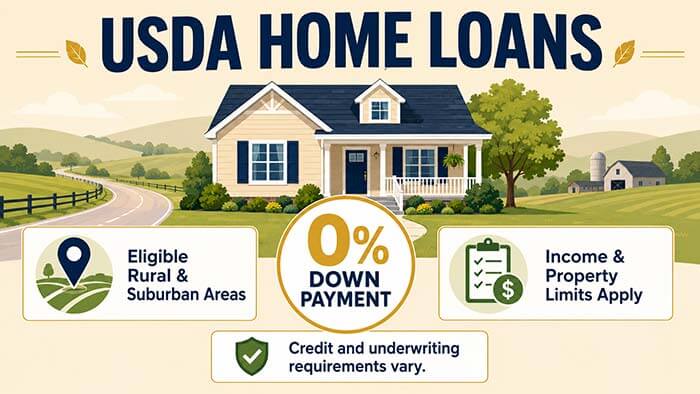
The USDA loan program is designed for homebuyers in rural and suburban areas. It’s one of the only mortgage loan programs for homebuyers that offers 100% financing with no down payment.
Benefits of USDA Loans
USDA loans are great for homebuyers because they come with some nice perks. For starters, you don’t need a down payment, which really helps keep those upfront costs down. Plus, the interest rates are usually lower than what you’d find with regular loans, so you save cash over time.
USDA doesn’t set one universal minimum score, but many lenders use 640 for faster automated approval. Scores below that may still be possible, but often require a deeper/manual review and stronger overall files.
Requirements
- Must meet USDA income limits.
- Property must be located in a USDA-eligible area.
- Waiting period: 3 years after foreclosure or bankruptcy.
Best for: Buyers with low-to-moderate income looking for homes outside major cities
Jumbo Loans: For High-Priced Homes
If your loan amount is above the current conforming loan limit, you’ll typically need a jumbo (non-conforming) mortgage. For 2026, the baseline conforming limit for a one-unit home is $832,750 in most counties, with higher caps in some high-cost regions (up to $1,249,125). Loan limits can change yearly and vary by county.
Benefits of Jumbo Loans
Jumbo loans have many advantages, especially for folks wanting to buy high-end homes or properties in pricey areas. These loans are flexible, since you can choose between fixed or adjustable rates depending on what works best for your budget and needs.
Requirements
- Higher credit score (usually 680+).
- Larger down payment (often 20% or more).
- Strong income and reserves required.
Best for: Buyers of high-cost or luxury homes.
Non-QM Loans: Flexible Options for Unique Situations
Non-QM (Non-Qualified Mortgage) loans are specialty mortgage loan programs for homebuyers who don’t fit traditional guidelines. These are perfect for self-employed borrowers, real estate investors, or those with recent credit issues.
Benefits of Non-QM Loans
- Bank statement loans (no tax returns required).
- DSCR loans for real estate investors.
- No waiting period after bankruptcy or foreclosure.
- As low as 500 credit scores are accepted in many cases.
Requirements
- Larger down payments (10–20%).
- Higher interest rates compared to traditional loans.
Best for: Self-employed borrowers, investors, or buyers with unique financial situations.
Fixed-Rate vs. Adjustable-Rate Mortgages
When choosing between fixed-rate mortgages (FRM) and adjustable-rate mortgages (ARM), one of the most important factors to consider is how long you plan to stay in your home. This decision can significantly impact your finances in the long run.
Fixed-Rate loans
Fixed-rate mortgages are great because they keep your monthly payments the same for the whole loan term. This is helpful if you want to know exactly what to expect for your budget. With a fixed-rate mortgage, you don’t have to stress about interest rates going up and down, affecting what you pay each month. It’s a solid choice for anyone planning to stay in their home for a while. Plus, having that kind of predictability can feel comforting, especially when the economy is shaky and rates might rise.
Adjustable-Rate loans
Adjustable-rate mortgages (ARMs) usually kick off with a lower interest rate than fixed-rate loans, which means your initial monthly payments can be much friendlier on your wallet. The catch is that these rates can change after a specific period—typically 3, 5, 7, or even 10 years—based on the loan terms. An ARM might be a smart choice if you plan on moving or refinancing in a few years. You get to enjoy those lower initial rates before any changes happen, making it a solid option for folks who value short-term savings over long-term stability.
However, it’s essential to be aware of the potential for rising payments in the future, especially if you plan to stay in the home longer than the fixed period.
Down Payment Requirements by Loan Type
- Conventional Loans: 3% to 20% depending on property type.
- FHA Loans: 3.5% with 580 credit, 10% with 500–579 credit.
- VA Loans: 0% down.
- USDA Loans: 0% down.
- Jumbo Loans: Typically 20% or more.
- Non-QM Loans: 10%–20% depending on program.
Final Thoughts
With so many mortgage loan programs for homebuyers in 2025, finding the loan that fits your unique situation is key. Whether you need a low down payment FHA loan, a zero down VA or USDA loan, a jumbo mortgage for a luxury home, or a flexible Non-QM option, Gustan Cho Associates has you covered.
Borrowers who need a five-star national mortgage company licensed in 48 states with no overlays and who are experts on mortgage loan programs for homebuyers, please contact us at 800-900-8569, text us for a faster response, or email us at alex@gustancho.com. The team at Gustan Cho Associates is available 7 days a week, on evenings, weekends, and holidays.
Frequently Asked Questions About Mortgage Loan Programs for Homebuyers:
What are the Main Mortgage Loan Programs for Homebuyers?
The most common options are Conventional, government-backed loans (like FHA, VA, USDA), and non-conforming loans (like Jumbo and some specialty programs). The best fit depends on your credit, down payment, income type, property, and loan size.
What Mortgage Loan Programs for Homebuyers Allow the Lowest Down Payment?
Some conventional loans offer 97% LTV financing (often as low as 3% down) for eligible buyers. FHA commonly allows 3.5% down with stronger credit, while VA and USDA may allow $0 down for qualified borrowers.
Which Loan is Best for First-Time Homebuyers?
Many first-time buyers start with an FHA loan (more flexible credit/down payment requirements) or a conventional 3% down option if they qualify. The “best” loan is usually the one that gives you the lowest total cost for your timeline (monthly payment + mortgage insurance + upfront costs).
What Credit Score Do I Need to Buy a House?
It really depends on the program and the lender. The VA does not set a minimum credit score, but some lenders may require one. For USDA loans, they often point to 640 as a key score for a smoother approval process, but it can still vary. With conventional and FHA loans, the rules can change a lot based on how strong your application is, how much you put down, and what the underwriters find.
Can I Get an FHA Loan with a 500 Credit Score?
In some cases, FHA financing may be possible with a higher minimum down payment (commonly 10%) when the “decision” credit score is 500–579 (and other requirements are met). Exact eligibility depends on the full file and lender underwriting.
What’s the Difference Between FHA and Conventional Loans?
FHA tends to be more forgiving on credit and down payments, but it includes mortgage insurance that can increase the total cost. Conventional often rewards higher credit and can be lower-cost over time—especially if you can reduce or remove PMI later—depending on your structure and equity.
What are the Requirements for a VA Loan?
You’ll need VA eligibility (typically proven with a Certificate of Eligibility), and the home must generally be your primary residence. VA also notes it doesn’t require a minimum credit score, though lenders may set one.
How do I Know if a Home is Eligible for a USDA Loan?
USDA eligibility usually depends on the property’s location (in a USDA-eligible area) and on household income being within program limits. USDA credit guidance and documentation requirements can vary based on credit depth and score thresholds used in the file review process.
What is a Jumbo Loan, and When Do I Need One?
A jumbo loan is typically used when your mortgage amount is above conforming loan limits for your county, meaning it can’t be sold to Fannie/Freddie under standard conforming rules. Jumbo loans often require stronger credit, larger down payments, and more reserves than conforming loans.
What Loan Options are Best for Self-Employed Borrowers?
If tax returns don’t reflect your actual cash flow due to write-offs, some borrowers explore alternative documentation programs (commonly called Non-QM). These programs vary by lender/investor and may use bank statements or other documentation methods to evaluate income.
This article about “Easy Mortgage Loan Programs for Homebuyers With Bad Credit” was updated on January 30th, 2026.
Who can help me get approved with bad credit?
Gustan Cho Associates specializes in bad credit mortgages nationwide.