Conforming down payment guidelines vary by occupancy, property type, number of units, loan program, and automated underwriting findings. There may be qualified buyers who purchase a one-unit primary residence with as little as a 3% down payment, whereas the minimum down payment is typically higher for second homes, investment properties, and multi-unit structures. Putting less than 20% down typically means mortgage insurance is applied. The final minimum is underwritten by Fannie Mae or Freddie Mac, and the borrower’s overall total mortgage loan.
Conforming Loan Down Payments at a Glance
Conforming down payment guidelines depend mainly on occupancy, property type, number of units, loan size, and underwriting method. The following chart summarizes common minimums for eligible purchase loans:
| Purchase scenario | Maximum LTV | Minimum down payment |
|---|---|---|
| One-unit primary residence with an eligible 97% LTV program | 97% | 3% |
| One-unit primary residence when 97% financing does not apply | 95% | 5% |
| Two- to four-unit primary residence with eligible automated underwriting | 95% | 5% |
| One-unit second home | 90% | 10% |
| One-unit investment property | 85% | 15% |
| Two- to four-unit investment property | 75% | 25% |
These percentages represent maximum agency LTV limits—not guaranteed approval terms. High-balance loans, manual underwriting, manufactured homes, certain condominium reviews, and other loan features may require a larger down payment. The borrower must also satisfy the applicable credit, income, asset, property, and automated underwriting requirements. The 3% option is generally limited to qualified borrowers purchasing an eligible one-unit primary residence under a specific 97% LTV program. Review the complete requirements for a 3 percent down payment conventional loan for program-specific eligibility. A down payment below 20% generally requires private mortgage insurance.
Minimum Down Payment for a Primary Residence
For a one-unit primary residence, lenders offer a standard conforming purchase loan that finances up to 95% of the property’s value, with a 5% down payment. Borrowers are offered some 97% LTV loans that also require a 3% down payment and have other requirements. These requirements include the property, occupancy, loan type, income, first-time homebuyer status, and automated underwriting.
A 3% down payment program often requires first-time homebuyer status, but it can also offer programs to repeat buyers. Lenders typically need to research all Fannie Mae and Freddie Mac loan programs and choose the program that best fits the buyer’s income and ownership history.
A 3% down payment on a $400,000 loan is $12,000, and a 5% down payment would be $20,000. A down payment also cannot be used to cover closing costs or prepaid taxes and insurance. Several programs can offset these costs. These basic conforming down payment guidelines set LTV limits set by the agencies, but they do not guarantee specific requirements for each borrower. The final requirements can also be impacted by credit score, debt-to-income ratio, available funds, property eligibility, auto-underwriting, and mortgage insurance.
Down Payments for Two- to Four-Unit Primary Homes
A borrower purchasing a two-, three-, or four-unit property may qualify for up to 95% financing—and a down payment as low as 5%—when the borrower occupies one unit as a primary residence and the loan receives eligible automated underwriting findings. A property is not treated as an investment property merely because the borrower plans to rent the remaining units. The 5% minimum is not available in every situation. Under current conforming down payment guidelines, high-balance or super conforming loans and manually underwritten mortgages may have lower maximum LTV limits. Depending on the agency, underwriting method, loan amount, and number of units, these transactions may require 15%, 20%, or 25% down. Multiunit properties also receive additional underwriting review. The lender may require reserves, analyze any rental income used for qualification, and confirm that the property meets agency appraisal and eligibility standards. Private mortgage insurance is generally required when the down payment is below 20%.
Second-Home Down Payment Requirements
Current conforming down payment guidelines generally permit a down payment as low as 10% on an eligible one-unit second home. This corresponds to a maximum LTV ratio of 90% under both Fannie Mae and Freddie Mac guidelines. A down payment below 20% generally requires private mortgage insurance.
The property must be occupied by the borrower for part of the year, suitable for year-round use, and under the borrower’s exclusive control. Second-home financing is limited to a one-unit dwelling.
The property must not be a timeshare or subject to a management company that controls its occupancy. Rental income from the second home generally cannot be used to qualify for the mortgage. The 10% figure is an agency maximum, not a guarantee that every borrower will qualify with that amount. Automated underwriting findings, credit history, debt-to-income ratio, reserves, the number of financed properties, and lender requirements may result in a larger down payment. Borrowers should also compare the mortgage rate, private mortgage insurance, and total monthly payment when deciding whether to put 10%, 15%, or 20% down.
Can You Buy With 3% Down? Find Out Before You Shop
Some conventional conforming programs allow qualified buyers to purchase with as little as 3% down. Get a quick review to see if you meet the guidelines.Investment-Property Down Payment Requirements
Under current conforming down payment guidelines, a viable one-unit investment property can be bought with as little as a 15% down payment. On the other hand, 25% down payment is required for a two-, three-, or four-unit investment property. These down payment requirements correspond to maximum LTV ratios of 85% and 75%, respectively. 15% down payment does not ensure approval. In addition to a comprehensive credit evaluation, an analysis of the debt-to-income ratio, and automated underwriting, other findings, such as available reserves and the number of properties a borrower has financed, may influence the required down payment. The risk profile of investment property mortgages prompts lenders to adjust pricing. Investment property mortgages may allow a qualified borrower to use rental income to help meet the qualifying criteria. Rental income supplements borrowers’ down payment and required reserve. Documented rental income meets the qualification criteria. Rental income must be analyzed to determine the cash flow, along with the anticipated costs of owning the investment property. Buying a one-unit investment property with a 15% down payment typically requires Private Mortgage Insurance. Lowering the down payment to 20% avoids the need for Private Mortgage Insurance due to cost concerns. A 25% down payment is recommended, as it results in a better deal with a lower monthly mortgage payment.
How Credit, DTI, and AUS Findings Affect the Down Payment
The minimum percentages listed in conforming down payment guidelines represent the lowest down payments permitted for eligible transactions. They do not mean every borrower will qualify at the maximum allowed LTV. Credit history, debt-to-income ratio, reserves, occupancy, property type, and other risk factors can affect whether the loan receives an acceptable automated underwriting result.
A stronger credit profile can increase the likelihood of qualifying for the minimum down payment. It may result in better loan pricing and private mortgage insurance terms. Credit challenges may result in higher costs or an automated underwriting recommendation that requires the borrower to strengthen the file.
Increasing the down payment lowers the LTV and may improve the underwriting result, but it does not erase late payments, unresolved derogatory credit, or other eligibility problems. The debt-to-income ratio compares the borrower’s required monthly obligations with qualifying gross monthly income. A larger down payment reduces the loan amount and monthly housing payment, which may lower the DTI. However, the improvement may be too small to materially affect the result unless the additional down payment reduces the payment. Paying down another monthly debt may sometimes have a greater effect. Fannie Mae’s Desktop Underwriter and Freddie Mac’s Loan Product Advisor evaluate the complete loan profile rather than relying on one factor. Both systems consider items such as credit, LTV, DTI, reserves, occupancy, property type, and loan terms. If a loan does not receive an acceptable result at the minimum down payment, possible adjustments may include increasing the down payment, reducing debt, documenting additional reserves, correcting inaccurate application data, or selecting a more suitable loan structure. An acceptable AUS finding also does not waive agency eligibility, property, documentation, or lender requirements.
Gift Funds and Down-Payment Assistance
Gift funds may be used toward the down payment, closing costs, or reserves on eligible conforming loans. A true gift cannot require repayment. The lender generally must document the donor, the donor’s relationship to the borrower, the source of the money, and the transfer of funds through a gift letter, account records, or closing documentation. Under Fannie Mae guidelines, an eligible one-unit primary-residence purchase may allow all required funds to come from an acceptable gift. For a two- to four-unit primary residence or second home with an LTV above 80%, the borrower generally must contribute at least 5% of the purchase price from personal funds before using gifts to cover the remaining costs, unless a specific program provides an exception. Personal gifts are not an eligible source of funds for an investment property purchase. Down payment assistance may come from a state or local housing agency, a nonprofit organization, an employer, a community program, or another eligible provider. Assistance can be structured as:
- A grant that does not require repayment
- A forgivable loan
- A deferred-payment second mortgage
- A repayable second mortgage
- A shared-appreciation or shared-equity arrangement
Not every assistance program is free money. Some funds must be repaid when the home is sold, refinanced, transferred, or no longer used as the borrower’s primary residence. A required monthly payment may also affect the borrower’s DTI. Fannie Mae Community Seconds and Freddie Mac Affordable Seconds can provide eligible subordinate financing for down payments and closing costs when all program requirements are satisfied. Under conforming down payment guidelines, the lender must review the source, repayment terms, combined LTV, borrower contribution, and compatibility of the assistance with the first mortgage. Borrowers should have the program reviewed before making an offer, as income limits, location restrictions, homebuyer education requirements, and funding availability can affect eligibility.
Private Mortgage Insurance Below 20% Down
Under current conforming down payment guidelines, private mortgage insurance is generally required when a conventional first mortgage exceeds 80% of the property’s value. PMI allows qualified borrowers to purchase with less than 20% down, but it protects the lender—not the borrower—if the mortgage defaults.
PMI is often paid alongside the mortgage payment each month. The cost of PMI varies depending on the down payment, credit, the amount of money borrowed, the type of home being purchased, how the home will be used, the loan term, and the type of mortgage insurance.
Because PMI increases the total cost of the housing payment and also increases the DTI, borrowers shouldn’t just look at the interest rate. Rather, the total payment should be analyzed. Federal law usually allows borrowers to request the removal of PMI when the loan balance falls to 80% of the original loahome’se. Depending on the lender’s requirements, borrowers may be expected to submit a PMI cancellation request to the lender, have an unblemished payment record, be current on the mortgage, have no junior liens, and confirm that the property valueproperty’siminished. PMI is automatically canceled by the lender when the loan balance reaches 78% of the original loan value, regardless of whether the mortgage is current. An increase in the home’s market value does not automatically remove PMI. Earlier cancellation based on current value may lender’sable under agency, mortgage insurer, and servicer rules, but it may require seasoning and a new property valuation. Borrowers comparing 3%, 5%, 10%, or 15% down should consider the PMI cost, cash reserves remaining after closing, and the time they expect to keep the loan. 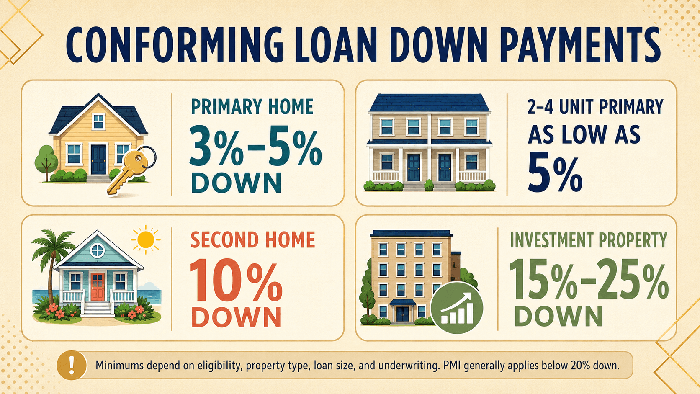
High-Balance Conforming Loan Considerations
A high-balance conforming loan exceeds the standard conforming limit but remains within the higher limit available in an eligible high-cost county. For 2026, the baseline limit for a one-unit property is $832,750, while the general high-cost ceiling is $1,249,125. Actual limits depend on the county and number of units, with separate statutory limits applying in Alaska, Hawaii, Guam, and the U.S. Virgin Islands. Under current conforming down payment guidelines, an eligible one-unit primary residence may qualify for a high-balance loan with as little as 5% down. The 3% down or 97% LTV option is not available for high-balance loans. Fannie Mae also requires high-balance loans to be underwritten through Desktop Underwriter. Down payment requirements can increase substantially for multi-unit, high-balance properties. Fannie Mae generally limits a two-unit high-balance primary residence to 85% LTV and a three- or four-unit property to 75% LTV. Freddie Mac’s super-conforming limits generally allow up to 85% LTV for a two-unit primary residence and 80% for a three- or four-unit primary residence. The minimum down payment ranges from 15% to 25%, depending on the agency and the number of units. High-balance loans may also have different pricing, reserve, appraisal, and mortgage-insurance considerations. Rates are not automatically higher than those for every standard conforming or jumbo loan, so borrowers should compare the interest rate, PMI, total monthly payment, and cash required at closing. See the complete high-balance conforming loan guidelines for county limits and program-specific requirements.
Steps to Determine Your Required Down Payment
The minimum down payment cannot be determined from the purchase price alone. Use the following process to apply the correct conforming down payment guidelines to the transaction:
- Confirm the intended occupancy. Determine whether the property will be a primary residence, second home, or investment property. Occupancy directly affects the maximum LTV and minimum down payment.
- Identify the property type and number of units. A one-unit home, two- to four-unit property, condominium, co-op, or manufactured home may have different eligibility and LTV requirements.
- Check the county loan limit. Use the property location and number of units to determine whether the mortgage is standard conforming, high-balance conforming, or above the applicable conforming limit.
- Identify the applicable Fannie Mae or Freddie Mac option. Certain one-unit primary-residence programs allow a 3% down payment, while others may require 5%. Second homes and investment properties generally require more. The agency eligibility matrix establishes the maximum available LTV, not automatic approval for every borrower.
- Obtain automated underwriting findings. The lender should submit accurate income, debts, credit, assets, occupancy, loan terms, and property information through Desktop Underwriter or Loan Product Advisor. If the loan does not receive an acceptable result at the maximum LTV, a larger down payment may strengthen the file.
- Verify the source of funds. Confirm whether the down payment will come from personal savings, gift funds, a grant, employer assistance, or an eligible second mortgage. Some transactions require a minimum contribution from the borrower’s own funds.
- Calculate the complete cash requirement. Add the down payment, closing costs, prepaid taxes and insurance, and required reserves. Then subtract the earnest-money deposit, eligible credits, gifts, and approved assistance. Seller and lender credits generally help with eligible closing costs rather than replacing the required down payment.
- Review the appraisal and final underwriting conditions. The LTV is generally calculated using the lower of the purchase price or appraised value. A low appraisal may increase the cash needed unless the price or loan terms are renegotiated.
Borrowers should compare several down-payment options before closing. The lowest permitted percentage may preserve savings, while a larger down payment may reduce PMI, improve pricing, lower the monthly payment, or help the loan receive an acceptable underwriting result.
Final Thoughts on Conforming Down Payment Guidelines
Down payment guidelines allow flexibility, but there is no minimum applicable to every homebuyer. While some qualified borrowers can purchase a primary residence with as little as 3% down, multiunit homes, second homes, investment properties, and high-balance loans often require much more down payment. The final amount required will depend on the occupancy, property type, loan amount, agency eligibility, and findings from the underwriting process. Just because the required minimum down payment is the lowest available does not mean it is the most cost-effective. While a low down payment can help preserve savings, it increases the overall cost of the loan by requiring private mortgage insurance and often raises the monthly cost as well. A higher down payment can help eliminate the need for PMI, secure a better interest rate, lower the debt-to-income ratio, and improve automated underwriting results. Before making an offer, homebuyers should receive a full mortgage pre-approval and evaluate different down payment options. Funding sources, reserves, estimated private mortgage insurance, total cash needed to close the loan, and the number of units permitted in the county must all be confirmed by the lender. With pre-approval, potential home buyers can make more informed decisions than if they based their down payment on advertised rock-bottom minimums.
FAQs About Conforming Down Payment Guidelines
How Long Must Down-Payment Funds Be in My Bank Account?
Funds do not automatically need to remain untouched for 60 days. However, Fannie Mae’s Desktop Underwriter commonly requires two consecutive monthly bank statements for purchase transactions. Recent large deposits may be acceptable, but the lender must document an eligible source when those funds are needed for closing or reserves.
Can I Use a Personal Loan for a Conforming Loan Down Payment?
Do not assume an unsecured personal loan will be accepted. Fannie Mae does not allow unsecured loans, like signature loans or credit card lines, to be used for down payments, closing costs, or reserves. Borrowed funds secured by an eligible asset may be acceptable when properly documented.
Can I Use a 401(k) or IRA for the Down Payment?
Vested retirement assets may be used for the down payment and closing costs when the borrower owns the account, can access the money, and satisfies the plan’s withdrawal or loan requirements. The lender may need evidence of liquidation or receipt of funds before closing. Borrowers should also consider possible taxes, penalties, loan payments, and the effect on long-term retirement savings.
Can Stocks or Mutual Funds Be Used Without Selling Them Immediately?
Vested stocks, bonds, and mutual funds are acceptable assets when ownership and value can be verified. Whether they must be sold before closing depends on how much verified cash the borrower already has and whether the investment proceeds are needed to complete the transaction. Market fluctuations may affect the amount the lender will recognize.
Can Proceeds From Selling My Current Home Fund the Down Payment?
Yes. If the sale proceeds are needed to purchase the new home, the lender must verify the net amount available from the sale. Fannie Mae generally requires the settlement statement from the existing home before or at the same time as the new-home closing. A listing agreement or an unsigned estimate does not verify available proceeds.
Can Cryptocurrency Be Used for a Conforming Down Payment?
Under Fannie Mae’s standard asset rules, cryptocurrency must be exchanged into U.S. dollars and deposited with a regulated U.S. financial institution before it can be used for the down payment, closing costs, or reserves. The lender must verify the conversion and the resulting U.S.-dollar funds. A separate loan secured by cryptocurrency is a different financing arrangement and requires its own eligibility review.
Can Undocumented Cash Savings Be Used for the Down Payment?
Cash kept outside a verifiable account is generally not an acceptable source under standard Fannie Mae rules. A limited HomeReady exception may apply when the borrower customarily uses cash, the savings pattern is reasonable, and the funds are deposited and documented in accordance with program requirements. Borrowers should disclose cash savings early rather than depositing a large unexplained amount shortly before closing.
Can Sweat Equity Replace Part of the Cash Down Payment?
Generally, no. Fannie Mae accepts sweat equity only for certain eligible HomeReady transactions that satisfy specific property, labor, appraisal, and documentation requirements. Work performed by the borrower should not be counted as down-payment funds unless the lender confirms eligibility before the work begins.
This article about “Conforming Down Payment Guidelines for Homebuyers” was updated on August 26th, 2026.