
This guide covers how to prepare for a mortgage for first-time homebuyers. The best way on how to prepare for a mortgage is to first consult with a loan officer. Do not just talk to one loan officer but many loan officers and due to your own research. Dale Elenteny, a senior mortgage loan originator at Gustan Cho Associates, says the following about how to prepare for a mortgage for first-time homebuyers:
Follow 2026 mortgage prep steps for first-time buyers: improve credit, budget hidden costs, compare lenders, and avoid rookie mistakes for homeownership success.
As you talk to more loan officers, you will get different answers to your questions so that is where doing your own research comes in. In this article, we will discuss and cover how to prepare for mortgage for first-time homebuyers. In the following paragraphs, we will cover how to prepare for a mortgage for first-time homebuyers.
How To Prepare For A Mortgage For First-Time Homebuyers
Check Your Credit Score—The First Step Toward A Great Mortgage
The best way to kick off your journey toward a home is to look at your credit score. Lenders use this three-digit number to decide how likely you are to repay a loan. For a conventional mortgage, a score of at least 620 is the minimum, but if you can get it to 740 or higher, you’ll unlock the best interest rates.
You can get free credit reports from all three bureaus—Equifax, Experian, and TransUnion—once a year at AnnualCreditReport.com. After you get the reports, look for mistakes, old debts, or anything that should not be there. These can drag your score down.
If you’re getting ready for a mortgage and want to improve your credit score, make sure to pay your bills on time, try to pay down those high credit card balances, and steer clear of taking out new loans or credit cards in the months leading up to your application. The better your score, the better the loan you’ll get, saving you thousands in interest over time. Fixing your credit is the first and most important step in how to prepare for a mortgage approval.
First-Time Buyer? We’ve Got Your Back
Preparing for your first mortgage doesn’t have to be overwhelming — we’ll show you how.Saving for a Down Payment: Smart Tips for First-Time Homebuyers Getting Ready for a Mortgage
The most important part of getting ready for a mortgage is saving for a down payment. This is usually between 3% and 20% of the home’s price. First-time buyers can look at FHA loans, which let you put down just 3.5%, while most conventional loans require 5% or more. Start by choosing a realistic target amount based on the home price you expect in your area by 2026.
Set up automatic transfers to a high-yield savings account so your money grows without extra effort. To speed things up, cut back on things you don’t need, like takeout meals or extra streaming services.
Check for down payment assistance programs from your state housing agency or workplace. These programs might offer grants or low-interest loans to help. The bigger your down payment, the smaller your loan will be, which means smaller monthly payments and a higher chance of skipping private mortgage insurance, or PMI. This puts you in a better spot when you start house shopping.
Many buyers assume they need 20% down to buy a home, but that is not always the case. In fact, some conventional loans allow for lower down payments, and FHA loans may enable qualified borrowers to purchase with as little as 3.5% down.
When considering how to prepare for a mortgage, it’s important to understand that a larger down payment can reduce your loan balance and monthly payments, while also helping you avoid private mortgage insurance. On the other hand, putting less down can be advantageous if it allows you to maintain emergency savings after closing. Overall, preparing for a mortgage involves evaluating both your immediate cash needs and your long-term monthly budget.
Getting Pre-Approved: A Smart Move for Rookie Homebuyers
Getting a mortgage pre-approval can boost your homebuying confidence as a first-timer. During this step, a lender looks at your income, assets, debts, and credit score to give you a written estimate of how much money you can borrow. A solid pre-approval tells sellers you mean business and can close the deal faster.
To find the best deal, reach out to at least three lenders. Check interest rates, closing costs, and loan terms. Online mortgage calculators can help you figure out how much you can afford.
With interest rates changing in 2026, locking in early pre-approval can help you avoid higher costs later. Always submit clear and accurate paperwork to keep the process speedy. Most pre-approvals last between 60 and 90 days, so you’ll have enough time to find the right home while showing you’re financially ready to buy.
Choosing the Right Mortgage Type: A Simple Guide for First-Time Homebuyers
Picking the right mortgage is one of the biggest steps when getting ready for a mortgage, especially if it’s your first time. You’ll usually see these main types: Conventional loans need a solid credit score and a down payment that starts around 3%. FHA loans are great if your credit isn’t perfect; they ask for just 3.5% down, but do have mortgage insurance.
VA loans are for qualifying veterans and require no down payment at all. USDA loans are for folks buying in rural areas and come with no down payment.
You’ll also need to decide between a fixed-rate mortgage, where the payment stays the same for 15 or 30 years, and an adjustable-rate mortgage (ARM), which starts lower but can go up. Think about how long you plan to live in the home. If you want to plant roots for a long time, the fixed-rate loan may be a better pick. Visiting a mortgage advisor can help you find the choice that fits your budget and matches your long-term goals, especially with the mortgage market changing in 2026.
Budgeting for Additional Costs: Hidden Expenses in Mortgage Preparation
First-time homebuyers must look beyond the down payment when getting ready for a mortgage. Closing and ongoing expenses can sneak up on you and usually add up to 2-5% of the loan amount. These costs include the appraisal fee to value the home, title insurance to protect your ownership, the origination fee the lender charges to process the loan, and the initial escrow setup for property taxes and insurance.
You also have to think long-term. Property taxes, homeowners’ insurance, and any homeowners’ association (HOA) fees can vary greatly based on where you live.
A budget app or a simple spreadsheet can help you track all monthly payments, including principal, interest, taxes, and insurance—often called PITI. Keep an eye on the market: in 2026, home prices are expected to keep climbing, so adding a little cushion to your estimates is wise. Do not wipe out your emergency savings. After you close on the home, you should still have 3 to 6 months’ worth of living expenses set aside.
By planning for these hidden costs, you can avoid financial stress and enjoy a smoother move into your new home.
Getting approved for a certain loan amount does not always mean that amount is the right fit for your budget. Before you apply, look at your full financial picture, including debts, daily living expenses, savings goals, and how much cash you want to keep after closing. Preparing for a mortgage means choosing a payment that feels manageable month after month, not simply stretching to the highest amount a lender may approve.
Getting Your Documents Ready: Making Your Mortgage Application Smoother
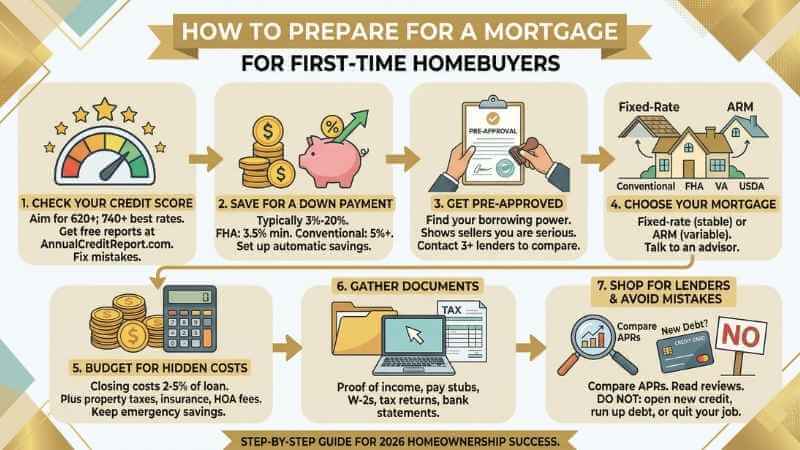 Having the right paperwork ready is the secret to getting a mortgage easily. Lenders usually ask for some info: proof of income like pay stubs, your last two W-2 forms, and two years of tax returns. You’ll also need to confirm where you work, share recent bank statements, show a form of ID, and list any other debts or valuable assets you own. The bank might also want monthly profit and loss statements if you’re self-employed.
To stay organized, create digital folders for each document type so everything is just a click away. In 2026, most lenders will still prefer you to upload your documents straight to their secure portals.
Submitting them digitally speeds things up, but make sure you upload everything they ask for. They might ask for more info if something is missing, which can slow you down. The sooner you hand over a complete set of papers, the faster you can get a thumbs-up. With the paperwork out, you’ll have more time to find the home you want. When considering how to prepare for a mortgage, it’s important to keep your bank statements clean and organized. Avoiding large unexplained deposits or repeated overdrafts can help mitigate any concerns during the loan review process. Maintaining stable account activity and keeping detailed records of major transfers will contribute to a smoother application experience.
Shopping for Lenders: How to Score the Best Mortgage Rates
If you’re a first-time homebuyer, comparing lenders is one of the smartest moves you can make before you buy a house. Start by asking a mix of banks, credit unions, online lenders, and mortgage brokers for quotes. Zero in on the annual percentage rates (APRs) since these numbers include both the loan cost and the fees.
Don’t forget to ask if you can get a break to set up autopay or join a special first-time buyer program. Many experts think rates might drop in 2026, so carefully timing your search could pay off.
Take a few minutes to read reviews and check lenders’ records on the Better Business Bureau or the Consumer Financial Protection Bureau (CFPB) database. If you opt for a mortgage broker, ask them up front what they charge to avoid surprise costs. Being a smart shopper might lower your interest rate by half a percent or more, which means you could save a ton of money over the life of the loan.
Comparing lenders is crucial when learning how to prepare for a mortgage, as rates, fees, and qualifying criteria can vary significantly among lenders. Getting quotes from different lenders can help you find a mortgage that better fits your credit situation, budget, and financial goals.
This step is essential for ensuring that you make an informed decision during the mortgage process. Comparing lenders is important because rates, fees, and qualifying flexibility can vary from one lender to another. Getting quotes from more than one source can help you find a mortgage that better fits your credit profile, budget, and goals.
Steering Clear of Costly Mistakes: Mortgage Prep Missteps Every First-Time Buyer Should Skip
When buying your first home, it’s easy to trip over simple mistakes if you’re not careful about mortgage prep. First, never limit your budget. That exposes you to surprise repairs and life curveballs. Second, always insist on a home inspection. It’s your chance to catch deal-breaking issues before you sign.
Don’t take on a big new loan or switch jobs until you get the keys. Either one can sink your approval. Fourth, improve your credit and lock your mortgage rate when the market wobbles.
A slip can cost you thousands. Finally, in 2026’s unpredictable economy, stay updated through Fannie Mae and the CFPB. Avoiding these slips puts you on the smooth, confident road to homeownership.
Boost Your Chances of Approval
With the right prep, first-time buyers can qualify faster and with better terms.Final Steps to Prepare for a Mortgage
Before you apply for a mortgage, focus on the steps that strengthen your file and protect your budget. Review your credit, pay bills on time, avoid taking on new debt, and keep your job and income stable. Build your down payment and emergency savings, gather your documents early, and compare multiple lenders before choosing a loan. These simple steps can help you qualify more smoothly and avoid surprises during the mortgage process
Monthly Housing Expenses for Homeowners
When learning how to prepare for a mortgage, it’s essential to consider more than just the loan payment. Your overall monthly expenses for housing may consist of principal, interest, property taxes, homeowners’ insurance, and, if required, mortgage insurance. Additionally, you’ll want to account for homeowners’ association dues, utilities, internet, cable, and routine maintenance. Many first-time buyers focus only on the estimated mortgage payment, but the real cost of owning a home is often higher once other expenses are factored in. Reviewing your full monthly budget before you apply can help you choose a payment that feels comfortable and avoid becoming house-rich and cash-poor.
Ask Questions Before You Apply for a Mortgage
When learning how to prepare for a mortgage, it’s essential to ask clear questions early in the process. Inquire with lenders about the credit score you may need, the required down payment, expected closing costs, and the documents you’ll need to gather. Additionally, determine how much the monthly payment fits your budget and how long the pre-approval lasts. You should also ask about any programs that may suit your financial situation. The more you understand before applying, the more confident and prepared you will be during the mortgage process. Preparing for a mortgage takes time, planning, and the right information. Knowing how to prepare for a mortgage involves reviewing your credit, organizing your finances, building savings, and comparing lenders early on. By taking these steps, you can approach the mortgage process with more confidence. If you’ve got more questions about your mortgage options, speaking with a friendly loan officer can help you figure out what to do next for your situation.
Frequently Asked Questions About How to Prepare for a Mortgage:
What Should I Do First When Preparing for a Mortgage?
The first step is to review your credit report, check your credit score, and fix any errors you find. After that, review your monthly budget, estimate the payment you can realistically afford, and start gathering the basic documents lenders typically request.
How Much Money Should I Save Before Applying for a Mortgage?
You should prepare for more than just the down payment. Buyers also need money for closing costs, and many mortgage prep guides recommend keeping emergency savings in place so you do not stretch your budget too thin after closing.
What Credit Score do I Need to Prepare for a Mortgage?
There is no single score that works for every mortgage program, but your credit score has a major effect on approval options and pricing. In general, a stronger score can improve your loan choices and help you qualify for better terms, so it is smart to work on your credit before you apply.
What Documents Do I Need to Prepare for a Mortgage Application?
Most lenders will want recent pay stubs or other proof of income, bank statements, W-2s or tax returns, identification, and details about your debts and assets. Getting these documents organized early can make the mortgage process smoother and help prevent delays.
Should I Get Pre-Approved Before I Start Shopping for a Home?
Yes. Getting pre-approved early can help you understand how much you may be able to borrow and give you a clearer price range before you start house hunting. It can also make you look more prepared when you are ready to make an offer.
What Should I Avoid Doing While Preparing for a Mortgage?
When considering how to prepare for a mortgage, it’s very important to avoid opening new credit accounts, taking on large debts, missing payments, or making financial moves that could destabilize your budget before you apply. Mortgage preparation guides consistently highlight the importance of maintaining stable finances during this time.
This article about “How To Prepare For a Mortgage For First-Time Homebuyers” was updated on April 2nd, 2026.