
Quick answer: An FHA 20(3k) contractor doesn’t need HUD approval or to be on a HUD contractor list. They have to meet the applicable local licensing and bonding requirements and pass the lender’s review of their qualifications, bid, and ability to do the work. A HUD-approved 203(k) consultant is a different type of person altogether. You need one for a Standard 203(k), and it’s optional for a Limited 203(k). Before you hire anyone, you should compare detailed bids and find out how the permits, renovation drawings, and completion date will work.
Does an FHA 203(k) Contractor Have to Be HUD Approved? No. HUD maintains a roster of approved 203(k) consultants, not a roster of approved contractors. A contractor does not become “HUD certified” to work on your project. The lender reviews the contractor’s credentials, experience, references, and bid. The contractor must also meet licensing and bonding requirements where the local jurisdiction requires them. Ask about insurance coverage appropriate for the work and any additional documentation the lender needs before you sign an agreement.
FHA 203(k) Contractor vs. FHA 203(k) Consultant
The contractor and the 203(k) consultant have different jobs.
FHA 203(k) Contractor
The FHA 203(k) contractor performs the renovation work. The contractor provides bids, obtains the required permits, completes the approved repairs, submits payment documentation, and works within the approved rehabilitation budget and schedule.
FHA 203(k) Consultant
The consultant does not perform the renovation work. On a Standard 203(k), the HUD-approved consultant inspects the property, prepares the Work Write-Up and Cost Estimate, inspects completed work for draw requests, and helps document applicable changes to the rehabilitation plan. A HUD-approved consultant is required for a Standard 203(k). Using one on a Limited 203(k) is optional.
Limited 203(k) vs. Standard 203(k) Contractor Requirements
The contractor’s responsibilities depend partly on which version of the 203(k) program is being used.
Limited 203(k)
A Limited 203(k) is designed for eligible nonstructural repairs and improvements. The current maximum total rehabilitation cost is $75,000. A 203(k) consultant is not required, although the borrower and lender may choose to use one. The contractor’s detailed estimate is an important part of establishing the project’s cost and scope.
Standard 203(k)
A Standard 203(k) can be used for larger rehabilitation projects, including eligible structural work, with a minimum rehabilitation cost of $5,000. A HUD-approved 203(k) consultant is required. The consultant prepares the Work Write-Up and Cost Estimate and remains involved in inspections and draw requests throughout the project.
What Should You Look for in an FHA 203(k) Contractor?
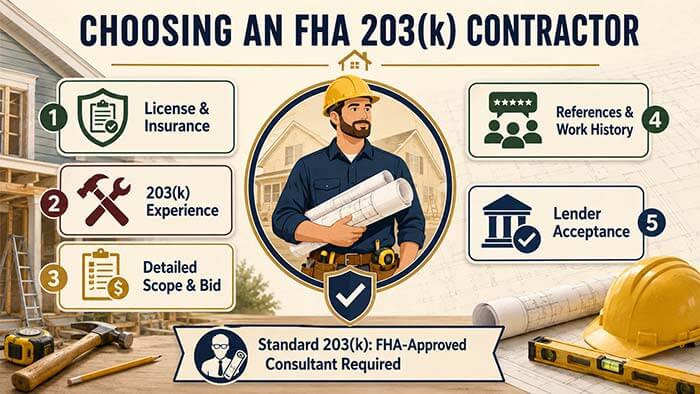
Start with the work you actually need done. Ask each contractor about similar completed projects, current references, required licenses, bonding where applicable, insurance, permits, and who will supervise subcontractors. Call the references and ask whether the job finished close to its original price and schedule.
Discuss payment before choosing a contractor. Ask whether the contractor can pay workers and suppliers between draws and whether they have accounted for inspections, possible holdbacks, and the final payment.
Familiarity with 203(k) loans is helpful, but a contractor who understands and adheres to the actual payment schedule is more valuable than one who advertises 203(k) experience. Finally, ask for a realistic start date and a schedule that allows time for permits, materials, inspections, and unexpected repairs. A promise to finish quickly is less useful than a plan that explains how the work will get done.
Found a Fixer-Upper? Turn It Into Your Dream Home With an FHA 203(k) Loan!
Choosing the right contractor is an important step in securing FHA 203(k) renovation financing. Gustan Cho Associates helps borrowers understand contractor eligibility, renovation requirements, and the mortgage approval process so they can move forward with confidence.FHA 203(k) Contractor Bids and Scope of Work
Get a written bid that details each repair, proposed materials, labor costs, permit costs, and any subcontracted work. It should state what is excluded, who is to remove the debris, when the work is expected to start and finish, and when the contractor expects to ask for payment. The lender may require a specific format or want a more detailed cost breakdown. Compare bids against the same work plan, not just against each other on total price. If one roof bid includes disposal and permit costs and the other doesn’t, then the lower price doesn’t necessarily mean the one with disposal and permit costs is the cheaper one. Get both contractors to clarify what’s included and what’s not before you make your decision. For a Standard 203(k), compare the bid against the consultant’s Work Write-Up and Cost Estimate. Wherever possible, resolve any differences before closing, as they can become a budget issue once the work commences. An omitted repair or an unrealistic allowance can be a real problem at that stage.
How FHA 203k Contractors Get Paid
The lender holds rehabilitation funds in escrow and releases them under the approved draw process. Contractors should not assume they will receive the entire renovation budget at closing. Work completed, required inspections, properly executed draw requests, and the lender’s disbursement rules all affect payment.
Standard 203(k) Draws
With a Standard 203(k) loan, a HUD-approved consultant checks the finished work before the lender releases funds.
Limited 203(k) Draws
In June 2026, HUD changed the Limited 203(k) rules. Now, each contractor can request up to four draws: one at closing, up to two in the middle, and one final draw. These are just the maximums—some projects may use fewer draws, and not all requested amounts are paid in advance. HUD made this change to help contractors with cash-flow issues. Before work begins, ask your lender for the planned draw schedule and review it with your contractor. If your contractor wants a separate deposit, check with your lender first to see how that payment fits into your loan and construction agreement.
How Long Does an FHA 203 (k) Contractor Have to Finish the Work?
The approved rehabilitation period cannot exceed 12 months for a Standard 203(k) or nine months for a Limited 203(k).
If delays occur, contact the lender promptly about the available options; do not assume an extension will be granted.
The contractor’s proposed schedule should be realistic before closing. Delays involving permits, materials, subcontractors, or inspections can affect the entire renovation.
What Happens If the Scope of Work Changes?
Unexpected repairs sometimes appear after renovation begins. An FHA 203k contractor should not make major changes to the approved scope of work without going through the required 203(k) process. On a Standard 203(k), the consultant helps document applicable changes when work needs to be added, removed, or modified. The lender decides whether the revised work and funding are approved. Discuss the cost, timeline, and funding source before authorizing a change; do not assume escrow will cover it.
Can You Change Contractors During an FHA 203(k) Project?
A contractor can sometimes be replaced, but borrowers should not assume they can terminate one contractor and hire another without consequences.
HUD’s borrower acknowledgment warns that changing contractors may leave the borrower responsible under the original contractor agreement and recommends obtaining legal advice before taking that step.
A contractor change may require a new agreement and bid, updated credentials, and an accounting of completed work and remaining escrow funds. Contact the lender before hiring a replacement or requesting another draw. The consultant should be involved in a Standard 203(k). Unpaid subcontractors, potential liens, and the completion deadline may affect the next steps.
Can the Borrower Do Their Own FHA 203k Repairs?
Possibly, but borrower self-help requires lender approval. HUD requires the lender to document that the borrower is either a licensed general contractor or has relevant rehabilitation experience and the ability to complete the specific work competently and on time. The borrower must also maintain records of actual costs, obtain required permits, provide lien waivers from subcontractors when applicable, and sign the required self-help agreement. Even when self-help is approved, only the cost of materials is reimbursable, not the borrower’s own labor. Self-help should therefore be discussed with the lender before the renovation budget is finalized.
How Gustan Cho Associates Helps Review the Contractor Plan
Gustan Cho Associates can help you gather the contractor’s bid, credentials, proposed schedule, and renovation documents early in the loan process. We can also help identify questions about the scope or draw schedule that should be resolved before closing. The FHA-approved lender conducts the required contractor review and makes decisions regarding the rehabilitation escrow and disbursements.
FAQs About FHA 203(k) Contractors
Can a Limited 203(k) Contractor Receive Money at Closing?
An initial draw at closing is allowed under the Limited 203(k) rules. The amount and method of payment must follow the lender’s approved disbursement arrangement. It does not mean the contractor receives the entire renovation budget at closing.
Can I Use More Than One Contractor?
Yes, a project may use more than one contractor. Give the lender a clear scope and cost estimate for each contractor, along with the agreements and qualification documents the lender requests. Discuss how draws will be scheduled for each contractor.
What If the Lender Does Not Accept My Contractor?
Ask which requirement the contractor did not meet. The contractor may be able to provide missing documents or revise an incomplete bid. If the issue cannot be resolved, you may need another contractor and a new estimate before the loan can proceed.
What If the Bid Is Higher Than the Approved Renovation Budget?
Do not assume the difference can be paid from the loan. Ask the lender and, on a Standard 203(k), the consultant whether the scope or budget can be revised and what funds would be needed. Resolve the shortfall before authorizing additional work.
What If the Contractor Stops Working or Misses the Schedule?
Tell the lender promptly and contact the consultant on a Standard 203(k). Document the work completed and payments made. The lender will need to review the remaining escrow balance, any unpaid bills or liens, and the time remaining to complete the project before a replacement takes over.
Does the Contractor Need Prior FHA 203(k) Experience?
HUD does not require a contractor to be on a special 203(k) contractor roster. Relevant construction experience and the ability to meet the lender’s requirements matter most. Before hiring a contractor who has never done a 203(k) project, make sure they understand the approved scope, inspections, escrow draws, and payment timing.
Final Thoughts on Choosing an FHA 203(k) Contractor
Choose a contractor who can explain precisely what the bid covers, who can demonstrate they can do the work, and who can work within the loan’s approved schedule and draw process. Having clear expectations before closing will go a long way to minimizing the impact of any surprises when the renovation actually gets underway.
This article about “FHA 203(k) Contractor Guidelines: How to Choose a Contractor for a Rehab Loan” was updated on November 20th, 2026.