
In the mortgage world, credit reports are not updated each time there is a payment by the borrower.
An example could be a borrower paying off a credit card today, while the mortgage credit report pulled a week earlier may still show the credit card balance. If the account can affect the borrower’s qualification, underwriting may need updated information showing the current account status.
This may be the reason a lender requests a credit supplement. The same would be true if the credit report shows the monthly payment is incorrect, the account has been closed, a payoff has not been reported, or the payment history is incomplete.
What Is a Credit Supplement for a Mortgage?
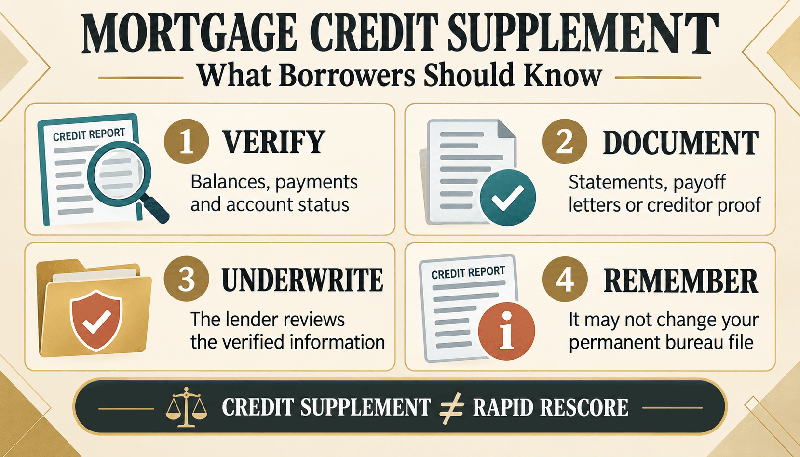
A credit supplement is an item-specific verification that a mortgage lender orders through its credit-report provider. It is commonly requested when information on the original mortgage credit report is missing, outdated, incomplete, or inconsistent with the borrower’s current records. The supplement may verify an account balance, required monthly payment, payoff or zero balance, account status, or recent payment history. It may also help document that significant derogatory credit information was reported incorrectly. The borrower may be asked to provide a current account statement, payoff confirmation, payment receipt, bank statement, canceled check, or letter from the creditor. Once the information is verified, it becomes part of the mortgage file for the underwriter to review. The supplement does not automatically change the borrower’s credit score, remove a debt from the DTI calculation, or guarantee mortgage approval.
Credit Supplement vs. Rapid Rescore
A credit supplement and a rapid rescore solve different problems.
A credit supplement provides more detail to the underwriter on a particular account. It may confirm a zero balance when the credit report still shows an outstanding balance.
It does not necessarily change what Equifax, Experian, or TransUnion are reporting. A rapid rescore may be used when a mortgage lender needs qualifying updated information reflected on a credit report sooner than waiting for the creditor’s normal reporting cycle. For example, if a borrower pays down a large credit-card balance before closing, the lender may request a rapid rescore so the updated balance is reflected and a new credit score can be obtained. A higher score is not guaranteed. The new score can go up, go down, or stay about the same.
Does a Credit Supplement Affect Your Credit Score or Update the Credit Bureaus?
A credit supplement generally verifies updated information for the lender’s underwriting file. It does not, by itself, recalculate the borrower’s credit score or necessarily correct the borrower’s permanent consumer files with Equifax, Experian, and TransUnion. For example, a supplement may confirm that a credit card has been paid to a zero balance even though the original mortgage credit report still shows the previous balance. The underwriter can review that verified information, but the borrower’s consumer credit reports and scores may remain unchanged. If the underlying bureau information must be updated or corrected, the lender may require a rapid rescore, a creditor update, a formal dispute, a new credit report, or another credit-reporting process. The appropriate method depends on what needs to be verified, the credit-report provider’s procedures, and the applicable mortgage guidelines.
What Happens if the Credit Report Shows Incorrect Information?
Credit report inaccuracies do happen. An account may be paid but still show an unpaid balance. An account may be closed but continue to show as open. The credit report may show an incorrect monthly payment. Negative information may also have been reported in error. When significant derogatory credit information has been reported in error, Fannie Mae allows the lender to support the error with documentation that may include:
- A credit supplement
- A new mortgage credit report
- Documentation from the creditor that reported the information
The emphasis is on documentation. A credit supplement can help document a legitimate reporting error. It cannot be used to disregard accurate negative credit information.
Nontraditional Credit and Housing Payment History
Nontraditional credit refers to payment histories that may not appear as traditional accounts on a borrower’s consumer credit reports. Depending on the mortgage program, examples may include rent, utilities, insurance, telephone service, or other recurring financial obligations.
These payment histories are not automatically added as conventional tradelines to Equifax, Experian, and TransUnion. The lender can either gather eligible nontraditional credit information directly from the borrower or the creditor, or acquire a nontraditional mortgage credit report from a consumer reporting agency.
Housing payment history is crucial for borrowers with limited traditional credit. Fannie Mae generally requires the most recent 12 consecutive months of housing payments when its nontraditional-credit requirements apply. Acceptable documentation may include canceled checks, bank statements, money orders, other evidence of consistent payments, or direct verification from the landlord. The documentation should identify the payee, payment amount, and payment pattern. Requirements differ by loan program and underwriting method. A standard credit supplement used to verify an existing account should not be confused with establishing a complete nontraditional credit history. See Fannie Mae B3-5.4-03 and GCA’s guide to nontraditional credit for mortgage qualification.
Can Borrowers Order a Credit Supplement?
When a mortgage credit-reporting company is handling the file, it is usually the lender that requests the supplement. Borrowers may need to provide documents like a bank statement, current account statement, or payoff statement. The lender determines what needs to be verified and what supporting documentation is acceptable for the mortgage file. If the credit report contains an error, the borrower also has the right to dispute inaccurate information with the creditor or applicable credit reporting agency.
How Long Does a Credit Supplement Take?
Each situation is different, and there is no set timeframe for every request. Confirming a balance or payment may happen fairly quickly. Other requests can take longer.
Slow creditor responses, incomplete documents, or an account history that requires additional research can all affect the turnaround time.
For this reason, borrowers should not expect every supplement request to be completed within three to five business days.
How Could a Credit Supplement Affect Mortgage Approval?
Verified information from a credit supplement can change how the loan is underwritten. For example, the supplement may confirm that a monthly debt is lower than what appeared on the original credit report. It may show that an account has been paid off, verify satisfactory payment history, or confirm that negative information was reported incorrectly. The verification may also show that a debt still needs to be counted. It may create another underwriting condition that has to be cleared. If the verified information changes material data used to underwrite the loan, the lender may need to update the information and resubmit the casefile through the applicable automated underwriting system. A credit supplement may help clear an underwriting condition, but it does not guarantee mortgage approval.
Need Updated Credit Information Before Closing?
A lender may use a credit supplement to confirm balances, payment history, account status, or other details that are not clearly reflected on the original credit report.Credit Supplement Example
This is only a hypothetical example. A borrower applies for a mortgage, revealing a credit card balance of $6,000 with a monthly payment of $180. Before closing, the borrower pays the account to zero using documented funds. The credit-card company has recorded the payoff, but the zero balance has not yet been reflected on the mortgage credit report. The lender accepts documentation of the payoff and requests a credit supplement. The supplement verifies that the current balance is zero. The underwriter must then determine whether the associated monthly payment can be excluded from the borrower’s debt-to-income ratio. A zero balance does not automatically allow the removal of every debt payment under every mortgage program. For a conventional loan, Fannie Mae generally allows payment on a revolving account that is paid off at or before closing to be excluded from the DTI calculation. The account does not necessarily have to be closed. FHA, VA, USDA, non-QM, and individual investor requirements may differ. Whether a payment can be excluded depends on the debt type, loan program, payoff timing, supporting documentation, source of payoff funds, remaining assets, and underwriting findings.
Avoiding Credit Mistakes When Applying for a Mortgage
A credit supplement can resolve an underwriting concern, but it is not a credit-repair solution. One mistake borrowers make is moving balances or paying off debt without first discussing the change with their loan officer.
A change may affect more than the credit report. It can also affect available funds, reserves, DTI, or automated underwriting results.
Borrowers should not assume a credit supplement will raise their credit score, update all three credit bureaus, remove accurate negative credit information, automatically remove a debt from DTI, or produce the same result as a rapid rescore. The best approach is to determine exactly what underwriting needs before making changes to credit or paying off debt. Sometimes a supplement is the answer. Other times a rapid rescore, new credit report, creditor verification, bureau reinvestigation, or formal bureau correction may be needed.
Final Thoughts on Credit Supplements
A credit supplement can help resolve a specific underwriting question when information on a mortgage credit report is missing, outdated, or unclear. However, it is not the same as a rapid rescore, formal credit dispute, or permanent correction to the borrower’s consumer credit files. Before paying off debt, closing an account, or disputing credit information, speak with your loan officer. A change intended to help could affect available funds, reserves, debt-to-income ratios, credit scores, or automated underwriting results. The Gustan Cho Associates team can review the credit issue and determine whether the lender may need a credit supplement, creditor documentation, updated credit report, rapid rescore, or another solution. The appropriate approach depends on the borrower’s circumstances, loan program, and applicable underwriting requirements.
Frequently Asked Questions About Credit Supplements
Does a Credit Supplement Cause Another Hard Credit Inquiry?
A credit supplement generally verifies information connected to an existing mortgage credit report. It is not the same as applying for new credit. However, the lender may order a new credit report or a credit refresh separately during the mortgage process. Ask your loan officer whether any additional credit inquiry will be required.
How Much Does a Credit Supplement Cost, and Who Pays for It?
There is no standard nationwide price. The cost depends on the credit-reporting company, the type of verification, and the number of accounts involved. Some lenders absorb the expense, while others may charge the borrower a properly disclosed third-party fee. Your loan officer should explain any costs before ordering the supplement.
Can a Credit Supplement Verify a Student Loan Payment?
A lender may use a credit supplement to confirm a student loan’s current balance, repayment status, or required monthly payment. The payment used to calculate your debt-to-income ratio must still comply with the applicable loan program’s guidelines, even if the supplement shows a different amount.
Can a Lender Request Supplements for More Than One Account?
Yes. A lender may request verification for multiple accounts when several balances, payments, or account statuses require clarification. Depending on the credit vendor, these requests may appear in one supplement or as separate updates. Additional accounts can increase the required documentation, processing time, or costs.
Can a Credit Supplement Verify a Collection, Charge-Off, Judgment, or Tax Lien?
A supplement may be used to verify the balance, ownership, payment status, satisfaction, or reported accuracy of a derogatory item. It does not automatically remove accurate negative information or eliminate any payoff, waiting-period, or documentation requirements imposed by the loan program.
Does a Credit Supplement Expire?
There is no single expiration period that applies to every credit supplement. The lender determines whether the verification is recent enough based on the loan program, the credit report’s age, the expected closing date, and whether the account has changed. An updated supplement or credit report may be required if the information becomes outdated.
This article about “Credit Supplement for a Mortgage: What It Is and How It Works” was updated on September 21st, 2026.