

Freddie Mac asset depletion lets eligible borrowers use some of their assets as income when they have little regular income. This helps self-employed people, business owners, and investors who have valuable assets but don’t have enough W-2 or tax return income to qualify the normal way.
Getting an asset depletion mortgage doesn’t mean you avoid a financial check. The lender will review your assets, confirm they qualify, calculate how much monthly income they can count on, and make sure you follow the Freddie Mac asset depletion mortgage guidelines.
Your Debt-to-income ratio, loan amount versus property value, property type, savings, and ability to repay the loan still matter.
It’s important to know that Freddie Mac asset depletion is different from a non-QM asset depletion loan. Freddie Mac asset depletion is a regular mortgage that follows Freddie Mac’s rules. Non-QM asset-depletion loans are provided by private investors or specialized lenders. They might be more flexible, but often come with different costs, down payment rules, credit requirements, and paperwork.
If you have many assets but little regular income, asset depletion can help you get a mortgage. The key is to find the program that works best for you, whether it’s Freddie Mac asset depletion, non-QM asset depletion, bank statement loans, using retirement income, or another choice.
What is an Asset Depletion Mortgage?

An asset depletion mortgage allows eligible borrowers to use certain assets as qualifying income when they do not have enough traditional income to qualify for a mortgage.
This does not mean the lender gives you income from your assets. It also does not mean every dollar in your account counts as income. Instead, the lender uses a formula to convert eligible assets into monthly qualifying income for underwriting purposes.
For example, a borrower may have strong savings, investment accounts, or retirement accounts but limited W-2 income, self-employment income, or tax-return income. With asset depletion, the lender may be able to use a portion of those assets to help show the borrower has the ability to repay the mortgage.
The calculated asset depletion income is used only for mortgage qualifying. The lender will still review credit, debts, loan-to-value, property type, and all other Freddie Mac mortgage guidelines before issuing an approval.
How Are Assets Used To Determine the Ability to Repay on Asset-Depletion Mortgages?
The percentage depends on the type of account. You can use 70% of stocks and bonds, 60% of retirement funds, and 100% of cash in a savings account. Suppose that you have $300,000 in stocks and bonds.
A lender might multiply that by .7 to get 70%, which is $210,000. Divide that amount by 360 months for a 30-year loan, and you get to add $583 per month to your qualifying income.
Last year, however, Freddie Mac revised its guidelines, and they are a lot more generous. In this article, we will discuss the Freddie Mac asset depletion guidelines. We will detail how to use your assets as qualifying income and review the changes Freddie Mac implemented.
How Freddie Mac Calculates Asset Depletion Income
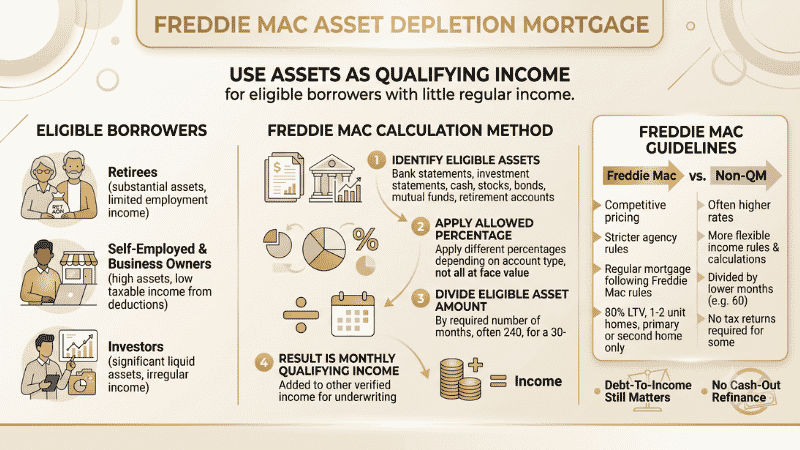
Freddie Mac asset-depletion income is calculated by treating eligible assets as qualifying income on a monthly basis.
The lender does not usually count all assets at face value. Different asset types may be treated differently, and the final calculation must meet Freddie Mac and lender underwriting requirements.
Step 1: Identify Eligible Assets
The lender first reviews which assets may be used for qualifying.
Eligible assets may include:
- Bank accounts
- Savings accounts
- Investment accounts
- Stocks and bonds
- Retirement accounts
- Other acceptable liquid assets
Not every asset automatically qualifies. The lender must verify ownership, access, account type, and documentation.
Step 2: Apply The Allowed Percentage
After identifying eligible assets, the lender determines how much of each asset can be used.
For example, some assets may be counted at a lower percentage than 100%.
This is why borrowers should not assume the full account balance will be used for mortgage qualifying.
Step 3: Divide The Eligible Asset Amount
Once the eligible asset amount is determined, the lender divides that number by the required number of months.
This creates a monthly qualifying income amount.
For example:
- Eligible asset balance: $210,000
- Divided by: 240 months
- Monthly qualifying income: $875
That $875 may then be added to the borrower’s qualifying income for mortgage underwriting.
Step 4: Use The Result As Monthly Qualifying Income
The final number is not cash paid to the borrower.
It is simply the monthly income used for mortgage qualification.
The underwriter may use this calculated income along with other income sources, such as:
- Social Security income
- Pension income
- Retirement income
- Part-time income
- Self-employment income
- W-2 income
- Other verified income sources
Important Freddie Mac Asset Depletion Warning
Asset-depletion income must be accepted by the lender, supported by proper documentation, and approved under Freddie Mac underwriting requirements.
Borrowers should not assume they qualify just because they have assets. The lender still reviews credit, debts, debt-to-income ratio, property type, and overall ability to repay.
Am I Eligible for Freddie Mac Asset Depletion?
Not everyone is eligible for an asset depletion loan under Freddie Mac. You have to meet these requirements. Your maximum loan is 80% of the property value. You cannot use asset depletion for cash-out refinancing. The property must be a 1- to 2-unit primary or second home with no rentals. In addition, you must meet all other Freddie Mac underwriting guidelines—for example, credit score minimums and maximum debt-to-income ratios.
Is There A Minimum Age For Freddie Mac Asset Depletion?
Freddie Mac does not base asset-depletion eligibility solely on age. Retirees often benefit from asset depletion, as they may have substantial assets but limited employment income.
Younger borrowers may also qualify if they have:
- Eligible assets
- Proper asset documentation
- Enough qualifying income after calculation
- Acceptable credit
- Acceptable debt-to-income ratio
- Required reserves, if applicable
- Freddie Mac underwriting approval
Asset depletion is based on the borrower’s eligible assets and ability to repay, not age alone.
What Are The Types of Borrowers Who Benefit From Asset Depletion Mortgages?
Asset depletion mortgages can help anyone with income challenges qualify for a mortgage. This includes retired applicants and those living off their savings (perhaps in addition to social security or pension income).
Self-employed borrowers whose taxes show less income than what’s available to pay their mortgage. Other borrowers need to show more income or have difficulty proving their income.
Asset depletion is an additional tool to help you qualify for a mortgage more easily. Even boosting your qualifying income by $200 a month can make the difference between being approved or declined for a home loan. Related: Non-QM Asset Depletion Mortgages (Tax Returns Not Required)
Explore the difference between Traditional and Freddie Mac Asset Depletion Mortgages
Apply now to find the perfect fit for your financial goals!Traditional vs. Freddie Mac Asset Depletion Mortgages
We have offered asset depletion loans for non-QM mortgages for a long time. Non-QM loans often offer more flexible guidelines; some allow you to deplete higher percentages of assets (90% instead of 70%, for example) or divide assets by lower numbers (for example, 60 months instead of 240 months) to come up with qualifying income. You may not need tax returns to qualify for asset depletion with a non-QM loan. Many Americans do not know that you can obtain a conventional mortgage without the standard forms of income. Non-QM asset depletion loan interest rates are usually slightly higher than Freddie Mac loans.
Mortgage Lenders Experts on Asset-Depletion Loans
While we are unsure what sparked the change in the guidelines, we believe it concerns the average American’s mortgage loan length. Most Americans sell or refinance their home within 5 and 1/2 years. Asset-depletion mortgages can help thousands of Americans qualify for home loans. If you have income challenges but are sitting on a nice nest egg, please contact Gustan Cho Associates for more information. For questions about asset depletion or mortgages, contact Gustan Cho Associates at 262-716-8151. Text us for a faster response. You can also e-mail us at alex@gustancho.com.
Asset Depletion Mortgage Guidelines For Borrowers Without Income
Non-traditional mortgages came to an abrupt halt after the 2008 mortgage meltdown. Popular loan programs such as stated income, no-doc, bank statements, and asset depletion loans abruptly stopped. The good news is that alternative financing is coming back. Gustan Cho Associates now offers the following:
- Non-QM Loans with no waiting period after bankruptcy or foreclosure
- Bank statement loans for self-employed borrowers where no income tax returns are required
- Non-QM Jumbo Loans with credit scores down to 500 FICO
- 90% Loan-To-Value NON-QM Jumbo Mortgages With Low Credit Scores
- Asset Depletion Loan Programs with no income requirements
Freddie Mac Asset Depletion Eligibility Requirements
Freddie Mac asset depletion can help eligible borrowers use certain assets as qualifying income.
However, not every borrower, property, or loan type qualifies.
The lender must verify the assets, calculate the allowable income, and confirm the loan meets Freddie Mac underwriting guidelines.
Eligible Borrowers
Freddie Mac asset depletion may help borrowers with strong assets but limited traditional income.
This may include:
- Retirees
- Self-employed borrowers
- Business owners
- High-net-worth borrowers
- Borrowers with irregular income
- Borrowers with seasonal income
- Borrowers with strong liquid assets but limited W-2 income
- Borrowers whose tax returns do not show enough qualifying income
Can First-Time Homebuyers Use Asset Depletion?
Yes. First-time homebuyers may be eligible for Freddie Mac asset depletion if they meet the requirements.
The main factors are:
- Eligible assets
- Enough qualifying income after calculation
- Acceptable documentation
- Credit history
- Debt-to-income ratio
- Loan-to-value
- Freddie Mac underwriting approval
Can Retirees Use Asset Depletion?
Yes. Retirees are often good candidates for asset depletion.
Many retirees have limited employment income but strong assets, such as:
- Retirement accounts
- Investment accounts
- Savings accounts
- Pension income
- Social Security income
- Asset depletion may help turn eligible assets into qualifying income.
Can Self-Employed Borrowers Use Asset Depletion?
Yes. Self-employed borrowers may benefit from asset depletion.
This can help when tax returns do not show enough qualifying income because of:
- Business deductions
- Write-offs
- Irregular income
- Lower taxable income
- Strong assets but limited documented income
- Possible Restrictions
Freddie Mac asset depletion does not require automatic approval.
Common restrictions may include:
- Loan-to-value limits
- Cash-out refinance limits
- Property type limits
- Credit requirements
- Debt-to-income ratio limits
- Reserve requirements
- Asset documentation rules
- Freddie Mac underwriting rules
- Lender-specific requirements
Loan-To-Value Limits
Some asset depletion loans may require lower loan-to-value ratios.
That means the borrower may need:
- More equity on a refinance
- A larger down payment on a purchase
Documentation Requirements
The lender must verify the assets being used.
Borrowers may need:
- Bank statements
- Investment account statements
- Retirement account statements
- Proof of account ownership
- Proof of access to funds
- Large deposit documentation, if required
- Other documents requested by the underwriting
Important Borrower Note
Having assets does not automatically mean mortgage approval.
Asset depletion income must be:
- Calculated correctly
- Documented properly
- Accepted by the lender
- Approved through Freddie Mac underwriting
The lender will still review credit, debts, income, assets, loan-to-value, property type, reserves, and ability to repay.
Benefits of Asset Depletion Mortgages
Many home buyers, especially retirees, have limited or no traditional income. However, they have assets. Some people have well over six figures in assets. With our asset depletion mortgage program, borrowers with many assets but little to no traditional income can now qualify for home mortgages. This unique home loan program allows borrowers with substantial assets and low to no income to qualify for home loans.
Who Benefits Most From An Asset Depletion Mortgage?
An asset-depletion mortgage can help borrowers with strong assets but limited traditional income.
This program may be useful when the borrower has money available but does not show enough income from W-2 wages, pay stubs, or tax returns.
Retired Borrowers
Retired borrowers may benefit if they have strong assets but limited employment income.
Examples include borrowers with:
- Retirement accounts
- Investment accounts
- Savings accounts
- Pension income
- Social Security income
Self-Employed Borrowers
Self-employed borrowers may benefit when their tax returns do not show enough qualifying income.
This can happen when the borrower has:
- Business deductions
- Write-offs
- Irregular income
- Lower taxable income
- Strong assets outside the business
Business Owners
Business owners may have strong cash reserves or investment accounts but low taxable income.
Asset depletion may help when the business owner can repay but does not qualify based on standard tax-return income alone.
Investors
Investors with significant liquid assets may benefit from asset depletion.
This may include borrowers with:
- Cash reserves
- Stocks and bonds
- Brokerage accounts
- Retirement accounts
- Other eligible liquid assets
Borrowers With Social Security, Pension, Or Part-Time Income
Some borrowers have income, but not enough to qualify for the mortgage they want.
Asset depletion may help add qualifying income when combined with:
- Social Security income
- Pension income
- Part-time income
- Retirement income
- Other verified income sources
High-Net-Worth Borrowers With Irregular Income
High-net-worth borrowers may not always receive a steady monthly income.
Asset depletion may help borrowers who have substantial assets but irregular income from:
- Investments
- Business distributions
- Capital gains
- Seasonal income
- Variable income
Remember: Asset depletion is not only for retirees. It may help any eligible borrower with strong documented assets, limited traditional income, and the ability to meet Freddie Mac or lender underwriting requirements.
Important Note About Asset Depletion Calculation
Asset depletion calculations can vary by loan program. The following example may apply to a non-QM or private investor asset-depletion program, not necessarily to Freddie Mac.
Freddie Mac and non-QM lenders may use different formulas, asset percentages, loan-to-value limits, and documentation requirements. Always confirm which loan program is being used before relying on any asset depletion calculation.
Non-QM Asset Depletion Example
Some non-QM or private investor programs may allow a shorter asset depletion calculation period than Freddie Mac.
For example, a borrower may have:
- $200,000 in cash
- $700,000 in an IRA account
- $900,000 in total assets
If a non-QM investor allows the assets to be divided by 60 months, the calculation may look like this:
$900,000 divided by 60 months equals $15,000 per month in qualifying income.
That $15,000 is not money paid to the borrower. It is the monthly qualifying income the lender uses for underwriting purposes.
Have assets but no income? You may still qualify for a mortgage
Apply now to explore asset-based loan options tailored to your needs!
Can I Get A Mortgage If I Have Assets But No Income?
Yes, some borrowers may qualify for a mortgage using assets instead of traditional employment income.
However, approval is not automatic.
The lender must verify that the assets are:
- Eligible
- Documented
- Accessible
- Sufficient for mortgage qualifying
- Accepted under Freddie Mac or lender guidelines
Assets Do Not Replace The Full Underwriting Review
Even if you have strong assets, the lender still reviews:
- Credit history
- Monthly debts
- Debt-to-income ratio
- Loan-to-value
- Property type
- Occupancy
- Reserves
- Asset documentation
- Ability to repay
- Freddie Mac underwriting requirements
What This Means For Borrowers
Having assets can help you qualify, but the assets must be calculated properly. The lender will convert eligible assets into monthly qualifying income using the required asset depletion formula.
That calculated income may then be used to help qualify for the mortgage.
Qualifying For Freddie Mac Asset-Depletion Loan Program
Borrowers who do not have a regular source of income but have assets can now qualify for the Freddie Mac asset depletion mortgage. The asset depletion loan program is ideal for wealthy borrowers with substantial assets but no regular traditional income source.
Many wealthy individuals may have assets but not traditional income. Many retirees and business owners are ideal borrowers who can benefit from the asset depletion loan program.
Final Thoughts On Freddie Mac Asset Depletion Mortgage Guidelines
Freddie Mac asset depletion may help borrowers with strong assets but limited traditional income qualify for a conventional mortgage. This can be useful for retirees, self-employed borrowers, business owners, investors, and high-net-worth borrowers.
However, approval is not automatic. The lender must verify eligible assets, calculate qualifying income, review credit and debts, review loan-to-value and property type, review reserves, and confirm that the loan meets Freddie Mac guidelines.
Borrowers should also understand that Freddie Mac asset depletion is different from non-QM asset depletion. Each program may use different formulas, documentation rules, and loan requirements.
Gustan Cho Associates can review your assets, income, credit, and mortgage goals to help determine which asset-depletion loan option is the best fit.
FAQs on Freddie Mac Asset Depletion Mortgage Lending Guidelines
What Is A Freddie Mac Asset Depletion Mortgage?
A Freddie Mac asset depletion mortgage allows eligible borrowers to use documented assets as a source of qualifying income. Instead of relying only on wages, self-employment income, Social Security, pension income, or retirement distributions, the lender may calculate a monthly qualifying amount from eligible assets.
What Does “Net Eligible Assets” Mean?
Net eligible assets are the assets remaining after the lender subtracts funds that cannot be used for asset-depletion income. This can include money needed to close the transaction, borrowed funds, gift funds, or any portion of the assets pledged as collateral for another loan. For example, if a borrower has $500,000 in eligible assets but needs $80,000 for a down payment and closing costs, the lender would generally start with the remaining eligible amount before dividing by 240.
What Property Types Are Eligible For Freddie Mac Asset Depletion?
Freddie Mac allows assets to be used as a basis for repayment when the mortgage is secured by a 1- to 2-unit primary residence or a second home. The transaction must generally be a purchase, no-cash-out refinance, or Freddie Mac Enhanced Relief Refinance. Freddie Mac also lists maximum LTV, TLTV, and HTLTV of 80%, unless the loan is an Enhanced Relief Refinance, which is subject to separate rules.
Can Stocks, Bonds, And Mutual Funds Be Used For Asset Depletion?
Yes, securities may be eligible if they meet Freddie Mac’s requirements. The borrower must have proper ownership, access to the funds, and documentation. If the borrower does not receive a formal stock or securities account statement, Freddie Mac allows the lender to document ownership and verify value using a financial publication or website.
Is Freddie Mac Asset Depletion The Same As A Non-QM Asset-Based Mortgage?
No. Freddie Mac asset depletion is an agency conventional mortgage guideline. A non-QM asset-based mortgage is a non-agency loan program that may allow different documentation, different calculations, higher pricing, larger down payments, or more flexible income rules. Freddie Mac asset depletion may offer more competitive conventional loan pricing, but it usually comes with stricter agency underwriting requirements.
This article about “Freddie Mac Asset Depletion Mortgage Lending Guidelines” was updated on May 19th, 2026.








Do I have to be 62 years of age to use a non retirement account for asset depletion. I have 4.6 million in a stock account. Can I use these assets to qualify for the program you mentioned above.
There is no age requirement on asset depletion mortgage loan programs. Please reach out to us at gcho@gustancho.com or call us at 262-716-8151. Text us for a faster response. What state are you in?
Which asset depletion mortgage has the lowest rates? Freddie Mac Asset Depletion or Non-QM Mortgage? What type of lenders offer Freddie Mac Asset Depletion mortgages and which type lenders offer Non-QM asset depletion mortgages? I am retired with substantial assets and will be buying a new retirement home first half of 2022. Also, are these type loans available in “construction loan” format? I may buy land sooner and then build next year. Thank you for your assistance.
Please reach out to us at gcho@gustancho.com or call us at 262-716-8151. Or text us for a faster response. We have several asset depletion loan programs.
What if you lock a 15 year fixed loan in. Can you divide by 180 months, and not by 240 months?
Yes. Check out our user-friendly mortgage calculator. Here is the link http://www.gustancho.com/best-mortgage-calculator