
There is no single answer to the question, “How much income do I need to buy a house?” in 2026. Your required income will depend on various factors, including the home price, interest rate, down payment, property taxes, homeowners’ insurance, monthly debts, and credit profile. Lenders typically assess your debt-to-income ratio, which illustrates how much debt you carry each month in relation to your pre-tax income. The less you owe on other obligations, the more house you can afford.
Affordability remains a major problem in 2026. Mortgage rates are much higher than the low rates during the pandemic. On March 26, 2026, the average rate for a 30-year fixed mortgage was 6.38%, according to Freddie Mac’s Primary Mortgage Market Survey. At the same time, the National Association of Realtors reported that the median price of existing homes was $398,000 in February 2026.
This combination means that many buyers now need a stronger income, a lower debt burden, or a lower target price than they did a few years ago. The good news is that you don’t need to make a 20% down payment to purchase a home. Many buyers can qualify with a significantly lower down payment, depending on their financial profile and the specific loan program. To determine “how much income do I need to buy a house,” it’s important to evaluate your full monthly housing payment, which includes principal, interest, taxes, insurance, and any HOA dues. You can then compare this total against your gross monthly income and existing debts. In this guide, we will explain how lenders calculate affordability, what income ranges are needed for different price brackets, and what steps you can take to qualify for a higher-priced home in 2026.
How Lenders Use Debt-to-Income Ratio in 2026
The debt-to-income ratio, or DTI, indicates how much of your gross monthly income is allocated toward monthly debt payments. Lenders utilize this figure to help determine how much income you need to buy a house. There are two common ways to evaluate DTI. The front-end DTI focuses exclusively on your housing costs, including principal, interest, property taxes, homeowners’ insurance, and any applicable association dues. Conversely, the back-end DTI assesses your housing expenses, along with other monthly obligations such as student loans, car loans, credit card payments, and personal loans. Generally, the lower your DTI, the easier it may be to qualify for a mortgage. While some borrowers can secure approval with higher DTI levels, this largely depends on the loan program, credit profile, cash reserves, and other compensating factors.
What Lowers the Income You Need?
It’s more than your monthly pay stub. Here’s what can help you qualify with a lower income:
- Type of loan (FHA, VA, USDA, or Traditional).
- Interest rate (a higher rate means a bigger bill).
- Amount of down payment.
- Property taxes and homeowners’ insurance.
- Current debt load.
- Credit score.
- If you have a 740 credit score, no credit card debt, and you put 20% down, you’ll need a smaller income than if you’ve got car loans, student debt, and a lower credit score.
How Lenders Size Your Loan Amount
- Lenders check your debt-to-income (DTI) ratio.
- They divide your monthly debt bill by your monthly income before taxes, then turn that into a percentage.
Typical DTI Guidelines by Loan Type in 2026
Your debt-to-income ratio, also known as DTI, helps answer the question, “How much income do I need to buy a house?” It represents the proportion of your monthly earnings allocated to debt repayment. Lenders use DTI to estimate how much house you may be able to afford and whether the new mortgage payment fits within your budget. Different loan programs may allow for varying DTI levels, but there is no single DTI percentage that guarantees approval.
Lenders also consider your credit history, cash reserves, down payment, income stability, and the overall strength of your loan application.
To put it simply, your housing ratio focuses solely on the proposed home payment, which includes principal, interest, property taxes, homeowners’ insurance, and HOA dues, if applicable. Your total DTI includes your housing payment and other recurring debts, such as car loans, student loans, credit cards, and personal loans. Generally, lower debt makes qualifying easier, while higher debt can reduce how much you can afford to spend on a home.
Conventional Loans
Conventional loans often work best for borrowers with stronger credit and a manageable overall debt load. For manually underwritten Fannie Mae loans, the standard maximum total DTI is 36%. However, it can reach 45% when the borrower meets certain credit score and reserve requirements. For loan casefiles run through Desktop Underwriter, the maximum allowable DTI can reach 50%. That does not mean every borrower with a 50% DTI will qualify. It means the file may still be eligible if the rest of the application is strong enough. From a consumer point of view, the practical takeaway is simple: conventional financing usually rewards lower monthly debt, stronger credit, and more financial cushion. If your DTI is already high, a conventional loan may still be possible, but approval often becomes easier when you reduce other debts or buy at a lower price point.
FHA Loans
FHA loans are often more flexible for borrowers with moderate credit scores or limited cash for a down payment, raising the question of “how much income do I need to buy a house?” FHA generally utilizes qualifying ratios around 31% for housing costs and 43% for total debt as benchmarks, although exceptions can be made if the borrower has compensating factors.
In actual lending scenarios, some FHA borrowers are approved above these levels, but the specific outcome depends on the complete file and the lender’s underwriting process.
A lot of folks find that FHA loans are more flexible compared to regular loans, especially if they have a bit more debt. However, it’s important to consider that a lower debt-to-income (DTI) ratio still plays a crucial role. If your monthly obligations, such as car payments, credit cards, or student loans, consume a significant portion of your income, they can affect the home price you qualify for. Understanding the relationship between your income and these debts is vital to determine how much income you need to buy a house effectively.
VA Loans
VA loans can be very competitive because they offer major benefits for eligible borrowers, but affordability still matters. Approval is not based on a single DTI number. Lenders review the full file, including income, debts, and overall ability to handle the new payment. That means some VA borrowers may qualify with debt ratios that look high on paper. In contrast, others may need to lower debts or target a smaller monthly payment. The safest way to explain VA in a consumer article is this: VA can be flexible, but the whole financial picture still matters.
USDA Loans
USDA loans are designed for eligible rural and certain suburban areas and can be attractive for moderate-income borrowers. Like other programs, USDA qualification depends on the total monthly payment and the borrower’s recurring debts, not just the purchase price alone. A buyer may like the zero-down feature, but monthly affordability still has to work within the household budget and program guidelines. The lower your other monthly debts are, the more flexibility you may have.
What These DTI Ranges Really Mean
When considering the question, “How much income do I need to buy a house?”, it’s crucial for homebuyers to understand that DTI (Debt-to-Income) ratios are merely guidelines, not guarantees. One borrower might qualify with a higher DTI due to stronger credit, more savings, or a larger down payment, while another may need to aim for a lower DTI because of weaker credit, limited reserves, or stricter automated underwriting criteria.
This means that two buyers with the same income could qualify for very different home prices.
A helpful rule of thumb is to view lower debt as a significant advantage. Even if a loan program permits a higher DTI, it doesn’t necessarily mean that the monthly payments will feel manageable. The Consumer Financial Protection Bureau (CFPB) notes that while some mortgage standards allow for higher ratios, many financial planners recommend keeping debt levels well below these upper limits to ensure financial comfort and stability.
Bottom Line on DTI in 2026
If you are trying to figure out how much income you need to buy a house in 2026, focus less on chasing a single “magic” DTI number and more on your full affordability picture. Your income, home payment, taxes, insurance, interest rate, and other monthly debts all work together. Conventional, FHA, VA, and USDA loans can each offer a path to approval, but the strongest applications usually combine steady income with a manageable debt load.
How Much House Can I Afford in 2026 Based on My Income?
Here’s a rough ballpark for what you might afford in 2026, assuming you keep debt low and rates stay in a normal range with typical taxes and insurance:
- Income of $50,000/year: Expect to buy a home in the $170,000 to $220,000 range.
- Income of $75,000/year: Expect to buy a home in the $250,000 to $325,000 range.
- Income of $100,000/year: Expect to buy a home in the $350,000 to $450,000 range.
- Remember that your exact budget will change with interest rates, how much you can put down, your credit score, and the housing market in your area.
These examples are only rough estimates. They assume a 30-year fixed mortgage, an estimated market interest rate, typical property taxes and homeowners’ insurance, and limited other monthly debt. Your actual buying power may be higher or lower depending on your credit score, down payment, location, HOA dues, and existing debt.
Can You Buy a House on a Low Income in 2026?
Yes, it is possible to buy a house on a low income in 2026. Low and moderate-income individuals still have access to mortgages, particularly through government-backed loans such as FHA, VA, and USDA, which often come with less stringent income and credit requirements. An FHA loan lets you buy a home with a 580 credit score and a down payment as low as 3.5%. Additionally, USDA loans can enable buyers to purchase homes with no down payment, provided they select a qualifying rural area and meet the income cap. If you’re wondering, “How much income do I need to buy a house?” there are a bunch of down payment assistance programs out there that can make buying a home a lot easier, even if you don’t have a ton of cash saved up.
How to Get More House for the Money You Make
If you’re wondering, “How much income do I need to buy a house?”, it’s important to know that even with a smaller paycheck, you can still find a home that meets your needs. To maximize your buying potential, consider paying down debt to lower your debt-to-income (DTI) ratio and boosting your credit score to secure lower interest rates. Adding a co-borrower, such as a partner or family member, can also help. Additionally, consider government-backed loans such as FHA or USDA, which offer more lenient requirements. Using gift money for your down payment and closing costs, and exploring first-time homebuyer programs that offer financial assistance, can further enhance your ability to purchase a home without straining your budget.
Is a Two-Income Household Required to Buy in 2026?
Not at all. You can still get approved for a home loan with one income if your debt is low or you qualify for FHA or USDA loans. Adding a co-borrower can boost your application if you have a lot of debt or are looking in a pricey market.
Other Hidden Costs That Affect Affordability
When considering how much income do I need to buy a house, it’s important to remember that mortgage approval is just the beginning of your financial commitment. After closing day, several hidden costs can significantly impact your budget. When you’re planning your budget each month, don’t forget about property taxes and homeowners’ insurance—they’re two costs that keep popping up. If you’re purchasing a condo or a home in a managed community, you’ll also need to account for monthly HOA dues. If you’re putting down less than 20%, you’ll pay private mortgage insurance (PMI), which will increase your monthly expenses. And don’t forget about closing costs, which usually fall between 2% to 5% of the home price. Plus, you’ll need to factor in monthly utilities and regular maintenance bills, too. All these factors can shrink the financial space you initially thought you had for mortgage payments.
Can You Afford a House in a High-Cost Area in 2026?
If you’re curious about “how much income do I need to buy a house?” in high-cost areas like California or New York in 2026, you’ll want to consider several factors. First, aim for a larger down payment to strengthen your financial standing in a competitive market. Additionally, incorporating a second income or a co-borrower can significantly boost your borrowing potential. Exploring jumbo loans might also be beneficial, although they usually come with higher costs, more paperwork, and stricter credit score requirements. For self-employed individuals or gig workers, non-QM loans offer an alternative by allowing qualification through bank statements or liquid assets rather than relying solely on traditional tax returns.
What Income You Need Depends on YOU
Wondering, “How much income do I need to buy a house?” The answer isn’t universal; it varies based on your individual circumstances, such as debt, credit score, location, loan type, and your down payment capabilities. The easiest way to determine if you qualify to buy a house is to get pre-approved by a lender. This process will clarify your financial standing and help you make confident, winning offers.
Other Costs That Affect How Much House You Can Afford in 2026
When considering “how much income do I need to buy a house?” in 2026, keep in mind that the home price is only one element of the equation. Your monthly housing payment is what truly matters, as it encompasses more than just principal and interest. Buyers need to consider property taxes, homeowners’ insurance, and, in some cases, homeowners’ association dues. These additional costs can significantly affect affordability, particularly in areas with higher taxes or communities that impose monthly HOA fees.
The size of your down payment is important in deciding how much house you can afford. A larger down payment reduces your loan amount and lowers your monthly mortgage payment.
However, you don’t always need to put down 20%. Depending on the loan program, you might qualify with a smaller down payment. Keep in mind that a lower down payment can lead to higher monthly payments and may require mortgage insurance, which increases your overall housing costs. Moreover, closing costs are a vital component of your budget. These upfront expenses associated with the mortgage and home purchase can include lender fees, title charges, prepaid taxes, homeowners’ insurance, and other settlement costs. Even if your income supports the monthly payment, it’s essential to plan for the cash required at closing unless you qualify for assistance or negotiate credits that can help reduce your out-of-pocket expenses.
Your existing monthly debts also come into play. Student loans, car loans, credit cards, personal loans, and other recurring obligations impact your debt-to-income ratio.
Two buyers with the same salary might qualify for very different home prices if one has minimal debt while the other has significant monthly obligations. This highlights why determining “how much income do I need to buy a house?” extends beyond just income; it also involves understanding how much of your income is already committed each month. In summary, when answering the question of “how much income do I need to buy a house?” in 2026, consider the complete monthly payment and evaluate your overall financial picture. Income is crucial, but so are your debts, down payment, taxes, insurance, and closing costs. A comprehensive budget will lead to a more realistic target for your homebuying journey.
Can I Buy a House With No Down Payment?
Lenders offer 100% financing on VA and USDA loans at competitive mortgage rates due to the government guarantee. VA loans are available to active and retired members of the U.S. Armed Services who have a Certificate of Eligibility (COE). They’re often seen as the best loan option, but they’re exclusive to veterans. On the flip side, USDA loans are for people looking to buy homes in rural areas designated by the U.S. Department of Agriculture as eligible. When considering these options, many potential buyers often wonder, “How much income do I need to buy a house?” Understanding your income requirements can help you determine whether these no-down-payment options are feasible.
What Are The Down Payment Requirements on FHA Loans?
FHA loans, for example, require a 3.5% down payment of the home’s purchase price for homebuyers with at least a 580 credit score. Homebuyers with credit scores under 580 and down to 500 FICO require a 10% down payment.
Down Payment Requirements on Conventional Loans
Fannie Mae and Freddie Mac require a 3% down payment on conventional loans for first-time homebuyers. First-time homebuyers are defined as homebuyers who had no interest in homeownership for the past three years.
Down Payment Requirements on Conventional Loans
Otherwise, Fannie Mae and Freddie Mac require a 5.0% down payment on conventional loans. Government and conventional loans only require a 3% to a 5% down payment. However, specialty mortgages such as Jumbo and Non-QM loans require larger down payment requirements.
Down Payment Requirements On Jumbo And Non-Conforming Loans
When considering non-QM and alternative mortgage loan programs, potential buyers often wonder, “How much income do I need to buy a house?” Down payment requirements in these cases can range from 10% to 30%. For instance, if a borrower has experienced a bankruptcy or housing event, a wholesale non-QM lender may require a 30% down payment. However, if the bankruptcy or foreclosure has been seasoned for more than one year, the down payment could drop to 20%. Essentially, the less risk the non-QM lender faces, the lower the down payment requirements will be. We will delve deeper into the down payment requirements for non-QM mortgages in the next paragraph.
What Are The Down Payment Requirements On Non-QM Mortgages
Non-QM loans normally require a 20% down payment on a home purchase. All home purchase transactions require closing costs. However, closing costs vary depending on the borrower, what county and state the home is located in, and the type of property. Borrowers will not know the exact amount of closing costs until the latter part of the mortgage process.
What Are The Closing Costs of a Home Purchase
When considering “How much income do I need to buy a house,” it’s essential to factor in more than just your down payment. When borrowers receive their Loan Estimate (LE), they’ll see an estimated amount for closing costs. This document must be provided by the loan officer within three days of completing a full mortgage loan application (1003). Most homebuyers primarily focus on the down payment, often overlooking closing costs. Fortunately, these costs are typically covered through seller concessions and/or a lender credit. In the following paragraphs, we will explore the money required to purchase a house, helping you understand how much income you may need to ensure a smooth buying process.
How Much Income Do I Need For First-Time Homebuyers
First-time homebuyers can normally qualify for a home purchase loan with a 3% to 5% down payment PLUS closing costs. VA and USDA loans do not require any down payment. Lenders will offer 100% financing on VA and USDA loans at competitive mortgage rates due to the government guarantee. All home purchase transactions come with closing costs. Closing costs are any costs and/or fees that are incurred by homebuyers in the homebuying and mortgage process.
The Difference Between The Down Payment and Closing Costs
The down payment is a fixed percentage of the home’s purchase price. However, closing costs vary and are dependent on the city, county, state of the property as well as the type of property. The borrowers’ credit profile and the type of mortgage loan program have an impact on closing costs. The down payment and closing costs on a home purchase can be gifted.
How Much Are Closing Costs On A Home Purchase?
When considering buying a home, you might wonder, “How much income do I need to buy a house?” While the actual closing costs aren’t known until further along in the mortgage process, homebuyers will receive a Loan Estimate (LE) three days after completing their mortgage loan application. This estimate will include potential closing cost figures, helping buyers budget accordingly. You’ll find all the closing costs laid out in the Closing Disclosure.
Itemized Closing Costs on Loan Estimate
When considering how much income do I need to buy a home, it’s also important to understand the itemized closing costs outlined in the Loan Estimate. This document gives you a clear view of the highest closing costs you might encounter. Typically, loan officers purposely inflate these estimates as a precaution. The rationale behind this over-disclosure is that if the estimated closing costs are under-represented by 5% or more, the loan officer could be held responsible for covering the difference. As a result, you’ll often find that the actual itemized closing costs on the Loan Estimate tend to be higher than what you may ultimately pay. Understanding these costs is crucial in determining how much income you’ll need to successfully purchase a home.
How Seller Concessions Can Pay For Closing Costs
Most homebuyers may wonder, “How much income do I need to buy a house?” Luckily, many don’t have to worry about closing costs, as they typically only need to provide the down payment for their home purchase. Often, closing costs are handled by the home seller, who offers the homebuyer a seller concession towards these expenses. Seller concessions, also known as seller contributions, can be used to cover closing costs but cannot be applied to the down payment itself. It’s essential to differentiate that seller concessions are strictly for closing costs.
Overage In Seller Concessions
Seller concessions can sometimes reduce a buyer’s upfront cash needed at closing, but they do not change the income required to qualify for the home payment.
Seller Concession Credits To Homebuyers
Closing costs range anywhere between 2% to 8% or sometimes more than the purchase price of the home. There are maximum seller concessions a home seller can contribute depending on the mortgage loan program.Can We Cover Closing Costs Using Seller Concessions?
When considering how much income do I need to buy a house, it’s essential to understand the options available for managing closing costs. The maximum amount a home seller can contribute towards a homebuyer’s closing costs varies by loan type. For instance, HUD, the parent of FHA, permits a seller contribution of up to 6%. Similarly, the Veterans Administration (VA) allows up to 4% in seller concessions for the buyer’s closing costs, while USDA Rural Development also permits up to 6% seller concessions. Conventional loans offered by Fannie Mae and Freddie Mac allow up to 3% in seller concessions for owner-occupied primary residences and 2% for investment properties. In a buyer’s market, many home sellers are likely to offer these concessions. However, with the current booming housing market, an increasing number of renters are asking themselves, “How much income do I need to buy a house?” and deciding to purchase homes sooner rather than later.
What Happens When Sellers Will Not Agree To Seller Credit?
In a standard housing market, getting a seller concession is no problem. Therefore, homebuyers do not have to worry about coughing up the closing costs. All they need to worry about is the down payment on a home purchase. However, sellers can tell homebuyers to go pound sand and that they are not offering seller concessions on a seller’s market.
Strong Housing Market Hurts Seller Concession Credits
In 2026, affordability is shaped more by current mortgage rates, home prices, property taxes, insurance costs, and a buyer’s monthly debt than by the pandemic-era market conditions that drove ultra-low rates. Buyers need a current affordability framework, not old market commentary.
Sellers Market Make Seller Concession For Homebuyers A Challenge
Home prices in San Francisco are the highest in the nation at $1,100,000 for an average two-bedroom home. HUD and the FHFA have increased FHA and Conforming Loan Limits for the past five years due to rising home prices. More renters are deciding to become homeowners. You do not need a 20% down payment to purchase a home. Closing costs can be covered with either a seller concession and/or a lender credit. Lender credit is when the lender will give you credit for a part and/or all of your closing costs in lieu of a higher mortgage rate.
While there are advantages to having a seller concession there can also be downsides. If a seller is not desperate to sell, they may not agree to pay part of the closing costs which could mean that you ultimately are not able to purchase the property.
For this reason, it is important to save enough money to cover all costs when purchasing a house in case a seller’s concession does not work out. Buying a home is one of the most expensive purchases of your life and as such, it is important to be prepared. Buyers should not only speak with a qualified real estate agent but also a mortgage broker and once a home is found, the seller, to figure out exactly what concessions might be possible. Buyers should also look into loan prequalification. This can put the seller’s mind at ease as it is a letter stating that you are eligible for a mortgage loan. Ultimately this can help speed up the home buying process. Some real estate brokers offer sellers commission rebates when their homes sell. If a seller can get a commission rebate from their broker then that can help them pay for seller concessions. If a deal is consummated then all parties win when compared to a deal that doesn’t get done. The coronavirus pandemic has changed the business models of companies. Many companies now are offering their employees remote job positions.
Final Thoughts on How Much Income Do I Need to Buy a House
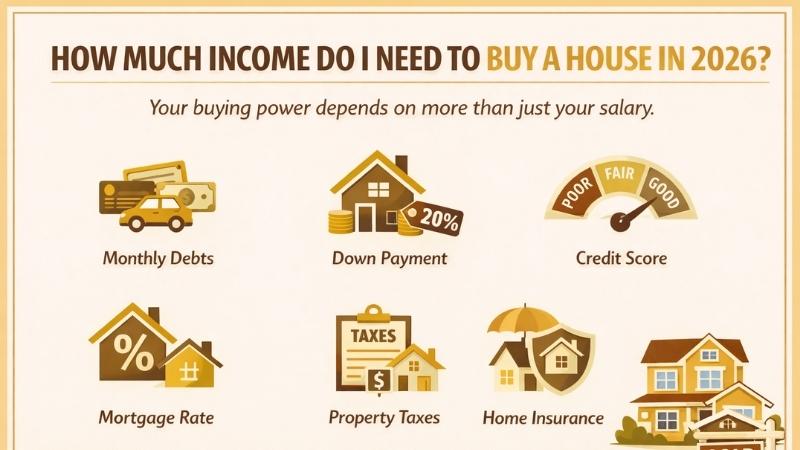
If you are asking, “How much income do I need to buy a house?” the answer depends on more than just your salary. Your buying power in 2026 is shaped by your monthly debts, down payment, credit profile, mortgage rate, property taxes, homeowners’ insurance, and the total monthly payment tied to the home you want. Two buyers with the same income can qualify for very different price ranges depending on their full financial picture.
The most important step is to assess affordability realistically, rather than focusing only on the listing price. A home may seem within reach based on income alone, but the full cost of ownership matters as much. By understanding how lenders evaluate debt-to-income ratios and by planning for upfront and monthly expenses, you can set a more confident and realistic homebuying budget.
The good news is that many buyers can qualify without perfect credit or a huge down payment. With the right loan program and a clear understanding of your finances, homeownership may be more achievable than you think. The better prepared you are, the easier it becomes to answer the question, “How much income do I need to buy a house?” and move forward with a plan that fits your budget.
Frequently Asked Questions (FAQ) on How Much Income Do I Need To Buy a House in 2026
How Much Income Do I Need to Buy a House?
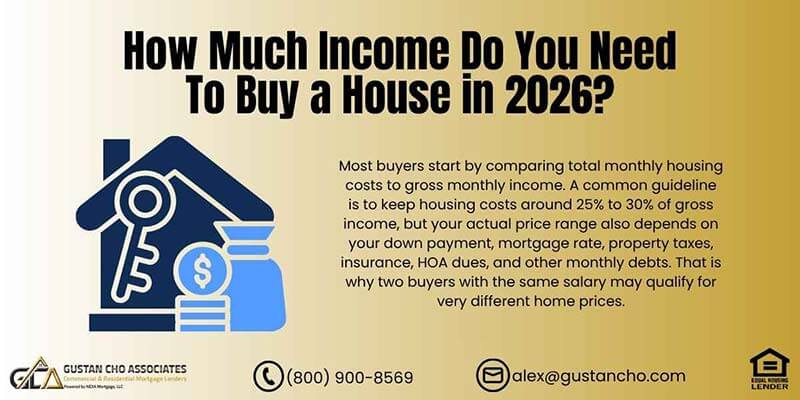
Most buyers start by comparing total monthly housing costs to gross monthly income. A common guideline is to keep housing costs around 25% to 30% of gross income, but your actual price range also depends on your down payment, mortgage rate, property taxes, insurance, HOA dues, and other monthly debts. That is why two buyers with the same salary may qualify for very different home prices.
What Income do I Need to Buy a $300,000 House?
The income needed for a $300,000 house varies by rate, down payment, taxes, insurance, and debt, but many estimates place it between $75,000 and $95,000 per year for a typical buyer. Some buyers may need more, especially if taxes, insurance, or monthly debts are high. Others may qualify with less if they have a larger down payment or lower recurring debt.
Do I Need 20% Down to Buy a House in 2026?
No. A lot of buyers don’t actually need to put down 20%. There are loan programs out there that let you put down a lot less. Just keep in mind, though, that if you go for a smaller down payment, you’re likely to end up with a bigger loan and higher monthly payments. In some cases, it may also mean mortgage insurance or other added costs, which can affect how much income you need to qualify comfortably.
What Debt-to-Income Ratio do Lenders Look for When Buying a Home?
Lenders check your debt-to-income ratio (DTI). It basically measures how much you owe each month compared to what you earn before taxes. Many affordability guidelines suggest keeping housing costs under about 28% of gross income. In comparison, total debt is often discussed at around 36% to 43%, depending on the loan type and borrower profile. Some buyers may be approved above those levels, but lower debt usually makes qualifying easier.
How do Lenders Decide How Much House I Can Afford?
Lenders typically review your gross income, monthly debts, credit history, down payment, interest rate, and estimated housing costs such as taxes and insurance. They are not just looking at the sale price. They are looking at whether the full monthly payment fits your budget and loan guidelines.
What Other Costs Should I Budget for Besides the Mortgage Payment?
You should budget for more than principal and interest. Buyers also need to consider property taxes, homeowners’ insurance, HOA dues if applicable, closing costs, maintenance, and existing monthly debt. These extra costs can significantly change how affordable a house feels, even when the loan payment itself seems manageable.
This article about “How Much Income Do I Need To Buy A House In 2026” was updated on March 26th, 2026.