In this article, we will be comparing FHA loans vs VA loans. VA loans are by far the best mortgage loan program in the nation. The U.S. Department of Veterans Affairs is the federal government agency administering the mortgage guidelines for VA loans. The role of the Veterans Administration (VA) and the U.S. Department of Housing and Urban Development (HUD) is to insure and partially guarantee banks, credit unions, and mortgage companies.
The Veterans Administration partially guarantees and insures lenders in the event borrowers default on VA loans. HUD insures and partially guarantees lenders in the event borrowers default on FHA loans.
There is no doubt that FHA loans vs VA loans are no comparison in benefits. However, there are instances when homebuyers need to take FHA loans vs VA loans in cases where they may need non-occupant co-borrowers or cannot get an approve/eligible per automated underwriting system per AUS for VA loans. In the following paragraphs, we will cover comparing FHA loans vs VA loans. This update covers HUD’s August 12, 2026, Handbook 4000.1 changes, the 2026 FHA loan limits, and the newest VA guidelines.
FHA and VA Loans Side by Side
FHA and VA loans are both government-backed mortgages offered through approved lenders, but they are intended for different borrowers. To find the best option, it’s important to compare FHA loans vs VA loans side by side.
FHA financing is an option for any qualified home buyer. VA loans offer mortgage options to Veterans, active-duty service members, members of the National Guard and the Reserves, and some surviving spouses.
If you qualify for both programs, there’s no single rule or rate that makes one always better. Many factors matter, such as your down payment, credit history, debt-to-income ratio, residual income, mortgage insurance, VA funding fee, loan limits, property requirements, and lender guidelines. This guide outlines the distinctions between FHA and VA mortgages in accessible language to help readers determine which loan best aligns with their financial needs.
FHA Loans vs VA Loans: The Primary Distinction is Eligibility
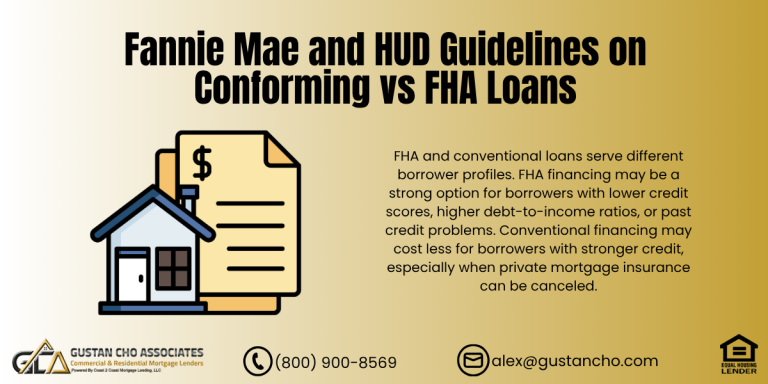
FHA loans are accessible to a broader range of borrowers and require a minimum 3.5% down payment for those with credit scores of at least 580. Some lenders may accept scores as low as 500 with a 10% down payment. VA loans are available to eligible veterans and provide benefits such as no down payment, no monthly mortgage insurance, and no set minimum credit score. The optimal loan choice depends on the borrower’s overall financial profile.
What is the Difference Between FHA Loans vs VA Loans?
The main difference is who can qualify for each program. FHA loans are backed by the Federal Housing Administration, part of the U.S. Department of Housing and Urban Development. This guarantee helps lenders manage the risk of default, making it easier for more people to qualify.
The Department of Veterans Affairs partially backs VA loans. This gives eligible borrowers benefits such as a zero down payment and no monthly mortgage insurance. Only people who meet VA eligibility can get a VA loan.
FHA loans do not require military service. Cost is another key difference. FHA borrowers usually pay closing costs and annual mortgage insurance, while most VA borrowers skip monthly insurance and pay a one-time VA funding fee instead.
FHA Loans and Their Eligibility
FHA loans are available to both first-time and repeat home buyers. To get an FHA loan, you need to meet both FHA and lender requirements. The loan must be for your main home. Lenders will check your income and may ask for a cash reserve. FHA loans are popular with borrowers who have lower credit scores, past credit issues, or other challenges that might make it hard to get a traditional loan. Your unit properties satisfy the FHA occupancy and qualification criteria. FHA’s standard 203(b) program supports approximately 96.5% financing for qualified borrowers.
Are FHA Loans Just for First-Time Home Buyers?
Many people think FHA loans are only for first-time home buyers, but that’s not true. You can use FHA financing to buy a home, even if it’s not your first time. FHA loans are available to qualified borrowers who meet the occupancy, credit, income, asset, property, and underwriting requirements. FHA’s low down payment option is popular with first-time buyers, but you don’t have to be a first-time buyer to qualify.
Are You Eligible for a VA Loan?
VA home loans are available to buyers who meet the military service requirements set by the U.S. Department of Veterans Affairs. Active-duty service members, certain National Guard and Reserve members, and some surviving spouses may qualify for VA home loans.
A Certificate of Eligibility (COE) shows that your military service meets the VA loan requirements. Having a COE doesn’t guarantee you’ll get a mortgage.
You still need to meet the lender’s requirements for credit, income, occupancy, and underwriting. VA states that borrowers needing a VA-backed mortgage must meet both VA and lender criteria for occupancy, credit, and income.
FHA Loans vs VA Loans When it Comes to Down Payments
The down payment is often the biggest difference between FHA and VA loans. A credit score of 580 or higher may qualify you for the maximum FHA financing, which usually requires a 3.5% down payment. For FHA loans, maximum financing for most applicants with an FHA minimum decision credit score in the range of 500 to 579 may still require a minimum 10% investment. For FHA loans, if the credit score is below 500, the FHA minimum credit score requirement is not met.
Unlike FHA loans, VA loans are generally more flexible in their requirements. If you have sufficient entitlement and qualify with the lender, a VA loan may allow you to buy a property with no down payment.
Every VA loan means you’ll have zero cash due at closing. Closing costs, prepaid expenses, entitlement, appraisal issues, or a purchase price above the appraised value can all affect how much you need to bring to closing. When it comes to VA and FHA loans, FHA requirements also address credit scores.
HUD Guidelines on FHA Loans
For FHA loans, minimum credit scores affect the maximum amount of financing offered. A 3.5% down payment may be needed for borrowers with a 580 credit score. Borrowers with a credit score between 500 and 579 may need to make at least a 10% down payment. Even if you meet the FHA minimum credit score, it doesn’t guarantee you’ll be approved. A loan may not receive an acceptable recommendation through automated underwriting, or a lender may require additional criteria, referred to as overlays. Your credit score matters, but it’s just one of several things lenders look at when making a decision.
Mortgage Underwriting Requirements on VA Loans
The VA does not set a minimum credit score to qualify for a VA loan. Although the VA doesn’t set a minimum credit score, your credit score still matters to lenders.
VA lenders assess whether you are an acceptable risk, and different lenders may have their own requirements and set minimum credit score requirements for VA loans.
VA loans have clear underwriting guidelines and do not set a minimum credit score, but many VA lenders do. This means a credit score of 500, 580, 620, or any other number will not automatically qualify or disqualify you for a VA loan.
Which is Easier to Qualify for, FHA Loans vs VA Loans?
There isn’t one simple answer.t one right answer for everyone. decision for an FHA loan but not a VA loan. Meanwhile, others may get the opposite decision. In addition to using a borrower’s credit and overall profile, VA loans evaluate residual income.
Like VA loans, FHA loans have various underwriting guidelines that offer flexibility through the TOTAL Mortgage Scorecard and manual underwriting. It’s not correct to assume one loan program is always easier.
It’s not accurate to assume that one loan program is always easier to qualify for than the other. Lenders look at your income, employment, credit history, payment history, debts, reserves, loan amount, property type, whether you’ll live in the home, automated underwriting results, and their own requirements.
Not VA Eligible? FHA May Still Be a Strong Option
FHA loans can help buyers with lower credit scores, higher DTI, limited savings, or past credit issues. Get your FHA approval path reviewed before you shop.What are the Debt-to-Income Ratio Guidelines on VA Loans?
Debt-to-income ratio, or DTI, compares your monthly debt payments to your qualifying monthly income. FHA loans vs VA loans handle DTI differently.
FHA Loans vs VA Loans: Which Mortgage Options Should Homebuyers In 2026 Consider?
There isn’t a single FHA maximum DTI that applies to all automatically underwritten borrowers. For automated underwriting of FHA loans, the system looks at your whole file. Automated approval isn’t based on a specific DTI, so you might be approved even if your ratios are higher than what’s usually allowed in manual underwriting.
For FHA loans that are manually underwritten, HUD sets guidelines for ratios and the circumstances under which elevated ratios can be supported by documented compensating factors.
The main thing to remember is that a high DTI doesn’t automatically disqualify you from getting an FHA loan.n residual income. Residual income is the money you have left after paying for housing, debts, taxes, and other necessary expenses. VA uses a DTI of 41% as a guideline, but going over 41% doesn’t mean you’ll be denied. In these cases, lenders look at your whole file, including your residual income and other compensating factors. VA’s underwriting guidelines state that DTI must be considered in the context of all the borrower’s credit factors, rather than resulting in automatic approval or denial. That’s why it can be misleading to advertise a single VA maximum DTI, like 50%, 55%, or 60%.
FHA Mortgage Insurance vs VA Funding Fee
Regardless of the motivation, it is essential to thoroughly compare FHA and VA loans. Cost is typically the most significant consideration, particularly regarding monthly mortgage payments. The upfront fee for FHA loans currently averages 1.75% of the principal and may be included in the mortgage amount.
The annual FHA mortgage insurance amount depends on factors such as your loan term, loan amount, and loan-to-value ratio.
For example, the annual MIP for an FHA purchase loan with a term longer than 15 years, an LTV greater than 95%, and a loan amount within the standard range is 0.55% of the principal. How long you pay FHA mortgage insurance depends on your loan-to-value ratio. For FHA loans at 90% LTV or lower, the current rule says you pay annual MIP for 11 years.
How the VA Funding Fee Works
Unlike FHA loans, VA loans don’t require private mortgage insurance or monthly mortgage insurance. However, most borrowers pay a funding fee. There are exceptions for veterans with service-connected disabilities, depending on the type and length of discharge, among other factors. These exceptions are also eligible for a funding fee exemption.
The funding fee has two tiers for a purchase mortgage with less than 5% down. The first time you use the VA benefit, the fee is about 2.15%. For later purchases, it goes up to about 3.3%.
If your down payment is at least 5%, the fee drops to 1.5%, and with at least 10% down, it drops to 1.25%. Most borrowers can add the VA funding fee to their mortgage. Some borrowers are exempt from the VA funding fee. Most borrowers can roll the VA funding fee into their mortgage.its, as well as some surviving spouses.
VA Funding Fee Exemptions
VA funding fee exemptions are decided by the VA. For eligible Veterans who don’t have to pay the funding fee, VA financing can offer even more financial benefits.026 FHA vs VA Loan: If you’re an eligible Veteran who doesn’t have to pay the funding fee, a VA loan can be an even better financial deal.
Loan limits are based on property location and the number of units. For 2026, the FHA loan-limit floor for a one-unit property is $541,287. The standard high-cost area ceiling for a one-unit property is $1,249,125.
Higher special-exception limits can apply in Alaska, Hawaii, Guam, and the U.S. Virgin Islands. FHA loan limits for a county or metro area can be lower than the national floor or ceiling, since they’re based on local housing costs.
Do VA Loans Have Loan Limits?
VA borrowers with full entitlement don’t have a VA county loan limit on how much they can borrow with no money down. The maximum mortgage amount still depends on underwriting factors such as your income, credit history, debts, assets, property value, and other details.
Borrowers with VA entitlement may have a gap or a partial entitlement. Conforming loan limits in the county dictate the amount of VA guaranty and the need for a down payment.
So, saying that VA loans have “no loan limit” can be misleading. FHA and VA loans don’t have many similarities, but both require an appraisal. Keep in mind, an appraisal is not the same as a home inspection. When an FHA appraisal is conducted, the home is reviewed for the loan program standards. VA appraisals also review the property to ensure it complies with the
VA Minimum Property Requirements.
Neither program expects the home to be in brand-new condition. Safety, access, sound structure, roof, utilities, sanitation, and other major deficiencies are grounds for review and repairs. Home buyers should still get a home inspection even after the property has had an FHA or VA appraisal. FHA and VA loans are meant for financing your main home, not traditional investment properties.
VA Guidelines on Home Occupancy
VA loans require the eligible veteran to live in the property. HUD 4000.1 Handbook on FHA loans has occupancy requirements similar to those of FHA for purchased properties. Certain deployed active-duty service members and spouse- or dependent-child-related situations trigger special VA occupancy provisions. The VA’s lender guidance accounts for family-member occupancy in certain situations. Standard FHA and VA purchase loans are not for investment properties.
FHA Loans and VA Loans for Two through Four Family Units
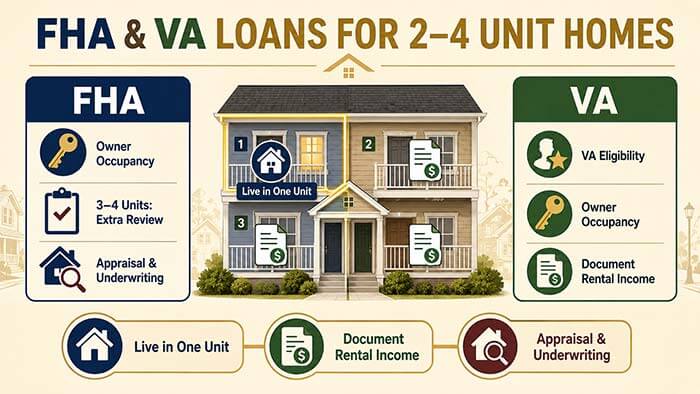
Financing for qualifying multi-unit properties through both programs is permitted, provided the respective program requirements are met. With an FHA loan, you can buy an eligible two-, three-, or four-unit property if you plan to live in one unit as your main home. VA financing is also allowed for these properties if you meet VA requirements and plan to live there. This can be a good option for buyers interested in government-backed loans for multifamily properties. Documented, approved rental income from other units can help you qualify for a loan.
Seller Concessions on FHA Loans vs VA Loans
Seller-paid costs can reduce the amount you need to bring to closing, but FHA and VA have different rules about seller contributions.
For FHA loans, combined contributions toward origination fees, closing costs, and other allowed expenses, plus discount points, can be up to 6% of the sales price.
These funds can’t replace the borrower’s required investment. VA rules require a different explanation. VA allows sellers and builders to pay some regular closing costs. VA also limits seller concessions to 4% of the home’s reasonable value. This 4% limit doesn’t mean sellers can only pay 4% of every VA closing cost. VA separates regular closing costs paid by the seller from concessions.
FHA Loans vs VA Loans With Co-Borrowers
Deciding whether to use FHA or VA mortgages with co-borrowers depends on the co-borrower rules. FHA financing may approFHA financing may allow non-occupant co-borrowers. This can help if someone is helping the main borrower qualify, even if the co-borrower won’t live in the home. Over the VA loan for the Veteran and the Veteran’s spouse. There are the above-mentioned instances in which more than one Veteran may qualify for the loan.
Some people think VA financing doesn’t allow any co-borrowers, but that’s not true. VA does allow certain joint financing, like a Veteran and a non-Veteran who isn’t the Veteran’s spouse.
Regarding Veteran/non-Veteran financing, VA lending handbooks note that FHA mortgages are often simpler for co-borrowers, but the entire transaction still needs to be reviewed before approval.to approval.
Automated Underwriting on FHA Loans vs VA Loans
Most FHA and VA loans start with an automated underwriting system, or AUS. The underwriting system reviews your chances based on your income, assets, debts, credit history, proposed housing payment, loan-to-value ratio, and other possible risks. An AUS decision looks at more than just your credit score.
FHA loans are much more forgiving to render an approve/eligible per AUS with late payments in the past 12 months than VA loans. VA loans are lenient with lower credit scores, derogatory credit, and higher debt-to-income ratios but NOT late payments in the past 12 months.
The FHA TOTAL Mortgage Scorecard functions with approved automated underwriting systems for FHA mortgages. The FHA states that a TOTAL score does not indicate approval or denial of a mortgage by the lender, and that lenders must review Handbook 4000.1. A bigger down payment may improve your file, but it’s not a guarantee of AUS approval.
Manual Underwriting on FHA Loans vs VA Loans
Both FHA and VA financing types may permit manual underwriting under qualifying circumstances. With manual underwriting, a mortgage underwriter reviews your full financial picture, applies the guidelines, and doesn’t rely on an automated system’s recommendation. Getting a manual underwrite doesn’t mean your loan is bad. However, it does require a more detailed review of your payment history, housing history, income, employment, reserves, residual income or compensating factors, debts, and past credit problems. Some lenders don’t offer manual underwriting, even if the government program allows it. This is called a lender overlay.
FHA and VA Loans During Chapter 13 Bankruptcy

VA also states that lenders may consider borrowers after the borrower has made satisfactory payments for at least 12 months and the trustee or bankruptcy court approves the requested credit.
Bankruptcy approval depends on your specific situation. Things like trustee and court approval, payment history, income, debt, and other credit factors all play a big role.ant.
Lender Overlays on FHA and VA Loans
FHA and VA programs are set by the government, but lenders can set stricter rules of their own. These extra rules are called lender overlays. A lender may set a higher credit score requirement than FHA allows. They may also have extra rules about manual underwriting, DTI, credit problems, or other factors. VA doesn’t set a minimum credit score, but VA lenders do. That’s why one lender might decline your application, while another approves you for the same FHA or VA program. VA program. If you’re denied, review the reason to see if it’s an agency rule, an AUS result, a property issue, or a lender-specific overlay.
Mortgage Rates on FHA Loans vs VA Loans
HUD and the Department of Veterans Affairs do not establish the retail mortgage rate that a borrower receives from a lender. The rate depends on market conditions, the lender, loan structure, your credit, discount points, property, loan amount, and the pricing available when the rate is locked.
VA mortgage rates are often competitive, but you shouldn’t assume a VA rate will always be lower than an FHA rate. The best comparison is based on actual Loan Estimates for the same transaction and the same time period.
It is advisable to compare the interest rate, APR, lender credits, discount points, cash to close, monthly payment, mortgage insurance or funding fee, and total costs, rather than selecting a loan solely based on the published rate.
When VA Loans Are Better than FHA Loans
For borrowers who are eligible for VA financing and qualify for both types, VA financing is worth serious consideration. For borrowers who qualify for VA financing, it can help you keep more cash for things like moving expenses, repairs, or emergencies.
VA financing can also let you avoid the funding fee and mortgage insurance. VA financing is also appealing to borrowers with residual income and financial profiles that VA underwriting may find compelling.
However, it remains important to review the specific loan terms to identify the most suitable option. VA financing is not always the least expensive choice. For qualifying borrowers, FHA may be a better option than VA under certain circumstances.
Getting Automated Underwriting System Approval on FHA Loans But Not VA Loans
If you don’t qualify for VA financing, FHA financing may still be an option. Favorable automated underwriting may give you more flexible criteria for FHA financing,/or a structure that’s easier to qualify fore under FHA.
In general, borrowers will get an approve/eligible per AUS on FHA loans vs VA loans with late payments. FHA will approve borrowers with late payments in the past 12 months with a large down payment.
VA will not render an approve/eligible per AUS with one late payment in the past 12 months no matter how much the down payment is. Some lenders’ pricing can also affect which loan. Eligible veterans are encouraged to consider VA financing when it is financially advantageous; however, VA eligibility alone should not determine the choice of loan for every mortgage scenario.
Why Would a Veteran Consider FHA Loans vs VA Loans?
This comparison should focus on this question. In some cases, FHA financing is better than VA because you get an acceptable FHA underwriting result but not a VA one. This can also happen if you need a non-occupant co-borrower. You may also see overlays or differences in product availability, pricing, and property eligibility. This choice depends on comparing both programs for your situation and property. It’s great to be VA eligible, but being eligible doesn’t guarantee you’ll get approved for a loan.
FHA Loans vs VA Loans for Borrowers with Bad Credit
Neither program should be called a “bad-credit mortgage.” For both programs, the lender decides if you’re a good credit risk for a mortgage. With FHA, your credit score determines the maximum loan amount, which can help people with lower scores.
With VA loans, there’s no set credit score requirement, but lenders still assess your ability and willingness to repay the mortgage.
Your payment history, recent collections, charge-offs, bankruptcies, housing history, federal debt, and other credit factors can affect your credit analysis. A low credit score doesn’t always mean you’re a bad risk, and a high score doesn’t guarantee you’ll be approved.
Is It More Strict To Get Automated Underwriting System Approval Than FHA Loans?
VA and FHA loans both allow for manual underwriting. In general, FHA and VA loans have a lenient AUS algorithm when it comes to getting an approve/eligible per AUS. However, you normally cannot get an AUS approval with a late payment in the past 12 months no matter how large of a down payment the borrowers put. All payments need to be timely in the past 12 months on VA loans. However, borrowers with late payments in the past 12 months, they can get an approve/eligible per AUS with a larger down payment. .
If not approve/eligible, then the MLO will keep on increasing the down payment until he is able to get an approve/eligible per automated underwriting system (AUS).
However, both VA and FHA manual underwriting guidelines require timely payments in the past 12 months on VA loans and 24 months on FHA loans.. If a borrower cannot get an approve/eligible per automated underwriting system (AUS) on a VA loan but can get an approve/eligible per AUS on FHA loan, the veteran can only go with an FHA loan. From our experience, you can definitely get an approve/eligible per AUS on FHA loans with the combination of recent late payments, credit scores down to 500 FICO, and outstanding collection and charged-off accounts with a substantial down payment between a 10% to a 20%.
How to Evaluate FHA Loans vs VA Loans
If you qualify for both loans, ask your lender to compare both options for you. Compare the total cash out at closing first. Next, compare the total monthly housing payment, including principal and interest, estimated property taxes, insurance, HOA fees, if applicable, and FHA MMI. Then compare the cost to you. An FHA loan will include MMI, and a VA loan will include a funding fee, unless exempt.
How Long Do You Think You Will Keep the Mortgage?
A small difference in monthly payments could develop significant interest over several years. Lastly, compare both Loan Estimates rather than assuming “VA is cheaper.”The most appropriate mortgage is the one that best aligns with the borrower’s financial circumstances. The situation the best.
The Importance of Working with a Lender that Understands FHA and VA Guidelines
A borrower can comply with the government’s requirements but run into issues depending on the lender’s underwriting requirements. Before drawing the conclusion that you won’t qualify, identify the reason for the loan denial.
- Was this an actual HUD or VA guideline?
- Was this an automated underwriting result?
- Was this a lender overlay?
- Did you include additional documentation?
- Was there some issue with the property?
- These are all very different circumstances.
Gustan Cho Associates works with people seeking FHA or VA financing, including those with not-so-great credit, higher debt-to-income ratios, manual underwriting cases, and prior credit issues. Every mortgage must go through individual underwriting, agency guidelines, investor requirements, property eligibility, and lender approval. VA DTI Mortgage Calculator
Final Considerations: FHA Loans vs VA Loans
Choosing between FHA and VA financing isn’t about which one is better overall. FHA loans contain numerous advantages. They include low-down-payment loans, defined credit standards, government insurance, and more flexible credit standards. VA loans also offer generous terms, and eligible Veterans can secure 100% financing, benefit from flexible credit standards, avoid monthly mortgage insurance, and have no VA county loan limit for borrowers with full entitlement.
Many Veterans will find VA financing is the better option. In other situations, the best option is FHA financing, depending on the financing, property, and the co-borrower’s requirements.
The only way to know for certain is to have both types of financing priced using the same criteria. The best way to know for sure is to have both loan types priced out using your actual credit, income, debt, property, and current financing details. Typically, a VA loan is superior to loans from other institutions because it requires neither a down payment nor MMI. However, a variety of factors might change that. Those factors include a borrower’s creditworthiness, funding fee status, the lender’s pricing, the property, the results of the application evaluation, and the borrower’s preferences. FHA DTI Mortgage Calculator
FHA Loan Automated Approval per AUS
To get an approve/eligible per AUS on FHA Loans With 500 Credit Scores, borrowers need to meet the minimum agency HUD guidelines stated in the HUD 4000.1 FHA Handbook. Below is a list of bullet points borrowers must meet to get the best chances of an approve/eligible per the automated underwriting system:
- Timely payments in the past 12 months on all monthly payments reporting to credit bureaus
- Outstanding collections and charged-off accounts do not have to be paid off but you cannot have credit disputes on non-medical collections, charged-off accounts, and other derogatory credit tradelines
- Two-year waiting period after Chapter 7 Bankruptcy discharged date
- Three-year waiting period after the recorded date of foreclosure, deed in lieu of foreclosure, short sale
- Meet DTI Guidelines
- Borrowers in an active Chapter 13 Bankruptcy payment plan are eligible to qualify for an FHA loan after making 12 timely payments
- The Chapter 13 Bankruptcy does not need to be discharged
- There is no waiting period after the Chapter 13 Bankruptcy discharged date to qualify for an FHA loan
- If the Chapter 13 Bankruptcy has not been seasoned for 24 months, the file needs to be a manual underwrite
- FHA manual underwriting guidelines apply
- The maximum front-end debt to income ratio cap is 46.9% and the back-end is 56.9% DTI to get an automated approval per AUS
If borrowers meet all guidelines on the FHA Scorecard TOTAL, the borrower will render an approve/eligible on AUS. Gustan Cho Associates is a mortgage company licensed in multiple states with no overlays on government and conventional loans. We can qualify and close borrowers with 500 credit scores with automated approval.
Do Different Lenders Have Different Requirements for the Same Mortgage Program?
Over 80% of our borrowers at Gustan Cho Associates are folks who either have gotten a last-minute mortgage denial or are stressing over their loan process with a current lender. Most lenders have overlays.
What are overlays? Lender overlays are additional credit score requirements that are above and beyond those agency guidelines imposed by HUD.
For example, borrowers can qualify with 500 credit scores with a 10% down payment under HUD Guidelines on FHA loans. However, a lender can say no to approving anyone with under 580 credit scores as part of their lender overlays. Mortgage lenders can have lending requirements that surpass the minimum lending guidelines of HUD on FHA loans.
FHA and VA Guidelines During Chapter 13 Bankruptcy Payment Period
Homebuyers can qualify for FHA Loans during the Chapter 13 Bankruptcy Repayment plan. However, they need to be in an active Chapter 13 repayment for one year with 12 timely monthly payments. Chapter 13 does not have to be discharged. It needs to be a manual underwrite. Trustee approval is required. Most trustees will approve a home loan.
FHA and VA Guidelines After Chapter 13 Bankruptcy Discharge
There is no waiting period after the Chapter 13 Bankruptcy discharged date to qualify for FHA Loans. If the Chapter 13 discharge is seasoned for less than 24 months, it needs to be a manual underwrite. Timely payments during the Chapter 13 Bankruptcy payment period are very important. No late payments after the Chapter 13 Bankruptcy discharge date.
Same Loan Programs Different Guidelines: Apply With Mortgage Broker With No Overlays
Gustan Cho Associates are mortgage brokers licensed in 48 states. We have lending partnerships with over 300 wholesale mortgage lenders. We have relationships with wholesale mortgage lenders with no lender overlays on VA loans. VA loans provide even better benefits for qualified military members, veterans, and some surviving spouses, including zero down payment and no monthly mortgage insurance.
Compare Loan Estimates and review your monthly payments and upfront costs to make sure your mortgage fits both your short-term budget and long-term financial goals.
To qualify for FHA loans With 500 credit scores with a mortgage company with no lender overlays, please contact us at Gustan Cho Associates at 800-900-8569 or email us at gcho@gustancho.com. Text us for a faster response. The team at Gustan Cho Associates is available 7 days a week, on evenings, weekends, and holidays. Gustan Cho Associates has a national reputation for being able to do mortgage loans other lenders cannot do. We have a national reputation for not having lender overlays.
FAQs – FHA Loans vs VA Loans: Comparing Mortgage Options
What FHA Lenders Work With A 500 Credit Score?
Not all mortgage companies will work with a 500 credit score. This holds true even though per HUD agency guidelines, borrowers who get an approve/eligible and/or meet the HUD manual underwriting guidelines with a 500 credit score are eligible for FHA financing. Gustan Cho Associates is one of the very few mortgage companies licensed in multiple states.
What Are FHA Loans vs VA Loans?
The FHA loans are designed for individuals buying their first home with lower credit scores and higher debt-to-income ratios. On the other hand, VA loans are meant for current and retired members of the U.S. Armed Services and eligible spouses, providing 100% financing without the need for a down payment.
Which Loan Is Better, FHA Loans vs VA Loans?
VA loans are generally considered superior due to benefits such as no down payment, mortgage insurance, or loan limit. However, FHA loans can be more accessible for those with lower credit scores or needing non-occupant co-borrowers.
Why Would Someone Choose FHA Loans vs VA Loans?
An FHA loan might be chosen over a VA loan for various reasons. To begin with, FHA loans allow non-occupant co-borrowers who are related by blood, marriage, or law. In contrast, VA loans only allow a married spouse to be a co-borrower. Moreover, FHA loans are more accessible due to their less strict credit score and underwriting requirements, making them a better option for individuals with lower credit scores or recent late payments.
What Are The Credit Score Requirements for VA vs FHA Loans?
No specific minimum credit score is required for VA loans, although lenders usually look for scores above 500. They offer flexible guidelines for debt-to-income ratios, often approving applicants with high ratios if they have strong residual income. On the other hand, FHA loans require a minimum credit score 580 to qualify for a 3.5% down payment. For those with scores between 500-579, a 10% down payment is needed. FHA loans are also more forgiving in approving applicants with recent late payments, provided a larger down payment is made.
Are VA Loans More Difficult to Get Approved for Than FHA Loans?
Yes, VA loans can be stricter due to their underwriting algorithms. FHA loans may be more forgiving, especially with larger down payments and recent late payments.
Can I Use a Non-Married Spouse or Non-Occupant Co-Borrower with a VA Loan?
No, VA loans do not allow non-married spouses or non-occupant co-borrowers. Only a married spouse can be a co-borrower on a VA loan.
How Do FHA And VA Loans Handle Manual Underwriting?
FHA and VA loans both permit manual underwriting. Approval for FHA loans is easier to obtain with recent late payments if a larger down payment is made, and timely payments in the past 24 months are crucial. On the other hand, VA loans are generally lenient with prior bad credit but require timely payments in the last 12 months.
Can I Qualify for a VA Loan with a 500 FICO Score?
With a 500 FICO score, you can still be eligible for a VA loan if you satisfy other requirements, like solid residual income.
How Does the VA Funding Fee Compare to the FHA Mortgage Insurance Premium?
The VA funding fee can be higher than the FHA upfront mortgage insurance premium but can be rolled into the loan balance. Unlike FHA loans, VA loans do not require ongoing mortgage insurance premiums.
Can I Get An FHA Loan During A Chapter 13 Bankruptcy?
After making 12 timely payments, you can qualify for an FHA loan during an active Chapter 13 repayment plan. Trustee approval is required, and it must be a manual underwrite.