
Buying a house near an apartment community does not automatically lower its value or prevent mortgage approval. What matters is the home’s actual surroundings, local sales evidence, and applicable loan requirements. Before making an offer, check noise, traffic, parking, privacy, and nearby development plans.
When This Location May Work for You
The location may suit you when the home offers the space and features you need at a price supported by recent comparable sales. An extra bedroom, a usable backyard, or a better floor plan can make a property worth considering.
Look at how those spaces face the neighboring property. Bedrooms overlooking your own yard may offer more privacy than bedrooms facing apartment balconies. A patio separated from nearby activity by distance and landscaping may also be more comfortable to use.
Convenience can be another benefit if your workplace, shops, or public transportation are actually nearby. Check the routes and travel times yourself. The advantage comes from access to places you use, rather than the presence of apartments alone.
Does an Apartment Community Affect Property Value?
An apartment community does not automatically lower the value of a nearby single-family home. The effect, if any, depends on how buyers in that particular market react to the location.
A property that directly backs up to a large parking lot, busy entrance, or heavily traveled access road may be viewed differently from a home several lots away with little direct exposure.
The home’s price should reflect what comparable buyers have actually been willing to pay for similar properties.
How Appraisers Evaluate Nearby Land Uses
Appraisers look at similar home sales to see how buyers react to a property’s location. They also factor in things like size, condition, lot features, and when the home was sold. Just seeing a lower sale price does not mean nearby apartments are the reason.
The kind and level of activity next door make a difference. For example, a house facing an apartment entrance might have more traffic and light than one set back with trees or distance in between. A busy road or business nearby also affects the property in its own way. These situations are not all the same just because they are close by.
Fannie Mae allows appraisers to use sales of homes that attract the same buyers, even if they are not exactly the same as the property being valued. If needed, the appraiser can highlight key differences and adjust the value based on market data. So, not having a sale with the exact same neighboring use does not automatically stop you from getting a loan. The appraisal must clearly support the value, and the property must meet the loan program’s rules.
Can a Nearby Apartment Community Affect Mortgage Approval?
When financing a house near an apartment community, the lender evaluates three separate questions: Does the value support the transaction? Is the property eligible for the selected program? Does the borrower qualify?
Appraised Value
If the appraisal is lower than the contract price, a price reduction, extra buyer funds, or another adjustment may be needed to proceed. A lower valuation doesn’t automatically make the property ineligible.
Property Eligibility
The home’s use, zoning, legal access, condition, and the relevant safety requirements are all important factors. An appraisal that supports the purchase price will not in any way resolve a separate property eligibility issue.
The selected financing program determines which standards apply:
- FHA: The lender will assess the property in accordance with HUD’s relevant property and appraisal requirements as set out in Handbook 4000.1.
- VA: The property needs to comply with the relevant VA Minimum Property Requirements during the appraisal and property evaluation process.
- Conventional: The property must meet the requirements of the applicable investor. Fannie Mae’s requirements cover zoning, access, acceptable use of the property, and the impact of the adjacent properties on value and marketability.
Borrower Qualification
The buyer needs to meet the program’s requirements for credit, income, debt, and available funds, including any reserves. Even if the property is acceptable and the appraisal is supported, this does not mean the borrower is financially qualified.
Getting preapproved as a borrower does not mean the property itself is approved. Preapproval is conditional, so you still need to meet the remaining underwriting requirements. Be sure to give your loan officer the property address and mention any location concerns early, before you decide to waive appraisal or financing contingencies.
What to Check Before Making an Offer
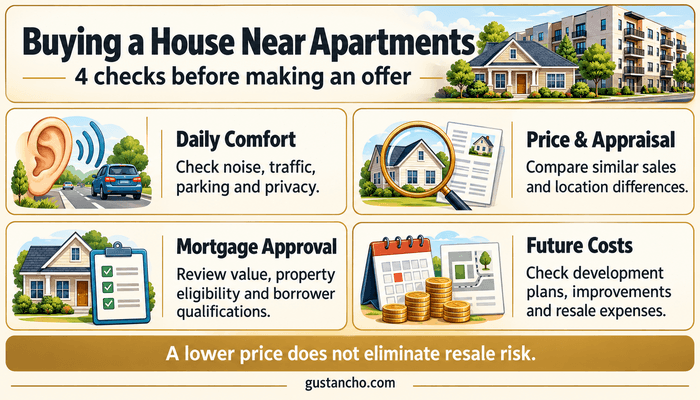
Take notes when you visit at different times. This helps you compare what you notice and follow up on any questions that come up.
- Noise: Try visiting when nearby businesses are open, in the evenings, or on weekends. While you’re there, listen both inside the bedrooms and outside. Notice any sounds that might make it hard to sleep, work, or enjoy the backyard.
- Lighting: Come back after dark to check if parking lot lights, signs, or building lights shine into bedroom windows, living spaces, or the patio.
- Parking and access: See what street parking is like during busy times. Look for any posted restrictions, check how easy it is to use the driveway, and note whether nearby entrances create traffic where you would be coming and going.
- Privacy: Notice if neighbors’ upper-floor windows or balconies look into your home or yard. Check what you can see from bedrooms, living areas, and outdoor spaces.
- Future development: Talk to the local planning department to find out how nearby land is zoned, what projects have been proposed, and what has already been approved. Remember, just because something is allowed or approved doesn’t mean it will be built soon.
- Shared access: Have a title expert or real estate lawyer check any recorded easements and maintenance agreements. Make sure you know who can use a shared driveway or path, who is responsible for it, and whether any rules could affect how you use it.
If the Home Also Borders Commercial Property
Check out the operations of the neighboring business and see what activities are taking place right up near the home. Different businesses will require different checks.
- Car wash: Find the dryers and vacuums, check the queue of vehicles, and listen to the equipment as it runs.
- Restaurant: Check the exhaust vents, outdoor seating, dumpster placement, and any drive-through traffic.
- Warehouse: Identify the loading bays, truck entrances, and delivery routes. Check whether you can hear the loading activity or the reversing alarms from the house.
Confirm the delivery, cleanup, and waste collection schedules separately from the public opening hours. There may be some activity before opening and/or after closing. Wherever possible, visit during those times to ensure your assessment is of how the business actually operates.
Real Mortgage Case: The Better House Had a More Difficult Location
One borrower we worked with spent months searching for the right home. A property eventually became available that offered more of what the buyer wanted, but its location required a closer look.
The house was near an apartment property and a commercial use. Rather than automatically rejecting it, the buyer compared the home with other properties in the area and considered whether the price reflected the location.
The buyer looked at the home’s condition, lot, privacy, surrounding activity, comparable properties, and how long similar homes were taking to sell.
The important lesson was not that the location was necessarily good or bad. The home needed to be evaluated as a complete package.
For buyers considering a property with an unusual location, the purchase price, appraisal support, intended length of ownership, and future resale market can matter just as much as the house itself.
Evaluating a Location Discount and Future Resale
Paying less for a house may reduce your outlay at purchase, but it doesn’t mean you won’t end up with a loss in the long run. You need to compare the purchase price against relevant comparables to determine whether the apparent discount reflects the property’s real market value.
Also bear in mind the location issue in terms of future demand. Check with your property professional about local sales and marketing cycles rather than assuming that a lower price today will be sufficient for the next buyer.
How Long You Plan to Own the Home
If you’re thinking of selling in the very near future, then you need to work out your purchase costs, your likely selling costs, and your mortgage payoff before you even consider how much the discount is going to help you. A small price advantage can be wiped out by transaction costs.
For a longer period of ownership, you’ll need to budget for taxes, insurance, maintenance, and repairs. A longer period of ownership may well make those costs worthwhile in your particular circumstances, but longer ownership doesn’t necessarily equate to appreciation or stronger resale demand.
Budgeting for Privacy Improvements and Renovations
Get estimates for fencing, landscaping, and any noise-related works before you rely on them to make the site acceptable. You need to consider the maintenance involved and whether the proposed works will actually reduce the exposure.
Separate the comfort improvements you’re after from those you’d expect to add to resale value. A buyer may not be prepared to pay enough to cover the cost of your renovations, and the appraisal will assess the improvement in terms of its contribution to value rather than its cost.
Questions to Ask Before Closing
Buying a house near an apartment community deserves the same careful due diligence as any other purchase, with extra attention to the surrounding property.
Before closing, buyers should understand:
- Whether the appraisal adequately supports the purchase price.
- Whether comparable sales have similar location characteristics.
- What the neighboring properties are currently used for.
- Whether nearby parcels are zoned for additional development.
- Whether easements or shared access affect the property.
- Whether the home’s insurance costs are acceptable.
- Whether the property fits the buyer’s long-term plans.
Questions about zoning, permits, property boundaries, easements, or future development should be directed to the appropriate local authority or qualified professional.
Do not rely solely on comments from a seller, listing agent, neighbor, or online listing.
FAQs About Buying a House Near an Apartment Community
Will Nearby Apartments Increase My Homeowners Insurance Premium?
- Not necessarily. Insurance premiums depend on the home’s characteristics, coverage, and insurer. Obtain property-specific quotes and ask whether neighboring uses affect coverage or pricing.
Should I Order an Appraisal Before Making an Offer?
- Usually, review comparable sales with your real estate agent first. Let your lender arrange any required mortgage appraisal; an appraisal you commission independently may not be acceptable for the loan.
What Can I do if the Appraisal is Below the Contract Price?
- Your options depend on your contract, deadlines, and loan terms. You might be able to renegotiate, pay more out of pocket, or cancel if your contract allows. If you find mistakes or have new market information, you can ask your lender to review the appraisal, but a higher value is not guaranteed.
Will Adding a Fence Increase the Appraised Value?
- A fence can make your property more private, but whether it adds value depends on what buyers in your area want. You should not expect the appraised value to go up by the full cost of the fence.
Does a Longer Time on the Market Prove a Location Problem?
- No. Talk with your agent about your price, the property’s condition, local demand, and any issues with the sale. Just being on the market for a long time does not mean that nearby apartments kept buyers away.
How Can I Investigate a Neighboring Redevelopment Proposal?
- Contact the planning department to get the application, site plan, approval status, and any hearing notices. Make sure you know which changes are being proposed and which have already been approved, such as building height, entrances, parking, and setbacks.
Final Thoughts About Buying a House Near an Apartment Community
A home that looks attractive on paper should also work for the way you live. Decide whether the neighboring activity is acceptable during the hours you will actually be home and whether the total ownership cost fits your budget. The purchase should make sense without depending on costly improvements to make it comfortable or a future resale gain to justify the price.
Raise unresolved property and appraisal questions early, while there is time to investigate them before important contract deadlines. Share the specific concerns with your real estate professional and loan officer. Contact Gustan Cho Associates to discuss financing and potential appraisal concerns before you commit.
This article about “Buying a House Near an Apartment Community: Property Value, Financing, and Buyer Checks” was updated on October 13th, 2026.
Get Pre-Approved and Have Us Review the Area Before You Close
Don’t just fall in love with the house—make sure the surroundings make sense too