Why is the lender asking you to pay for an appraisal or credit report before you are fully approved? It can feel alarming to spend money while the mortgage is still uncertain. Some upfront mortgage costs are normal, but the important questions are when the fee is requested, what service it covers, and whether it appears on your Loan Estimate or Closing Disclosure.
Understanding those details can help you distinguish between a standard third-party charge and a fee that warrants further explanation. It also gives you a better way to compare lenders, avoid surprises, and know what to ask before sending payment.
Can a Lender Charge You Before You Are Approved?
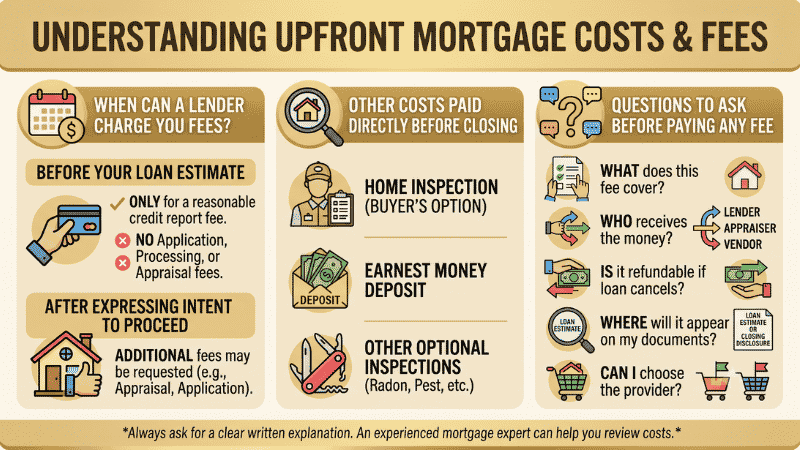
Yes, some charges can be normal before final loan approval, but federal disclosure rules limit when a lender may collect them. For most mortgage loans that use a Loan Estimate, the lender may generally charge only a bona fide, reasonable credit-report fee before providing that document. It cannot collect an appraisal fee, an application fee, a processing fee, or any other loan charge at that stage.
After you receive the Loan Estimate and tell the lender you want to move forward, known as expressing your intent to proceed, the lender may charge additional fees. An appraisal fee or application fee may be requested at that time, even though the loan is not yet fully approved. Before paying, ask what the fee covers, whether it is refundable, and where it will appear in your loan disclosures.
Before You Receive a Loan Estimate
For most home-purchase and refinance loans that require a Loan Estimate, a lender may generally charge only a bona fide, reasonable fee to obtain your credit report before sending that disclosure. The lender is not permitted to charge an appraisal fee, an application fee, a processing fee, or any other mortgage-related fee at this point. It also cannot require your credit card number or a check for charges other than the credit-report fee.
A lender generally must provide a Loan Estimate within three business days after receiving the six pieces of information that create a mortgage application: your name, income, Social Security number to obtain credit, property address, estimated property value, and requested loan amount. The Loan Estimate lets you review the expected rate, payment, and costs before deciding whether to move forward.
After You Express Intent To Proceed
Expressing intent to proceed means telling the lender that you want to move forward with a specific loan offer. You can do this by phone, email, or another method the lender accepts. At that point, you have chosen the lender and loan option you want to pursue, even though final approval has not been issued yet.
Once you indicate your intent to move forward, the lender may require additional upfront mortgage costs to proceed. These costs can include an application fee, appraisal fee, or fees for necessary third-party services such as flood certification, title work, or property reviews. Before you make any payments, ask about the following: what the charge is for, who will benefit from it, whether you can get the fee back, and where it will show up in your Loan Estimate or Closing Disclosure.
Homebuying Costs You May Pay Directly Before Closing
During the homebuying process, some costs are paid directly by the buyer and are not associated with the lender, which can be considered part of the upfront mortgage costs. One such example is a home inspection. Buyers may also opt to cover additional inspections, such as radon, sewer, well, septic, or pest inspections, especially if there are concerns about the property or if the purchase contract requires them. Additionally, a survey may be necessary to verify property boundaries, easements, or lot lines.
These costs help you evaluate the property before closing. They are different from lender charges because the lender may not require every service. For example, a lender may require an appraisal, but a general home inspection is usually the buyer’s decision.
Consult your real estate agent, lender, attorney, or title company about which inspections or reports are necessary for the home you’re purchasing.
You may also pay an earnest money deposit after your offer is accepted. This deposit shows the seller that you intend to move forward under the purchase contract. It is usually held by the title company, escrow agent, broker, or attorney. It is typically credited toward your down payment or cash to close at settlement.
Why Some Early Fees May Not Be Refundable
Some upfront mortgage costs may not be refundable because a vendor has already completed the work. For example, once an appraiser inspects the home and prepares the report, the appraisal fee may still be due even if the loan is later denied, delayed, or canceled. The same can apply to a credit report, survey, or specialty inspection after the service has been ordered or performed.
Cancellation timing can also matter. A fee may be refundable if the service has not yet been ordered, but it may not be refundable after a third party has begun work or charged the lender. Before paying, ask what the fee covers, who receives the money, when the service will be ordered, and whether any refund is available if the transaction does not close.
Find Ways to Lower Your Out-of-Pocket Closing Costs
Seller credits, lender credits, and assistance programs may reduce the cash you need at closing when structured correctly.
What Counts as Mortgage Closing Costs?
Mortgage closing costs are the charges paid to complete a home purchase or refinance. They may include lender charges for underwriting, processing, and originating the loan; title services that help confirm ownership and transfer the property; government recording fees; and transfer taxes where state or local rules apply. In some areas, an attorney also handles part of the closing process and charges a separate fee.
Your final amount may also include prepaid interest, homeowners’ insurance, and property taxes. Prepaid interest covers the interest due from the closing date until your first full mortgage payment period. Insurance and taxes may be collected in advance based on your closing date and local requirements.
Many borrowers also pay an initial escrow deposit at closing. This starts the escrow account that the lender may use to pay future property taxes and homeowners’ insurance. It is separate from your down payment and may be separate from the lender and title fees shown on your closing documents.
The exact amount depends on the loan type, property location, lender, title company, and closing date. Review your Closing Disclosure carefully and ask about any charges you do not understand before signing.
Why Cash-to-Close Can Be Higher Than Closing Costs
Closing costs are only one part of the money you may need at settlement. Your cash-to-close amount may be higher because it may include your down payment, prepaid interest, homeowners’ insurance, property taxes, and the initial deposit for an escrow account. These amounts are shown separately on your Loan Estimate and Closing Disclosure, but they are added together when the lender estimates how much money you need to bring to closing.
Your down payment is the portion of the home price you pay from your own funds or eligible sources. It is not a closing cost. For example, a buyer purchasing a $300,000 home with a 3.5% down payment may need $10,500 for the down payment before adding closing costs, prepaid items, and escrow deposits.
Some amounts can reduce your final cash-to-close. Earnest money paid after your offer was accepted is usually credited back to you at settlement. Seller credits may help cover eligible closing costs, depending on the purchase contract and loan program. Lender credits can also reduce certain closing charges, though they may be tied to a higher interest rate or other loan pricing terms.
Prepaid items and initial escrow deposits can still increase the final amount due, even when you receive seller or lender credits. Your closing date can affect these costs because it changes how much daily interest, insurance, and property-tax money must be collected. Before closing, review the “Calculating Cash to Close” section of your Closing Disclosure so you can see how your down payment, credits, deposits, and fees add up.
Where To Find Fees on the Loan Estimate
The Loan Estimate is the early disclosure you can use to review and compare mortgage costs before you choose a lender. It displays your estimated interest rate, monthly payment, closing costs, and cash to close. Review it carefully before moving forward, especially if you are comparing more than one loan offer.
Start with the lender charges section. This may include origination, underwriting, processing, application, verification, or rate-lock fees. Compare the total lender charges across Loan Estimates rather than focusing on a single fee.
Next, review the services you can shop for. These are lender-required services, but you may be allowed to choose the provider. They can include title services, surveys, pest inspections, or other settlement services. Your lender should give you a list of approved providers so you can compare options.
Also, review prepaid items, such as homeowners’ insurance, property taxes, and daily interest due before your first mortgage payment. Check the estimated cash to close so you understand the total amount you may need at settlement. Finally, look for lender credits. A lender credit can reduce some closing costs, but it may be tied to a higher interest rate or different loan pricing.
What To Compare on the Closing Disclosure
The Closing Disclosure shows your final mortgage terms, closing costs, and cash to close. For most covered mortgage loans, you must receive it at least three business days before closing. Use that time to compare it with your most recent Loan Estimate, ask questions, and correct any errors before signing.
Start by checking the loan amount, interest rate, monthly payment, loan term, and whether the rate is fixed or adjustable. Then compare lender charges, title and settlement fees, prepaid interest, property taxes, homeowners insurance, initial escrow deposits, seller credits, lender credits, and your final cash-to-close. Make sure the credits and earnest money deposit shown on the form match what you expect.
Some costs can change between the Loan Estimate and Closing Disclosure, especially if loan details, the property, or third-party services changed during the process. Ask the lender or closing agent for a clear explanation of any fee that increased, disappeared, or was added late.
Which Mortgage Fees Should You Question?
Question any request for money before you receive a Loan Estimate, other than a bona fide, reasonable credit-report fee on most covered mortgage loans. A lender should be able to explain what the charge covers, why it is needed now, and whether the fee will appear on your Loan Estimate or Closing Disclosure.
It’s important to ask questions when upfront mortgage costs have vague names, lack a listed vendor, or come with no written explanation. Be vigilant for duplicate charges, like the same service appearing multiple times under different names.
A significant non-refundable fee without a clear service associated with it merits a more detailed examination, particularly if the lender cannot clarify when the work will be done or who will receive the payment.
Finally, do not ignore a major increase in your cash-to-close. Some changes can be valid, but your lender or closing agent should clearly explain why the amount changed and whether it came from loan terms, property taxes, insurance, escrow deposits, or a new charge. Ask for an updated written breakdown before sending funds or signing your closing documents.
Questions To Ask Before Paying Any Mortgage Fee
Before you pay any mortgage-related fee, ask for a clear answer to these questions:
- What does this fee cover? Ask for the specific service, such as a credit report, appraisal, title search, or inspection.
- Who receives the money? Find out whether the payment goes to the lender, an appraiser, a title company, or another third-party provider.
- Is the fee refundable? Ask what happens if you cancel the loan, the appraisal comes in low, or the mortgage is not approved.
- Has the work already been completed? A fee may be non-refundable once a vendor has performed the service.
- Will this fee appear on my Loan Estimate or Closing Disclosure? Your loan documents should show how the cost is being handled.
- Can I choose the provider? Some lender-required services allow you to shop for your own title company, surveyor, or other provider.
Getting these answers in writing can help you understand what you are paying for and identify any upfront mortgage costs that may require further clarification before you proceed with payment.
Final Thoughts About Upfront Mortgage Costs
Upfront mortgage costs can feel stressful when you are still waiting for final approval. The key is knowing what the fee covers, when it is being requested, who receives the money, and whether it will appear on your Loan Estimate or Closing Disclosure.
Before paying any mortgage-related charge, ask for a clear written explanation and carefully compare your loan documents. An experienced mortgage expert can help you review costs, understand your cash-to-close, and identify questions to ask before you move forward.
Frequently Asked Questions About Upfront Mortgage Costs
How Much are Closing Costs on a House?
There is no single closing-cost amount that applies to every buyer. Your total can vary based on the loan type, lender, property location, loan amount, title or attorney charges, taxes, insurance, and prepaid items. The best way to estimate your costs is to compare Loan Estimates from multiple lenders before choosing a loan.
Who Pays Closing Costs When Buying a House?
Both the buyer and seller may have costs at closing. The buyer commonly pays loan-related charges, while the seller may have separate transaction expenses. A seller can agree to contribute toward the eligible buyer’s closing costs, but the purchase contract and loan program rules govern how much assistance is allowed.
Can You Negotiate Mortgage Closing Costs?
Yes, you can ask to negotiate mortgage terms and costs before signing your final loan documents. Lender fees may be easier to negotiate than third-party charges, such as government recording fees or title costs. Comparing Loan Estimates gives you a stronger basis for asking a lender to match or improve its pricing.
Can Gift Funds be Used for Closing Costs?
Gift funds may be used for closing costs on many loan programs when the donor, source of funds, and documentation meet program requirements. For eligible Fannie Mae loans, gift funds may cover all or part of the closing costs, subject to applicable borrower contribution rules. Do not move gift money into your account without first asking the lender what documentation is required.
Can Closing Costs be Rolled Into a Mortgage?
Sometimes. A refinance may allow certain closing costs to be added to the new loan balance if the program and available equity allow it. When making a purchase, a lender might provide a lender credit in return for a higher interest rate. Either option can reduce the money due at closing, but it may increase your payment, loan balance, or total cost over time.
Are Mortgage Closing Costs Tax Deductible?
Usually, most closing costs are not deductible. If you itemize deductions, qualifying mortgage interest and certain real estate taxes may be deductible. Some other purchase-related settlement costs may instead be added to your home’s tax basis. Tax rules can be complex, so review your Closing Disclosure with a qualified tax professional.
What Does “Paid Outside of Closing” Mean?
“Paid outside of closing,” sometimes shown as P.O.C., means a fee was paid before settlement rather than from the funds collected at closing. The Closing Disclosure should identify the charge and the party who paid it. Because the fee was paid separately, it should not be added again to the cash you need to bring to closing.
Can You Switch Mortgage Lenders After Receiving a Loan Estimate?
Yes. Receiving a Loan Estimate does not commit you to that lender. You are generally not committed until you sign the final closing documents. However, switching lenders can restart parts of the process. It may delay your scheduled closing or put it at risk, so compare offers early and ask whether any completed third-party work can still be used.
This article about “Upfront Mortgage Costs vs. Closing Costs: Key Differences” was updated on June 30th, 2026.