FHA Loans With 500 FICO Credit Score: 2026 Guidelines
It may be possible to get an FHA loan with a 500 FICO credit score. The Federal Housing Administration does not require every FHA borrower to have a credit score of 580, 600, or 620. Under FHA guidelines, borrowers with a Minimum Decision Credit Score between 500 and 579 may be eligible for FHA-insured financing, but the loan is generally limited to a maximum loan-to-value ratio of 90%.
FHA loans with a 500 FICO credit score are permitted under HUD guidelines. Borrowers with scores between 500 and 579 are generally limited to a 90% loan-to-value ratio, meaning at least 10% down on a purchase.
Borrowers with scores of 580 or higher may qualify for maximum FHA financing, including up to 96.5% financing on a standard purchase transaction, which corresponds to a minimum 3.5% down payment. The primary challenge is identifying a lender willing to originate a loan for borrowers with lower credit scores. Many mortgage companies have credit score requirements that are more restrictive than the FHA guidelines. These additional lender requirements are commonly referred to as lender overlays.
Can You Get an FHA Loan With a 500 FICO Credit Score?
Yes. FHA guidelines permit mortgage financing for certain borrowers with credit scores as low as 500. HUD’s FHA Single Family Housing Policy Handbook establishes 500 as the minimum qualifying credit-score threshold for standard FHA-insured forward mortgage financing. A borrower with a Minimum Decision Credit Score below 500 is generally not eligible. A borrower with a score between 500 and 579 is limited to a maximum 90% loan-to-value ratio.
A borrower with a qualifying score of 580 or higher is eligible for maximum FHA financing, subject to all other FHA underwriting requirements.
This difference matters because many borrowers hear that FHA requires a 580 or 620 credit score. That is not the same as HUD’s FHA minimum credit-score guideline. An individual bank, mortgage company, investor, or wholesale lender may establish a higher minimum score for the FHA loans it is willing to originate. That does not necessarily change the underlying FHA guideline.
What Does a 500 to 579 Credit Score Mean for an FHA Loan?
A credit score between 500 and 579 does not automatically disqualify you from FHA financing. However, it lowers the maximum amount the FHA will insure relative to the property’s value. For standard purchase transactions, borrowers in this credit-score range are generally restricted to 90% LTV.
If you purchase a $300,000 home, for example, 90% financing would result in a $270,000 base loan amount before any upfront mortgage insurance premium.
The remaining 10%, or $30,000 in this example, represents the minimum equity position needed under the credit-score based LTV restriction. Closing costs, prepaid taxes, homeowners’ insurance, and other settlement expenses are separate from the minimum down-payment calculation.
What Changes at a 580 Credit Score?
The 580 threshold can make a major difference. A qualifying borrower with a 580 or higher Minimum Decision Credit Score may be eligible for FHA’s maximum 96.5% financing on a standard purchase. That reduces the minimum down payment from approximately 10% to 3.5%. For a $300,000 purchase, 3.5% equals $10,500, not $30,000. So, even a small increase in your credit score can make a big difference in how much money you need for the purchase.
FHA Credit Score Requirements for 500, 580 and 620 Scores
One of the biggest sources of confusion surrounding FHA mortgages is the difference between an FHA guideline and a lender requirement. FHA establishes the basic eligibility framework for loans insured by the Federal Housing Administration. Individual lenders determine which FHA loans they are willing to originate within that framework.
Is 500 the Minimum FHA Credit Score?
For standard FHA-insured forward mortgages with traditional credit, HUD states that a borrower is ineligible if the Minimum Decision Credit Score is below 500. Scores between 500 and 579 are limited to 90% LTV. Scores of 580 and above may receive maximum financing. This is why 500 is an important cutoff for FHA loans. But not everyone with a score of 500 will qualify. A credit score is only one part of mortgage underwriting.
Does FHA Require a 620 Credit Score?
No. There is no universal HUD rule requiring a 620 credit score for an FHA mortgage. If a mortgage lender tells a borrower that it requires a 620 score for FHA financing, that may be the lender’s own minimum credit-score requirement rather than the FHA minimum. The same can occur with lenders that require a score of 600, 580, or another score. This difference is especially important for borrowers who have been denied despite appearing to meet the FHA’s published guidelines.
Why Many Lenders Do Not Offer FHA Loans Down to 500 FICO
FHA insures qualifying mortgages against certain lender losses. It does not require every FHA-approved mortgage company to originate every loan permitted under HUD guidelines.
Mortgage companies evaluate risk, investor requirements, quality-control concerns, servicing considerations, and their own business policies when determining which FHA loans they will accept.
As a result, a lender may establish additional requirements beyond HUD’s minimum standards. These additional requirements are often called mortgage lender overlays.
What Is an FHA Lender Overlay?
A lender overlay is an additional underwriting requirement imposed by a lender beyond the minimum requirements of the mortgage program. For example, FHA may permit financing with a 500 credit score and 10% down. One lender may nevertheless require a minimum of 580. Another may require 600. Another may accept lower scores but impose additional requirements concerning debt-to-income ratios, reserves, payment history, or other risk factors. This is why two mortgage lenders can look at the same borrower and make different decisions.
A Mortgage Denial Does Not Always Mean You Are Ineligible for FHA
A Borrower May Hear:
- “You don’t qualify for an FHA loan.”
- But what the lender may actually mean is:
- “You don’t meet our company’s requirements for an FHA loan.”
- These two statements are not always the same.
- Before assuming that homeownership is impossible, borrowers with low credit scores should determine whether the problem is an actual FHA guideline or simply a particular lender’s overlay.
- A second review can be especially valuable when a borrower has a credit score between 500 and 579, a manually underwritten file, recent credit problems, collections, a bankruptcy, or another circumstance that not every lender accepts.
How FHA Underwriting Works With a 500 FICO Credit Score
Having a 500 credit score does not create an automatic approval. Mortgage lenders evaluate the complete loan application. For most FHA forward mortgages, the loan information is submitted through an Automated Underwriting System that interfaces with FHA’s TOTAL Mortgage Scorecard.
Scores below 500 are not eligible for standard FHA-insured financing. However, meeting FHA’s minimum credit score does not guarantee approval. Income, debt-to-income ratio, payment history, housing history, collections, bankruptcy, assets, underwriting findings, and lender requirements can all affect eligibility.
TOTAL evaluates credit and application information and produces either an Accept or Refer classification. HUD explains that an Accept generally permits the loan to proceed without a full manual underwriting review unless a manual downgrade is otherwise required. A Refer means the file must be manually underwritten by an FHA Direct Endorsement underwriter.
FHA Automated Underwriting versus Manual Underwriting
Automated underwriting analyzes numerous factors together. These can include credit history, income, assets, debt, reserves, mortgage payment, loan-to-value ratio, and other information contained in the application. You should not assume that having a 500 score is the only thing that will stop or guarantee your approval. FHA’s TOTAL Mortgage Scorecard evaluates the overall risk of the transaction. When a loan receives a Refer recommendation or otherwise requires a manual downgrade, an FHA Direct Endorsement underwriter must evaluate the file under HUD’s manual-underwriting guidelines.
FHA Manual Underwriting With a 500 to 579 Credit Score
Manual underwriting rules become particularly important for borrowers with lower credit scores. Under HUD’s manual underwriting matrix, borrowers with a Minimum Decision Credit Score between 500 and 579 generally may not exceed a 31% housing ratio and 43% total debt-to-income ratio. HUD permits 33%/45% stretch ratios for qualifying Energy Efficient Homes. The higher manual-underwriting ratio tiers available to some borrowers with scores of 580 or higher do not apply to borrowers below 580. This is one reason why a 500 FICO FHA loan should not be judged by credit score alone. Income and monthly debts can be just as important.
Debt-to-Income Ratio Requirements With a 500 Credit Score
Your debt-to-income ratio compares your monthly debt obligations with your qualifying gross monthly income. The housing ratio considers the proposed mortgage-related housing payment.
The total debt ratio includes the proposed housing payment plus recurring obligations such as car loans, student loans, credit cards, personal loans, child support, alimony when applicable, and other qualifying debts.
For manually underwritten FHA loans with a 500–579 Minimum Decision Credit Score, HUD’s standard maximum ratios are generally 31% housing and 43% total debt, subject to the limited Energy Efficient Home exception described above. A borrower earning $6,000 per month in qualifying gross income, for example, would have a 43% total debt threshold of approximately $2,580 per month under that manual-underwriting standard. That amount would include the qualifying housing payment and other debts counted by the underwriter.
What FHA Underwriters Review Besides Your Credit Score
A 500 FICO score tells an underwriter that the borrower’s credit profile requires closer review. It does not explain why the score is 500. This difference is important. One borrower may have a low score because several credit cards are close to their limits. Another may have had recent late payments. Another may have medical collections. Another may have recently completed a bankruptcy. Another may have older derogatory accounts, but an excellent recent housing and payment history. Those profiles can present very different underwriting risks even when the numerical scores are identical.
Recent Payment History Can Be More Important Than Old Credit Problems
Underwriters pay close attention to recent financial behavior. A borrower whose credit problems happened several years ago but who has since paid rent, auto loans, and other obligations on time may present a stronger case than someone with a higher score who has very recent late payments. If you have a low credit score, try to avoid new negative marks on your credit before or during the mortgage process. A new 30-day late payment, collection, or overdraft pattern, undisclosed debt, or a major increase in credit card balances can materially change a loan file.
Housing Payment History Matters
Housing history can become especially important in a manually underwritten mortgage. A documented history of paying rent or an existing mortgage on time helps demonstrate an ability and willingness to manage a monthly housing obligation. Be ready to show proof of your housing payment history if asked. The documentation method may depend on whether rent is paid to a professional property management company, an individual landlord, or another party.
Stable and Documented Income Still Matters
A low credit score does not eliminate FHA income requirements. The income used for qualifying must meet applicable FHA standards concerning documentation, stability, and continuance. W-2 wages, overtime, bonuses, commission income, self-employment income, Social Security, pensions, disability income, rental income, and other income types can each have different documentation requirements. A borrower with a strong, stable income may still be declined if the income cannot be documented in accordance with FHA guidelines.
Can You Get an FHA Loan With Collections and a 500 Credit Score?
Collections do not always need to be removed from a credit report for a borrower to qualify for an FHA mortgage. However, collection accounts can affect underwriting. The lender must evaluate the borrower’s entire credit profile and comply with FHA requirements regarding collection accounts, disputed accounts, judgments, and other derogatory credit.
The treatment depends on the type of account, the amount involved, whether the account is disputed, whether payments are being made, and whether the loan is being underwritten automatically or manually.
Do not automatically pay off old collections just because you plan to apply for a mortgage. Paying, settling, or disputing an account can sometimes change the credit report or credit score in unexpected ways. The better approach is to have the mortgage professional review the actual credit report before making changes.
Low Credit Score? FHA Financing May Still Be Possible
FHA guidelines may allow eligible borrowers with lower credit scores to qualify, but the full file matters. Get your scenario reviewed before assuming you cannot buy.Can You Get an FHA Loan With Charge-Off Accounts?
A charge-off is not automatically the same thing as an unpaid judgment. FHA underwriting considers the borrower’s overall credit history and the circumstances surrounding derogatory accounts. An old charge-off does not automatically mean a borrower must wait until it disappears from the credit report. However, recent serious derogatory credit may pose a greater underwriting concern, particularly when it suggests ongoing financial mismanagement rather than an isolated past event. The account’s age, payment history since the event, overall credit pattern, available assets, housing history, and underwriting method can all matter.
Can You Get an FHA Loan After Bankruptcy With a 500 FICO Score?
Potentially. A bankruptcy does not permanently prevent someone from qualifying for an FHA mortgage. The applicable requirements depend on the type of bankruptcy, discharge date, whether the bankruptcy remains active, payment performance, underwriting method, and whether documented extenuating circumstances apply. The U.S. Housing and Urban Development, often called HUD, is the parent of FHA. HUD is not a lender. FHA is a federal government agency under HUD that insures and partially guarantees lenders on FHA loans in case of borrower default. HUD created and launched FHA to promote homeownership in the United States.
FHA Loans After Chapter 7 Bankruptcy
Under FHA manual underwriting guidelines, a Chapter 7 bankruptcy generally does not disqualify a borrower if at least 2 years have passed since discharge and the borrower has either reestablished good credit or chosen not to incur new credit obligations. HUD also provides a possible exception when less than two years—but at least 12 months—has passed if documented extenuating circumstances caused the bankruptcy and the borrower has demonstrated responsible financial management since the event. This exception is not automatic. The lender must document that the circumstances meet FHA requirements.
FHA Loans During Chapter 13 Bankruptcy
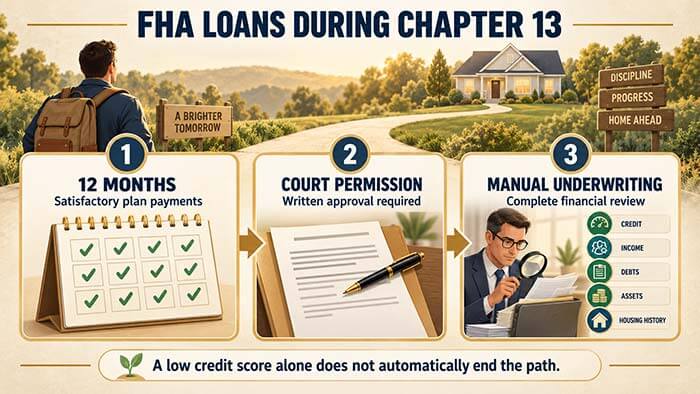
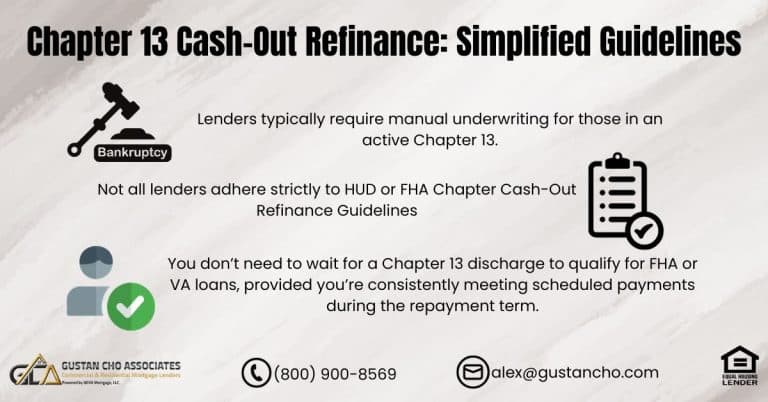
FHA guidelines can permit financing while a borrower is still in an active Chapter 13 bankruptcy. For manual underwriting, at least 12 months of the Chapter 13 payout period generally must have elapsed, required payments must have been made satisfactorily and on time, and the borrower must receive written permission from the bankruptcy court to enter into the mortgage transaction.
A complete review by the mortgage underwriter of your full credit report, income, debts, assets, housing history, and underwriting results will give you a much clearer answer than just your credit score.
This can make FHA financing particularly important for borrowers rebuilding financially while completing a court-supervised repayment plan. A low credit score does not automatically eliminate this option, but the borrower must still satisfy the applicable credit score, down payment, DTI, income, assets, and underwriting requirements.
FHA Loans After Foreclosure With Low Credit Scores
A previous foreclosure also does not permanently eliminate FHA eligibility. Under FHA manual-underwriting guidance, borrowers are generally not eligible for another FHA-insured mortgage when a foreclosure or deed-in-lieu occurred during the three years before FHA case-number assignment. HUD provides limited exceptions for qualifying documented extenuating circumstances beyond the borrower’s control. Waiting for the required period does not automatically grant approval. The borrower must still demonstrate current mortgage eligibility and an acceptable overall credit profile.
How Much Down Payment Do You Need With a 500 Credit Score?
For a standard FHA purchase, borrowers with a qualifying credit score between 500 and 579 are generally limited to 90% LTV. That means a minimum equity position of approximately 10%.
- A $200,000 purchase would generally require at least $20,000.
- A $300,000 purchase would generally require at least $30,000.
- A $400,000 purchase would generally require at least $40,000.
By comparison, a borrower qualifying for maximum FHA financing at 580 or higher could purchase with a minimum required investment of 3.5%. The down payment is not the same thing as the total cash needed at closing. Borrowers may also have closing costs, prepaid property taxes, homeowners’ insurance, interest, escrow deposits, appraisal-related costs, and other expenses.
FHA Loan with Low Credit Scores
HUD, the overseeing body of FHA, permits prospective homeowners to be eligible for FHA loans with 500 FICO. It’s essential to note that different lenders may have varying minimum credit score criteria for FHA loans. John Strange, a seasoned loan officer at Gustan Cho Associates, specializes in assisting borrowers in meeting the criteria and securing approval for FHA loans with 500 FICO. According to John, here’s the insight into qualifying for FHA loans with a 500 FICO credit score:
HUD, the parent of FHA, is very forgiving with low credit score borrowers. HUD is also forgiving with low credit scores and late payments in the past 12 months on FHA loans.
If you have a low credit score, such as a FICO score of 500, and have recently missed payments, you might wonder if you’re eligible for an FHA loan. Obtaining approval for FHA loans with 500 FICO can be challenging but entirely feasible. By making a significant down payment, applicants increase their chances of approval.
What Are Lender Overlays
Lender overlays are additional guidelines set by individual mortgage lenders that is above and beyond the minimum agency guidelines. All lenders need to meet agency mortgage guidelines. In the case of FHA loans, all lenders need to meet HUD agency guidelines, but the lender can have higher lending requirements.
Gustan Cho Associates has no lender overlays on FHA, VA, USDA, and Conventional loans. We just go off the minimum agency guidelines and do not have any higher lending requirements.
It is important to distinguish between the guidelines set by the HUD agency and the lender’s overlays. Lender overlays refer to the lending requirements imposed by mortgage companies that surpass the minimum agency requirements outlined by HUD. The next paragraphs delve into qualifying for FHA loans with 500 FICO.
Can Gift Funds Be Used on an FHA Loan?

FHA permits eligible borrowers to use properly documented gift funds and other acceptable sources toward qualifying funds when FHA requirements are satisfied. HUD has specifically noted that FHA’s minimum required investment may come from acceptable sources such as borrower funds, gifts, certain second mortgages, and qualifying grants. The gift must be properly documented. You must properly document any gift funds you use, the transfer of funds, source requirements, and that the gift is not an undisclosed loan that must be repaid. Borrowers should discuss the gift with their loan officer before funds are transferred.
FHA Mortgage Insurance With a 500 FICO Credit Score
FHA loans generally require both upfront and annual mortgage insurance premiums. HUD currently lists the Upfront Mortgage Insurance Premium for most FHA purchase and refinance mortgages at 1.75% of the base loan amount. The annual mortgage insurance premium depends on factors including the mortgage term, loan amount, and original loan-to-value ratio There can actually be an interesting difference in mortgage insurance for a borrower making a full 10% down payment.
For FHA mortgages originated at 90% LTV or less, the annual mortgage insurance period is generally 11 years under the applicable FHA rules.
For loans originated at or above 90% LTV, annual mortgage insurance generally continues for the term of the mortgage. So, the higher down payment needed for a 500–579 credit score can affect both your starting loan balance and how long you pay the FHA annual mortgage insurance.
FHA Loan Limits for 2026
A credit score does not change the FHA loan limit. The maximum loan amount depends primarily on the property’s location and number of units.
For FHA case numbers assigned in 2026, the one-unit FHA loan-limit floor in most lower-cost areas is $541,287. The one-unit high-cost-area ceiling is $1,249,125.
Higher limits apply to qualifying two-, three-, and four-unit properties, and special limits apply in Alaska, Hawaii, Guam, and the U.S. Virgin Islands. Check the FHA mortgage limit for the county where your property is located instead of assuming the national limit applies.
Denied for FHA Because of a 500 Credit Score? Get a Second Opinion
Many lenders add overlays above FHA minimums. We’ll review your file and see whether FHA, manual underwriting, or another mortgage option may still work.Can You Buy a Two- to Four-Unit Property With a 500 FICO FHA Loan?
FHA financing can be used for eligible one- to four-unit residential properties when the borrower meets occupancy and other FHA requirements. HUD recognizes eligible property types, including single-family residences, qualifying two- to four-unit properties, townhomes, condominiums, modular homes, and qualifying manufactured housing. The borrower generally must occupy the property as a principal residence. The property must also meet FHA appraisal, eligibility, safety, soundness, and security requirements. With a credit score between 500 and 579, the credit-score-based maximum 90% LTV limitation still applies.
Does FHA Require Perfect Credit?
No. FHA was not designed exclusively for borrowers with perfect credit. HUD itself has specifically addressed the misconception that FHA borrowers must have high or perfect credit scores. FHA credit requirements can be more flexible than those of many conventional mortgages. But flexible does not mean automatic approval. An underwriter still needs to determine that the borrower has the ability and willingness to repay the mortgage. The complete credit history matters.
What Is the Minimum Decision Credit Score on an FHA Loan?
Mortgage professionals often use the term Minimum Decision Credit Score, or MDCS. When three qualifying credit scores are reported for one borrower, FHA generally uses the median score. When two differing scores are reported, the lower score is generally used.
When there are multiple borrowers, an MDCS is determined for each borrower, and the applicable lowest qualifying borrower score is used under FHA’s methodology.
This is why you should not assume that the score you see on a free credit app is the same one your mortgage lender will use. Mortgage credit scores and consumer credit monitoring scores can differ.
FHA Credit Scoring Is Changing
Credit scoring in the mortgage industry began an important modernization in 2026. FHA announced that it intends to permit VantageScore 4.0 and FICO Score 10T as eligible credit-scoring models in addition to Classic FICO.
HUD stated in May 2026 that lenders should continue following the existing credit-report policy in Handbook 4000.1 until additional implementation guidance and dates are published.
The main takeaway: don’t rely only on a credit score from a consumer website when deciding if you can qualify for a mortgage. Ask which mortgage credit report and scoring model will actually be used for your loan.
How to Improve Your Chances of FHA Approval With a 500 FICO Score
If your score is near the FHA minimum, focus on your whole mortgage profile, not just your credit score.
- Recent housing payments should remain on time.
- Credit-card balances should be managed carefully.
- New debts should generally be avoided while qualifying.
- Large unexplained bank deposits should be documented.
- Employment and income documentation should be organized.
- Bankruptcy or foreclosure paperwork should be available when applicable.
- Any required rent verification should be prepared early.
Most importantly, avoid paying collections, closing credit cards, opening new accounts, or disputing negative credit right before applying unless you understand the impact on mortgage approval. Raising your score from 560 to 580 can significantly change your options and potentially reduce the minimum down payment from 10% to the maximum FHA financing level.
Should You Improve Your Credit Before Applying for an FHA Loan?
Not necessarily. It depends on the individual situation. A borrower with a 500 score who has 10% down payment, stable income, low debt, strong housing history, and an acceptable overall credit profile may have reason to explore current eligibility.
A borrower with a 575 score and limited funds may benefit considerably from raising the score above 580 before purchasing, due to the potential reduction in the required down payment.
Someone with very high revolving credit utilization might be able to improve their mortgage score relatively quickly by paying down credit card balances. Another borrower may have derogatory accounts that require a longer rebuilding period. The best approach depends on the specific factors influencing your score and the findings of the mortgage underwriting review.
Loans With a 500 FICO Versus Conventional Loans
Borrowers with a 500 credit score usually have far fewer conventional financing options. FHA is particularly worth evaluating because its published eligibility framework allows scores as low as 500 when the required equity position and other underwriting standards are met. Conventional mortgage programs operate under different underwriting systems, credit requirements, mortgage-insurance rules, and pricing structures. Therefore, compare loan programs based on your actual eligibility rather than assuming all low-credit mortgages are equivalent.
The Entire Credit Profile Matters More Than One Number
A credit score is important, but it is only one measurement of mortgage risk.
Consider Two Borrowers with a 520 Credit Score:
- One borrower recently missed several rent, car, and credit-card payments.
- The second borrower experienced financial problems several years ago but has made every housing and installment payment on time for the past 18 months.
- Even if their scores are the same today, their recent financial habits are very different.
- Mortgage underwriting is designed to evaluate those differences.
This is why borrowers with low scores should work with mortgage professionals who understand FHA guidelines, manual underwriting, lender overlays, and the difference between old derogatory credit and continuing financial problems.
Final Thoughts on FHA Loans With 500 FICO Credit Scores
An FHA loan with a 500 FICO score is possible under HUD guidelines, but qualifying involves more than just meeting the minimum score. Borrowers with scores between 500 and 579 are generally limited to 90% LTV, meaning approximately 10% down payment on a standard home purchase.
Borrowers reaching 580 may potentially qualify for maximum FHA financing with a 3.5% minimum down payment. The loan must also satisfy FHA requirements for income, employment, assets, debt-to-income ratios, credit history, property eligibility, and underwriting.
The biggest obstacle for many low-credit borrowers is not necessarily FHA itself. It can be finding a lender willing and able to originate a loan under the actual HUD guidelines without imposing a higher minimum credit-score requirement. If you’ve been told you can’t qualify because your score is below 580 or 620, find out if the denial is due to an FHA rule or just that lender’s own requirement.
Not All Mortgage Lenders Have the Same Mortgage Lending Requirements
Gustan Cho Associates only goes by the automated findings of the automated underwriting system. The only lending guidelines we use are HUD Agency Guidelines with no lender overlays. NOTHING EXTRA. ZERO LENDER OVERLAYS.
I recommend you give us a call directly versus reading this handbook. The handbook is full of hard-to-interpret mortgage lingo, not to mention over 1000 pages of guidelines.
Please contact us at Gustan Cho Associates at 800-900-8569 or text us for a faster response. Or email us at gcho@gustancho.com. In the following paragraphs, we will discuss and cover qualifying for FHA loans with 500 FICO 10% Down Payment.
Frequently Asked Questions on FHA Loans with 500 FICO Credit Score
Can I Qualify for an FHA Loan with a 500 FICO Credit Score?
Yes, you can qualify for an FHA loan with a credit score as low as 500, according to the guidelines set by the Department of Housing and Urban Development (HUD), the overseeing body of FHA.
What is the Minimum Down Payment Required for an FHA Loan with a 500 FICO Score?
For credit scores below 580, a 10% down payment is required to be eligible for an FHA loan. However, if your credit score is 580 or above, the down payment can be as low as 3.5%.
Do All Lenders Have the Same Requirements for FHA Loans with 500 FICO Scores?
No, different lenders may have varying minimum credit score criteria for FHA loans. It’s crucial to understand the guidelines set by HUD and any additional requirements imposed by individual lenders, known as lender overlays.
What Are Lender Overlays on FHA Loans?
Lender overlays are additional lending requirements imposed by mortgage companies beyond the minimum agency requirements outlined by HUD. It’s essential to be aware of these overlays when seeking an FHA loan with a 500 FICO score.
Can I Get an FHA Loan with a Low Credit Score?
Yes, individuals with low credit scores, including those with a FICO score of 500, can qualify for FHA loans. HUD permits borrowers with credit scores as low as 500 FICO to apply for these loans.
How Can I Improve My Credit Score for an FHA Loan with 500 FICO?
To increase your chances of approval, consider making a significant down payment, as applicants with higher down payments have a better likelihood of approval. Additionally, it’s crucial to understand the guidelines provided by Gustan Cho Associates for FHA loans with a 500 FICO credit score.
What if I Get Denied for an FHA Loan with a 500-FICO Credit Score?
If denied by other lenders, Gustan Cho Associates specializes in helping borrowers secure FHA loans with 500 FICO scores. They can assist in understanding the reasons for denial and guide you through the process.
Are There Specific Mortgage Lenders Recommended for 500 FICO Borrowers?
Yes, Gustan Cho Associates is a recommended mortgage lender for borrowers with 500 FICO scores. They have a national reputation for not having any lender overlays on government and conventional loans.
This Guide About FHA Loans With 500 FICO Credit Score Was Updated on September 5, 2026.