Fannie Mae guidelines on timeshare foreclosure do not require borrowers to complete the standard foreclosure waiting period that applies to a mortgage foreclosure. Fannie Mae treats timeshare accounts as installment debt, even when the account is reported differently on a credit report. Borrowers may still qualify for a conventional loan if they meet all other credit, income, debt-to-income, asset, property, and underwriting requirements.
Fannie Mae Timeshare Foreclosure Guidelines
Unlike traditional foreclosures, the Fannie Mae Guidelines on Timeshare Foreclosure are unique. Fannie Mae does not classify a timeshare foreclosure as a major derogatory credit event. She states that it does not have to follow the lengthy waiting periods for such events. In simpler terms, a borrower will not have to wait a few years due to a timeshare foreclosure. As usual, the lender must thoroughly review the file. Recent derogatory credit accounts may still negatively affect the credit decision. Timeshare foreclosure does not create a waiting period, so lenders must still conduct a thorough credit review.
Why a Timeshare Foreclosure Does Not Trigger the Standard Foreclosure Waiting Period
Fannie Mae established specific waiting periods that the mortgage industry must follow after major derogatory credit events, such as foreclosures. By definition, timeshare accounts fall outside such waiting periods since Fannie Mae classifies them as installment loans.
The lender must review the credit report and any supporting documentation needed to confirm that the account involves a timeshare. The account may contain a foreclosure remark or may be reported as a mortgage tradeline, but Fannie Mae still instructs the lender to treat an identified timeshare account as installment debt.
For Fannie Mae underwriting purposes, a timeshare account is treated as installment debt rather than mortgage debt, regardless of how the account is reported on the credit report or other documentation. Therefore, a timeshare foreclosure is not subject to Fannie Mae’s standard mortgage foreclosure waiting period. Borrowers with a timeshare foreclosure and either a mortgage foreclosure, bankruptcy, deed-in-lieu, or short sale are subject to the associated credit event’s waiting period.
How Fannie Mae Treats Timeshare Accounts as Installment Debt
Fannie Mae directs lenders to treat timeshares as installment debt, even in the absence of a Credit Report or other documentary evidence. This includes a timeshare account that is reported as a mortgage loan. Fannie Mae states further that timeshare accounts reported as mortgage tradelines do not fall under the usual Fannie Mae previous mortgage payment history requirement. Rather, they are to be treated as installment loans. This matters when a borrower’s Credit Report shows a timeshare default that resembles a traditional mortgage foreclosure. Here, lenders must appropriately classify and analyze the account as installment debt rather than default mortgage debt.
How an Active Timeshare Payment Affects Debt-to-Income Ratio
A timeshare would not generate a foreclosure waiting period, but an active timeshare loan would impact the borrower’s DTI. According to Fannie Mae, installment debt that does not secure a financial asset is considered a recurring monthly obligation if it has a planned duration of more than ten months. Timeshares fall in this category.
More Than 10 Payments Remaining
If there are more than ten payments remaining on a Timeshare debt, the required monthly payment should be factored into the borrower’s DTI. A borrower’s monthly timeshare payment of $350, with three years left to pay, is considered a monthly debt obligation.
Less than Ten Payments Remaining
An installment debt with fewer than 10 payments remaining may sometimes be excluded. However, a lender may include the payment if the obligation threatens the borrower’s ability to meet other credit obligations. This is why borrowers should give a lender the correct information on the balance, monthly payment, and the repayment term for the timeshare.
Timeshare Foreclosure Reported as a Mortgage on the Credit Report
A timeshare account can appear as a mortgage tradeline on a borrower’s credit report. In itself, that reporting is not considered a foreclosure on a mortgage timeshare per the Fannie Mae guidelines on timeshare foreclosure. Fannie Mae instructs lenders to treat the account as an installment debt, even if the credit report lists it as a mortgage loan. The lender may request evidence linking the account to a timeshare to conduct a complete analysis of the loan file.
Credit Report Errors Should Be Reviewed Separately
A borrower should not dispute a report of a timeshare account as a foreclosure (mortgage) timeshare because it was listed under a mortgage category. Fannie Mae has outlined procedures for lenders and credit repositories to correct incorrect data on credit reports and, if applicable, resubmit loan case files to Desktop Underwriter. It is important that the underwriting file accurately reflects the actual account. Additionally, issues related to credit information should be addressed (if they are incorrect).
Desktop Underwriter and Timeshare Foreclosures
Most loans sold to Fannie Mae are based on Desktop Underwriter (DU). DU reviews and analyzes the credit report to explain the reasons for the underwriting recommendation. A timeshare foreclosure does not automatically make a borrower ineligible or trigger Fannie Mae’s mortgage-foreclosure waiting period. However, the associated late payments, unpaid balance, collection activity, credit-score effect, and overall credit history can still influence DU’s recommendation.
When DU Identifies the Account as a Foreclosure
There can be some issues when DU identifies an account as a traditional foreclosure due to credit report data. Fannie Mae permits a lender to use documented evidence to correct erroneous foreclosure information and to resubmit the loan case file. This is relevant to timeshares, since Fannie Mae has a different policy on timeshare foreclosure, which classifies a timeshare account as an installment, so other mortgage foreclosure waiting periods do not apply.
Can You Still Qualify for a Conventional Mortgage?
Your approval depends on credit scores, debt-to-income ratio, assets, income, property type, and Desktop Underwriter findings. Get a full conventional loan review upfront.Fannie Mae Credit Score Requirements After a Timeshare Foreclosure
A timeshare foreclosure does not create a separate minimum credit score under Fannie Mae guidelines on timeshare foreclosure. However, missed payments, collection activity, an unpaid balance, and other derogatory information connected to the account may affect the borrower’s credit profile and mortgage qualification.
Loans Underwritten Through Desktop Underwriter
Fannie Mae does not impose a universal minimum credit score on loan casefiles underwritten through Desktop Underwriter. DU evaluates the information in the borrower’s credit report and conducts its own overall credit risk assessment. The absence of a universal minimum does not mean that credit scores are irrelevant. A borrower’s score may still affect mortgage pricing, loan-level price adjustments, mortgage insurance eligibility, and individual lenders’ requirements. The borrower must also receive an acceptable DU recommendation and satisfy all applicable income, asset, debt-to-income, property, and transaction requirements. Effective September 9, 2026, eligible lenders may choose either Classic FICO or VantageScore 4.0 when originating eligible loans through DU. If a lender elects to use VantageScore 4.0, the lender must request that model from each of the three credit repositories. The same credit-score model must be used for every borrower on the same loan. Lenders that are not operationally ready to use VantageScore 4.0 may continue using the eligible Classic FICO models. FICO Score 10T has been approved for future use but is not currently eligible for Fannie Mae loan delivery.
Manually Underwritten Conventional Loans
VantageScore 4.0 cannot currently be used for manually underwritten Fannie Mae loans. These loans must continue to use the eligible Classic FICO models. The general minimum credit scores for most manually underwritten loans are:
- 620 for fixed-rate mortgages
- 640 for adjustable-rate mortgages
These minimums are subject to Fannie Mae’s Eligibility Matrix and may vary based on the loan-to-value ratio, debt-to-income ratio, loan purpose, property type, number of units, amortization type, and other transaction characteristics. A borrower meeting the numerical minimum is not automatically approved. The lender must evaluate the borrower’s complete credit history, including the recency and severity of late payments associated with the timeshare account. The central distinction remains the same: a timeshare foreclosure does not trigger Fannie Mae’s standard mortgage foreclosure waiting period, but the resulting credit history can still influence DU, manual underwriting, mortgage pricing, and the lender’s final credit decision.
Other Foreclosures or Bankruptcies Can Still Create Waiting Periods
The special treatment of timeshares does not eliminate waiting periods caused by other major credit events. A borrower could still be subject to Fannie Mae waiting period requirements for:
- Bankruptcy
- Foreclosure of a mortgage
- Deed-in-lieu of foreclosure
- Preforeclosure sale / short sale
- Charge off of a mortgage account
Fannie Mae requires borrowers to meet the waiting period and to re-establish credit to become eligible. For instance, a borrower who had a timeshare foreclosure two years ago and a foreclosure of a primary residence would have to comply with the guidelines for the home foreclosure. The waiting period for the timeshare foreclosure would not be waived.
How Lender Requirements Can Affect Approval
 Compliance with Fannie Mae’s guidelines on timeshare foreclosure does not guarantee that a borrower’s loan will be approved by all lenders.
Fannie Mae expects lenders who access DU to use prudent underwriting skills and to verify the accuracy of the data provided, review the credit report, and research any contradictory or derogatory information, as appropriate.
Some lenders may also have their own more stringent internal lending requirements. This accounts for instances in which borrowers receive different answers to the same questions, even when they appear to meet Fannie Mae guidelines. The key is whether the request is being declined due to a Fannie Mae requirement or an individual lender requirement.
Common Timeshare Problems That Delay Conventional Loan Approval
Fannie Mae guidelines on timeshare foreclosure do not impose the waiting period associated with a residential mortgage foreclosure. However, our team at Gustan Cho Associates has encountered timeshare accounts that delayed underwriting because the credit report, loan application, and supporting documents did not clearly explain the obligation.
The Timeshare Appears as a Mortgage Tradeline
We have reviewed credit reports that classified a timeshare account as a mortgage tradeline. A foreclosure notation attached to that tradeline can make the account look like a house foreclosure. Fannie Mae instructs lenders to treat an identified timeshare account as installment debt, regardless of how it appears on the credit report. The underwriter must still verify that the account is associated with a timeshare before applying that policy.
The Documents Do Not Clearly Identify the Timeshare
A credit report may contain only the creditor’s name, balance, account type, payment history, and a foreclosure remark. It may not contain the word “timeshare.” When the account cannot be identified from the credit report, the underwriter may request supporting documents. Depending on the file, these could include account statements, the original timeshare agreement, correspondence from the creditor, surrender or foreclosure documents, or a brief letter of explanation. Delays occur when borrowers no longer have these records or when the documents fail to connect the derogatory tradeline to the timeshare.
An Active Timeshare Payment Was Omitted From the Application
We have also encountered borrowers who did not disclose an active timeshare payment because they did not consider it a traditional loan. Fannie Mae, however, treats a timeshare obligation as installment debt. When more than 10 monthly payments remain, the payment generally must be included in the borrower’s recurring monthly obligations. Discovering the payment after the initial DU submission can increase the debt-to-income ratio and require the lender to update and resubmit the loan casefile. Borrowers should disclose the remaining balance, the monthly payment, and the number of payments left as early as possible.
A Collection, Judgment, or Unpaid Balance Remains
Surrendering or losing the timeshare does not necessarily establish that every related obligation has been resolved. Our team has seen files in which an unpaid balance, a collection account, a judgment, or a continuing maintenance obligation remained after the borrower stopped using the timeshare. The absence of a foreclosure waiting period does not require the lender to disregard these obligations. The underwriter must determine whether a balance remains payable, whether a monthly payment must be included in DTI, and whether any collection or judgment must be addressed before closing.
Another Credit Event Creates Its Own Waiting Period
A borrower may have both a timeshare foreclosure and a separate bankruptcy, a residential mortgage foreclosure, a deed in lieu, a short sale, or a mortgage charge-off. The timeshare does not create a Fannie Mae foreclosure waiting period, but the separate credit event may. We have encountered borrowers who focused on the timeshare account while overlooking another derogatory event that controlled their eligibility date. Every major credit event should therefore be reviewed separately.
A Credit Dispute Interrupts the Underwriting Review
Some borrowers dispute the timeshare tradeline immediately after seeing the foreclosure notation. We have encountered files in which a new credit dispute complicated the underwriting process or required additional review before the lender could proceed with DU. A mortgage applicant should speak with the loan officer before disputing an account during underwriting. Reporting genuinely inaccurate information should be corrected, but a timeshare appearing as a mortgage tradeline is not automatically a credit-reporting error. Fannie Mae already instructs lenders to treat an identified timeshare account as installment debt. Providing complete information at the beginning of the mortgage process gives the loan officer and underwriter time to classify the account correctly, document any remaining obligation, and resubmit the file to DU when necessary.
Hypothetical Mortgage Approval After a Timeshare Foreclosure
Imagine a borrower who, a couple of years ago, stopped paying on their timeshare. That account was ultimately closed and now appears on the credit report with derogatory information. The borrower now wants to buy their first home with a conventional loan.
The lender confirms that the account in question was on a timeshare and not a mortgage foreclosure. The borrower possesses strong credit, a stable income, sufficient assets, and a reasonable DTI.
Fannie Mae considers a timeshare account to be installment debt, so the borrower in this case is not required to meet the standard foreclosure waiting period. The lender also submitted the loan file to DU and is satisfied with the recommendation. In this example, the borrower does not need to wait several years because of the timeshare event. Approval is still subject to review of the file, DU recommendation, property eligibility, and individual lender requirements.
Steps to Take Before Applying for a Mortgage if You Have a Timeshare Foreclosure
When purchasing a home, a conventional loan is the most common option. However, there are additional steps borrowers need to take if they have a timeshare foreclosure.
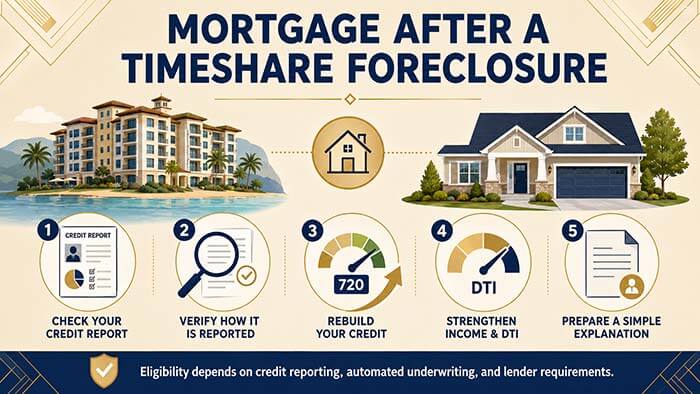
- Review the credit report and note how the foreclosed timeshare is listed.
- Tell the loan officer about the derogatory account that is a timeshare.
- Keep any records you have about the timeshare account.
- Review your credit report for other derogatory accounts (bankruptcies, foreclosures, collections, late payments, etc.).
- Give account balance and payment amount for timeshares that are not completely paid off.
- Don’t automate disputes. Talk to the loan officer for each case before doing so.
- Gather required mortgage documents to show your income and assets.
- Find out if any lender-specific requirements are preventing you from being approved.
Addressing the timeshare foreclosure early will give lenders the chance to address the credit report and fair lending DU before closing on the loan.
Final Thoughts on Fannie Mae Guidelines On Timeshare Foreclosure
Compared to a regular mortgage foreclosure, the risks associated with a timeshare foreclosure are low under Fannie Mae’s guidelines. Accounts from timeshare foreclosures are considered installment debt by Fannie Mae; therefore, the ordinary foreclosure waiting period is not triggered.
This does not mean Fannie Mae reviews the loan file less. Credit report, DU scores, and all other factors in the loan file are still reviewed.
Loan officers should be contacted immediately by borrowers to resolve issues if their timeshare is showing as a normal foreclosure. Identifying the account correctly can prevent a timeshare from being evaluated under the mortgage foreclosure rules, which typically do not apply to it.
Frequently Asked Questions About Timeshare Foreclosure and Mortgages
How Long Does a Timeshare Foreclosure Stay on a Credit Report?
Negative credit information typically stays on a person’s credit report for a maximum of seven years. The reporting period typically depends on the type of information reported and the delinquency date that led to the negative event. Fannie Mae’s treatment of a timeshare as installment debt does not require the credit bureaus to remove accurate derogatory information. Borrowers should review all three credit reports and challenge only information they believe is incomplete or inaccurate. The Consumer Financial Protection Bureau explains how long different types of information may remain on a credit report.
Can I Refinance My Home After a Timeshare Foreclosure?
Yes, a borrower may potentially refinance an existing home after a timeshare foreclosure. Fannie Mae does not impose its residential foreclosure waiting period solely because an account involved a timeshare. The borrower must still satisfy the requirements for the chosen refinance program, including credit, income, assets, home equity, DTI, property eligibility, and an acceptable underwriting recommendation. Cash-out and limited cash-out refinances also have separate transaction requirements.
Will a Timeshare Foreclosure Increase My Conventional Mortgage Rate?
Fannie Mae does not publish a separate interest-rate penalty or loan-level price adjustment specifically for a timeshare foreclosure. However, late payments and other derogatory activity associated with the account may lower the borrower’s credit score. A lower qualifying score can affect loan-level price adjustments, mortgage-insurance costs, and the rate or lender credit offered to the borrower. Therefore, a timeshare foreclosure can indirectly affect pricing, even though the timeshare event itself does not trigger a special Fannie Mae pricing adjustment.
Does a Timeshare Count Toward Fannie Mae’s Financed-Property Limit?
No. Fannie Mae excludes timeshare ownership from its limitations on the number of financed properties, even when the borrower is personally obligated on financing associated with the timeshare. This exclusion concerns only the financed-property count. An active timeshare payment may still need to be included in the borrower’s DTI.
Can a Co-Borrower Qualify if the Other Borrower Had a Timeshare Foreclosure?
Potentially. A timeshare foreclosure involving one borrower does not automatically prevent both applicants from obtaining a Fannie Mae conventional mortgage. The lender must evaluate the credit history and recurring obligations of every borrower. Derogatory information belonging to one applicant can still affect the loan’s representative credit score, pricing, DTI, and DU recommendation. Adding a co-borrower does not erase or override the affected borrower’s credit history.
Can a Timeshare Foreclosure Create a Tax Liability?
Possibly. If a creditor cancels part of the timeshare debt, it may issue Form 1099-C showing the canceled amount. Canceled debt is generally taxable unless the borrower qualifies for an exclusion or another exception applies. Tax treatment depends on the transaction and the borrower’s individual circumstances. Borrowers who receive a tax form or have debt forgiven should consult a qualified tax professional. The IRS guidance on canceled debt explains the general rules and possible exclusions.
This article about “Fannie Mae Guidelines on Timeshare Foreclosure and Mortgage Approval” was updated on September 14th, 2026.