Freddie Mac foreclosure guidelines depend on how your new loan is underwritten. For manual underwriting, the standard foreclosure recovery period is seven years, with a three-year path for documented extenuating circumstances. A qualifying Chapter 7 discharge may allow a different timeline. Loans receiving an LPA Accept result follow Freddie Mac’s automated credit assessment requirements.
A previous foreclosure does not permanently prevent you from getting a conventional mortgage. But before you start shopping for a home, your lender needs to determine which underwriting requirements apply to your file.
That review involves more than checking how many years have passed. The lender must identify the completed housing event, evaluate your current finances, and determine whether a bankruptcy-related provision or another documented exception applies. This guide explains Freddie Mac’s requirements for financing another home after foreclosure.
How Freddie Mac Reviews a Previous Foreclosure
Freddie Mac purchases eligible mortgages from lenders. You apply through a mortgage lender, which evaluates your application against the loan requirements. The first question is whether the lender is using Loan Product Advisor or manual underwriting.
Loans Receiving an LPA Accept Result
Loan Product Advisor, usually called LPA, is Freddie Mac’s automated underwriting system. For an Accept loan, LPA has evaluated the borrower’s credit reputation and determined that it is acceptable. Freddie Mac does not require the lender to obtain an explanation of adverse or derogatory credit solely for that credit assessment on an Accept loan. The lender still needs accurate application information, required documentation, and a loan that meets the applicable eligibility requirements. An Accept result is not a clear-to-close. Income, assets, debts, property, and other loan terms still need to be reviewed. If LPA returns Caution, ask whether manual underwriting is available for that loan. Product requirements and the lender’s available programs determine whether that path can be considered.
Manually Underwritten Loans After Foreclosure
For manual underwriting, Freddie Mac specifies recovery periods and documentation requirements. The standard foreclosure period is 84 months, or seven years, from completion when qualifying extenuating circumstances cannot be documented. A lender must also conclude that you have reestablished an acceptable credit history. Reaching the anniversary date alone does not establish eligibility. Ask your lender which underwriting method supports its decision. A general statement that every Freddie Mac borrower must wait 7 years overlooks the distinction between LPA and manual underwriting.
When Does the Foreclosure Recovery Period Start?
For manual underwriting, the foreclosure recovery period starts when the foreclosure is completed. Freddie Mac’s recovery documentation measures elapsed time through the application date.
Moving out, stopping payments, or receiving an initial foreclosure notice does not establish completion. A county recording date may provide evidence, but the lender must determine what the documents actually establish.
For example, suppose you left the property in 2018, but the foreclosure was completed in 2020. Under the standard manual underwriting requirement, the relevant seventh anniversary would be in 2027. If your records show conflicting dates, provide the lender with the foreclosure documents before choosing a target closing date.
Can Extenuating Circumstances Shorten the Waiting Period?
Freddie Mac permits a 36-month foreclosure recovery period for manually underwritten loans when qualifying extenuating circumstances are documented. The hardship needs to have been a one-time event that was outside your control and significant enough to lower your income or raise your expenses, making it impossible to pay your debts. The lender also has to show proof of your credit recovery. There are a few more requirements. The loan must be for buying a primary home and the combined loan-to-value ratio cannot be higher than 90% or the transaction’s limit, whichever is lower. It can also be an eligible no cash-out refinance. The file must show that the foreclosure was completed.
What Documentation Supports the Exception?
An explanation in writing should link the difficulty with the missed payments. Relevant supporting documents might consist of proof of an illness, a break in employment, or some other event pertinent to your situation. The explanation must align with the financial records; you need to state when the hardship began, how it affected your ability to make payments, when it ended, and what happened afterward. The lender will decide whether the evidence meets Freddie Mac’s requirements.
Freddie Mac Foreclosure Guidelines When the Mortgage Was Discharged in Chapter 7
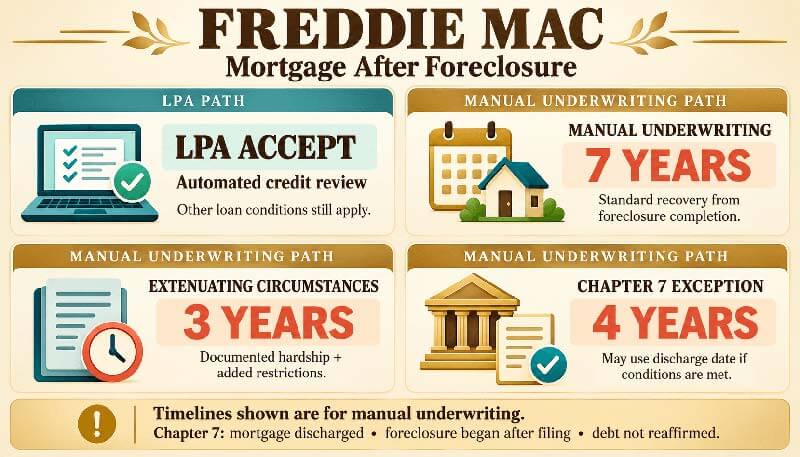
For manual underwriting, a foreclosure involving mortgage debt extinguished in Chapter 7 may qualify for a recovery period measured from the bankruptcy discharge.
The applicable Chapter 7 period may be 48 months if the event falls under financial mismanagement, or 24 months if qualifying extenuating circumstances are documented.
This provision has specific conditions: the lender must document that the mortgage debt was extinguished in Chapter 7, foreclosure proceedings must not have begun before the bankruptcy filing, and the mortgage must not have been reaffirmed. Merely listing a mortgage in the bankruptcy petition is not enough.
Why the Sequence of Events Matters
Suppose a borrower filed Chapter 7 in 2020, received a discharge in 2021, and had a foreclosure completed in 2023. The lender needs to establish when foreclosure proceedings began and whether the mortgage debt was discharged without reaffirmation. Those facts determine whether the bankruptcy-based provision can be considered. Have the lender review the petition, discharge, mortgage debt, and foreclosure timeline together. For a broader explanation of bankruptcy recovery requirements, see our Freddie Mac bankruptcy guidelines.
What Your Credit History Needs to Show Now
A better credit score can improve your chances with lenders, but they still consider your payment history. If you have recent missed payments, unpaid debts, or other major credit issues, these can still affect their decision.
Check your credit reports before you apply. Look for wrong balances, duplicate mortgages, or incorrect account statuses. Keep any documents that support the corrections you ask for.
Consider how much you can afford to pay each month. A bigger down payment can lower your total loan amount, but it doesn’t guarantee you’ll meet recovery requirements or demonstrate improved credit.
Foreclosure in Your Past? See When Freddie Mac May Allow a New Mortgage
Freddie Mac foreclosure guidelines include waiting periods and eligibility rules that can affect conventional loan approval. We’ll review your foreclosure date, credit recovery, income, debts, and overall file.What to Have Reviewed Before You Make an Offer
Request a review of the file to determine your eligibility for foreclosure before you go ahead with the purchase. Begin by looking at the documents that set out the event and the timeline of it; in different cases, these might be a foreclosure deed, a sale confirmation, a court record, or a document from the servicer. If Chapter 7 was involved, provide the petition, debt schedules, discharge order, and any reaffirmation agreement or evidence relevant to whether the mortgage debt was discharged. The lender will also identify the income, assets, housing history, and other documents needed for your loan. There is no single document list that fits every application. Before relying on a preapproval, make sure you understand:
- Which underwriting method the lender used.
- Which foreclosure or bankruptcy dates were accepted.
- Whether an exception is needed and has been reviewed.
- Which conditions remain before final approval.
Foreclosure, Short Sale, and Deed in Lieu Are Different Events
A foreclosure, a short sale, and a deed in lieu should not be treated as interchangeable. Under Freddie Mac’s standard manual underwriting recovery requirements, a short sale generally has a four-year period from completion, while a deed in lieu generally has a four-year period from execution. Documented extenuating circumstances may permit shorter periods, with additional requirements. Have the lender classify your actual event before calculating a timeline.
What If a Freddie Mac Loan Does Not Fit Your Situation?
A lender can evaluate another agency or loan program when your file does not meet the requirements for the proposed Freddie Mac loan. Each option needs its own review of credit, income, assets, occupancy, and the property. For the other conventional agency’s requirements, read our Fannie Mae guidelines on mortgage after foreclosure. Alternative financing also varies by investor. Avoid assuming that every non-QM loan permits financing immediately after foreclosure or requires the same down payment.
Get Your Foreclosure Timeline Reviewed Before House Hunting
The most useful next step is to have a lender review your records and identify an available underwriting path. That gives you a clearer answer about when to apply, what documentation is missing, and what purchase terms may fit your situation. Gustan Cho Associates can review your foreclosure history, current finances, and potential loan options. Call (800) 900-8569 or email gcho@gustancho.com to discuss your next home purchase.
Frequently Asked Questions About Freddie Mac Foreclosure Guidelines
Does an LPA Accept Result Guarantee My Loan Will Close?
No. The lender must verify the application and satisfy the remaining eligibility and documentation requirements before issuing final approval.
Can I Apply If the Foreclosure No Longer Appears on My Credit Report?
You still need to answer the application accurately. The absence of an account from your report does not establish that every applicable mortgage requirement has been met.
Does Every Chapter 7 Borrower Qualify for the Bankruptcy-Based Timeline?
No. The lender must verify the discharge of the mortgage debt, the timing of foreclosure proceedings, and whether the mortgage was reaffirmed.
Can a Co-Borrower’s Strong Credit Erase My Foreclosure?
Adding a co-borrower does not erase your credit history. Ask the lender to evaluate the full application rather than assuming that another borrower will resolve the issue.
Does This Guide Apply to Buying Someone Else’s Foreclosed Property?
This guide addresses a borrower’s previous foreclosure. Buying a bank-owned or foreclosed property raises separate questions about the property, title, condition, and financing.
This article about “Freddie Mac Foreclosure Guidelines: Qualifying for a New Mortgage” was updated on September 29th, 2026.