Jumbo Loans: Find Out Requirements, Rates, and Loan Limits
In this guide, we will cover jumbo loans. We will cover what a jumbo loan is, mortgage rates, and loan limits on jumbo mortgages. Buying a high-priced home can be really tough, especially when it comes to financing the mortgage process. Many people think that if they buy an expensive home, they will need a jumbo loan. That is not always the case.
An important factor about home loans is that they are based on the loan-to-value, which is the amount you borrow compared to the value of the house.
Jumbo loans are home loans exceeding the maximum conforming loan limit. If you are buying or refinancing a high-end home where the loan limit exceeds the standard conforming loan limit, the home loan you need is a Jumbo loan. Jumbo loans, commonly referred to as non-conforming loans, give homebuyers the mortgage loan they need to finance a high-end home. Before going shopping to buy a high-end home, it would be best to understand how jumbo loans work and the various types of jumbo loans available.
What Is a Jumbo Loan?
A jumbo loan is a type of mortgage often used to finance a high-end property. Jumbo loans are referred to as non-conforming loans since it exceeds the standard conforming loan limit. It is used when the loan amount exceeds the conforming loan limit set for the county where the property is located.
Conforming loans follow the maximum conforming loan limit set by Fannie Mae and Freddie Mac. Conforming loans have loan caps. Home loans that exceed conforming loan limits are called Jumbo loans.
In 2026, the usual loan limit for a single-family home in US counties is $832,750. In some expensive counties, the limit can go up to $1,249,125. Places like Alaska, Hawaii, Guam, and the US Virgin Islands have their limits. A $1 million home does not always need a loan. For example, if a buyer puts a lot of money down on a $1 million home, the loan amount might be low enough to be a loan, not a jumbo loan. A jumbo loan is often needed for homes that cost more than the conforming loan limit. A jumbo loan can help people buy homes.
Jumbo Loans Are Based on the Loan Amount, Not the Home Price.
The amount of money you borrow for a mortgage determines whether you need a loan. For example, let us say you are buying a home that costs $1 million. You pay $250,000 upfront. If a homebuyer is buying a home and it costs $750,000, you can qualify for a conforming or FHA loan because it is under the maximum loan limit.
The loan is higher than the FHA loan limit but not the conforming loan limit. Therefore, you do not need a Jumbo loan and can use a conventional loan.
If you buy a home that costs $950,000 and you only pay $100,000 upfront, you will need a mortgage for $850,000. $850,000 loan exceeds the $832,750 maximum loan limit. You would either have to come up with the difference of the overage or get a jumbo loan.
Jumbo Loans Are Based on Loan Amount, Not Home Price
Whether you need a jumbo loan depends on your loan amount, not just the home’s price. For example, buying a $1,000,000 home with a $200,000 down payment results in an $800,000 mortgage. In counties with a 2026 baseline conforming limit of $832,750, this may be a conforming conventional loan rather than a jumbo loan. In contrast, buying a $950,000 home with a $95,000 down payment results in an $855,000 mortgage. In most counties with the standard baseline limit, this loan amount will likely be classified as jumbo financing. To determine if your loan is jumbo, focus on your county’s loan limit, the property type, and how much you want to borrow.
Jumbo Loans versus High-Balance Conforming Loans
A high-balance conforming loan and a jumbo loan are not the same thing. High-balance loans are available in some counties. High-balance loans have limits set by the Federal Housing Finance Agency. High-Balance loans follow the rules as regular conforming loans, even if the loan amount is larger.
High-balance conforming loans apply to certain high-cost counties. They exceed the baseline conforming loan limit, but remain within the county’s higher local limit.
They are still conforming loans and follow Fannie Mae or Freddie Mac guidelines if the borrower and property are eligible. A jumbo loan will be higher than the county’s conforming loan limit. Jumbo lenders will set their own guidelines for credit, debt-to-income ratio, reserves, down payment, property type, and pricing. If you can get a high-balance conforming loan in your county, it’s usually better than a jumbo loan because jumbo loans often cost more.
Jumbo Loan Borrowers
Jumbo loans are common for buyers in pricey markets, whether the home is a luxury property or simply expensive for the area. Depending on the lender and program, you can use a jumbo loan to buy a second home, a vacation property, or an investment property.
Jumbo loans can also help you refinance for a better rate, shorten your loan term, remove a borrower, or access your home’s equity.
Jumbo loan requirements aren’t one-size-fits-all. Each lender sets its own rules, so your approval depends on your unique financial profile. Lenders typically consider your credit, income, job stability, debt-to-income ratio, down payment, reserves, property type, appraisal, and total mortgage amount.
Credit Requirements for Jumbo Loans
Generally, jumbo lenders view the complete credit profile. This includes: credit scores, payment history, revolving credit balances, recent inquiries, late payments, collections, charge-offs, and credit utilization.
A good credit score can help you get better loan options and rates, but it does not guarantee approval. High debt, recent late payments, low savings, or unstable income can still make it hard to qualify.
Jumbo lenders do not have a single minimum credit score. Some programs accept lower scores if you have strong compensating factors, like a bigger down payment, more assets, less debt, and a steady income.
Income and Employment Requirements
Lenders want to see that you can comfortably afford your new housing payment. If you’re a W-2 employee, expect to provide recent pay stubs, W-2s, tax returns, and proof of employment. If you earn extra through overtime, bonuses, commissions, or part-time work, be ready to show a history of that income. Lenders will check if it’s steady and enough to cover your payments. Self-employed? You’ll likely need to provide personal and business tax returns, profit-and-loss statements, business bank statements, K-1s, 1099s, and proof that you own your business.
Debt-to-Income Ratio for Jumbo Mortgages
Debt-to-income ratio or DTI is the ratio of total monthly debt obligations to total verified gross monthly income. Your DTI may include estimated monthly payments for your mortgage, property taxes, homeowners’ insurance, HOA dues, auto loans, student loans, credit card payments, personal loans, child support, alimony, and other recurring monthly obligations.
If you have great credit and a big down payment, lenders might be more flexible with your debt than if your credit is weaker and your down payment is smaller.
Jumbo Loans can be used for home purchases and refinances. Jumbo mortgage programs set different DTI limits. Jumbo lenders want to make sure you have enough savings left after paying your mortgage, so there is a limit on how much debt you can pay off.
Down Payment and Loan-to-Value Requirements
Many people think jumbo loans always require at least 20% down, but that is not always the case. Some jumbo loan programs require a minimum 20% down payment, while others may require more based on loan size, collateral type, credit profile, DTI, and reserves. A larger down payment and lower loan-to-value can reduce your borrowing costs and give you more loan choices. However, make sure you keep sufficient savings, as lenders may require cash reserves after closing.
Cash Reserve Requirements for Jumbo Loans
Cash reserves are the funds you have left over after closing. These can include money in checking, savings, investment, or retirement accounts, depending on your lender’s rules. Jumbo lenders typically look for reserves that cover several months of housing payments.
Reserve requirements can be raised for those who own multiple properties, have higher debt, or are buying a second home or an investment property.
Reserves are separate from your down payment and closing costs. Lenders require them to make sure you can keep up with payments if you face an unexpected expense or job loss.
Property and Appraisal Requirements
Your property needs to meet your lender’s standards and be appraised for the right loan amount. Appraisals for jumbo loans can be tricky if your property is highly customized, in a rural spot, newly built, or lacks similar sales nearby. This often applies to luxury homes, waterfront estates, large-acreage properties, unique condos, or stone-specific properties. Paying a high price for a home does not guarantee the appraisal will be the same. You may want to add an appraisal contingency to protect yourself, especially for stone-specific properties.
Buying or Refinancing a High-Value Home?
We’ll compare jumbo loan options, down payment requirements, reserves, and pricing so you can choose the right financing structure.Income and Employment Must Support Mortgage Payments
Jumbo lenders have to ensure borrowers can afford their mortgage payments.
- For people who work for a company and get a W-2 lenders may ask for pay stubs, W-2 forms and tax returns. They might also need to verify employment.
- If borrowers get bonuses, commissions, overtime pay or work time they may have to show that they have been getting that kind of income for a while.
- Self-employed borrowers must provide additional documents. These might include:
- business tax returns
- Profit and loss statements
- Business bank statements
- K-1 forms
- 1099s
- Proof of business ownership
When lenders evaluate mortgage programs, they consider several factors. These include:
- The size of the loan
- The borrower’s income
- The down payment
- The total costs
- The type of mortgage being used
Debt-to-Income. Jumbo Loan Approval
Your debt-to-income ratio, or DTI, is a comparison of your income to your monthly debt payments. This includes things like your mortgage, car loans, student loans, credit card debt, personal loans, alimony, child support, and other regular payments.
When you apply for a loan, lenders want to make sure you have enough money left over each month to afford the loan payments.
Even if you have an income, you may still have trouble getting approved if you have a lot of debt or own several properties with mortgages. Paying off some of your debt before applying for a loan can help. Do not use up all your savings to pay off debt without thinking about how much money you will have left after you close the loan. It is about finding a balance. You want to show lenders that you can afford the loan. You also want to make sure you have enough money left over to live on.
Down Payment Requirements for Jumbo Loans
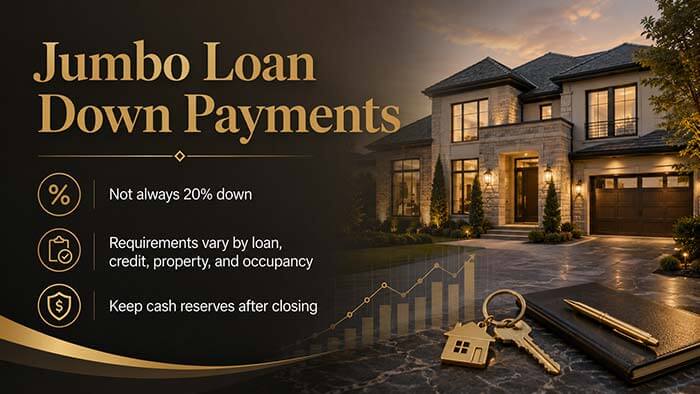
A lot of people think that you need to put 20 percent down to get a Jumbo Loan. That is not always the case. Some Jumbo Loan programs will let you put down less than 20 percent. Others will want you to put down more. The amount you need to put down depends on how much you’re borrowing, your credit score, what kind of property you are buying, if you will be living there, how much debt you have compared to your income, and what the lender says is okay.
If you put down a lot of money, it can be a thing. You will have a loan-to-value ratio, and you might have more financing options.
You will also pay less each month. You will not have to pay as much interest over time. Using all your savings for the down payment is not a good idea. Jumbo lenders want to make sure you have some money left over after you buy the house. They want you to have some cash set just in case.
Buying or Refinancing a High-Value Home?
Get a full jumbo loan pre-approval before comparing high-balance conforming, traditional jumbo, and Non-QM jumbo loans. Check your county limits, down payment, reserves, income, and property type before making an offer. Self-employed borrowers can qualify for jumbo loans, but be prepared for stricter documentation and requirements.
Traditional jumbo loans usually require tax returns and proof of income. For business owners, tax write-offs can make your reported income look lower than it really is, even if your business is thriving.
This can make it harder to qualify for the loan amount you want. Non-traditional mortgage programs can help. Options like bank statement loans, 1099 loans, asset-depletion loans, and other Non-QM programs may be available. Jumbo and Non-QM loans can both be large, but they’re not the same thing. Jumbo describes the loan size, while Non-QM refers to the loan type. Depending on the lender and program, a jumbo loan can be either a Qualified Mortgage or a Non-QM mortgage.
Buying or Refinancing a High-Value Home?
Get a full jumbo loan pre-approval before comparing high-balance conforming, traditional jumbo, and Non-QM jumbo loans. Check your county limits, down payment, reserves, income, and property type before making an offer. Self-employed borrowers can qualify for jumbo loans, but be prepared for stricter documentation and requirements. Traditional jumbo loans usually require tax returns and proof of income.
For business owners, tax write-offs can make your reported income look lower than it really is, even if your business is thriving. This can make it harder to qualify for the loan amount you want.
Non-traditional mortgage programs can help. Options like bank statement loans, 1099 loans, asset-depletion loans, and other Non-QM programs may be available. Jumbo and Non-QM loans can both be large, but they’re not the same thing. Jumbo describes the loan size, while Non-QM refers to the loan type. Depending on the lender and program, a jumbo loan can be either a Qualified Mortgage or a Non-QM mortgage.
Jumbo Loans for Self-Employed Borrowers
Self-employed buyers can get financing, but the problem is usually self-employed borrowers lack adjusted gross income. Most self-employed borrowers utilize the benefit of writing off expenses which reduces adjusted gross income.
The issue with self-employed borrower is that tax returns do not always show how much money a business owner really makes. This is because they can claim things like expenses and depreciation to pay tax. So when they apply for a loan, the bank might not think they earn enough.
This is because the bank uses tax returns to determine whether they qualify for the loan. Some self-employed borrowers can still get a loan. They have to use different paperwork. They can use bank statements or their 1099 form to show their income. They can also use their assets to qualify for the loan.
Non-QM Jumbo Loans
Alternative financing types of loans are called Non-QM loans, depending on the lender and the loan. It is important to know that a jumbo loan and a Non-QM loan are not the same.
Jumbo loans loans are mortgage loans that surpass the conforming loan limit. A Non-QM loan is a loan that does not meet all the rules for a Qualified Mortgage.
A Jumbo loan can be a Qualified Mortgage or a Non-QM loan; it just depends on the loan. Jumbo loans are about the amount of money borrowed. Non-QM loans are about how they are structured and whether they meet the rules.
Closing Costs Associated with Jumbo Loans and the Interest Rates
Jumbo loans sometimes offer interest rates similar to conforming loans. Your rate will depend on market trends, your loan amount, credit score, down payment, and other factors. The interest rate on a mortgage offer is not the only number to consider.
Review the Loan Estimates closely. Pay attention to the interest rate, APR, points, total fees, total lender credits, cash-to-close, total monthly payment, and the total cost of borrowing after 5 years.
The Consumer Financial Protection Bureau suggests comparing Loan Estimates side by side using the same loan parameters. If an offer has a low interest rate, but it comes with a lot of points, it may not be worth it if you’re selling the home in a few years. Similarly, lender credits may ease the immediate cost, but the trade-off will be a higher interest rate.
Jumbo Purchase Loans
Jumbo Purchase Loans help you buy a home when your loan amount is above your area’s conforming limit. Before you make an offer, know your maximum loan amount, minimum down payment, reserve requirements, and estimated cash-to-close.
Jumbo Rate-and-Term Refinancing
Rate-and-term refinancing means replacing your mortgage to get a better rate or term, without taking out much extra cash.
Jumbo Cash-Out Refinancing
Jumbo cash-out refinancing lets you replace your mortgage and take out extra cash. You can use these funds for renovations, big purchases, debt consolidation, education, investing, or other major expenses. Cash-out refinances often come with tougher requirements, such as higher credit scores, lower debt-to-income ratios, cash-out limits, and greater home equity.
Preparing for a Jumbo Loan
With the right preparation, qualifying for a jumbo loan can be much smoother. Review your credit, income, debt, reserves, and property type to determine what to address first.
Review Credit
Check your credit report for errors or fraud before applying. Avoid opening new credit cards or making big purchases between your application and closing.
Gather Income and Asset Documentation
Gather your paperwork before you apply: recent bank and investment statements, pay stubs, W-2s, tax returns, and business documents. If you’re self-employed, include business tax returns, a profit-and-loss statement, business bank statements, and proof that you own the business.
Accounting for Large Deposits
If you have large deposits, transfers, or gifts, keep clear records and documentation. Save gift letters, deposit slips, and any proof related to the funds. Lenders should provide the Loan Estimate, which includes your estimated cash to close, and should also provide a source of funds for your cash to close ([Consumer Financial Protection Bureau][2]). Get a Full Jumbo Pre-Approval A full jumbo pre-approval reviews your credit, income, assets, debts, down payment, reserves, and the property you want. Don’t rely on a Jumbo Loan Estimate for pre-approval. A solid pre-approval helps you make a competitive offer and focus your home search on properties you can truly afford.
Is a Jumbo Loan Right for You?
If your mortgage needs are higher than your county’s conforming limit, you might consider a jumbo loan. However, be sure to consider all your options, including standard conforming, high-balance conforming, traditional jumbo, and Non-QM jumbo programs. The best mortgage is not always the one with the lowest rate. Consider your budget, down payment, savings, property type, long-term plans, and your comfort with the monthly payment.
How To Prepare for a Jumbo Loan
To get ready for a loan, you should start getting everything in order before you even think about looking at homes. This means you should check your credit reports and fix any mistakes you find. You should also try to keep the amount you owe on your credit cards under control and avoid taking on any additional debt.
Make sure you have copies of things like your bank statements and tax returns. You should also keep records of your pay and any business you own
. If you have made any deposits or transfers, you need to have paperwork explaining the source of the funds. When you are moving money around, do not do it without keeping track of it. Lenders will want to know where your down payment and closing funds are coming from. So it’s a good idea to keep everything straight. Before you make an offer on a house, you should get something called a pre-approval for a loan. This will give you an idea of how much you can borrow and what you need to do to get the loan. A jumbo pre-approval will also tell you how much you need to put down and what paperwork you will need to get the loan for the price of the house you want to buy.
Talk With a Jumbo Loan Specialist
Talk to a mortgage expert to review your loan limits, credit, income, and debt before making an offer or moving your down payment. This helps you understand your financing options before buying a high-value home.
Frequently Asked Questions About Jumbo Loans
Do All $1 Million Homes Require Jumbo Financing?
Not necessarily. What matters is the mortgage amount, which is the purchase price less the down payment. If a buyer makes a large enough down payment, they may keep the loan within their county’s conforming loan limit.
Can First-Time Homebuyers Qualify for Jumbo Loans?
Yes. First-time homebuyers can qualify for a jumbo loan if they meet the lender’s credit, income, down payment, reserve, and debt-to-income ratio requirements. Being a first-time homebuyer does not disqualify an applicant from a jumbo loan.
Can Down Payments for Jumbo Loans be Funded with Gifts?
Some jumbo loan lenders accept gift funding, while others stipulate that a portion of the down payment be funded by the borrower’s own resources. The donor, the transfer method, the donor’s account history, and the documentation requirements may vary by lender.
Can Jumbo Loans Come with a Flexible Rate?
Yes. A number of lenders offer jumbo loans with both fixed and flexible interest rates. Although a flexible-rate mortgage may start with a lower interest rate, the borrower should be aware of the potential for the interest rate to increase.
Do I Automatically Fail to Qualify for a Jumbo Loan if I Own Other Properties?
No. Ownership of other properties is unlikely to affect jumbo loan approval. However, lenders may analyze the mortgage and payments, rental income and debts, equity, and reserve requirements for each and every property you own.
Is it Permissible to Refinance a Jumbo Loan into a Conforming Loan in the Future?
Yes, so long as the new loan amount is in line with the applicable conforming loan limit and you meet all of the other relevant underwriting criteria. This may be the case if you pay down the mortgage balance, the property’s value increases, and/or the conforming limit in the county increases. Most jumbo loans are not assumable, but the loan documents control. An assumable mortgage allows the buyer to take over the existing loan terms without procuring a new mortgage. The CFPB specifies that most loans do not allow assumptions.
Do Jumbo Loans Take Longer to Close?
Yes, they can, especially if the borrower has complex income, several properties, large assets, gift funds, or self-employment income, or a unique property. Well-organized documents and a strong pre-approval can reduce the closing time.
Can People from Other Countries Get Jumbo Loans?
Some lenders offer loans to people from other countries, but they might require more information and have different requirements than lenders serving people in the United States. They might need to make a larger down payment, have more money in the bank, show proof of income from another country, and provide more documents.
Can I Change My Loan to a Regular Loan Later On?
Yes, I can do that if I pay down the loan enough or if the amount, I can borrow without a loan increase in my area. The new loan still has to meet all the requirements for credit, income, appraisal, and underwriting.
Are Loans Something That Other People Can Take Over?
Most jumbo loans are not something that other people can take over. It depends on the loan agreement and the lender. Buyers should read the loan documents carefully before they think someone else can take over the loan.
Can I Use Money Someone Gave Me to Make a Payment on a Jumbo Loan?
Some lenders that give loans are okay with me using gift funds, but others might need me to use some of my own money. The rules for gift funds vary by lender, so I should talk to them before I get the money or move it around.
Do Jumbo Loans Take Time to Finalize?
Jumbo loans can take longer to finalize, especially if I have multiple homes, large bank accounts, or an unusual property. If I have all my documents ready and organized, it can help speed up the process.
Do I Need to Get Approval for a Jumbo Loan?
Yes, I need to get a pre-approval for a jumbo loan. The lender will look at my credit income, assets, debts, down payment, and how much money I have in the bank. This is better than getting a quick online estimate because jumbo loans require more documentation.