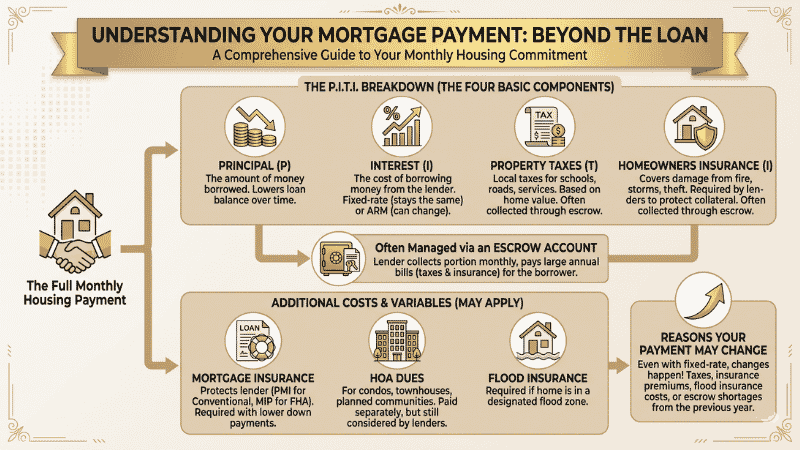
Your mortgage payment is more than just the money you borrowed to buy a home. Most monthly mortgage payments include principal, interest, property taxes, homeowners’ insurance, and sometimes mortgage insurance, HOA dues, or flood insurance. These costs can affect how much home you can afford, why your payment may change, and how much money you need to budget each month.
Understanding what makes up a mortgage payment helps borrowers avoid surprises after closing. Many homebuyers focus only on the interest rate or loan amount, but the full monthly housing payment can be higher once taxes, insurance, escrow, and mortgage insurance are included.
This is why knowing the full mortgage payment breakdown is important before buying or refinancing a home. At Gustan Cho Associates, we help borrowers understand the full cost of homeownership before they commit to a mortgage. Whether you are buying your first home, refinancing, or comparing loan options, understanding how your mortgage payment works can help you make a smarter, more affordable decision.
What Does A Mortgage Payment Include?

Principal
The principal is the amount of money you borrowed to buy or refinance the home. When you make your mortgage payment each month, part of the payment goes toward lowering your loan balance. For example, if you borrow $250,000, your starting principal balance is $250,000. Over time, your monthly payments reduce that balance. In the early years of the loan, a smaller part of your payment usually goes toward principal. Later in the loan, more of your payment goes toward paying down the balance.
Interest
Interest is the cost of borrowing money from the lender. Your lender charges interest in exchange for giving you the money to buy or refinance the home. Your interest rate plays a big role in what you pay each month. If your rate is higher, expect a bigger monthly bill. On the flip side, a lower rate usually means you’ll pay less each month.
A bunch of factors can affect your rate, like your credit score, the type of loan you’re getting, how much you put down, the type of property, how long the loan is, and what’s happening in the market right now.
With a fixed-rate mortgage, the principal and interest payment stay the same for the life of the loan. With an adjustable-rate mortgage, the interest rate may change after the fixed period ends, potentially altering the monthly payment.
Property Taxes
Property taxes are local taxes charged by your city, county, or local government. These taxes are usually based on the assessed value of your home and help pay for public services such as schools, roads, police, fire departments, and local government services. Many lenders will wrap property taxes into your monthly mortgage payment by creating an escrow account. Instead of paying a large tax bill once or twice a year, you pay a portion each month. When the tax bill is due, the lender uses the escrow account to pay it on your behalf. Property taxes can change over time. If your taxes go up, your monthly mortgage payment may also increase.
Homeowners Insurance
Homeowners insurance gives you a safety net for your house against things like fires, storms, theft, and other kinds of damage. Most lenders require homeowners’ insurance because the home is the collateral for the mortgage loan.
Like property taxes, homeowners’ insurance is often collected monthly through an escrow account. The lender collects part of the annual premium each month and pays the insurance company when the bill is due.
Your homeowners’ insurance cost can change from year to year. If your premium increases, your monthly mortgage payment may increase as well.
Mortgage Insurance
Mortgage insurance might be required based on the type of loan you have and how much you put down. It’s basically there to protect the lender if you can’t make your loan payments. On a conventional loan, mortgage insurance is usually called private mortgage insurance, or PMI. It is often required when a borrower puts less than 20% down. On an FHA loan, mortgage insurance is called an FHA mortgage insurance premium, or MIP. USDA loans may also have monthly guarantee fees. Mortgage insurance can increase your monthly payment, so borrowers should factor it in when estimating affordability. In some cases, mortgage insurance may be removed later, depending on the loan type, equity, and lender requirements.
HOA Dues And Flood Insurance
Some borrowers may have additional housing costs, such as homeowners’ association dues or flood insurance. HOA dues may apply if the property is located in a condo, townhouse, planned community, or subdivision with a homeowners association.
HOA dues may cover services such as landscaping, exterior maintenance, snow removal, security, community amenities, or shared building expenses. These dues are usually counted as part of your housing expense, even if they are paid separately from the mortgage payment.
Flood insurance may be required if the home is located in a designated flood zone. Some lenders may include flood insurance in the escrow account, while others may require it to be paid separately. These extra costs matter because they can affect your total monthly housing payment and your debt-to-income ratio when qualifying for a mortgage.
Understanding Amortization: The Shift Over Time
Your mortgage payments follow a schedule that illustrates the portion of each payment allocated to interest and the amount applied to reducing the principal balance of the loan.
- Early Years: Mostly interest
- Middle Years: Balance begins to shift
- Later Years: Mostly principal
For example, in year one of a 30-year loan, your payment might be $1,800/month, with $1,450 going to interest and $350 to principal. In year 20, those numbers may flip.
Fixed-Rate vs. Adjustable-Rate Mortgages (ARMs)
Your loan type affects your mortgage payment structure:
- Fixed-Rate Mortgage: Same monthly payment throughout the loan term. Predictable.
- Adjustable-Rate Mortgage (ARM): This type of mortgage has a lower starting rate, but your payment can change after a set period (like 5, 7, or 10 years).
If you plan to stay in your home long-term, a fixed-rate might offer more peace of mind. For short-term ownership, ARMs can save you money up front.
Are HOA Dues Included In A Mortgage Payment?
 HOA dues may be part of your total monthly housing expense, but they are often not included directly in your mortgage payment. If the home is located in a condo building, townhouse community, planned unit development, or subdivision with a homeowners association, you may need to pay HOA dues separately each month, quarter, or year.
HOA dues are fees paid to the homeowners’ association. These dues may cover shared costs such as landscaping, exterior maintenance, snow removal, security, trash service, common-area upkeep, pools, gyms, clubhouses, or building insurance in certain condo communities.
Even when HOA dues are paid separately from the mortgage payment, lenders still count them when qualifying you for a home loan. This is because HOA dues affect your total monthly housing cost and your debt-to-income ratio. A borrower may qualify for a mortgage based on principal, interest, taxes, and insurance, but high HOA dues can reduce buying power. For example, your lender may look at your full housing expense, including:
- Principal and interest
- Property taxes
- Homeowners insurance
- Mortgage insurance, if required
- HOA dues
- Flood insurance, if required
The key point is that HOA dues may not always be collected through your escrow account, but they still matter. Before buying a home with an HOA, ask how much the dues are, how often they are paid, what they cover, and whether the association has any pending increases or special assessments. This helps you understand the true monthly cost of owning the home.
Homeowners Insurance Portion Of A Mortgage Payment
Homeowners insurance is one part of a mortgage payment that protects the property against covered losses. These losses may include fire, theft, wind damage, storms, or other covered events listed in the insurance policy. Most lenders require homeowners’ insurance because the home is used as collateral for the mortgage loan.
Homeowners insurance is often rolled into your monthly mortgage payment through an escrow account. Your lender takes a bit of your yearly insurance premium each month and puts it aside. Then, when it’s time to pay the insurance bill, the lender uses that money from the escrow account to cover it.
Homeowners’ insurance costs can change over time. If your insurance premium goes up, your monthly mortgage payment may also increase. This is one reason a fixed-rate mortgage payment can still change, even when the principal and interest portion stays the same. Before buying a home, borrowers should review the estimated homeowners’ insurance premium and include it in their full monthly housing payment. This helps avoid surprises and gives a more accurate picture of what the home will cost each month.
What Is An Escrow Account?
An escrow account is an account run by your mortgage lender or loan servicer that helps cover some of your home expenses. These expenses usually include property taxes and homeowners insurance. Depending on the loan and property, escrow may also include mortgage insurance or flood insurance.
Instead of paying these bills separately once or twice a year, the borrower pays a portion of each bill each month as part of the mortgage payment. The lender keeps the cash in an escrow account and handles the bills when they’re due.
For many borrowers, escrow makes budgeting easier because taxes and insurance are spread over 12 monthly payments instead of being paid in a single lump sum.
Why Lenders Collect Taxes And Insurance Monthly
Lenders collect property taxes and homeowners’ insurance monthly to ensure these important bills are paid on time. The home serves as collateral for the mortgage loan, so lenders need to know the property is protected and that tax bills will not become a problem. Property taxes are important because unpaid taxes can create liens against the property. Homeowners insurance is important because it protects the home from covered losses, such as fire, storms, theft, and other perils. When taxes and insurance are escrowed, the borrower makes one monthly payment to the lender. The lender then pays the tax bill and insurance premium from the escrow account when those bills are due.
Why Your Mortgage Payment Can Change
Your mortgage payment can change even if you have a fixed-rate mortgage. With a fixed-rate loan, the principal and interest portion usually stay the same. However, the escrow portion can change over time.
The most common reasons your mortgage payment changes are property tax increases, homeowners’ insurance increases, changes to mortgage insurance or flood insurance, or escrow shortages from the previous year.
For example, if your county raises your property taxes or your insurance company increases your premium, your lender may need to collect more each month to cover the higher cost. That can increase your total monthly mortgage payment. Your payment may also change if there wasn’t enough money in your escrow account to cover the bills. This is called an escrow shortage. When that happens, your lender may increase your monthly payment to make up the difference.
What Is An Escrow Analysis?
An escrow analysis is a yearly review of your escrow account. Your mortgage servicer reviews how much money was collected, how much was paid out for taxes and insurance, and how much money should be collected for the next year. If your lender collected more money than necessary, you may receive an escrow refund. If your lender did not collect enough, you may have an escrow shortage. When there is a shortage, you may have the option to pay the shortage in one lump sum or spread it out over future monthly payments, depending on your loan servicer’s rules. An escrow analysis helps explain why your mortgage payment may increase or decrease. If your payment changes, review the escrow analysis carefully. The change is often tied to property taxes, homeowners’ insurance, or another escrowed cost rather than the loan principal and interest.
How to Lower You Mortgage Payment
Understanding the components of mortgage payments for borrowers can also help you find ways to lower your payments. For example, you could refinance to a lower interest rate, appeal your property tax assessment if your home value has dropped, or shop for cheaper homeowners insurance.
You can also remove mortgage insurance if you reach 20% equity in your home. The type of loan you choose plays a big role in what’s included in your mortgage payment.
FHA loans include both upfront and monthly mortgage insurance premiums. VA loans, which are for eligible veterans and military members, don’t require monthly mortgage insurance. Still, they do have a one-time funding fee. USDA loans include an annual guarantee fee. Conventional loans may require PMI if you put down less than 20%, but you can cancel it once you reach 20% equity. If you’re wondering how to better handle your mortgage payments, talk to a trusted lender like Gustan Cho Associates. We help borrowers understand their payment breakdown and work with them to get the most affordable loan possible. We don’t believe in lender overlays; we’re known for approving loans while others deny.
Rewards of Understanding Your Mortgage Payment
When you understand what’s in your mortgage payment, you’re better equipped to manage your money, plan for the future, and spot opportunities to save. It’s not just about paying your loan—it’s about being a smart homeowner. Contact our team if you’re ready to apply for a mortgage, refinance, or just have questions. We’re licensed in 48 states and work with borrowers of all credit profiles, including those with credit scores as low as 500. Call us today at 800-900-8569 or visit GustanCho.com to get started. At Gustan Cho Associates, we offer solutions and not just loans.
How Your Mortgage Payment Pays Down Your Loan
Each mortgage payment helps pay down your home loan over time. Part of your payment goes toward interest, which is the cost of borrowing money. Another part goes toward principal, which is the amount you borrowed.
At the beginning of a mortgage, more of your payment usually goes toward interest. As the loan balance gets smaller, more of your payment goes toward principal. This process is called amortization.
Amortization is important because your mortgage payment does not reduce your loan balance by the same amount each month. In the early years, the balance goes down slowly. Later in the loan, more of each payment is applied to the principal, so the balance starts dropping faster. For example, if you have a fixed-rate mortgage, your principal and interest payment may stay the same each month. However, the way that payment is split changes over time. Early payments may be mostly interest. Later payments may be mostly principal. Understanding amortization can help borrowers see why extra principal payments may reduce long-term interest costs. Even small extra payments toward principal can help lower the loan balance faster, as long as the lender applies the extra money to principal and there are no prepayment penalties.
What Factors Affect Your Monthly Mortgage Payment?
Your monthly mortgage payment can be affected by more than the amount you borrow and the interest rate. The full housing payment may include principal, interest, property taxes, homeowners’ insurance, mortgage insurance, HOA dues, flood insurance, and escrow changes. This is why two borrowers with the same loan amount can have different monthly mortgage payments. The home’s location, loan program, insurance costs, taxes, down payment, and property type can all affect the final payment.
Loan Amount
The loan amount is basically the cash you take out from the lender. A higher loan amount usually creates a higher monthly principal and interest payment. A lower loan amount usually creates a lower payment. Your loan amount depends on the purchase price, down payment, and any financed costs. For example, if you make a larger down payment, you may borrow less and lower your monthly mortgage payment.
Interest Rate
Interest rates are basically what you pay to borrow money. When interest rates are higher, your monthly payments tend to be higher, too. On the flip side, a lower interest rate usually means lower payments. A bunch of things can influence your interest rate, like your credit score, the type of loan, how long you take to pay it off, your down payment, the kind of property, whether you’re living in it or renting it out, and what’s happening in the market right now. Even a tiny change in the rate can have a big impact on how much you pay each month and the total interest you end up shelling out over the life of the loan.
Loan Term
The loan term is basically the time you get to pay back your mortgage. Common mortgage terms include 15-year and 30-year loans. A longer loan term usually gives you a lower monthly principal and interest payment because the balance is spread out over more years. A shorter loan term usually has a higher monthly payment. It may help you pay off the loan faster and reduce total interest costs.
Property Taxes
Property taxes are local fees that depend on how much your home is worth and the tax rate in your area. They can vary widely by city, county, and state. Many lenders collect property taxes monthly through an escrow account. If property taxes increase, your total monthly mortgage payment may also increase. This can happen even if you have a fixed-rate mortgage.
Homeowners Insurance
Homeowners insurance protects the property against covered losses, such as fire, storms, theft, or certain types of damage. Most lenders require homeowners’ insurance before closing. Insurance premiums can vary based on the property location, home value, coverage amount, claims history, and insurance company. If your homeowners’ insurance premium increases, your monthly mortgage payment may increase if the premium is escrowed.
Mortgage Insurance
Mortgage insurance might be needed based on the loan program and how much you put down. It protects the lender if the borrower defaults on the loan.
Conventional loans may require private mortgage insurance (PMI) when the borrower puts down less than 20%. FHA loans require mortgage insurance premiums. USDA loans may include a guarantee fee. VA loans do not require monthly mortgage insurance, but eligible borrowers may be required to pay a VA funding fee.
Mortgage insurance can add to the monthly payment, so borrowers should include it when estimating affordability.
HOA Dues
HOA dues may apply if the home is in a condo, townhouse, planned community, or subdivision with a homeowners association. These dues may cover shared services such as landscaping, exterior maintenance, snow removal, security, amenities, and common-area expenses. HOA dues are often paid separately from the mortgage payment, but lenders still count them as part of your monthly housing expense. Higher HOA dues can increase your debt-to-income ratio and reduce how much home you may qualify for.
Flood Insurance
Flood insurance may be required if the home is located in a designated flood zone. This insurance is separate from standard homeowners insurance and protects against certain flood-related losses. If flood insurance is required, it can increase your total monthly housing cost. In some cases, the lender may collect the flood insurance premium through escrow. In other cases, the borrower may pay it separately.
Loan Program
The loan program you choose can affect your monthly mortgage payment. FHA, VA, USDA, conventional, jumbo, and non-QM loans may have different mortgage insurance rules, down payment requirements, rates, fees, and escrow requirements.
For example, an FHA loan may have monthly mortgage insurance. A conventional loan may require PMI if the down payment is less than 20%. A VA loan does not have monthly mortgage insurance, which may help eligible veterans and service members lower their monthly payments.
Choosing the right loan program is important because the lowest interest rate does not always mean the lowest total monthly payment.
Escrow Account Changes
Changes to escrow account balances can affect your monthly mortgage payment over time. Your escrow account is used to pay property taxes, homeowners’ insurance, and, sometimes, flood or mortgage insurance. Your lender or loan servicer usually reviews your escrow account once a year. If taxes or insurance go up, your payment may increase. If your escrow account is short, your payment may also increase to make up the difference. This is one of the most common reasons a borrower’s mortgage payment changes after closing. Even with a fixed-rate mortgage, the escrow portion of the payment can go up or down. See today’s mortgage rates.
Common Mistakes to Avoid
- Ignoring Escrow: Property taxes and insurance can add hundreds to your monthly payment.
- Underestimating PMI: It’s not permanent but it can cost more than you think.
- Not Shopping Rates: Even a 0.25% difference in interest can change your total cost by thousands.
- Choosing Wrong Loan Term: A 15-year loan saves interest, but payments are higher.
Financial advisors and mortgage experts from Hitachi Credit explains that when you extend your mortgage term, you have lower monthly payments, which can save you a significant amount of money each year. It can also allow you to comfortably pay off your mortgage little by little without having to stress over it. Your mortgage payment structure matters more than just getting approved—it affects your budget, savings, and lifestyle.
xample of a Mortgage Payment Breakdown
For a $300,000 loan at 6.5% interest on a 30-year fixed loan:
- Principal & Interest: ~$1,896/month
- Taxes: ~$300/month
- Homeowner’s Insurance: ~$100/month
- PMI: ~$125/month (if applicable)
Total Monthly Payment: ~$2,421/month
This is just an estimate. Gustan Cho Associates can give you a personalized quote based on your credit score, income, and location.
Get Pre-Approved With Experts Who Know Mortgage Payment Structures
At Gustan Cho Associates, we don’t just approve loans—we educate you. Whether you have great credit or are rebuilding, our team helps you:
- Understand your full monthly mortgage payment structure
- Eliminate surprises at closing
- Qualify with high DTI or lower credit scores
- Remove PMI as soon as possible
We specialize in no-overlay lending and manual underwriting, which means we can help when others can’t.
Other Parts of a Mortgage Payment
The P and I are probably just part of your mortgage payment because most lenders require borrowers to also pay their homeowner’s insurance and property taxes with their monthly P and I. That’s because they want to make sure that you pay these costs on time. When the lender adds these amounts to your payment, they call it an “escrow” or “impound.” Lenders divide the annual amount of your taxes and insurance, divide it by 12 months, and add that amount to your P and I payment. The entire amount is called PITI for principal, interest, taxes, and insurance.
But Wait, There’s More
Your mortgage payment might include even more than PITI. Borrowers who put less than 20% down on their homes usually also pay for mortgage insurance. Mortgage insurance policies pay the lender if you default (don’t pay your mortgage). And if you buy a home in a designated flood zone, you’ll also have to purchase flood insurance.
Final Thoughts On Understanding Your Mortgage Payment
Understanding your mortgage payment helps you make better decisions before and after buying a home. Your monthly payment may include more than principal and interest. Property taxes, homeowners’ insurance, mortgage insurance, HOA dues, flood insurance, and escrow changes can all affect the total amount you pay each month.
The most important thing to remember is that a mortgage payment is not always one fixed number forever. If you have a fixed-rate mortgage, your principal and interest payment may stay the same. However, your total monthly payment can still change if taxes, insurance, or escrow costs go up or down.
Before you buy or refinance, review the full payment breakdown with your lender. Ask what is included in the payment, what may be paid separately, and what could change in the future. This can help you avoid surprises, compare loan options more clearly, and choose a mortgage that fits your monthly budget. At Gustan Cho Associates, we help borrowers understand the full cost of homeownership before they move forward. Whether you are buying a home, refinancing, or trying to lower your monthly payment, understanding how your mortgage payment works is the first step toward making a smart, confident mortgage decision.
Mortgage Payment FAQs
What Is Included In A Monthly Mortgage Payment?
A monthly mortgage payment usually includes principal, interest, property taxes, and homeowners’ insurance. This is commonly called PITI, which stands for principal, interest, taxes, and insurance. Some borrowers may also have mortgage insurance, HOA dues, flood insurance, or escrow payments included in their total monthly housing cost. The Consumer Financial Protection Bureau explains that PITI represents the four basic parts of many mortgage payments.
Does My Mortgage Payment Include Taxes And Insurance?
Many mortgage payments include property taxes and homeowners insurance through an escrow account. With escrow, your lender collects a portion of your taxes and insurance each month and pays those bills when they are due. However, not every mortgage has escrow. Some borrowers pay taxes and insurance separately, depending on the loan type, lender rules, down payment, and state requirements.
Why Did My Mortgage Payment Go Up If I Have a Fixed-Rate Loan?
Your mortgage payment can go up even with a fixed-rate mortgage. The principal and interest portion usually stays the same, but property taxes, homeowners’ insurance, flood insurance, or escrow shortages can increase your total monthly payment. The CFPB says borrowers should review their mortgage statement for itemized charges and contact their servicer if they do not understand why the payment changed.
What Is Escrow In A Mortgage Payment?
Escrow is an account your lender or loan servicer uses to hold funds for property taxes, homeowners’ insurance, and, sometimes, mortgage or flood insurance. Instead of paying these bills in large lump sums, you pay a portion each month with your mortgage payment. When the bill is due, the lender pays it from the escrow account. Wells Fargo notes that escrow often includes property taxes, mortgage insurance, and homeowners’ insurance.
Is Mortgage Insurance The Same As Homeowners’ Insurance?
No. Homeowners’ insurance protects the home against covered damage or losses. Mortgage insurance protects the lender if the borrower defaults on the loan. Conventional loans may require PMI if the borrower puts down less than 20%, while FHA loans require mortgage insurance premiums. Travelers explains that PMI does not cover the home or protect the buyer; it protects the lender if the borrower cannot make payments.
Are HOA Dues Part Of My Mortgage Payment?
HOA dues are part of your total monthly housing cost, but they are often paid separately from the mortgage payment. If you buy a condo, townhouse, or home in a homeowners’ association, the lender will still count the HOA dues when calculating your debt-to-income ratio. Freddie Mac explains that homeownership costs beyond principal and interest can include PMI, taxes, homeowners’ insurance, and HOA fees.
This article about “Mortgage Payment Guide: Avoid Costly Surprises” was updated on April 29th, 2026.