2026 Mortgage Guidelines: FHA Loans with Low Credit Scores
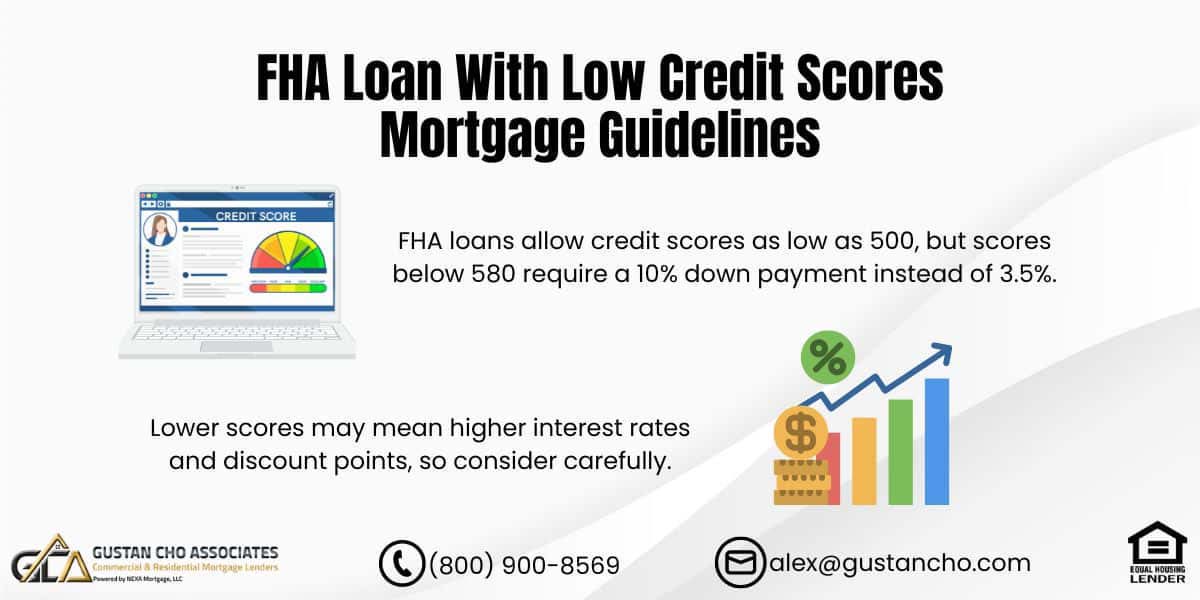
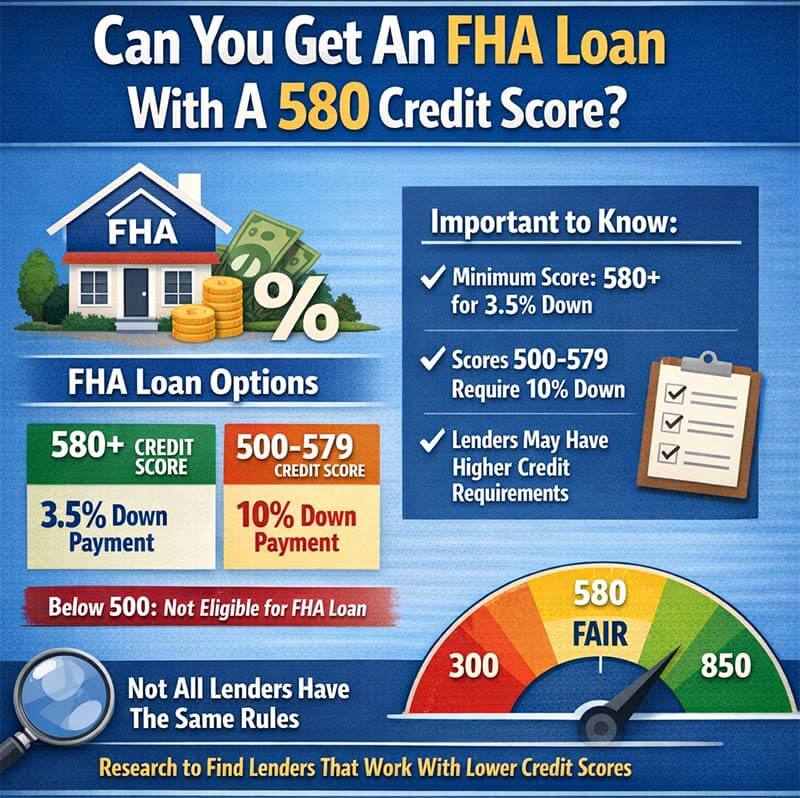
FHA loans make it possible for people with low credit scores to buy a home. If your score is 580 or above, you could qualify for the full loan with just a 3.5% down payment. If your score falls between 500 and 579, you may still be eligible, but you’ll usually need to put down 10% since the loan covers only 90% of the home’s value. Lenders consider your entire loan application, not just your credit score, when making a decision.
FHA loans are backed by the Federal Housing Administration, which is part of the U.S. Department of Housing and Urban Development, more commonly referred to as HUD.
FHA does not give out loans. Instead, it authorizes banks and lenders to offer mortgages and provides insurance to help protect them against losses. This system allows lenders to help people with lower credit scores, less money saved for a down payment, or riskier credit histories get a chance to buy a home. According to HUD, FHA loans offer low down payments (often less than 3.5%), lower closing costs, and easier approval rules. You can use an FHA loan to buy an eligible one- or two-family home.
FHA Credit Score Requirements for 2026
When you’re thinking about an FHA loan, your credit score is one of the first things to consider. FHA groups borrowers into three credit score levels.
Credit Scores of 580 or Higher
If your credit score is 580 or higher, you may qualify for FHA’s full loan amount.
Usually, This Means:
- Loan-to-value: up to 96.5%
- 3.5% minimum cash investment
- Required FHA mortgage insurance
- Full income, assets, debt, credit, and property qualification
- Having a credit score of 580 does not guarantee you’ll be approved for a loan.
- The lender will still determine if the borrower meets all other FHA requirements and any additional lender and/or investor requirements.
Credit Scores Between 500 and 579
If your credit score is between 500 and 579, you can still qualify for an FHA loan. However, the loan-to-value ratio is capped at 90%. In this situation, you’ll need to make a 10% down payment instead of the usual 3.5%. A 550 credit score is not an automatic disqualifier if below 580. Other parts of your loan application also matter. Your credit history, recent payments, housing history, steady income, debt compared to income, savings, past credit problems, and lender decisions all play a role.
Credit Scores Below 500
If your credit score is below 500, you usually cannot get an FHA-insured loan under the standard rules. To qualify, you may need to improve your credit. A low credit score doesn’t always reflect your overall credit health. Credit scores and credit history are connected but different. For example, someone could have a low credit score even if their credit history doesn’t show serious problems.
Some Reasons Your Credit Score Might Be Low Include:
- Using most of your credit card limits
- Not having much credit history
- Recently opened accounts
- Not having many active credit accounts
- Having old accounts that were sent to collections
- Recent credit inquiries
- Errors in your credit report
- Another borrower might have a higher score but has recently missed many payments.
- Mortgage underwriters look at more than just your credit report numbers.t report.
- The loan officer will check the reasons for your low credit score and look at your recent financial habits to see if you can repay the loan.
- This is especially important if your loan needs a manual review by the FHA.
- Lenders can have different credit score requirements.
- One confusing part of FHA mortgages is that FHA’s basic rules and each lender’s rules can differ.
- Lenders may add extra rules to the loans they offer.
- These extra lending requirements are often referred to as lender overlays.
How Lender Overlays Affect Low-Credit Borrowers
While FHA may approve a loan for a borrower with a 580 credit score, some lenders may require a 600, 620, or higher score.
A Lender Will Also Make More Stringent Requirements of:
- debt-to-income ratio
- recent collection accounts
- recent bankruptcies
- recent foreclosures
- recent employment
- cash reserves
- manual underwriting
- So, if one FHA lender turns you down, don’t lose hope.
- Another lender might approve you.
- They might say yes.
There are basically two different types of lending requirements on FHA loans. All lenders need to make sure all borrowers meet the minimum agency guidelines on FHA loans. HUD, the parent of FHA will not insure any lenders that originated FHA loans and does not meet the minimum HUD 4000.1 Handbook on FHA loans. The second type of loan requirements on FHA loans are lender overlays. Lender overlays are guidelines that is above and beyond the minimum HUD guidelines on FHA loans. Each individual lender can have higher lending requirements above the minimum agency guidelines on FHA loans.
Comparing FHA Mortgage Automatic Underwriting To FHA Mortgage Manual Underwriting
Most FHA mortgage applications start the underwriting process with an automated underwriting system. This system reviews the applicant’s credit, scores, income, assets, debt, proposed house payment, and loan, and the property. If the automated system gives your loan the green light, the rest of the process is usually much smoother. However, FHA does not automatically approve all loans.
FHA Manual Underwriting
Automated underwriting for FHA loans cannot approve certain loans. In those cases, or when FHA’s rules require it, the loan is eligible for manual review. Manual underwriting doesn’t mean the rules are looser. The Underwriter conducts a full review of the borrower’s finances and decides if the risk is adequate to meet FHA’s underwriting standards. HUD has its own requirements for manually underwritten FHA mortgages.
Debt-to-Income Ratios in FHA Manual Underwriting
The ratios of funds borrowers can spend on a home relative to their income are also evaluated as compensating factors. The baseline is generally a maximum 31% of income spent on housing and a total of 43% spent on all debts. Debt-to-income ratios on manual underwriting on FHA loans is restricted Borrowers with high debt-to-income ratios on FHA manual underwrites need additional compensating factors.
Manual underwriting guidelines allow FHA to approve borrowers with ratios as high as 40% of income for housing and 50% for debts if certain compensating factors exist.
FHA accepts higher ratios for borrowers with scores of 580 or more. Lower scores are more restrictive. Higher ratios are not automatically approved. Compensating factors must meet the FHA definitions and be documented.
Compensating Factors for FHA Manual Underwriting
Compensating factors are considerations that may help offset undefined weaknesses in a manually underwritten loan.
If Evaluated on a Case-by-Case Basis, and Based Upon the Appropriate FHA Criteria, These May Include:
- Verified cash reserves
- A limited increase in the borrower’s housing payment
- Adequate residual income
- Good credit usage
- Other qualifying financial strengths recognized by FHA
- Simply calling something a compensating factor isn’t enough—it has to fit the FHA’s official guidelines for manual underwriting.
- Recent payment history may be more significant than the credit score.
- For example, a borrower with a 580 score and recent late payments may face additional scrutiny.
- FHA manual underwriting emphasizes recent credit behavior over other considerations.
- The lender may evaluate whether the borrower has paid all obligations, including housing and installment debt, revolving accounts, and other credit obligations.
- Therefore, recent late payments may result in more adverse credit considerations, even when the credit score meets the FHA’s minimum criteria.
Bad Credit? FHA Financing May Still Be Possible
FHA loans can be more flexible for borrowers with past credit issues, collections, charge-offs, bankruptcy, or limited savings. Get a quick review before assuming you cannot qualify.
Rent and Housing Payment History
Housing history can be very important for borrowers with low or manually underwritten credit scores. According to underwriting specifications, the lender may ask for evidence of rent, such as verification, signed canceled checks, bank statements, property management documents, or other documentation for the following borrowers:
- Borrowers who rent for free
- The loan’s specific terms and the borrower’s situation will determine which documentation the underwriter requires.
FHA Loans and Collections/Charge-Offs
Having collections does not always mean the borrower must pay them off to finalize an FHA mortgage. The lender will review each collection account and determine the collection’s impact based on FHA credit guidelines.
On outstanding collection accounts, FHA may require the lender to assess a collection’s calculated monthly obligation, a documented repayment arrangement, or the collection’s payoff when determining the borrower’s liabilities.
According to HUD, in some cases, lenders may use a collection’s unpaid balance multiplied by 5% to determine the monthly obligation, so the collection need not be paid in full. However, collections are not ignored. The amount, type, payment arrangement, underwriting method, and entire credit report affect how collections are viewed.
Judgments Require Separate Review
Collections should not be treated the same as judgments. An unresolved judgment can cause additional issues and may prevent FHA financing. Borrowers should disclose judgments, liens, unpaid repayment agreements, and other unpaid obligations to the loan officer as early as possible in the mortgage process.
Credit Disputes Can Affect FHA Underwriting
Disputing negative accounts in hopes that it improves a borrower’s credit score can be problematic during the mortgage underwriting process. Some disputed derogatory accounts may require additional reviews before the file remains eligible for automated underwriting. HUD has made provisions regarding certain disputed credit accounts, including exceptions for medical accounts and other qualifying situations. Disputed credit accounts should not be removed or added before applying for a mortgage without first consulting an experienced mortgage professional.
FHA Loans After Bankruptcy
The Requirements are Primarily Dependent Upon:
- Discharge or dismissal
- Type of bankruptcy
- Credit established afterward
- Payment history
- Circumstances
- Underwriting method
Chapter 7 Bankruptcy
Typically, there is a waiting period after discharge before a borrower becomes eligible for FHA financing. Exceptions may be granted under certain narrowly defined circumstances when FHA requirements for documented extenuating circumstances are met.
The Borrower Must Have a Good Post-Bankruptcy Credit Record:
- Chapter 13 Bankruptcy
- Chapter 13 bankruptcy may be treated differently.
- HUD confirms that an FHA loan may be available to a borrower who has an active Chapter 13 bankruptcy, as long as FHA criteria are met.
Borrowers in an Active Chapter 13 Bankruptcy May Need the Following:
- Satisfactory plan payments
- Approval from the court or trustee
- Manual underwriting
- Bankruptcy payment documentation
- Post-bankruptcy payment history that is acceptable to the underwriter
- Chapter 13 loans are more complex and, before signing a purchase agreement, should be reviewed when possible.
Impact of Late Payments on FHA Loans with Low Credit Scores
There isn’t an across-the-board assessment for late payments. Underwriting considers a complete history. An isolated payment made outside the usual pattern due to circumstances beyond the borrower’s control may be examined differently from a history of late payments. Underwriting examines mortgage and rental payment histories to gauge the borrower’s ability to make housing-related payments.
If a Borrower’s Credit Report Has Late Payments That Were Made Within the Last 12 Months, the Borrower Should Expect Underwriting to Request Additional Documentation:
- Writing a letter to explain late payments won’t automatically fix your credit.
- Writing a letter to explain late payments will not automatically improve your credit.
- Debt-to-income ratio (DTI) describes the amount of debt relative to income.
For FHA Loans, the Lender Would Include:
- Monthly mortgage payment
- Property taxes
- Homeowners insurance
- FHA mortgage insurance
- Auto loans
- Credit card minimums
- Student loans, personal loans
- Alimony or child support payments
- Other recurring debts
- There isn’t one set DTI ratio that applies to every FHA loan.
- Automated underwriting assesses total exposure risk.
- Manually underwritten loans require the FHA’s compensating-factor and ratio requirements to be met.
- This is why two borrowers can have the same credit score and income, but receive different underwriting outcomes.
FHA Low Credit Scores and Down Payment Requirements
A higher down payment is required for borrowers with lower credit scores on FHA loans..
The Basic Structure is as Follows:
- 580+: up to 3.5% down available.
- 500-579: 10% down typically required.
- Less than 500: generally not eligible for standard FHA financing.
- Down payment is only one piece of the puzzle when it comes to buying a home.
- Other financial components may include closing costs, prepaid taxes, insurance, the escrow account, inspections, etc.
FHA Standards for Gift Funds
FHA can consider gift funds toward a home purchase, as long as the defined guidelines are satisfied.
For Such Transactions, Lenders Must Maintain Documentation for:
- Donor
- Gift amount
- Source of funds
- Transfer of funds
- Other documentation required by FHA
- Gift funds cannot be disguised as loans that the borrower is expected to repay.
- Such funds will not count toward the borrower’s financial resources.
- Gift funds can really help buyers who haven’t saved much for a down payment.
Seller Concessions on FHA Loans

Contributions by interested parties for borrower costs are permitted by FHA. As per the current HUD guidance, in most cases, interested-party contributions can amount to 6% of the sales price for permissible components such as origination fees, closing costs, prepaid expenses, and discount points. Seller concessions do not substitute for the borrower’s required investment from an acceptable source. However, they do reduce the cash the borrower must generate to meet other closing costs.
FHA Mortgage Insurance
FHA loans are characterized by two types of mortgage insurance: the upfront mortgage insurance premium (UFMIP) and the annual mortgage insurance premium. A 1.75% loan-level charge applies. The annual MIP changes depending on your loan. Since mortgage insurance adds to the total cost of an FHA loan, it’s smart to look at the big picture—including long-term expenses—and compare FHA loans with other mortgage options. The other mortgage option is recommended.
2026 FHA Loan Guidelines
FHA loans with low credit scores follow the same federal FHA credit guidelines as in any other state. The largest state-specific factor is the applicable FHA loan limit for the county where the subject property is located.
2026 FHA Loan Limits
For 2026, FHA’s one-unit loan-limit floor nationwide is $541,287. HUD sets FHA mortgage limits each year and provides a county-by-county lookup tool. Current 2026 FHA loan-limit data places one-unit counties at the FHA’s loan floor of $541,287. Buyers should still confirm the county of the subject property and the current FHA limit before making an offer, as limits are determined on an annual basis. Higher limits apply to eligible two-, three-, and four-unit properties.
FHA Property Requirements
An FHA- financed property must meet applicable FHA eligibility and appraisal requirements.
FHA Financing May Be Used to Purchase the Following:
- Single-family homes
- FHA-approved condominiums
- Townhouses
- FHA-approved manufactured homes
- two- to four- family homes
- The buyer is required to occupy the property as their primary residence.
- FHA financing should not be used to purchase an investment property.
FHA Mortgage Rates With Low Credit Scores
FHA doesn’t have a fixed mortgage interest rate for all borrowers.
There Are Various Factors That Affect the Rate and the Price the Borrower is Charged:
- Credit score
- Loan amount
- Loan-to-value
- Property type
- Rate lock period
- Discount points
- Market conditions
- Even if you get approved, having a lower credit score can lead to higher costs and less favorable loan terms.e loan terms.
- This is why it’s smart to shop around and compare offers from different lenders.
According to the Consumer Financial Protection Bureau, consumers are encouraged to compare the costs of loans offered by different mortgage lenders, rather than assuming all lenders will charge the same cost for a mortgage loan. Multiple credit inquiries made during the normal rate-shopping window are usually treated differently from repeated applications for new credit.
How to Improve an FHA Loan Application
A low credit score doesn’t mean you can’t get an FHA loan. Lenders look at much more than just your score.e than just your score. Boost your odds by gathering and organizing your loan documents before you apply.
Keep Every Payment Current
Make sure you don’t rack up any new late payments. A newly reported delinquency will negatively affect your credit and will offset any newly increased credit score.
Reduce Revolving Credit Balances
High credit card balances can lower your credit score and increase your monthly bills. Paying down your credit cards can improve your credit and may help you qualify for an FHA loan. Don’t use all your savings just to improve your credit score. You’ll need some money for closing costs and to show you have enough cash reserves.
New Debt
Defer major purchases, such as vehicles, furniture, or appliances, during the mortgage process. Inform your loan officer of any new obligations to avoid complications. Acquiring new debt may negatively impact credit scores and increase the debt-to-income ratio.
Credit Report Errors
Mistakes on your credit report could cost you higher mortgage rates, so double-check your report before applying. The Consumer Financial Protection Bureau advises checking your credit report for errors before shopping for a mortgage.
Evidence of Large Deposits
Mortgage lenders require a paper trail of large deposits made during a real estate transaction. Keep a paper trail for any transfers, gifts, or asset sales.
Remain Still; Avoid Unnecessary Transfers of Money When US Government Funds are Depressed
Pre-approval for owner-occupied housing financing is possible for borrowers with a 568 credit score.
Other Factors Include:
- Stable W-2 Employment
- No recent late payments on housing
- No recent derogatory accounts
- Some collections
- A manageable DTI
- Documented income
- Sufficient funds for a 10% down payment and closing
- A 568 credit score does not automatically make an applicant ineligible under FHA credit guidelines.
- For scores between 500 and 579, the maximum loan-to-value ratio is typically 90%.
- The lender will review the rest of the application to determine whether the approval standards are met.
Let’s look at one last example of a borrower with a 620 credit score who has also started missing several housing payments and installment payments.
- A higher credit score doesn’t always mean your loan application is stronger.
- Recent payment behavior can raise underwriting concerns and, in some cases, concern borrowers with cre credit scores above the FHA’s minimum requirements.
- Remember, keep in mind, your credit score is only one part of getting approved for a mortgage.
- For low-credit-score borrowers.
Comprehensive Overview of Borrower’s Income and Credit Profile
Spotting potential underwriting issues before you sign a purchase contract can save you time and stress.
The Typical FHA Process Includes the Following:
- Review the mortgage credit report
- Verify income and employment
- Review the qualifying debts and calculate the DTI
- Review the available assets and closing funds
- Conduct automated underwriting, if applicable
- Determine the availability or need for manual underwriting
- Review the collections, disputes, late payments, bankruptcy, and credit concerns
- Formally pre-approve, if the file warrants it
- Select a property that is eligible
- Complete the FHA appraisal and the underwriting process
- Satisfy the underwriting requirements
- Complete the final verification and prepare for closing
- Mortgage preapproval involves a comprehensive review beyond simply evaluating the applicant’s credit score.
- Before the borrower commits to purchasing a home, loan officers should have a full understanding of the borrower’s complex credit.
After an FHA Loan is Denied – What’s Next?
If your FHA loan is denied, it can be frustrating. The next step is to find out the reason for the denial.
Was the Problem Related to:
- FHA eligibility
- Automated underwriting
- Manual underwriting
- Lender overlays
- DTI
- Income calculations
- Employment
- Credit history
- Recent late credit payments
- Collections, judgments, or
- Bankruptcy
- Property eligibility
- Documentation
- If the issue is specific to a lender overlay rather than an FHA requirement, a different lender may make a different decision regarding the same borrower.
- If the loan does not meet FHA criteria, simply transferring it to another lender is not the solution.
- Understanding the difference can save you time and frustration as you go through the mortgage process.
FHA Loans with Low Credit Scores
In 2026, FHA loans will remain one of the most flexible options for people with low credit scores to buy a home. A borrower with a minimum score of 580 is eligible for 3.5% down financing. Scores between 500 and 579 are still eligible under the FHA’s credit guidelines with a 10% down payment.
Lenders evaluate multiple factors beyond credit score, including income, employment history, assets, debts, housing and payment history, overall affordability, and property eligibility.
If you’re turned down for credit, find out if it was because of an FHA rule or an extra requirement from the lender. Gustan Cho Associates helps borrowers with unique mortgage situations, such as those applying for FHA financing after multiple lender denials. Program approval and eligibility are determined by the borrower’s full report, FHA policies, underwriting considerations, and lending policies. If you want FHA mortgage financing with Gustan Cho Associates, please get in touch with Gustan Cho at 800-900-8569. Text Gustan for a faster response. If email is better, please use gcho@gustancho.com. You may discuss any questions about the mortgage process and review your mortgage financing goals.
FAQ: FHA Loan With Low Credit Scores Mortgage Guidelines
Over the past few months, Gustan Cho Associates has received numerous phone calls from potential FHA borrowers with lower credit scores. This blog will detail how to obtain FHA mortgage financing with a low credit score. We will also explain the difference between credit scores below 580 and above 580. We are experts in FHA loan with low credit scores and bad credit mortgages. We offer traditional and non-QM mortgages licensed in 48 states.
Is FHA Part of HUD?
One of the Federal Housing Administration’s (FHA) objectives is to promote homeownership for first-time homebuyers and consumers who have bad credit and seek mortgages with low credit score.
Can the Seller Contribute To Closing Costs On FHA Loans?
Yes. According to HUD, interested parties can contribute up to 6% of the sales price to help cover closing costs, prepaid expenses, discount points, and other similar fees.
Is Mortgage Insurance Required For FHA Loans?
Yes. Most FHA forward mortgages include an upfront mortgage insurance premium of 1.75% and an annual mortgage insurance premium that varies based on the applicable FHA premium schedule and other exceptions.
Can One Lender Deny You and Another Approve You?
Different lenders may have varying lending requirements, including credit score overlays. Just because one lender denies you doesn’t mean another won’t approve you. Shopping around and finding a lender whose requirements match your financial situation is essential.
Can Different Lenders Approve You After Getting Denied?
Yes, Gustan Cho Associates, for instance, reports that over 80% of its clients have been turned down by other lenders. It specializes in FHA mortgage financing and aims to assist clients who other lenders may have denied.
How to Rebuild Credit For Mortgage After Bankruptcy?
Individuals can use secured credit cards to recover their credit after filing for bankruptcy and ensure they make timely payments. As long as they are responsible with their credit, they can witness a positive impact on their credit scores within a year.
Why Is Credit Score Important for a Mortgage?
A mortgage’s eligibility and interest rates are highly dependent on credit scores, making them a pivotal factor. Improved loan terms are usually a consequence of higher credit scores.
How Does My Credit Score Affect Getting a Mortgage?
Credit scores influence whether borrowers qualify for a mortgage and impact the rates they receive. Different credit score ranges correspond to different levels of creditworthiness.
Which Credit Score is Most Important When Buying a House?
Suppose you’re considering applying for an FHA loan. In that case, you may be interested to know that borrowers with a credit score of 580 or higher can typically make a down payment of 3.5%. Remember that conventional loans typically require a minimum score of 620.
What Mortgage Can You Get With a Low Credit Score?
Gustan Cho Associates offers various mortgage programs, including FHA loans, with no lender overlays. They specialize in assisting borrowers with low credit scores.
Can I Get an FHA Loan with Low Credit Scores After Getting Denied?
Yes, Gustan Cho Associates assists clients denied by other lenders. They offer expertise in FHA mortgage financing and aim to help clients achieve their homeownership goals.
Can One Apply for an FHA Loan with a 550 Credit Score?
This is possible. FHA’s credit policy allows 500 to 579 credit scores with a maximum 90% loan-to-value ratio (LTV), which is usually equivalent to a 10% down payment. Having a 550 credit score is not an automatic red flag, but if the borrower meets the underwriting requirements, income, DTI, credit history, asset, and credit profile, they can still qualify for the loan.
Does Removing Revolving Debt Balance Help an FHA Loan Application?
It does. DRTV (Debt Revolving Today’s Value) decreases when the revolving credit balance is reduced or paid off. This also improves the credit structure and sometimes reduces monthly debt obligations. Borrowers’ cash should not be used to pay off debt unless they are certain the cash is for closing and/or a reserve.
How Long Should One Wait Before Applying for an FHA Loan After a Collection Appears on a Credit Report?
There is no single rule to answer this. Underwriting policies are different. The severity of the collection, the account type, how recently it was delinquent, how many times it has been delinquent, the frequency of delinquency, etc., all play a role. Housing-related accounts with collection are underwriting concerns that receive greater scrutiny.
Could I Still Get an FHA Loan with No Credit?
FHA approves loans for people with limited or alternative credit. Lack of credit doesn’t automatically mean a borrower is ineligible for approval, but additional supporting documents may be required for the borrower to proceed with manual underwriting.
Will Adding a Non-Occupying Co-Borrower with a Higher Credit Score Help?
Having a co-borrower with good credit and income can sometimes help borrowers qualify, but it won’t magically solve the primary borrower’s credit issues. Housing Authority (FHA) guidelines still apply to the primary borrower’s credit, family ties, residence ownership, loan amount, and underwriting.
Could I Try Refinancing Later with Better Credit?
Again, perhaps. A homeowner may evaluate FHA or Conventional refinance (or both) in the future if credit, equity, income, market rates, and other qualifications improve. A refinance should occur when the financial outcome is better than the current rate, after accounting for the new loan and closing costs.
Does a Bigger Down Payment on an FHA Loan Help with Approval?
No. A larger down payment helps reduce the loan amount and loan-to-value ratio, but it won’t resolve credit issues, income issues, a high debt-to-income ratio, or other issues that prevent approval. The lender must approve the entire loan file.
Should I Apply with Several FHA Lenders After Being Denied?
If your loan application was denied for lender-specific reasons, it may be worth applying with another lender. The CFPB (Consumer Financial Protection Bureau) supports mortgage borrowers shopping around and comparing several lenders. Before you apply with multiple lenders, analyze the reason for this loan application denial to prevent this from happening again.