Quick Answer: You may be able to qualify for a mortgage after short sale waiting period, but the answer depends on the loan program and what happened before the sale. FHA generally requires three years, although borrowers who kept their mortgage and installment payments current for the required 12 months may qualify sooner. Fannie Mae generally requires four years, with a possible two-year exception for documented extenuating circumstances.
VA does not impose a universal two-year short sale wait; the lender reviews the circumstances and credit history. USDA treats a short sale within the past 36 months differently depending on the underwriting result. A non-QM loan may be an option, subject to the lender’s specific requirements. The short sale paperwork and payment history are just as important as the closing date.
What Is a Short Sale?
A short sale occurs when a lender permits a property to be sold for a price that is lower than the outstanding mortgage balance. If you are applying for another home loan, the new lender will want to know when the sale was completed, whether you missed payments beforehand, and how your credit has recovered since then.
A short sale does not automatically prevent you from becoming a homeowner again. It does, however, affect loan programs differently. Start by identifying the program you want to use, then have a loan officer review the sale documents and your current finances.
FHA Mortgage After a Short Sale
FHA generally requires a three-year wait after a short sale. The period begins when title transfers through the short sale and is measured against the date the new FHA case number is assigned. That distinction matters if you are approaching the three-year mark: the date you apply is not necessarily the date FHA uses to determine eligibility.
There is an important exception for a borrower who remained current. FHA allows a borrower to be eligible without the usual three-year wait if all mortgage payments were made on time in the 12 months before the short sale, and installment debts were also paid on time during that same period.
The lender must verify the payment history and determine whether the borrower meets the other requirements for the new loan.
FHA may also consider an exception when documented circumstances beyond the borrower’s control caused the short sale and the borrower has re-established good credit. A hardship alone does not guarantee an exception. If you were told to skip a mortgage payment while the short sale was being completed, have the actual payment record reviewed before assuming you qualify under the current-payment exception.
Conventional Mortgage After a Short Sale
For a loan sold to Fannie Mae, you must wait four years after a short sale before applying for a new loan. A two-year period may be permitted when the borrower documents qualifying extenuating circumstances. For a manually underwritten Fannie Mae loan, the waiting period runs through disbursement of the new loan. Fannie Mae also requires the lender to assess whether the borrower has re-established acceptable credit.
Freddie Mac also treats a short sale as a significant credit event. Its guide describes a 48-month recovery period for events resulting from financial mismanagement and a 24-month recovery period for qualifying extenuating circumstances. Additional loan restrictions may apply, so a borrower should not assume that reaching the two- or four-year date alone guarantees conventional approval.
An extenuating circumstance must be supported by records showing what happened and how it led to the financial problem. Your loan officer should review those records early, especially if you are hoping to use a shorter conventional waiting period.
VA Mortgage After a Short Sale
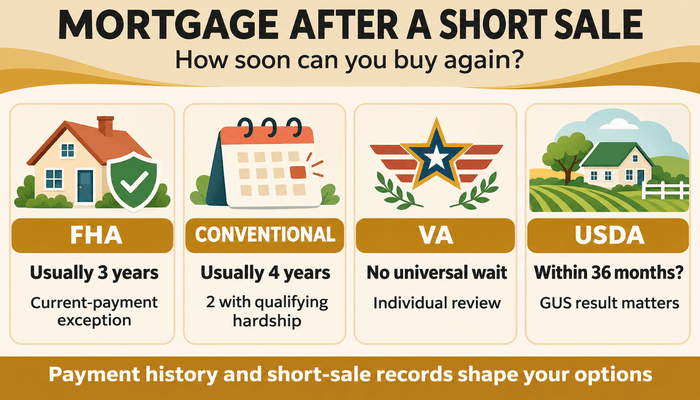
VA does not set a blanket two-year waiting period for every short sale. Its lender handbook directs lenders to develop the facts surrounding the sale. If the borrower’s payment history was not affected before the short sale and the borrower communicated with the loan servicer, a waiting period after the transfer of the property may not be necessary. The lender must still assess the borrower’s credit and ability to repay.
If the short sale involved a VA-guaranteed mortgage, the lender must also check how much VA entitlement is available for the new loan. Borrowers should be ready to provide an explanation of the short sale, the prior mortgage history, and documents showing how the sale was resolved.
USDA Mortgage After a Short Sale
USDA’s treatment of a recent short sale is more nuanced than a fixed three-year prohibition. Under its guaranteed-loan credit guidance, a short sale closed at least 36 months before submission to the agency is no longer considered adverse credit for this purpose. For a more recent short sale, the underwriting result matters. A file receiving a GUS Accept or Accept with Full Documentation result does not require a credit exception on that basis; certain referred or manually underwritten files do require one. The lender must still determine that the overall loan meets USDA requirements.
If you are considering a USDA loan, ask the lender to review the short-sale date, your credit record, and the GUS findings before telling you that you must wait three full years.
Can a Non-QM Loan Help You Buy Sooner?
A non-QM or portfolio mortgage may be worth exploring if you do not yet qualify for the agency program you want. Eligibility after a short sale, down payment, reserves, pricing, and documentation requirements vary by lender and loan product. Some programs may consider a recent short sale; others impose their own waiting periods.
Compare the full terms of any available option with the cost of waiting for an FHA, VA, USDA, or conventional loan. Buying sooner may be valuable, but the monthly payment, cash needed at closing, and long-term cost should fit your plans.
When Does the Short-Sale Waiting Period Start?
Keep the date the property changed hands, the closing date shown in your sale documents, and the date reported on your credit record. A lender may need to reconcile those records if they differ.
There is no single new-loan milestone that applies to every program. FHA measures its standard three-year period from transfer of title to assignment of the new FHA case number. Fannie Mae assesses its waiting period based on when the new loan is disbursed for manually underwritten loans. USDA evaluates whether the short sale closed within the 36 months before submission to the agency. Ask your loan officer which dates govern the program you are applying for.
What If You Were Told to Skip the Final Mortgage Payment?
Some borrowers say their servicer told them not to make another payment because the short sale was about to close. That conversation does not establish how the payment will be evaluated for a new FHA loan.
Request the mortgage payment history and check the due date, the date any final payment was received, and how the account was reported. Give the new lender any written instructions you received from the servicer. If the records show a payment was not made within the month it was due, the lender should assess your other available options rather than assuming the current-payment exception applies.
Do this review before making an offer on another home. A small difference between the payment history you remember and the history the lender can document may change your financing plan.
How to Document an FHA No-Waiting-Period Request
Start with the settlement statement or Closing Disclosure from the short sale and any document confirming when title transferred. The lender may need those records to identify the transaction and resolve a discrepancy between the date shown on your credit report and the transaction date.
Next, gather a complete payment history for the previous mortgage covering at least the 12 months leading up to the sale. Obtain records for your installment debts during that period as well. Bank statements may help explain a payment, but the lender will determine what documentation is sufficient to verify when the creditor received and applied it.
Tell your loan officer about any disputed late payment at the beginning of the review. It is easier to investigate a reporting error before you have a purchase contract and a closing deadline.
Can FHA Make an Exception If You Fell Behind?
FHA has a separate provision for documented extenuating circumstances beyond a borrower’s control. The lender may consider an exception to the three-year requirement if the circumstances that caused the short sale have been resolved and the borrower has re-established good credit. A serious illness or the death of a wage earner is the type of circumstance addressed in FHA’s guidance. An explanation of hardship, without supporting records, does not automatically qualify.
This is different from the exception for borrowers who stayed current. If payments were missed, ask the lender to review the circumstances and supporting documents under the applicable FHA provision rather than treating the two paths as interchangeable.
What About Conventional and Non-QM Loans?
Keeping your payments current before a short sale does not remove Fannie Mae’s standard four-year conventional waiting period. Fannie Mae allows a shorter two-year period only when the borrower meets its requirements for documented extenuating circumstances. The FHA current-payment exception should not be applied to a conventional loan.
A non-QM or portfolio lender may have a program that considers a recent short sale. These are lender-specific products, so there is no single no-waiting-period rule, down payment requirement, or price that applies to all of them. Ask for the actual program terms and compare the cost with the agency loan you might qualify for later.
What to Gather Before Applying
Start with the short-sale settlement statement or Closing Disclosure, the recorded transfer information if available, and any letters from the previous lender explaining the sale. If you believe you qualify for an exception, gather the mortgage payment history, records of your other required payments, and documents supporting the circumstances that led to the short sale.
Check your credit reports for errors, and be ready to resolve any discrepancies between your mortgage account and the short-sale documents. The lender will also review your current income, debts, assets, and housing payment history. Providing the short-sale records at the beginning can help identify the right loan program before you begin shopping for a home.
FAQs about Mortgage After Short Sale Waiting Period
Can I Seek Preapproval Before My Waiting Period Ends?
- Yes. A lender can review your finances and short-sale records before you reach a required date. That review can help you plan, but preapproval does not waive the program’s eligibility rules. Make sure the proposed closing and other program-specific dates work before making an offer.
What if My Credit Report Describes the Short Sale as a Foreclosure?
- Tell your loan officer and provide the settlement and transfer documents. The lender needs to identify what actually happened and when. If the credit report is inaccurate, you can also pursue a correction with the company reporting the information.
Does One Missed Payment Before the Short Sale Change My Options?
- It can. In particular, FHA’s exception for borrowers who remained current depends on the required mortgage and installment payments being made within the month in which they are due during the 12 months preceding the sale. A missed payment does not mean every loan option is closed; it means the lender must assess your file under the rules that apply to your circumstances.
Can I Apply with a Lender Other than the One that Approved My Short Sale?
- Yes. The lender reviewing your new mortgage will need records of the prior sale and your payment history, regardless of which company handled the old loan.
What if I had Both a Short Sale and a Bankruptcy?
- Give the loan officer the documents and dates for both events before relying on a short-sale timeline. The combination can change how the file is evaluated, and the applicable program may require review of both the bankruptcy and the property transfer.
Can I Qualify if I am Self-Employed?
- Possibly. A short sale and self-employment raise separate underwriting questions. The lender will review the short-sale history under the chosen loan program and assess your qualifying income using that program’s documentation rules.
Final Thoughts on Mortgage After Short Sale Waiting Period
The fastest route back to homeownership depends on more than counting years from a sale. A borrower who stayed current may have an FHA option sooner than expected. A VA borrower may receive a case-specific review, while a recent USDA short sale may be treated differently according to the underwriting result. Conventional loans have defined waiting periods and documented exceptions.
Gustan Cho Associates can review your short-sale records, payment history, and current finances to help you identify which mortgage options are available and when you may qualify.
This article about “Mortgage After Short Sale Waiting Period: Waiting Periods by Loan Type” was updated on November 24th, 2026.