Unsourced Funds in Mortgage Underwriting: 2026 Large Deposit and Bank Statement Rules
A large deposit in your bank account does not automatically mean your mortgage will be denied. However, money that cannot be tied to an acceptable source can create problems when you need it for the down payment, closing costs, debt payoff, or required financial reserves.
Unsourced funds are money in a borrower’s account that the lender cannot connect to an acceptable source. They do not automatically cause mortgage denial.
Mortgage underwriters commonly refer to this problem as unsourced funds. The rules are often misunderstood because FHA, VA, USDA, Fannie Mae, and Freddie Mac do not use one universal rule for determining which deposits must be documented. A deposit that requires additional documentation on one mortgage program may be treated differently on another. However, funds needed for down payment, closing costs, debt payoff, or reserves generally must meet the loan program’s documentation requirements. Large-deposit thresholds vary among FHA, VA, USDA, Fannie Mae, and Freddie Mac loans. An underwriter may require documentation, exclude certain funds, recalculate assets, or determine that you need additional verified funds.
Unsourced Funds in Mortgage Underwriting: 2026 Large Deposit and Bank Statement Rules
Unsourced funds are deposits or account balances for which the lender cannot establish an acceptable origin when documentation is required. Imagine that your bank statement shows a $7,500 deposit. Seeing $7,500 in the account is only part of the underwriting analysis.
The Underwriter May Also Need to Determine Where the $7,500 Came From:
- Was it transferred from another bank account you own?
- Was it a gift from an eligible donor?
- Did you sell a vehicle?
- Was it an income tax refund?
- Did you receive an inheritance?
- Was the money borrowed?
- Did it come from a business?
- Was it cash you had been saving at home?
- Each situation can require different documentation.
- The important distinction is not just whether money is in the bank.
- The lender may need to determine if the money belongs to the borrower,
- if it came from an eligible source,
- if it creates new debt, and if the mortgage program permits its use.
What Makes Mortgage Funds Properly Sourced?
Sourced funds normally have a clear paper trail connecting the money to its origin. For example, moving $15,000 from your savings to your checking account may be easy to document when both accounts belong to you and can be verified. Selling a car may require more documentation. The lender may need evidence that you owned the vehicle, documentation showing it was sold, and evidence that the proceeds entered your account.
Gift Funds for Down Payment or Closing Costs
Gift funds require yet another type of paper trail. The specific documentation depends on the loan program, transaction, automated underwriting findings, asset type, and lender requirements. The goal is to make the movement of money understandable from beginning to end.
Why Do Mortgage Underwriters Care About Large Deposits?
Mortgage approval is based partly on the borrower’s available assets and financial obligations. If a borrower needs $20,000 to close but $15,000 came from an undocumented loan, the borrower may have new debt not included in the debt-to-income ratio.
Similarly, some sources of down payment or closing funds are permitted, while others may be restricted by the applicable mortgage program.
Underwriters, therefore, review assets to determine whether the borrower has sufficient eligible funds to complete the mortgage transaction. A large deposit by itself does not prove that anything is wrong. The concern is whether a deposit requiring verification can be adequately explained and documented.
What Is Considered a Large Deposit for a Mortgage?
There is no universal dollar amount that makes a deposit “large” for every mortgage. A common internet claim is that every deposit over $200, $500, or $1,000 must be documented. That is not a reliable rule across all mortgage programs. The actual requirement depends heavily on whether the mortgage is FHA, Fannie Mae conventional, Freddie Mac conventional, VA, USDA, jumbo, Non-QM, or another type of financing.
Fannie Mae Large Deposit Guidelines
For Fannie Mae conventional mortgages, a large deposit is generally defined as a single deposit that exceeds 50% of the loan’s total monthly qualifying income. For example, suppose the total qualifying monthly income is $6,000. A single deposit exceeding $3,000 would meet Fannie Mae’s large-deposit definition.
For a purchase transaction, when a large deposit is required for the down payment, closing costs, or financial reserves, the lender must verify that the funds came from an acceptable source.
If part of the deposit can be documented and part cannot, only the undocumented portion is considered when determining if it meets the large-deposit threshold. Fannie Mae allows lenders, in some cases, to subtract the undocumented portion of a large deposit from the verified account balance if the borrower has enough remaining eligible funds to qualify. Fannie Mae does not require the same large-deposit documentation on refinance transactions, although the lender remains responsible for identifying and considering borrowed money and related liabilities.
Freddie Mac Large Deposit Guidelines
Freddie Mac uses a similar but not identical calculation. For purchase transactions, Freddie Mac generally defines a large deposit as a single deposit exceeding 50% of the sum of the borrower’s total monthly qualifying income plus certain amounts derived from assets when assets are being used as a basis for repayment of obligations.
If an undocumented large deposit is not needed for qualification, Freddie Mac permits the lender to reduce qualifying assets by the unverified amount rather than necessarily using those funds.
The deposit generally needs to be documented when it is needed to qualify the borrower. Freddie Mac also requires documentation when an unverified deposit is used to pay off or pay down debt so that the borrower can qualify for the mortgage.
FHA Large Deposit Guidelines
FHA’s large-deposit rule changed significantly in 2024. Current HUD guidance requires documentation for individual deposits exceeding 50% of the borrower’s total monthly Effective Income.
The lender must also determine that the deposits are consistent with the borrower’s income and savings history, and verify that no debt was incurred to obtain part or all of the borrower’s Minimum Required Investment.
For example, if the FHA Effective Income is $6,000 per month, an individual deposit exceeding $3,000 would meet this FHA documentation threshold. This is important because older mortgage articles may still state that FHA uses a threshold based on 1% of the property’s Adjusted Value. HUD replaced that method with the income-based standard. The current rule applies to both FHA TOTAL Scorecard underwriting and FHA manual underwriting.
Avoid Last-Minute Conditions From Unsourced Funds
Unverified deposits can trigger delays, updated bank statements, letters of explanation, gift documentation, or funds being excluded from approval. Get ahead of it early.VA Large Deposit Guidelines
VA mortgage guidelines approach asset verification differently. VA requires lenders to verify liquid assets to the extent they are needed to close the mortgage and to verify other significant liquid assets when they affect the overall credit analysis.
VA’s Lender’s Handbook does not establish one universal large-deposit threshold comparable to the 50% definition used by Fannie Mae.
That does not mean a VA underwriter ignores unexplained deposits. If the source of money is relevant to the borrower’s ability to close, indicates possible borrowed funds, or otherwise affects underwriting, additional documentation may be requested. Individual lenders may also have requirements beyond VA’s minimum guidance.
USDA Large Deposit Guidelines
USDA Guaranteed Loans use another standard. Current USDA guidance requires lenders to investigate recurring deposits not attributable to wages or earnings, with no minimum percentage or dollar threshold for such deposits.
USDA also requires lenders to investigate individual nonrecurring deposits greater than $1,000 that are not attributable to wages or earnings.
When the source is clearly identifiable in the statement, such as payroll, Social Security, an IRS refund, a state tax refund, or a transfer between verified accounts, additional explanation may not be required unless the lender questions the deposit. USDA also states that unverified funds are not an acceptable source for the down payment, closing costs, and similar transaction requirements.
Do Mortgage Lenders Have to Source Every Bank Deposit?
Not necessarily. Regular payroll deposits typically do not raise the same concerns as an unexplained transfer from an unknown source. Tax refunds that are clearly identified on the bank statement may also be easy to document.
Transfers between the borrower’s own verified accounts may require little additional documentation when the paper trail is clear. The mistake is assuming either extreme is true.
It is incorrect to assume every deposit must be documented or that only very large deposits matter. The correct answer depends on the loan program, deposit type, amount, transaction type, and whether the money is needed for qualification.
How Do You Source a Transfer Between Your Own Bank Accounts?
Transfers between accounts you own are typically easier to document than deposits from outside. Suppose you transfer $12,000 from savings at Bank A into checking at Bank. The Bank B statement may show a $12,000 incoming transfer. The underwriter may request the Bank A statement or transaction history showing the corresponding $12,000 withdrawal. Together, the records establish the paper trail. Problems arise when the borrower moves funds among several accounts shortly before closing. The money may still be acceptable, but each additional transfer creates another step in the documentation trail. For that reason, avoiding unnecessary movement of mortgage funds while your loan is in underwriting can make the process easier.
How Are Gift Funds Different From Unsourced Funds?
Gift funds are not automatically unsourced funds. A properly documented gift can be an acceptable source of money for many mortgage programs. The lender generally needs to establish who provided the gift, whether the donor is permitted under the applicable mortgage program, that repayment is not expected, and that the transfer of money can be documented.
What Type of Documentation is Required on Gift Funds on FHA Loans
For FHA loans, the lender must obtain the required gift documentation and verify the transfer. Depending on how the gift is delivered to the borrower or settlement agent, documentation may include bank records, canceled checks, withdrawal records, electronic transfers, or settlement documentation.
The lender must verify the transfer to the borrower or closing agent. Gift documentation should therefore be coordinated with the lender before moving the money whenever possible.
FHA also states that cash on hand is not an acceptable source of funds for the donor’s gift. VA also allows qualifying gift funds and requires documentation identifying the donor, gift amount, relationship, and confirmation that repayment is not expected.
Can Money From Selling a Car or Personal Property Be Used?
Funds from the sale of personal property may be acceptable when properly documented. For example, selling a vehicle may require evidence that you owned the vehicle, documentation of the sale, and proof that the sales proceeds were received.
A bill of sale by itself may not establish that the money actually reached you. Likewise, a bank deposit by itself may not prove what was sold. The cleanest file connects ownership, sale, payment, and deposit.
USDA, for example, specifically recognizes proceeds from personal property when ownership, transfer of ownership, and receipt of the sales proceeds are documented.
Can an Inheritance, Settlement, Tax Refund, or Winnings Be Used?
Potentially, yes. A one-time deposit is not automatically unacceptable simply because it does not come from employment. An inheritance may be documented through estate or probate records, together with evidence of receipt. A court settlement may require the settlement documentation and evidence showing that the money was received.
An income tax refund may be easy to identify when the bank statement clearly shows the IRS or state taxing authority as the source.
Some documented winnings or awards may also qualify under applicable program requirements. For example, Freddie Mac expressly recognizes certain awarded funds, including lottery winnings and court-awarded settlements, as potentially acceptable deposit sources when the requirements are satisfied. The important question is whether the lender can verify the source and whether that source is eligible for the transaction.
What Happens When the Deposit Came From Borrowed Money?

Certain secured or approved borrowed funds may be permissible depending on the mortgage program. Other borrowing arrangements may not be permitted for the borrower’s required investment.
Either way, borrowers should disclose borrowed funds rather than trying to make them appear to be accumulated savings. An undisclosed liability discovered late in underwriting can change the debt-to-income ratio and potentially affect approval.
Can Business Funds Be Used for a Mortgage?
Business funds can sometimes be used, particularly when the borrower owns the business. However, business accounts have additional underwriting considerations. The lender may need to confirm account ownership and assess whether withdrawing funds will affect the business.
When self-employment income from the same company is being used to qualify, the analysis becomes even more important.
Freddie Mac, for example, permits business assets that are subject to its requirements and provides specific treatment for deposits in business checking, savings, and money-market accounts. Self-employed borrowers should discuss planned transfers from business accounts with their mortgage professional before making significant transfers.
Are Cash Deposits Automatically Unsourced Funds?
Cash is one of the most misunderstood areas of mortgage underwriting. It is incorrect to say that depositing cash and leaving it in the bank for 60 days automatically makes it acceptable. It is also too broad to say that cash can never be used. The actual answer depends on the loan program.
FHA recognizes Cash on Hand as a category and requires the lender to document how the money was accumulated and determine whether that accumulation is reasonable based on the borrower’s income, spending habits, expenses, and history of using financial institutions.
The money must ultimately be deposited with a financial institution or held by the escrow or title company. USDA also provides a Cash on Hand procedure. The borrower must explain how the money was accumulated, and the lender must determine whether the explanation is reasonable. USDA permits qualifying cash on hand for funds to close, but does not treat it as eligible reserves under the cited guidance. Other programs and individual lenders may handle cash differently. The safest strategy is to discuss significant cash with the lender before depositing it, rather than assuming that time alone will resolve documentation issues.
Does Money Become “Seasoned” After 60 Days
No universal mortgage rule says every unsourced deposit automatically becomes acceptable after exactly 60 days. This misconception probably comes from the fact that many mortgage asset-verification procedures review one or two months of account activity.
Recently opened accounts, unusual balances, verification-of-deposit information, gifts, cash-on-hand funds, transfers, debt payoffs, and other circumstances may require additional documentation.
For example, Fannie Mae generally requires the most recent full two-month period of account activity for depository assets on purchase transactions under its standard documentation requirements. USDA commonly requires two months of recent bank statements or an approved alternative verification method. But the statement-review period and the eligibility of the money are not the same thing. Borrowers should never conceal the true source of funds or manipulate account activity to avoid underwriting questions.
What Happens If You Cannot Source a Large Deposit?
An unsourced deposit does not always mean the mortgage must be denied. The outcome depends on the loan program and whether the money is needed. With certain conventional loans, the lender may be able to remove the undocumented portion of a large deposit from the qualifying asset balance.
If an unsourced deposit is essential to completing the transaction and cannot be accepted under the applicable program, the borrower may need another eligible source of funds.
If the borrower still has enough verified funds for the down payment, closing costs, and required reserves, the mortgage may still qualify. Fannie Mae and Freddie Mac both provide circumstances under which undocumented amounts can be excluded from qualifying assets, rather than automatically resulting in denial. This solution does not apply universally. FHA, USDA, VA, down payment assistance programs, jumbo lenders, Non-QM lenders, and individual investor guidelines can have different requirements.
How Do Underwriters Handle Earnest Money Deposits?
Earnest money can create a sourcing issue because funds may leave the borrower’s bank account before the lender reviews assets. The underwriter still needs to determine how the earnest money fits into the borrower’s total funds required for the transaction.
Documentation can include the canceled check, confirmation from the deposit holder, bank records, or approved third-party asset verification.
For FHA manual underwriting, HUD requires documentation of the earnest money deposit amount and source when the deposit exceeds 1% of the sales price or appears excessive relative to the borrower’s history of savings accumulation. Freddie Mac similarly requires documentation showing that the qualifying earnest money cleared the borrower’s account, and it has additional requirements when the earnest money is needed to satisfy the borrower’s required personal contribution. Keeping the paper trail of earnest money from the start can prevent complications later.
What Do Mortgage Underwriters Look for on Bank Statements?
Underwriters do not simply check if the ending balance is high enough. They may review account ownership, deposits, transfers, withdrawals, new accounts, unusual activity, funds needed for closing, required reserves, and evidence suggesting additional debt. They may also compare account activity with information elsewhere in the mortgage file. For example, a recurring deposit identified as payroll may be straightforward. A recurring deposit from an unidentified source could lead to additional questions. Large transfers between accounts may require documentation showing both sides of the transaction. The exact level of review depends on the mortgage program, automated underwriting findings, documentation method, and lender requirements.
How Far Back Do Mortgage Lenders Look at Bank Statements?
There is no one answer for every mortgage. Fannie Mae commonly uses a two-month account history requirement for purchase transactions when traditional bank statements are used.
USDA generally requires two months of recent depository statements or another permitted verification method. VA requires verification of assets needed to close and permits bank statements or other approved verification methods.
FHA documentation may involve a Verification of Deposit plus a recent statement, or a third-party verification or recent statements, depending on the method used. Therefore, the common claim that all mortgage lenders look only 60 days back is inaccurate.
How to Avoid Unsourced Funds Problems Before Mortgage Underwriting
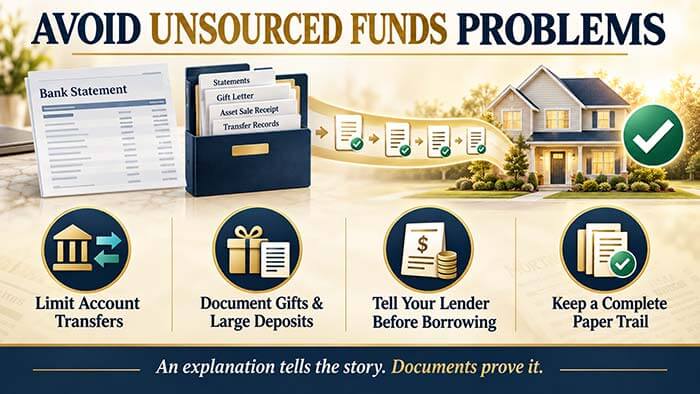 The simplest unsourced-funds problem is the one you never have. Stay proactive and organized as you get ready to buy or refinance. Avoid moving money unnecessarily between several accounts. Keep documentation whenever you sell a vehicle or other valuable property. If relatives will provide gift funds, tell your loan officer before the transfer so the gift can be documented correctly. Save records of tax refunds, inheritances, settlements, retirement withdrawals, and investment liquidations. Tell your lender before taking out a new loan or using borrowed money for the transaction. If a significant amount of cash is involved, discuss the situation before depositing it. Most importantly, do not assume an explanation alone satisfies underwriting. A good explanation tells the underwriter what happened. A good paper trail proves it.
Unsourced Funds Do Not Always Mean Mortgage Denial
Finding an Unexplained Deposit Does Not Automatically End a Mortgage Application:
- Many sourcing problems can be resolved by documenting the origin of the money.
- Sometimes the lender simply needs both sides of a bank transfer.
- Sometimes a gift must be properly documented.
- Sometimes the borrower needs to provide evidence of an asset sale.
- Sometimes, the underwriter can exclude the unsourced portion because enough verified funds remain.
- The earlier the issue is identified, the easier it usually is to determine the correct solution.
- Borrowers should have significant deposits reviewed before making an offer whenever possible, especially when those deposits will be needed for the down payment or closing costs.
Get Help With Large Deposits and Unsourced Funds
Gustan Cho Associates works with borrowers dealing with large deposits, gift funds, cash-to-close questions, manual underwriting, complex credit, and unusual mortgage scenarios. If you have a large or unexplained deposit appearing on your bank statements, it is better to review the source before the loan reaches final underwriting. The team at Gustan Cho Associates can review your mortgage scenario and determine what documentation may be required under the applicable loan program. VA and USDA loans offer zero down payment and we can help a structure where closing costs can be paid by seller concession or lender credit.
If you’ve got cash stashed away, like in your mattress, you can eventually use it for your closing costs. But if that’s your only cash option, you need to put that money into your bank account ASAP and let it sit there for 60 days.
Lenders just want to see 60 days’ worth of bank statements. After that, any money you deposit doesn’t need an explanation for where it came from. Remember, mortgage lenders will stick to asking for 60 days of statements. Homebuyers or homeowners needing to qualify for a mortgage with a lender with no overlays on government and conforming loans can contact us at Gustan Cho Associates at 800-900-8569 or text us for faster response. Or email us at gcho@gustancho.com. Gustan Cho Associates has ZERO LENDER OVERLAYS on FHA, VA, USDA, and Conventional loans.
FAQs About How Underwriters View Unsourced Funds In Mortgage Process
What are Unsourced Funds?
Unsourced funds, often called “mystery funds” or “gift funds,” are amounts deposited into a borrower’s account that lack a clear, traceable source or documentation. Mortgage underwriters view these funds with suspicion as they may raise concerns about the legality or the origin of the money used for down payments, closing costs, or other mortgage-related expenses.
Why are Unsourced Funds an Issue in Mortgage Underwriting?
Unsourced funds can indicate potential risks such as fraud or money laundering. Mortgage underwriters are responsible for ensuring that all funds used in a mortgage transaction are legitimate. They scrutinize unsourced funds to protect against these risks, as they could impact the lender’s decision on the loan approval.
How Do Mortgage Underwriters Handle Large or Irregular Deposits?
Mortgage underwriters require documentation for large or irregular deposits in a borrower’s bank statements. Each deposit over a certain threshold (commonly $200) must be adequately sourced with a paper trail. These funds must be verified to be eligible for use towards the down payment or closing costs.
What is Required from Borrowers when Using Gift Funds for a Home Purchase?
If using gift funds, borrowers must provide a gift letter from the donor that clarifies the nature of the gift, its amount, and a statement that it is not a loan and does not need to be repaid. Underwriters may also require additional documentation, such as bank statements from the donor, to verify the legitimacy of the gift.
What are the Seasoning Requirements for Cash Deposits to Become Sourced Funds?
Seasoning requirements stipulate that funds must have been in the borrower’s account for a specific period (often 60 days) before they can be used in a mortgage transaction. This ensures that the funds are not recent unsourced deposits.
Can Cash be Used as a Source of Funds in Mortgage Transactions?
Cash is generally considered unsourced and cannot be used directly in mortgage transactions. Borrowers must deposit cash into a bank account and let it mature for the required period to meet underwriting guidelines. If cash deposits are to be used, they must be documented to show their origin.
What Do Underwriters Look for in Bank Statements?
Underwriters look for consistency and transparency in financial transactions. They assess bank statements for inconsistencies, unexplained large deposits, undisclosed loans, or other irregularities that could indicate financial instability or fraudulent activity.
How Can Borrowers Ensure Their Funds are Accepted by Mortgage Underwriters?
Borrowers should maintain clear records of all transactions and deposits. All funds in a mortgage transaction should have a clear, documentable source. Transparency with lenders about the origin of funds and cooperation in providing necessary documentation can help ensure smooth mortgage application processing.
What Happens if Borrowers Attempt to Hide the Source of Funds?
Misrepresenting or concealing the origin of funds can have serious consequences, including rejection of loan applications and possible legal action. Openness and honesty with lenders are essential for a successful mortgage approval process.
These FAQs explain how the mortgage underwriting process handles unsourced funds, emphasizing the importance of transparency and proper documentation in securing a home loan. This GUIDE about How Underwriters View Unsourced Funds In Mortgage Process was updated on September 8, 2026.