This guide covers solutions for when things go wrong during the mortgage process. The mortgage process can be very stressful. This holds especially true for borrowers with credit issues or higher debt-to-income ratios. Every mortgage loan application is different from the next. Some mortgage files can be tricky.
The most important phase is the pre-approval stage of the mortgage loan application process. When things go wrong during the mortgage process, the borrower is not properly qualified for pre-approval.
Homebuyers with credit scores under 580 and down to 500 FICO are eligible to qualify for FHA loans. Per HUD guidelines,, you need a 10% down payment if your credit score is under 580. FHA loans are the most popular mortgage loans today. In the following paragraphs, we will cover what happens when things go wrong during the mortgage process.
What to Do When Things Go Wrong in the Mortgage Process
Unexpected twists in the mortgage process often happen when new issues pop up or details from pre-approval shift. New debt, job changes, sudden drops in income, mysterious bank deposits, appraisal hiccups, title snags, rising insurance costs, missing paperwork, credit worries, and underwriting hurdles are all common culprits.
The good news? Many of these headaches can be avoided or fixed simply by reaching out to your loan officer before making any big financial moves.
The mortgage approval process requires much more than obtaining a pre-approval and waiting for a closing date. The borrower, the property, and the mortgage terms must meet the requirements throughout the closing process. Fannie Mae mandates that lenders address the borrower’s increased liabilities or falling income post-underwriting that affects the borrower’s qualification.
Why Things Go Wrong After Pre-Approval
This is an important step in the mortgage process. However, a pre-approval is not an approval.vA pre-approval is based on the borrower’s information. The lender reviews credit, income, employment, assets, liabilities, and other factors. However, several items still need verification. Once a borrower has a contract for a property, the lender must review the property. Many developments can occur between pre-approval and closing.
Several contingencies could reduce the property’s appraised value, increase closing costs, raise the bank’s demand for documents, or render the borrower ineligible.
These can arise at any time, from pre-approval through closing. For example, the borrower’s employment status could change. Additional closing costs, like increased insurance, may occur. There may be title issues. The buyer may also become ineligible due to rising debt.
New Debt Can Cause Problems During the Mortgage Process
Additional debt or obligations prior to closing a mortgage can create mortgage problems that did not exist during pre-approval. It’s easy to think that buying a car on credit, opening a shiny new credit card, splurging on furniture, or co-signing a loan won’t rock the boat once your mortgage is in motion. But even if it seems harmless, taking on new debt before closing can throw a wrench into the process. Prior to or at closing, the lender is obligated to determine whether the borrower qualifies based on the debt-to-income ratio if the borrower’s new obligations have been identified.
Financing a Car Before Closing
New auto loans significantly affect a buyer’s ability to meet closing obligations. If your qualifying ratios are strong, you might still squeak by, but if you’re already close to the edge, buying or leasing a car right before closing is a gamble you don’t want to take.
Opening New Credit Cards
A credit card can lead to a hard credit inquiry, a new credit account, and a new monthly obligation. Even swiping a new credit card for a tempting discount can tangle up your mortgage process. Borrowers should consult their loan officer before applying for a new credit card, prior to closing the mortgage transaction.
Co-Signing is Still Counted as a Debt
A co-sign is not a way to avoid a mortgage lender seeing debt. If a borrower co-signs a loan during the mortgage process, the new obligation must be analyzed. Don’t count on someone else’s promise to pay letting you off the hook—co-signed debt still counts against your mortgage qualification.
Changes in Credit Before Closing can affect Mortgage Approval
Credit is not reviewed once. Depending on the loan program, the lender, and underwriting reviews, credit is reviewed several times prior to closing. Any one aspect of changes to credit, such as a new account, a credit limit increase, a new inquiry, collections, or late payments, will lead underwriting to review the credit in a new light. Borrowers should continue to pay all of their obligations on time during the mortgage process. Trying to close a loan with a recent late payment is a much tougher sell than explaining an old credit hiccup that was already reviewed at pre-approval.
You Don’t Need to Take Out New Credit to Max Out Existing Credit
Trouble can sneak up even if you never open a new credit account. Cards with high balances have high minimum payments and utilize a significant amount of available credit. This can negatively impact credit and debt-to-income calculations. It is best to hold off on buying that new couch, shiny appliance, or latest gadget until your mortgage is officially closed.
Another curveball in the process? Changes to your job: me that submitting pay stubs and W-2s eliminates employment as a concern in the mortgage process.
The guide states verbal verification of employment is typically required for borrowers who qualify based on employment income. Employment income verification must occur within 10 business days prior to the note date unless Automated Validation or an eligible alternative is used. A change in employment requires the lender to reanalyze the borrower’s qualifications.
Jobs Switched Prior to Closing
Switching jobs does not automatically mean denial of a mortgage application. The real problem isn’t switching jobs—it’s forgetting to loop your lender in about your new gig. A new job may bring changes in compensation, fewer guaranteed work hours, a commission-based or bonus job, a variable-income job, a probationary period, or a change in employment classification. Any of these changes could throw a wrench into how your lender calculates your income.
Do Not Leave Before Closing
Lenders want to see steady income. If you leave your job before closing, you create uncertainty and will have to explain any gaps. Don’t walk away from your job during the mortgage process. Switching to self-employment, taking unpaid leave, or quitting means your lender will have to take another hard look at your application.
Contact Your Lender if You Are Considering a Material Change to Your Employment.
Unanticipated Changes Can Create Last-Minute Underwriting Concerns
Even if you have a regular, steady source of income, other employment changes may affect your mortgage application. When you take a job with a higher earnings potential, you may have to prove regular income. Over time, bonus or commission structures introduce additional risks and challenges, and income may not be consistent.
Self-employed borrowers will have additional problems if they have recently changed their business conditions. Lenders focus on your recent earnings history rather than only your current income.
Mortgage underwriting requires a stable income for a specified period that meets the program guidelines. If you have a job with a bonus and your income changes, you may not qualify for a mortgage. If your income is in flux, it might be wise to hit pause on your mortgage application. Leaving your job could send your file back to square one with the lender.
Debt-to-Income Ratio May Also Increase Before Closing
Some expenses on your mortgage may change without you knowing. For example, you may take a mortgage with an insurance premium. If your insurance premium increases, your final cost may change, which may impact your mortgage. Borrowers with plenty of room in qualifying ratios aren’t cause for concern. Borrowers who are close to the applicable limit may need to restructure their loans. There is no DTI percentage treated as a universal maximum. Each mortgage case is unique, and criteria may vary based on the program, lending policies, the underwriting team, risk tolerances, credit profiles, and more.
Unexpected Mortgage Conditions Can Occur Due to Bank Statements

Mortgage lenders assess asset documentation to confirm that borrowers have sufficient funds for the down payment, closing costs, reserves, and other components of the transaction. Sometimes, a fresh bank statement can spark new questions that never came up during pre-approval. Examples include the appearance of funds in an account with no apparent source. Funds can transfer among many accounts. A borrower can receive a gift of funds from a third party without verifying the gift. Borrowers may use closing cost funds for other purposes. The CFPB suggests that borrowers provide lenders with the required documentation promptly to avoid delays in closing.
Don’t Move Money Without Reason
Transferring funds between accounts is acceptable if proper documentation is maintained. The real trouble starts when transactions don’t have the paperwork to back them up.entation. If funds need to be transferred, retain all documentation showing the exact source and destination of those funds. Don’t assume that cash deposits, borrowed money, business transfers, crypto proceeds, or funds from others will automatically pass muster. Always check with your lender before making any unusual moves.
Worried Your Mortgage Could Be Denied Before Closing?
A pre-approval is not a final approval. If something changed with your income, credit, debts, assets, or property, get a second review right away.
Appraisal Issues Can Delay or Frustrate the Mortgage Process
When a mortgage is being processed, the borrower is not the only participant. The lender and the loan program will also express their concerns and expectations. An appraisal is an opinion given about the value of the property being considered. At the lender’s discretion and per the mortgage, other allowed valuation methods may replace an appraisal. Borrowers are typically automatically given access to copies of appraisals and other valuations conducted in connection with qualified first-lien mortgage transactions.
What if the Appraised Value is Less than the Purchase Price?
A low appraisal doesn’t always spell the end of your deal. The available alternatives will depend on the specific circumstances. The buyer and seller may agree to change the purchase price. If allowed and financially feasible for the borrower, extra funds can be provided. Factual errors may be addressed through the reconsideration process. The loan structure may be changed. The solution will depend on the loan program, contract, appraisal, funds available, and the willingness of the buyer and seller to proceed.
Value is Not the Only Concern
Value is just one piece of the puzzle. Depending on the loan program and the property, issues related to the property’s condition may require repairs before closing is allowed. Concerns regarding safety, soundness, the structural integrity of the property, utilities, and access may require further evaluation. Not all homes eligible for a mortgage are eligible for all mortgage programs. There are many title issues that can arise and delay the closing of the mortgage. Some issues that can surface during the title search include liens, delinquent taxes, titles involving litigation, unreleased mortgages, title-related judgments, recording issues, and other issues that can affect the property’s ownership.
Some Title Issues are a Quick Fix
Others can drag on, requiring a lot of legal work and paperwork before they’re sorted out. Because of the likelihood of problems with a property’s title, title insurance and the work associated with it is often an integral part of the closing of a mortgage.
The Consumer Financial Protection Bureau states that the majority of issued titles are accompanied by work related to lenders’ title insurance.
Don’t wait until closing day to ask about title problems—get answers early to avoid last-minute surprises. Some of the most common concerns of borrowers may be homeowners’ insurance issues. While most borrowers know they are required to get homeowners’ insurance, they may not consider how the insurance premium can affect their mortgage. A spike in your insurance premium means your mortgage payment will climb, too.
The Mortgage Payment Will Begin to Affect DTI
Issues can also arise when insurance coverage for the residence is particularly problematic due to its condition, location, exposure to natural disasters, claims history, roof condition, and other related factors. Get your insurance quotes early—especially if your property is in a high-risk area—so you’re not caught off guard at closing.n high-risk areas. Most mortgage lenders require proof of homeowners’ insurance for closing and to complete the financing.
Flood Insurance Can Change the Numbers
Changes in the determination of flood-zone status can affect financing. The cost of flood insurance, either required by lenders or borrowers, will contribute to monthly housing costs. Borrowers whose debt-to-income (DTI) ratios are close to the maximum allowable limit may be impacted by this additional cost, whereas those with lower DTI ratios are less likely to be affected. This underscores the importance of a pre-approval process that accounts for multiple factors and incorporates flexibility.
Often, there are no issues with the borrower or the individual condominium unit. Issues may arise from the condominium project itself.
Depending on the specific features of the loan transaction, a particular mortgage program can mandate that the lender provide certain information with regard to the homeowner’s association, insurance, the project, litigation, assessments, the project’s financial condition, and more. If required project documentation is missing or the building fails to meet financing criteria, mortgage approval may be delayed, or alternative financing options may need to be considered. Prospective condominium buyers should recognize that mortgage approval typically depends on both individual borrower qualifications and the condominium project’s approval status.
Missing or Inconsistent Documents Can Slow Underwriting
The mortgage process requires extensive documentation. Issues may arise if documentation is incomplete, outdated, or inconsistent with other materials in the mortgage file. An example could be a pay stub showing employment with an employer that was not expected, or a different compensation structure than previously expected.
A bank statement can show an account that was not previously revealed or even an obligation for which there was no previous disclosure.
A credit report may show debt for which a loan application was previously submitted. A tax return may contain information for which additional review is necessary. Encountering these situations does not necessarily indicate borrower error. Rather, it indicates that lenders require additional documentation to reach a decision. Fannie Mae requires lenders to evaluate discrepancies between disclosed debts and liabilities and other information in the mortgage file, and to document the borrower’s liabilities that affect the borrower’s ability to repay.
Clearing Mortgage Underwriting Conditions
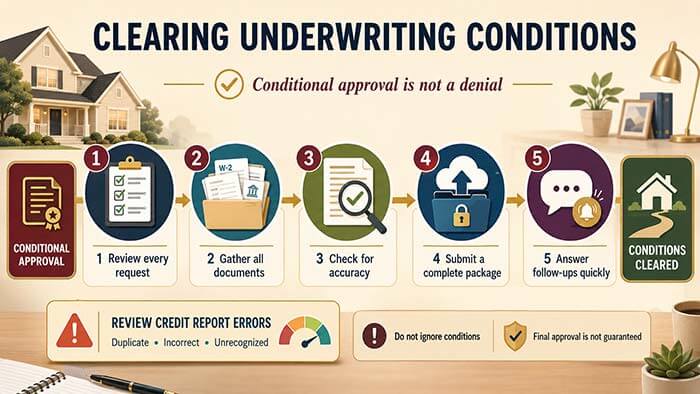
Not meeting the conditions of a loan approval does not automatically mean a loan was denied. Borrowers often express concern when loan approvals are issued with conditions.
Conditional approvals mean that the underwriter needs additional supporting documents or information. Do not ignore conditions or send incomplete paperwork.
This only leads to more questions and slows the process. Carefully review all conditions and requests from your lender. Submitting all required documents simultaneously, rather than individually, facilitates a more efficient mortgage process. Care is needed when reviewing credit reports. Errors can result in duplicate accounts, incorrectly reported accounts, accounts that belong to other consumers, and accounts that need additional explanation.
Credit Disputes During the Mortgage Process
Fannie Mae currently allows duplication of public records. Exercise caution when filing credit disputes during the mortgage process. It is important to determine the appropriate timing for adding or removing a credit dispute. The time to add or remove a credit dispute. The outcome of a dispute account depends on the loan program, type of debt, credit score, findings from the automated underwriting system, and the lender’s requirements. If you find a mistake, talk to your lender before making any changes to your credit report or score during underwriting.
Old Bankruptcies, Foreclosures, and Similar Major Negative Credit Events
Past negative credit events do not necessarily prevent someone from getting a home loan. However, if significant eligibility issues arise during underwriting after contract signing, the process may become challenging. Borrowers with bankruptcies, foreclosures, short sales, deeds in lieu, late mortgage payments, loan modifications, or other major credit events should ensure that all relevant dates and documentation are thoroughly reviewed during pre-approval. Mortgage program guidelines vary, and banks’ credit policies can differ as well. A careful pre-approval can catch these problems early and help you avoid spending money on inspections and appraisals you might not need.
Two Lenders May Disagree, but This Does Not Necessarily Indicate Noncompliance with Guidelines
Two lenders reviewing similar information about a borrower may reach different conclusions. This does not necessarily mean one lender has ignored the mortgage guidelines.
While the credit policies of the lender and investor may be part of mortgage guidelines, a lender may add its own requirements, called lender overlays.
This is particularly relevant for borrowers with lower credit scores, high debt-to-income ratios, manual underwriting requirements, recent credit issues, non-traditional income sources, or complex loan files. Approval by one lender does not guarantee eligibility with all lenders.
Changing to a Different Lender During the Mortgage Process
Switching to another lender will not fix a problem that breaks a mortgage program requirement. Start by finding out exactly what is causing the loan problem. Mortgage problems often do not result in denial. Sometimes, timing is the main issue. An appraisal done too late, an unresolved title issue, a missing document, an insurance issue, or an outstanding underwriting condition can delay a loan closing beyond the allowed time. This is very important because most Purchase Agreements include closing-date requirements, and there is a time limit on a locked interest rate. The Consumer Financial Protection Bureau states that delays in providing required mortgage documentation can cause closing at an unfavorable time for the borrower by failing to lock the interest rate and possibly violating the Purchase Agreement. Respond promptly to your lender’s requests, and let your real estate agent know if you need to delay the closing date.
What Not to Do During the Mortgage Process
Once you are pre-approved, and especially after you are under contract, it is important to keep your finances steady.
- New credit must be approved by your lender.
- Financing for the purchase of new furniture and/or appliances must also be approved by your lender.
- The purchase or lease of a new vehicle must also be approved by your lender.
- Never co-sign debt for someone else.
- Do not quit your job or materially change employment without informing the lender first.
- Do not miss payments.
- Do not move large amounts of funds between accounts without documenting the transfer.
- Do not use funds set aside for the down payment, closing costs, or required reserves.
- Do not make large deposits under the assumption that the lender will not find out.
- Most importantly, remain calm if a financial change occurs.
- Consult your lender for guidance before becoming concerned.
- Problems identified early in the process are more likely to have solutions.
- Problems that come up right before closing are much harder to fix.
What to Do When Something Goes Wrong With Your Mortgage
The first step is to find out what changed. Lengthy or vague explanations are unhelpful. If statements such as “your mortgage isn’t working” or “the underwriter doesn’t like the loan” are provided, request specific details. Clarify whether the issue pertains to credit, income, debt-to-income ratio, employment, assets, appraisal, title, insurance, property, or a particular loan program requirement. Comprehensive documentation is the most effective resource. Lengthy explanations without supporting evidence tend to create confusion and delay the process.
What Changes Have You Made? Do You Have Documentation?
If the lender requires employment documentation, provide it. Provide concise and clear explanations, avoiding unnecessarily lengthy responses. This Process is intended to address the specific underwriting concern.
Determine If the Loan Can Be Restructured
Sometimes, making a few changes to your loan can resolve your mortgage issues. Accordingly, alternatives such as adjusting the loan amount, significantly reducing specific debts, providing documentation of new qualifying income, modifying the down payment, negotiating the purchase price, switching mortgage programs, addressing property repair requests, or submitting additional relevant documentation may be considered. Not every solution is suitable for every borrower.
A comprehensive file review by a qualified mortgage professional is recommended before proceeding. It is essential to determine whether the issue lies with the lender or the loan terms, as understanding this distinction is critical.
If a borrower does not meet the real requirements of a loan program, simply referring the application to another lender will probably not resolve the problem. If an issue is a lender’s requirement or a restriction associated with a lender’s product, another lender may review the application differently. Knowing the real issue can save you from reapplying over and over without solving the main problem.
A Pre-Approval Can Outline Many Problems in a Mortgage Application
Many mortgage problems start well before you make an offer on a home. A good pre-approval is not merely about looking at a credit score and asking a borrower to provide an income estimate.
- Income must be analyzed.
- The borrower’s debts and credit must be analyzed.
- The borrower’s assets and the ability to bring funds to the closing must be analyzed.
- Major credit issues should be addressed.
- Please provide your employment history.
- Housing payments should allow some wiggle room for property taxes, insurance, HOA fees, and other expenses that may increase after purchasing a property.
- More complex files require additional work before the borrower signs a purchase contract.
- A robust pre-approval process involves more than simply obtaining a letter.
- Its primary purpose is to identify potential issues early, allowing them to be addressed prior to contract signing.
- A clear-to-close means the lender has satisfied the requirements to move the loan to the closing stage.
- However, it is still important to identify and address potential issues before signing a purchase contract.
- Even at this stage, it is advisable to avoid making significant purchases.
- Unexpected, last-minute liabilities or loss of income can still affect mortgage qualification at or near closing.
- Wait until the mortgage closes and, where applicable, funds before making major purchases or new debt.
Final Thoughts on What to Do When Problems Arise in the Mortgage Process
The most important thing when problems arise in the mortgage process is not whether they occur, but whether they are found and fixed quickly.
New debt, job changes, changes in income, credit problems, appraisal or title issues, insurance surprises, undocumented funds, or unfinished underwriting can all happen.
The good news is that most of these can be fixed if you act quickly. Risk can be minimized by maintaining stable finances, making timely payments, avoiding new debt, organizing documentation, responding promptly to underwriter requests, and consulting with a loan officer before making significant financial decisions. A successful mortgage process begins with thorough pre-approval and consistent communication throughout. Mortgage guidelines are affected by the type of loan, the borrower’s circumstances, the type of property, the outcome of automated underwriting, the investor, and the lender. Financial decisions based on general mortgage information should not be made until a borrower’s individual loan file has been reviewed.
FAQ’s on When Things Go Wrong During The Mortgage Process
Can a Mortgage Really be Denied after Pre-Approval?
Yes. A mortgage pre-approval is not a loan approval. There are many factors that have not been finalized and can affect the outcome, including credit report, income, employment, assets, debts, the property, appraisal, title, insurance, and others.
What are the Most Common Reasons for a Mortgage Loan to Not Close?
These include new debt, job changes, credit problems, insufficient funds to close the deal, appraisal issues, title issues, property eligibility issues, insurance issues, undocumented financial transactions, and underwriting conditions that cannot be resolved.
Do Mortgage Lenders Check Your Credit Just Prior to the Closing?
Whether a lender reviews your credit before closing depends on many factors, including the mortgage program, the lender, the results of automated underwriting, and the loan. Borrowers should assume that the lender may check credit and that new debts or major credit changes will be known to the lender, so it is best to avoid taking on new debts prior to closing.
Can Changes in Jobs Affect the Ability to Get a Mortgage?
Changing a job does not automatically result in an application being rejected. However, verification of the new employment is required, and the lender will assess if the new income qualifies. Changes in compensation, increase (or decrease) of hours, changes in commission or bonus, changes in employment status, or changes to being self-employed are some factors that affect the underwriting process.
Can I Use My Credit Cards Before the Sale of a Home Is Completed?
Not using your credit card responsibly can put your mortgage in jeopardy. You may be able to afford that nice new living room set you’ve been eyeing for months now, but it is best to wait until after the mortgage is closed.
What Happens if the Appraisal of the Property is Less than the Amount Purchased?
The buyer and the seller can agree on a different price. The borrower can also make up the difference if permitted. The appraisal can be reviewed to determine if there were any factual errors. The financing can also be changed. The solution depends on the contract and the loan program.
Can a Large Deposit Delay the Mortgage Approval?
If a large deposit is made, the lender will need to confirm the source of the funds to verify they are being used for an acceptable purpose. The borrower should keep records of any large, unexpected deposits and discuss the financial transactions with the lender.
What Reasons Could Homeowners’ Insurance Have to Delay the Mortgage Closing?
Most lenders require the policy to be in force before a mortgage is closed. There are issues if the insurance cannot be obtained, the property does not meet the underwriting requirements, or the premium is higher than anticipated.
Why Does an Underwriter Keep Asking for More Documents?
An underwriter requests additional documents to verify facts or clarify something found during the review. Additional documents can also add more questions or issues. For issues to be resolved faster, better quality and quantity of documents are required, along with meeting the conditions.
Can a Mortgage Still Have Problems After Clear to Close?
Problems can still occur, but major ones are unlikely. There can be issues which can require another review before the mortgage is finalized, even if there has been a change in employment, income, debt, assets, documents, loan terms, title, insurance, or the closing transaction.
Don’t Let Mortgage Problems Stop Your Home Purchase
Complete a quick application or send your scenario. We’ll review the issue, explain your options, and help move your loan toward clear-to-close.